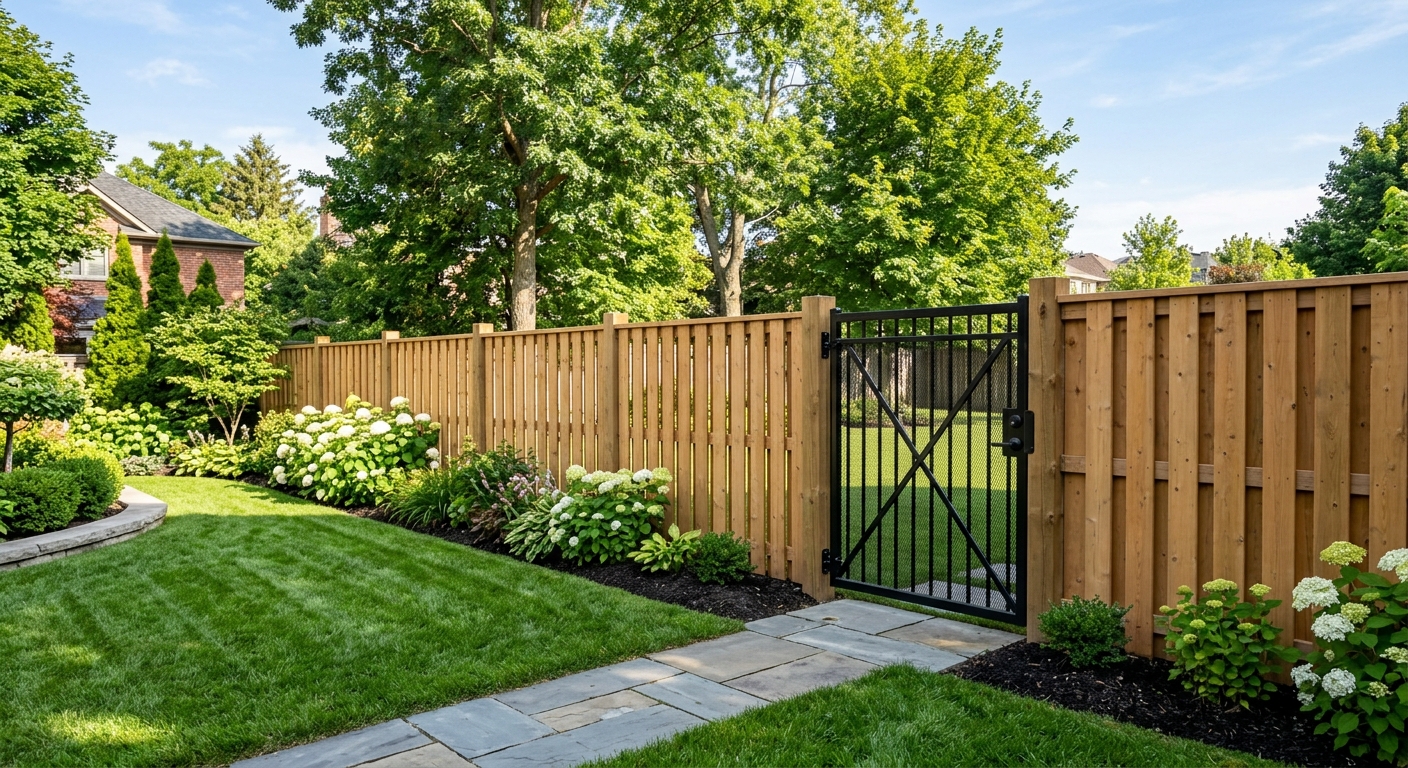
Fencing options and costs in Scenic Acres
In Scenic Acres, Alberta, most homeowners weigh the same three things when planning a fence: long winter durability, strong wind resistance, and an installed price that fits a typical backyard layout. With a population of 7,850 (Statistics Canada, 2021 Census), demand is steady but not overwhelming—so good crews tend to book quickly, especially in the more established pockets such as Haysboro-area style subdivisions with mature landscaping and lots of gates. Local housing stock also drives decision-making: fenced properties are common where families want defined yards for kids and pets, making detached homes a frequent starting point for fence conversations (Statistics Canada, 2021 Census).
Calgary’s Prairie continental climate is the cost-shaping factor. Long freeze–thaw cycles create frost movement, and open exposure increases wind loading. Because of that, crews often set posts about 4 ft (≈120 cm) deep to get below the regional frost line, particularly for 6 ft privacy fences and gate posts. That means more excavation, more concrete, and longer install time than you’d see in milder Canadian regions. It also helps explain why solid panels (wood privacy, vinyl privacy) usually cost more than airy chain-link systems—they need closer support spacing and sturdier, fully supported posts to resist racking.
Below is a practical cost comparison for Scenic Acres so you can match material to budget and maintenance expectations, then confirm specifics like post depth, footing type, and gate hardware in your quote.
| Material |
Lifespan |
Maintenance |
Privacy Rating |
Price per Linear Foot |
| Pressure-treated pine (standard wood) |
15–25 years |
Stain/seal every 2–3 years (and spot repairs) |
High (solid panels) |
$40–$80 |
| Cedar (natural rot resistance) |
20–30 years |
Periodic sealing or staining (typically every 2–3 years) |
High (solid panels) |
$55–$90 |
| Vinyl / PVC (no-maintenance) |
25–35 years |
Wash as needed; inspect posts and caps in freeze seasons |
High (solid or semi-solid) |
$45–$90 |
| Chain-link (galvanized steel) |
20–40 years |
Minimal; occasional tension/repair after storms |
Low to moderate (airflow-friendly) |
$25–$55 |
| Aluminum ornamental |
30–50 years |
Occasional cleaning; check gate alignment |
Low (decorative; mostly visibility) |
$70–$120 |
| Composite / recycled material |
25–35 years |
Low; periodic cleaning; verify colour-fade expectations |
High (solid designs) |
$60–$100 |
Prices are estimates only and vary by project scope, site access and material selection.
What affects the price of fencing in Scenic Acres
In Scenic Acres, you can see surprisingly different quotes for the same fence line—often in the 30–50% range—because the “hidden” work varies: post-footings, gate builds, grading, and the way wind-load requirements are engineered into spacing and bracing. Two crews may both say “6 ft privacy fence,” but one might plan for full concrete-set posts and reinforced gate frames, while the other assumes lighter construction that struggles in Prairie gusts. Labour availability also matters in the Calgary economic region: when multiple neighbourhoods need winter-start or spring rush scheduling, crews prioritise the most efficient job sites, and mobilization costs can shift.
The biggest structural driver is frost protection. In Alberta, posts typically need to be set about 1.5–2.0 m into the ground (roughly 4–6 inches below the design frost depth), which means longer posts, deeper holes, and more concrete volume. That’s why a “budget” fence can jump from mid-band wood pricing into the higher end when footing spec changes. Wind exposure on the Prairies also pushes tighter post spacing and heavier rails for solid wood or vinyl—while chain-link usually stays in the lower–mid cost range because airflow reduces racking pressure.
Concrete examples from Scenic Acres: (1) a fence replacing only panels in an existing straight run is often less than a full rebuild where post holes need rework; (2) a backyard with compacted clay that requires breaking and re-excavation raises labour time; (3) a gate that opens onto a sloped driveway often needs stepped footings and stronger hinges, which can move costs toward the vinyl/wood mid–upper bands (for example, $40–$80 for wood versus $45–$90 for vinyl/PVC). Snow load and wind-driven snow can also increase panel stresses on tall runs, so bracing and bottom clearance details affect longevity and repair risk.
| Price Factor |
Why It Matters |
Cost Impact |
| Fence length in linear feet |
The more linear footage, the more posts, rails, and fasteners are required |
Large: length drives almost every line item |
| Post depth required |
Frost protection determines hole depth and post length to reduce heaving |
Medium–High: deeper holes add labour and material |
| Post setting method |
Concrete vs. gravel pack vs. driven posts changes stability and excavation |
High: concrete footings cost more but improve wind performance |
| Material choice |
Vinyl/wood require solid bracing; cedar performs better but costs more; chain-link is lighter |
Medium–High: shifts you across $25–$55 (chain-link) or $40–$90+ (solid systems) |
| Gate count and type |
Walk-through gates are lighter; drive-through double gates need heavier frames |
High: gates add hardware, labour and often extra bracing |
| Grade and terrain |
Slopes require stepped or raked panels and additional layout time |
Medium: increases fitting, cutting, and sometimes rework |
| Old fence removal and disposal |
Hauling, disposal fees, and post extraction time |
Medium: can add a noticeable one-time cost |
| Permit fees and survey / property line locate |
Planning time and verifying property lines before digging reduces dispute risk |
Low–Medium: depends on existing documentation and fence height |
Permits & regulations in Alberta
In Alberta, fence requirements can change by location and height, but as a practical homeowner rule in Scenic Acres and the Calgary area, fences above a typical threshold often need a building permit—commonly around 2.0 m (6.5 ft) at the rear and 1.0–1.2 m (3–4 ft) at the front or corner. Exact thresholds can vary by municipal rules, so your contractor should ask for your specific fence location (front yard, corner lot, rear yard) before digging. Property line setbacks and shared fence ownership must be respected; if you’re replacing a boundary fence, it’s important to align expectations with the neighbours on who maintains it.
Before any post-hole excavation, you should arrange for utility locates (Alberta One-Call). Even if you’ve lived there for years, buried lines and later service upgrades can exist. Also, obtain a survey or locate your property pins so you don’t accidentally build on a neighbour’s land—this is one of the most common causes of costly changes.
What typically DOES require a permit: new fences at greater heights (especially near front/corner constraints), substantial privacy walls, and any project that alters approved conditions or extends across regulated setbacks. What typically does NOT: like-for-like panel or rail replacements on the same footprint and height where a permit was already previously issued (confirm with your local office).
To verify your Alberta contractor: check their licensing status online, ask for a current certificate of liability insurance, and confirm they carry WCB/WSIB coverage (coverage letters or policy proof, depending on the employer structure). A reputable fence crew will send these documents before work starts and will clearly show who is responsible for locates, footing work, and traffic/safety controls.
Choosing the right fence material for Scenic Acres
Choosing the right fence in Scenic Acres comes down to matching material performance to Alberta’s freeze–thaw cycles and Prairie wind. For privacy, solid systems are usually the best fit—but they must be engineered for wind racking. For low maintenance, vinyl and composite tend to win because they don’t require staining. For budget, pressure-treated pine is often the starting point; however, wood fences still need ongoing finish work to prevent grey weathering and keep fasteners and edges looking sharp.
Pressure-treated pine is cost-effective, typically in the $40–$80 range, but plan on staining or sealing every 2–3 years. Cedar costs more (often moving into the mid-to-upper range) but offers better natural rot resistance and a richer appearance; it still needs maintenance in our winter conditions. Vinyl / PVC is a popular no-paint option and often sits in the $45–$90 band, but in extreme cold some installations can be prone to panel distortion if not braced correctly—so proper post setting and rail rigidity matter. Chain-link is the lowest-cost long-life choice (commonly $25–$55) and handles wind well due to airflow, but it won’t provide privacy unless you add slats or a secondary privacy screen. Aluminum ornamental looks great and won’t rust, but it’s generally the most expensive within the typical fence categories (commonly $70–$120) and offers minimal privacy.
Concrete frost protection is the other key decision. In Scenic Acres, Calgary-area guidance commonly uses post depth around 4 ft (≈120 cm) and often concrete footings for taller privacy fences and gates. That extra stability is one reason solid wood or vinyl can outlast a cheaper, lightly supported build.
For example, if you’re comparing wood versus vinyl for a 50 ft run, a material-and-install difference can be meaningful: wood might land around $40–$80 per linear foot, while vinyl often sits $45–$90 per linear foot. If you only plan to re-stain once or twice over the next decade, the vinyl premium can be justified by reduced labour and finish costs; if you’re comfortable with regular maintenance, pressure-treated pine can be the better value.
| Material |
Cold Tolerance |
Lifespan |
Annual Maintenance |
Best For |
Price Band |
| Pressure-treated pine |
Good (if properly sealed and fastener corrosion is managed) |
15–25 years |
Low to moderate (inspect; stain as needed) |
Budget-focused privacy with willingness to maintain |
$40–$80 |
| Cedar |
Good (naturally resistant to rot) |
20–30 years |
Low to moderate (seal/stain periodically) |
Premium look and longer natural performance |
$55–$90 |
| Vinyl / PVC |
Good (proper bracing reduces cold flex) |
25–35 years |
Very low (wash/inspect after storms) |
Low-maintenance privacy |
$45–$90 |
| Chain-link |
Excellent (flexes under wind) |
20–40 years |
Very low (tension checks and spot repairs) |
Security with airflow; budget-friendly boundaries |
$25–$55 |
| Aluminum ornamental |
Excellent (coating protects against freeze effects) |
30–50 years |
Very low (clean and check gate alignment) |
Decorative front fencing |
$70–$120 |
| Composite / recycled |
Good (material stability depends on installation spec) |
25–35 years |
Low (wash; inspect joints/caps) |
Solid privacy without wood staining |
$60–$100 |
How to choose a fencing contractor in Scenic Acres
When you’re hiring in Scenic Acres, I treat fencing like structural work—not just carpentry. Start by verifying the contractor’s Alberta licensing status where applicable, then request their liability insurance certificate and proof of WCB/WSIB coverage. Where to look: ask them to email their certificate of insurance and WCB/WSIB clearance letter, and check their business details against the relevant online business registry or licensing listings. A legitimate fencing company should respond quickly with paperwork and be comfortable answering where their crews are insured for site work.
Next, get 2–3 itemised written quotes (not just a lump sum). Your quote should break down labour and materials separately—posts, rails, panels, hardware, gate frames, concrete footings, excavation, and removal/disposal—so you can compare apples to apples. Read the scope line-by-line: is permit pulling included if your fence triggers a height requirement? Is old fence removal and hauling included, or is it an extra charge? If utilities locate are required, who is responsible for arranging Alberta One-Call and documenting locates on site?
Warranty matters too. Ask for the workmanship warranty length and whether it transfers if you sell your home. Also review the manufacturer warranty for panels, caps, and hardware. For payment scheduling, never pay more than about 10–15% upfront; hold a portion until the job is complete and measurements match the agreed layout. Finally, insist on a written start date and a realistic completion estimate, considering Calgary-area wind and freeze conditions can affect scheduling.
- Confirm current liability insurance with certificate dates and job-site coverage details
- Provide WCB/WSIB coverage proof (clearance letter/policy proof) before work starts
- Ask for an itemised quote: posts, rails, panels, concrete, excavation, and hardware
- Verify footing spec: post depth and whether posts are concrete-set for privacy/gates
- Confirm whether permits (if required) are included or charged separately
- Ensure utility locates are included or clearly assigned (Alberta One-Call)
- Check whether gate hardware is upgraded (hinges, latches, self-closing if requested)
- Ask how they handle slopes: stepped vs. raked panel plans and who pays for additional labour
- Confirm fence alignment method: string-line/layout and reference to property pins/survey
- Get a written timeline with start date and completion window
- Confirm removal and disposal scope (dump fees, hauling, and how old posts are extracted)
- Request warranty details in writing for both workmanship and materials, including transferability
Red flags I see around Scenic Acres: (1) quotes that don’t specify post depth or footing type, (2) vague wording like “we’ll set posts properly” without concrete placement details, (3) refusing to provide insurance/WCB/WSIB proof, (4) asking for large upfront payments (well above 10–15%), and (5) no written start date or scope exclusions for permits, disposal, or gate bracing.
Frequently asked questions — fencing in Scenic Acres
What's the most low-maintenance fence?
For most Scenic Acres homeowners in Alberta, the lowest-maintenance choice is typically vinyl/PVC or aluminum ornamental. Vinyl/PVC usually lands around the mid pricing band (often roughly $45–$90 per linear foot) and is popular because you don’t stain it—just wash periodically and inspect after heavy wind events. Aluminum is similarly low maintenance (often higher cost, commonly $70–$120 per linear foot) and it doesn’t rust. That said, Prairie freeze–thaw and wind loading still mean installation details matter: posts should be set to frost-protection depth and gate hardware should be properly braced. If you prefer maximum privacy with minimal upkeep, vinyl privacy is usually the best match; if you can live with an open look, aluminum is very forgiving over winter.
How tall can my fence be in Scenic Acres?
Fence height rules in Alberta are commonly tied to whether the fence is in the front, corner, or rear yard, and whether it exceeds typical thresholds that trigger permits. A practical guideline many homeowners use is around 2.0 m (6.5 ft) in the rear and 1.0–1.2 m (3–4 ft) in the front or corner—fences above those ranges often require a permit. Because setbacks and corner-lot constraints can affect what’s allowed, confirm with your local municipal bylaws before ordering materials. In Scenic Acres, where winter winds can push tall panels, even if a height is allowed, you’ll want a contractor who accounts for wind racking and uses appropriate post depth and bracing for taller privacy fences.
Should fence posts be set in concrete here?
In Scenic Acres and the Calgary economic region, solid fence systems often benefit from concrete-set posts, especially for privacy fences (6 ft) and gate posts. The reasoning is frost movement and wind loading: crews typically set posts about 4 ft (≈120 cm) deep to reduce heaving and strengthen the fence against racking. Many jobs still include concrete footings because deeper holes and proper anchoring improve long-term alignment. That said, the best method depends on soil conditions, frost depth spec, and the fence type. A good contractor will tell you exactly how deep they’re digging, whether concrete is specified, and how they’ll meet the frost protection goal—rather than using a one-size-fits-all approach.
What's the best fence for privacy?
For privacy in Scenic Acres, the top choices are usually solid wood privacy, cedar, or vinyl/PVC privacy. All can provide high privacy ratings when installed with consistent panel coverage and proper rail/bracing. Budget-wise, pressure-treated pine often sits around the $40–$80 per linear foot band, while vinyl/PVC often ranges $45–$90. Cedar is typically higher than standard pine but offers better rot resistance and a more natural look. The key cost-to-performance decision isn’t only the material—it’s the engineering for Alberta winters: tall privacy fences need sturdy post spacing, reinforced gates, and frost-protected footings to prevent sagging and panel movement during freeze–thaw cycles.
How do I compare fencing quotes?
To compare quotes fairly in Alberta, ask for an itemised breakdown: linear footage, number of posts, post depth, setting method (concrete vs gravel pack), rail type, panel thickness/style, and gate hardware. Look for exclusions like removal/disposal, permit pulling (if required), and utility locates responsibility. If one quote gives a lower “per foot” number but skips concrete footings for a 6 ft privacy fence, it may cost less upfront and more later through repairs. Aim to compare within the same category: chain-link generally sits lower (often $25–$55 per linear foot), while wood and vinyl privacy sit higher (commonly $40–$80 for wood and $45–$90 for vinyl/PVC). Also confirm warranty terms and the workmanship timeline—those differences often explain why totals vary by 30–50%.
How long does fence installation take in Scenic Acres?
Installation time depends mainly on linear footage, site access, and whether you’re doing new posts with deep frost-set excavation. For a typical residential run with modern access, crews can often complete a straightforward section in a day or two, but in Scenic Acres the schedule can extend when there are multiple gates, significant grade changes, or full old-fence removal. Deep footing work is also the reason timelines shift in Calgary-area freeze–thaw conditions: deeper holes and concrete curing affect sequencing. If permits are needed, that can add lead time before digging begins. When you request your timeline, ask the contractor for a start date, a completion estimate, and how weather interruptions will be handled—especially during windy, freezing periods when bracing and alignment need extra care.