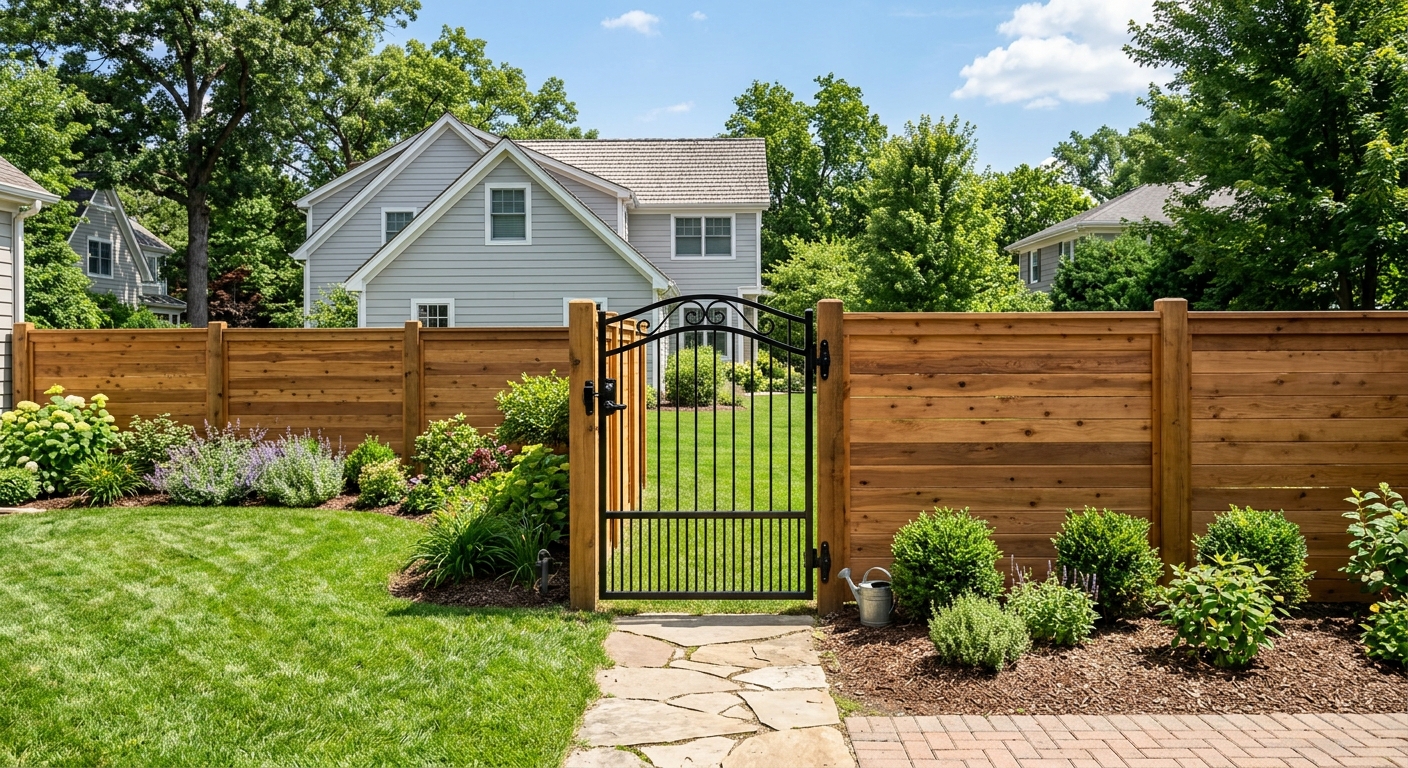
Fencing options and costs in Canossa
Canossa, Alberta homeowners typically start their fence decision with privacy, wind performance, and long-term upkeep. With a 2021 population of 3,211 (Statistics Canada, 2021 Census), Canossa is small enough that contractors often prioritize established routes, but fence demand still tracks closely with housing type—especially as detached homes create the most perimeter needing replacement or upgrades. In the Calgary economic region, where Canossa draws many service crews, availability is steadier than in smaller rural pockets, yet pricing still reflects heavy winter ground conditions and the labour needed for frost-proof post installation.
In this Prairie continental climate, freeze–thaw cycles are the main cost driver. Fences require frost protection, and for privacy panels and gate posts, crews often set posts about 4 ft (≈120 cm) deep to reduce heaving risk. That means more excavation, concrete volume, and longer posts compared to milder regions of Canada. Wind exposure on open Prairies also pushes you toward tighter post spacing and sturdier systems, particularly for solid-rail wood and vinyl privacy fences; chain-link usually costs less because airflow reduces racking pressure. If you’re in an area near County Road corridors where lots are more exposed to wind, you’ll often notice more requests for fully concreted footings and wind-stiff framing—especially for 6 ft privacy lines and double gates.
Below is a practical cost and performance comparison to help you shortlist options before you request itemized quotes.
| Material |
Lifespan |
Maintenance |
Privacy Rating |
Price per Linear Foot |
| Pressure-treated pine (standard wood) |
12–18 years |
Stain or seal every 2–3 years |
High (solid rails/panels) |
$40–$80 |
| Cedar (natural rot resistance) |
18–25 years |
Light staining/brightening every 3–4 years |
High (solid boards/panels) |
$55–$95 |
| Vinyl / PVC (no-maintenance) |
20–30 years |
Rinse annually; inspect posts/joints |
High (solid infill) |
$45–$90 |
| Chain-link (galvanized steel) |
25–35 years |
Minimal; tighten/straighten as needed |
Low to medium (see-through) |
$25–$55 |
| Aluminum ornamental |
25–40 years |
Occasional wash; touch-up if needed |
Low to medium (open pickets) |
$70–$120 |
| Composite / recycled material |
20–30 years |
Occasional wash; no staining |
High (solid boards) |
$60–$110 |
Prices are estimates only and vary by project scope, site access and material selection.
What affects the price of fencing in Canossa
In Canossa and the wider Calgary economic region, even identical fence designs can come back with pricing that’s 30–50% apart. The biggest reasons are site conditions (access, excavation difficulty, and yard slope), the way contractors price frost-depth work, and the structural choices needed to handle Prairie wind. In Calgary-area yards, crews commonly expect posts to be set below the heaving zone—often about 4 ft (≈120 cm) deep—especially for 6 ft privacy fences and gate hardware. That requirement raises material (longer posts, extra rails) and labour (excavation and concrete) compared to regions where frost penetrates less deeply.
Wind exposure also matters. Solid wood or vinyl privacy panels catch more wind than chain-link, so contractors typically use sturdier bracing, closer post spacing, and heavier top rails to prevent racking—moving the project toward wood/vinyl price bands (roughly $40–$80 for wood and $45–$90 for vinyl per linear foot). Meanwhile, chain-link can stay closer to $25–$55 per linear foot because airflow reduces wind loading on the system.
Concrete examples of local cost swings in Canossa: (1) If your fence line crosses hard-packed clay or needs rock removal, excavation time increases and labour cost climbs. (2) If your gate posts must be concreted for stability in windy exposure, you’ll see a noticeable step-up versus “light” post setting—often improving long-term alignment. (3) If a yard has a gentle slope and can use stepped panels, you may avoid the extra labour associated with custom racking cuts. With Canossa’s detached-home patterns (Statistics Canada, 2021 Census) and the region’s freeze–thaw cycles, the “foundation” portion of the quote can be the difference between a mid-band and a top-of-band project—often by hundreds of dollars on average-length runs.
| Price Factor |
Why It Matters |
Cost Impact |
| Fence length in linear feet |
Material and labour scale directly with total run length |
High |
| Post depth required |
Frost protection determines hole depth and post length |
High |
| Post setting method |
Concrete vs. gravel pack vs. driven posts affects stability |
Medium to High |
| Material choice |
Vinyl/cedar/wood require different framing and joint care |
Medium to High |
| Gate count and type |
Double drive gates need stronger posts and hardware |
High |
| Grade and terrain |
Slope may require steps, racking cuts, or more labour |
Medium |
| Old fence removal and disposal |
Hauling and sorting adds labour and disposal fees |
Medium |
| Permit fees and survey / property line locate |
Staking and locating reduce rework risk and delays |
Low to Medium |
Permits & regulations in Alberta
In Alberta, fences can trigger permitting based on height and location. A common threshold used in Alberta is that fences above about 2.0 m (6.5 ft) at the rear and about 1.0–1.2 m (3–4 ft) at the front or corner often require a building permit. Your local rules can also reference setback requirements, and every fence must be built within your property line and follow municipal setback bylaws. Because fence disputes are usually about boundary location rather than materials, start with a property verification plan—not just a material choice.
Before any post hole is dug, call for utility locates through Alberta One-Call so crews know where underground services run. Then confirm your boundary: obtain a survey or request a property pin locate before installing to avoid costly encroachment. Shared fence ownership is generally governed by Alberta’s line-fences approach, so if you’re tying into or rebuilding a shared boundary, clarify responsibility and alignment early.
Here’s what typically DOES require a permit: higher fences (especially over the thresholds above) and new fence installations in front/corner areas that exceed the lower height limit, plus any scenario where your design doesn’t match the expected bylaw allowances. What typically does NOT: low fences under the threshold and straightforward replacements that stay within existing footprint and height limits—still, confirm with your municipality before digging.
To verify a contractor in Canossa: check their Alberta licence/registration (where applicable) on the proper online registry, request a certificate of liability insurance showing fencing-relevant coverage, and confirm workers’ coverage for jobsite workers (WSIB/WCB). Ask for a clearance letter if they provide one, and make sure your quote includes jobsite protections (locates, safe work procedures) before they start excavation.
Choosing the right fence material for Canossa
Choosing the right fencing material in Canossa is mostly a trade-off between privacy, long-term maintenance, and how the system handles Calgary’s freeze–thaw cycles and wind. Pressure-treated pine is usually the budget-friendly route, but it still needs staining or sealing about every 2–3 years to reduce grey weathering and keep boards looking solid. Cedar offers a better natural appearance and rot resistance, yet it still benefits from periodic maintenance to keep colour and surface integrity stable. Vinyl/PVC is a strong “set it and forget it” option for homeowners who want minimal work; however, extreme cold can make some profiles more prone to cracking if installation isn’t detail-correct (proper post setting, spacing, and hardware).
For budget-conscious privacy, wood often sits in the mid range of local pricing (roughly $40–$80 per linear foot installed), while vinyl privacy typically lands slightly higher (about $45–$90 per linear foot). A concrete example: on a 50 ft privacy run, upgrading from pressure-treated pine to vinyl can be a difference of about $250–$1,000+ depending on post spacing and gate hardware. That premium can be justified if you want to avoid annual staining prep and you’re planning to stay in the home long enough to realize the lower upkeep cost. Chain-link is the lowest cost and longest life option (often $25–$55 per linear foot), but it won’t deliver real privacy unless you add screening. Aluminum ornamental offers durability and rust resistance with a mid-range price (about $70–$120 per linear foot), but it’s mainly for aesthetics and boundary definition rather than privacy.
Regardless of material, plan for post-depth discipline in this climate. With Prairie frost action, many Calgary-area installs rely on concrete-set posts for privacy fence stability—especially at corners and gates—to reduce heaving and keep panels aligned through winter. Wind and snow load can also translate into the need for stronger top rails and better bracing on solid fences.
| Material |
Cold Tolerance |
Lifespan |
Annual Maintenance |
Best For |
Price Band |
| Pressure-treated pine |
Good (proper posts + treatment matter) |
12–18 years |
1–2 times per year inspection; stain every 2–3 years |
Value privacy with manageable upkeep |
$40–$80 |
| Cedar |
Very good (naturally resistant to rot) |
18–25 years |
Inspect and stain/brighten every 3–4 years |
Premium look with moderate maintenance |
$55–$95 |
| Vinyl / PVC |
Good (installation quality is key in deep cold) |
20–30 years |
Rinse 1–2 times per year; check hardware/joints |
Low-maintenance privacy |
$45–$90 |
| Chain-link |
Excellent (galvanized resists weather) |
25–35 years |
Minimal; occasional tension checks |
Security with airflow |
$25–$55 |
| Aluminum ornamental |
Excellent (no rust) |
25–40 years |
Occasional wash |
Front/side curb appeal and boundary definition |
$70–$120 |
| Composite / recycled |
Good (holds up when installed with correct hardware) |
20–30 years |
Wash as needed; no staining |
Privacy with reduced maintenance |
$60–$110 |
How to choose a fencing contractor in Canossa
Choosing the right fencing contractor in Canossa comes down to proof: the right licensing/registration where applicable in Alberta, liability insurance, and workers’ compensation coverage. Start by asking for an up-to-date certificate of liability insurance (request the full document, not just a summary). For workers, confirm they carry WSIB/WCB coverage for their employees or show the appropriate clearance letter if they provide one. Then verify credentials through the appropriate Alberta online registry so you know the business exists and is in good standing for the work they’re quoting.
Next, request 2–3 written, itemized quotes—not a single lump-sum number. You want the labour and materials breakdown clearly shown: post spacing, post depth approach, concrete quantities, rail/screen systems, gate hardware, and any landscaping restoration. Ask whether the quote includes permit pull (if required), disposal of old fence materials, and whether they’ll re-stake property lines if needed. Read exclusions carefully: many “cheap” quotes omit concrete, rock excavation, or gate reinforcement, and that’s how final invoices creep up.
Warranty matters. Ask for the workmanship warranty length and what it covers (post alignment, panel sag, gate adjustment). Also confirm whether the manufacturer warranty on the product transfers to you and what conditions void coverage (for example, incorrect installation or missing routine inspection). Payment schedule should be conservative: never pay more than 10–15% upfront, and hold back until the fence is complete and final grading/clean-up is done. Finally, get a start date and completion estimate in writing, including weather-related contingency language for frost and ground conditions.
- Confirm Alberta credential/registration status and years in the trade
- Request liability insurance certificate showing fence-specific coverage
- Verify WSIB/WCB coverage and ask for a clearance letter if applicable
- Insist on utility locates confirmation before excavation
- Get itemized pricing: posts, rails, panels, hardware, concrete, and labour
- Confirm post depth approach (frost protection) in the written scope
- Ask how they handle rock, hard clay, and unexpected excavation
- Clarify gate build method (double gates need reinforced posts)
- Confirm slope handling: stepped vs. raked panels
- Check if old fence removal and disposal is included
- Review warranty terms in writing (workmanship and product warranty)
- Use a payment schedule with no more than 10–15% upfront and holdback at completion
Red flags I see in Canossa-area fencing bids include: (1) quotes that don’t specify post depth or concrete setting, (2) vague wording like “fence installed as per standard” with no scope details, (3) refusal to provide insurance/WSIB/WCB proof, (4) requests for large upfront deposits (beyond 10–15%), and (5) no written timeline or change-order process for extra excavation and gates.
Frequently asked questions — fencing in Canossa
What's the best fence for privacy?
For privacy in Canossa and the Calgary region, the best match is usually a solid-panel system: wood (pressure-treated pine or cedar) or vinyl/PVC privacy fencing. Solid privacy panels perform better for screening, but they also catch more wind, so a proper build matters just as much as the material—especially in Prairie freeze–thaw conditions. Make sure your contractor sets corner and gate posts deep for frost protection (often around 4 ft or ≈120 cm), and uses adequate bracing to prevent racking. On price, you’ll typically see privacy wood around $40–$80 per linear foot installed and vinyl around $45–$90 per linear foot. If you want true privacy with less upkeep, vinyl often wins; if budget and curb appeal balance, cedar or pressure-treated wood is commonly the sweet spot.
How do I compare fencing quotes?
To compare quotes in Alberta (including Canossa), line-item detail is everything. Ask each contractor to itemize labour and materials: post spacing, post depth/frost protection method, concrete quantity, rails, panel type, gate hardware, and disposal/cleanup. Confirm whether they include permits (if your fence height triggers requirements) and whether utility locates and property line verification are part of their process. Watch for “apples to oranges”: one bid might use more posts and concrete-setting for wind stability, while another uses lighter framing or different board spacing that can lead to early sagging and alignment issues. A fair apples-to-apples comparison will usually put most wood in the $40–$80 per linear foot range and chain-link in the $25–$55 range, with vinyl often in the mid band near $45–$90.
How long does fence installation take in Canossa?
Install time in Canossa depends mostly on excavation difficulty, frost-protected post depth, and how many gates you have. For a typical mid-size run, crews can often complete installation in a few working days, but it can stretch longer if there’s rock-hard soil, steep grading, or long gate builds that require reinforced framing. Another timing variable is weather: with the Prairie freeze–thaw cycle, digging and setting concrete can be slower when ground is partially frozen or when crews need to protect concrete from conditions that affect curing. A good contractor will provide a start date and completion estimate in writing and explain how they’ll sequence work—typically setting posts first, then rails and panels, and finishing with gate alignment and clean-up. If you’re planning removal of an old fence too, add time for hauling and disposal.
Can I install a fence on a slope in Canossa?
Yes, you can install a fence on a slope in Canossa, but the approach affects both cost and performance. Most privacy fences are built using either stepped panels (typical for board systems and many privacy styles) or raked panels (tracking the slope more continuously). Stepped construction can be more forgiving and easier to align through Alberta winters, while raked installs can require more custom cuts and careful measurements to keep heights consistent. Tell your contractor the direction you want the fence to “read” aesthetically (higher on one side vs. keeping a consistent top line). In windy exposure, correct bracing and post depth still matter—sloped yards don’t reduce the need for frost protection. Ask the quote to specify whether panels will be stepped or raked and how they’ll handle corners so the fence remains straight after freeze–thaw.
What is the most weather-resistant fence for Canossa's climate?
In Alberta’s Prairie continental climate, the most weather-resistant option is often chain-link for longevity and low upkeep, because galvanized steel handles freeze–thaw and moisture without needing the repeated staining wood requires. Many homeowners choose chain-link when they want long life and minimal maintenance, typically in the $25–$55 per linear foot range. That said, “weather-resistant” doesn’t mean “privacy”—chain-link is see-through. If you need privacy, vinyl/PVC or properly maintained cedar can be very resilient, provided posts are installed for frost protection and the system is built to resist wind loads. Vinyl privacy commonly lands around $45–$90 per linear foot and can be a strong low-maintenance choice if installation details are done correctly (tight hardware, correct spacing, and solid gate post support).
How do I prevent wood fence rot in Canossa?
Preventing rot in Canossa comes down to reducing moisture contact and improving how the fence is built at ground level. Pressure-treated pine and cedar both benefit from correct post setting: concrete-set posts reduce movement from frost heaving and keep the fence line stable, which reduces rubbing and water pooling around loose joints. Ensure boards have proper spacing for drainage (especially at pickets/rails) and avoid trapping water at the bottom edge. For maintenance, don’t wait for heavy weathering—plan to stain or seal pressure-treated wood about every 2–3 years, and periodically re-finish cedar to protect exposed surfaces. Also check annually for loose fasteners or damaged boards after wind events; small repairs stop rot from spreading. If your contractor recommends concrete and proper spacing for your specific wind exposure, that’s usually where rot prevention starts.