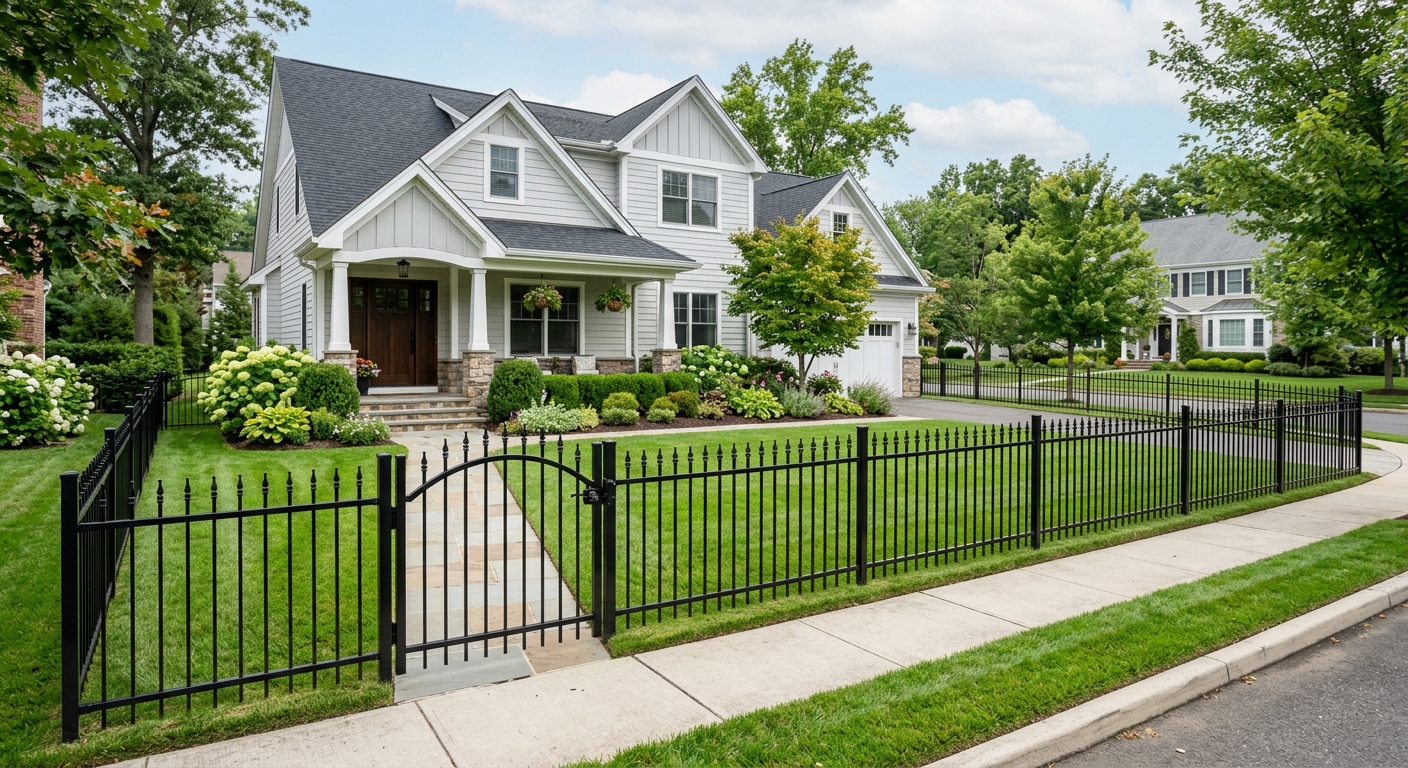
Fencing options and costs in Currie Barracks
In Currie Barracks, Alberta, your fence needs to look good in a newer-looking neighbourhood while still standing up to Calgary’s prairie freeze–thaw swings, wind-driven snow, and long cold snaps. That’s why fencing demand is steady here: the local population is small—1,275 residents (Statistics Canada, 2021 Census)—but each detached property is a potential fencing customer, and family-led lots typically value privacy and yard safety. In fact, fencing crews also see repeat work because residents upgrade from interim boundary fencing to full privacy systems as landscaping matures.
In the Calgary economic region, the regional climate is a primary cost driver. Fence posts are typically set about 4 ft (≈120 cm) deep to sit below the frost line, which increases excavation time, concrete volume, and labour—especially for 6 ft privacy fences and gate posts. Open Prairie exposure also increases wind loads, so privacy panels need tighter post spacing and more robust bracing to prevent racking. This pushes installation costs higher versus lighter, more airflow-friendly systems like chain-link.
Contractor availability is strongest around the communities and commercial edges where access is easiest; in Currie Barracks specifically, the trade is especially busy along established residential blocks where driveways and gates often require careful coordination. If you want a fast, apples-to-apples comparison, start with the material trade-offs and typical pricing per linear foot below.
| Material |
Lifespan |
Maintenance |
Privacy Rating |
Price per Linear Foot |
| Pressure-treated pine (standard wood) |
10–15 years |
Stain/seal every 2–3 years to reduce grey weathering |
High |
$40 – $70 |
| Cedar (natural rot resistance) |
15–25 years |
Light staining or clear seal as needed (typically every 2–4 years) |
High |
$55 – $80 |
| Vinyl / PVC (no-maintenance) |
20–30 years |
Minimal cleaning; inspect annually for impacts/cracking in extreme cold |
High |
$55 – $90 |
| Chain-link (galvanized steel) |
25–40 years |
Occasional rinse; tighten hardware as needed |
Low (airflow-friendly) |
$25 – $55 |
| Aluminum ornamental |
25–40 years |
Wash yearly or as needed |
Low–Medium (privacy requires inserts/screens) |
$70 – $120 |
| Composite / recycled material |
20–30 years |
Low; clean per manufacturer guidance |
Medium–High (solid boards) |
$65 – $110 |
Prices are estimates only and vary by project scope, site access and material selection.
What affects the price of fencing in Currie Barracks
Even when homeowners ask for the “same fence,” pricing across the Calgary region can swing by 30–50% because the job is never identical: post depth, gate complexity, terrain, removal/disposal, and how wind-ready the build must be all change the labour and materials. In Alberta, frost protection is the big divider. To prevent heaving, posts are typically set about 4–6 inches below the design frost depth. Practically, that means deeper holes (often around 1.5–2.0 m into the ground for typical Alberta frost design practices), concrete setting where required, and longer posts—raising both material cost and crew time.
Wind exposure on the Prairies also matters. A solid privacy panel acts like a sail; crews respond by spacing posts tighter and using more bracing, which is why wood and vinyl privacy fences land toward the mid–upper end of the local band. Chain-link systems cost less because they allow airflow and generally need less reinforcement. That’s why you might see wood running closer to $40 – $80 per linear foot and chain-link nearer $25 – $55, even before you factor in gates.
Concrete examples from Currie Barracks: (1) yards with a sloped line often require stepped or raked panels, which increases layout time and typically adds hardware and off-cuts; (2) properties that need old fence removal usually add hauling/disposal and extra labour for disconnecting posts; (3) gate-heavy runs (for example, a double gate plus a side walk gate) increase framing complexity and hinge hardware. As housing stock matures, many homes start with partial fencing and later expand; that “phased build” often costs more per linear foot because matching alignment and tying into existing sections takes extra measuring and retrofit work.
| Price Factor |
Why It Matters |
Cost Impact |
| Fence length in linear feet |
Every extra foot adds posts, rails, fasteners, and finishing |
Highest driver; directly scales total cost |
| Post depth required |
Frost protection determines excavation depth and post length |
Deeper frost-compliant settings increase excavation and concrete |
| Post setting method |
Concrete vs gravel pack vs driven posts changes labour and equipment |
Concrete-set posts usually add material + time vs gravel pack |
| Material choice |
Wind performance and panel type affect post spacing and bracing |
Vinyl and wood typically cost more than chain-link |
| Gate count and type |
Hinged frames, hardware, and alignment requirements increase work |
Double drive gates add framing and heavier hardware |
| Grade and terrain |
Slopes require stepping/raking and more layout time |
Can add labour and increased waste |
| Old fence removal and disposal |
Extra crew time and disposal fees apply |
Often adds a noticeable flat cost per run |
| Permit fees and survey / property line locate |
Some heights require permits and accurate locating prevents rework |
Can add admin and contractor coordination time |
Permits & regulations in Alberta
In Alberta, the need for a permit is usually tied to fence height and location. As a practical rule of thumb, fences above about 2.0 m (6.5 ft) at the rear and roughly 1.0–1.2 m (3–4 ft) at the front or corners often trigger a building permit requirement. Regardless of permit status, fences must respect property lines and follow municipal setback bylaws. Because Currie Barracks sits within the City’s planning framework, it’s smart to confirm whether your proposed height and placement meet local rules before digging.
Before any post holes get dug, call for utility locates using Alberta One-Call so you don’t hit underground services. Next, obtain a survey or at least a property pin locate before installation; it’s one of the most common causes of boundary disputes. For shared fences, Alberta’s line-fences approach governs shared ownership responsibilities—so keep documentation, photos, and agreements if you’re building or repairing along a shared boundary.
To verify your contractor in Currie Barracks: ask for their Alberta business licence (where applicable to their operations), then request a current certificate of insurance showing general liability. Confirm they carry WCB coverage (WCB/WCB-Alberta clearance, as applicable) and that they can provide clearance documentation or proof of registration. For legitimacy, also check public online registries and verify the certificate details match the company name on the quote.
Choosing the right fence material for Currie Barracks
Choosing fence material in Currie Barracks comes down to matching your priorities—privacy, low maintenance, budget, and lifespan—to Calgary’s prairie climate. Long freeze–thaw cycles mean your post setting and panel rigidity matter as much as the board type. For budget-conscious runs, pressure-treated pine is often the entry point, but it typically needs staining or sealing every 2–3 years to prevent grey weathering and keep the surface protected. Cedar costs more up front, yet it naturally resists rot and tends to weather more attractively, often with maintenance still needed but at a slightly more forgiving pace.
Vinyl/PVC is popular for low maintenance because it doesn’t need staining; however, in extreme cold snap conditions, it can crack from impacts, so it’s best paired with sturdy post support and sensible gate hardware. Chain-link is the most cost-efficient and typically long-lived, but it doesn’t provide privacy—especially across an open Prairie wind corridor where airflow is a feature. Aluminum ornamental looks sharp and resists rust, but it’s also not truly private unless you add infills or privacy slats. For composite/recycled boards, you’re paying for durability and a stable look, though pricing generally sits above basic wood and chain-link.
Post depth: for Calgary-area frost protection, plan on the same frost-conscious approach—often around 4 ft (≈120 cm) deep footings and concrete setting for privacy systems and gate posts. In many yards, that structural requirement narrows the “cheap options” gap, because a weakly supported privacy panel fails regardless of board cost.
Example: if you’re comparing a wood privacy fence versus chain-link for the same linear footage and gate count, wood might land in the mid range (around $40 – $80 per linear foot) while chain-link could be closer to $25 – $55. The extra cost is justified when you need privacy and wind-stable solid panels; it’s not justified if airflow and sightlines are acceptable.
| Material |
Cold Tolerance |
Lifespan |
Annual Maintenance |
Best For |
Price Band |
| Pressure-treated pine |
Good with proper sealing and intact fasteners |
10–15 years |
1 inspection; plan stain/colour refresh every 2–3 years |
Budget privacy with classic look |
$40 – $80 |
| Cedar |
Good; performs well in cold with quality installation |
15–25 years |
1 inspection; light seal/stain as needed every 2–4 years |
Premium wood appearance and better rot resistance |
$55 – $80 |
| Vinyl / PVC |
Moderate; can crack from impacts in extreme cold |
20–30 years |
Rinse/spot clean; check post alignment annually |
Low maintenance privacy |
$45 – $90 |
| Chain-link |
Excellent; metal resists cold effects |
25–40 years |
Minimal; tighten hardware as needed |
Security with lowest installed cost |
$25 – $55 |
| Aluminum ornamental |
Excellent; stays stable in cold winters |
25–40 years |
Wash as needed |
Curb appeal and durability |
$70 – $120 |
| Composite / recycled |
Good; stable boards with quality framing |
20–30 years |
Minimal; clean per manufacturer guidance |
Solid privacy with low upkeep |
$65 – $110 |
How to choose a fencing contractor in Currie Barracks
Choosing the right fencing contractor in Currie Barracks starts with verification and clarity. In Alberta, you want a crew that can legally work and protect you if something goes wrong. First, ask for their Alberta insurance certificate (general liability) and confirm coverage is active and matches the company name. Second, request proof of WCB/WCB-Alberta coverage or clearance documentation—this protects you when trades are on site. For licensing, check the contractor’s business registry information and any applicable trade registration; if they can’t provide straightforward proof, that’s a warning sign.
Next, get 2–3 itemised written quotes (not just a lump sum). Ask for a breakdown that shows labour, excavation, post depth/footings, concrete or setting method, rail/bracing, the selected material grade, gate hardware, and concrete finishing. Check whether permits are included (or who pulls them) and whether old fence removal and disposal are in scope. Warranty terms should be explicit: confirm the workmanship warranty length, the manufacturer warranty on materials, and whether warranties transfer to future owners.
For payment scheduling, never pay more than 10–15% upfront. Hold back remaining funds until the job is complete and you’ve confirmed line/grade alignment, gate operation, and a clean site. Ask for a start date and a completion estimate in writing so weather delays don’t turn into schedule surprises in winter-ready planning.
- Ask for an itemised quote with post depth, spacing, and concrete quantities assumptions
- Confirm how they handle frost depth requirements for the Calgary area (typical target: below frost)
- Verify general liability insurance is current and request the certificate number
- Verify WCB/WCB-Alberta coverage or clearance documentation
- Check whether permits are required for your height and whether they pull the permit
- Confirm utility locates and who schedules Alberta One-Call
- Request proof they used property pin/survey information before layout
- Ensure gate hardware specifications are listed (hinges, latches, frame type)
- Ask how they’ll manage sloped yard transitions (stepped vs raked panels)
- Clarify scope for old fence removal and disposal
- Review warranty length and what “workmanship” includes
- Set a written payment schedule with a holdback until final walkthrough
Red flags I commonly see in Currie Barracks: they won’t specify post depth or footing method; they give only a “per foot” number without including gates/returns/excavation assumptions; they ask for a large deposit before layout or locates are done; they won’t provide insurance and WCB/WCB-Alberta proof; or they refuse to put the timeline and warranty in writing.
Frequently asked questions — fencing in Currie Barracks
How much does a fence cost in Currie Barracks?
In Currie Barracks, fencing costs usually follow the broader Calgary-area ranges because frost-depth post setting and wind loading affect the install. Typical installed pricing is often about $40 – $80 per linear foot for wood and roughly $45 – $90 for vinyl/PVC, while chain-link commonly comes in around $25 – $55 per linear foot. Final cost changes with fence length, the number of gates, whether old fence removal is needed, and whether your yard has slopes or hard access. In prairie-exposed areas, privacy panels often require tighter post spacing and sturdier bracing, which pushes wood/vinyl toward the upper part of the band.
How deep should fence posts be for Currie Barracks's frost?
For Currie Barracks and the broader Calgary region, plan for frost-protected post depth. In practice, that often means setting posts about 4 ft (≈120 cm) deep, and many builds set posts roughly 4–6 inches below the design frost depth to reduce the risk of heaving. This is why contractors may recommend concrete footings for privacy fences and especially for gate posts—solid panels take more load, and shifting posts can lead to racking. Your contractor should describe the excavation depth they’re using and the setting method (concrete vs other methods) as part of the quote, not just the material price.
Wood vs vinyl vs aluminum fence — which is best?
“Best” depends on what you want most. Wood privacy fences in Alberta typically look warm and can be a mid-range option, often landing around $40 – $80 per linear foot, but they need periodic staining or sealing to reduce weathering. Vinyl/PVC is usually a strong low-maintenance choice for privacy and can fall around $45 – $90 per linear foot; it doesn’t stain, but it can be susceptible to impact damage in extreme cold if posts aren’t properly supported. Aluminum ornamental is durable and rust-resistant; pricing is typically higher (often $70 – $120 per linear foot) and privacy is limited unless you add infills. For many Currie Barracks homeowners, privacy-first yards favour wood or vinyl with concrete-set gate posts.
Do I need a permit to build a fence in Alberta?
Often, yes—depending on height and location. In Alberta, fences above about 2.0 m (6.5 ft) at the rear and roughly 1.0–1.2 m (3–4 ft) at the front or corner can require a building permit. Regardless, your fence must respect property lines and municipal setback rules. Before digging, you also need Alberta One-Call utility locates (so you don’t hit underground services). The safe homeowner approach in Currie Barracks is to provide your intended height and exact location to your contractor and ask them to confirm whether a permit is required and whether they will pull it.
How long does a wood fence last in Currie Barracks?
With correct post setting and ongoing surface protection, a wood fence in Currie Barracks commonly lasts about 10–15 years for pressure-treated pine and often longer with better materials like cedar. The main lifespan determinants are (1) frost-safe post depth and stable concrete/setting method, (2) fastener quality and rail straightness, and (3) maintenance. Calgary’s freeze–thaw cycles can stress joints and cause visible weathering if the surface isn’t sealed; that’s why you’ll usually want to plan staining/repair work every 2–3 years for pine to keep it looking consistent and reduce premature deterioration.
Who owns and maintains a shared fence?
In Alberta, shared fence situations are typically governed by line-fences legislation, which recognizes that the shared boundary and cost responsibilities can fall between neighbours. In practical terms for Currie Barracks homeowners, you should confirm the fence location relative to property lines (survey/pin locate if needed) and document the shared arrangement. If a fence is truly shared, maintenance and repair obligations may be split, but the exact responsibility can depend on boundary agreement and local circumstances. Before replacing or repairing, communicate in writing with your neighbour and keep photos, measurements, and contractor documentation so everyone understands scope, costs, and expected lifespan.