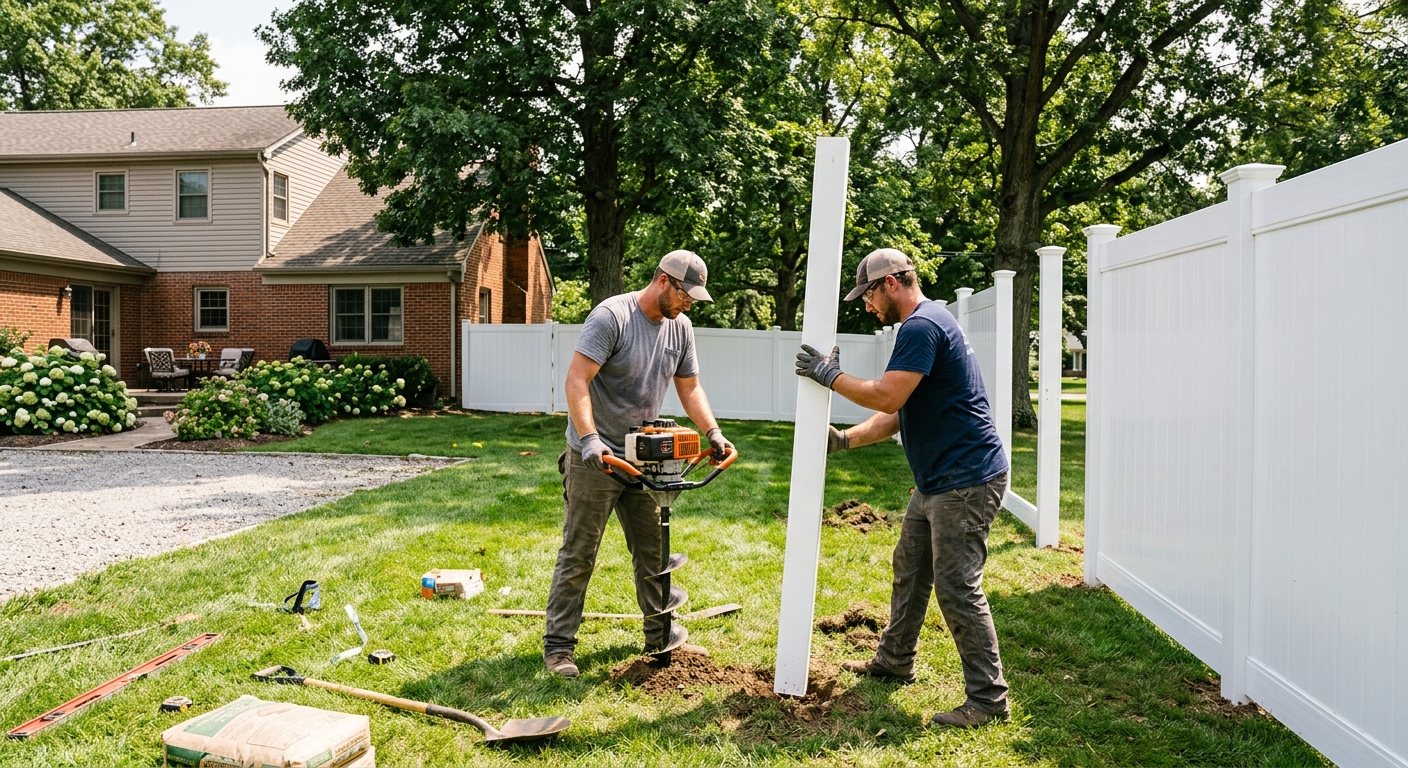
Fencing options and costs in Spirit River
In Spirit River, a fence is more than a boundary—it’s part of how your home holds up to Prairie wind, snow build-up, and deep winter freezes. With 81.6% of local dwellings being single-detached houses and 84.4% of households owning their homes (Statistics Canada, 2021 Census), demand is steady for backyard privacy, dog runs, and yard separation right around the town core and outlying acreage. Older housing stock matters too: 63.6% of homes were built before 1981 (Statistics Canada, 2021 Census), so many projects start as “replace aging runs,” not new fencing.
In the Athabasca–Grande Prairie–Peace River economic region, fencing costs are driven heavily by climate exposure. Frost routinely pushes the frost line to about 4–6 feet, so posts must be set deep and often concreted to prevent heaving and leaning over time. Prairie winds also act like a sail—privacy fences typically need tighter post spacing and sturdier panels than open styles. Access and ground conditions can vary in Spirit River (hardpan pockets and rocky spots), and that affects installation time, auger wear, and concrete consumption.
Trade demand is especially high where people are actively improving larger lots—commonly on the residential fringes of town and in the rural serviced areas along Highway 2 (and nearby side roads). Contractors there often schedule longer lead times in spring because fence replacements and new privacy upgrades stack up after winter weathering.
Below is a practical comparison of common materials so you can benchmark your quote before we break down what pushes pricing up or down.
| Material |
Lifespan |
Maintenance |
Privacy Rating |
Price per Linear Foot |
| Pressure-treated pine (standard wood) |
10–15 years |
Stain/seal every 2–3 years |
High (solid pickets/boards) |
$35 – $70 |
| Cedar (natural rot resistance) |
15–25 years |
Seal/stain every 2–4 years |
High (solid boards/pickets) |
$45 – $85 |
| Vinyl / PVC (no-maintenance) |
20–30 years |
Occasional wash; check hardware |
High (solid panels/boards) |
$40 – $80 |
| Chain-link (galvanized steel) |
20–35 years |
Rinse occasionally; tighten/swap ties |
Low to Medium (add privacy slats if desired) |
$25 – $50 |
| Aluminum ornamental |
25–40 years |
Wash; inspect for fastener tightness |
Low to Medium (decorative spacing) |
$45 – $90 |
| Composite / recycled material |
20–30 years |
Low; wash and inspect fasteners |
High (board-style) |
$55 – $95 |
Prices are estimates only and vary by project scope, site access and material selection.
What affects the price of fencing in Spirit River
If you’re comparing quotes for the “same fence,” it’s normal to see a 30–50% swing across Athabasca–Grande Prairie–Peace River and broader Alberta. Most of that difference comes down to how deep we must set posts for frost control, how windy exposure changes the structural design, and how the ground conditions affect labour and equipment time. Two crews can price the same material differently because one has to dig through harder subsoil or rock, and the other doesn’t—plus mobilization time in rural or semi-rural lots can change the effective labour rate per linear foot.
Frost depth is the big driver. In our climate, posts are typically set about 4–6 inches below the design frost depth to reduce heaving and leaning; practically, that often means augering and setting posts around 1.5–2.0 m into the ground. That raises material cost (longer posts) and labour cost (deeper holes, more concrete when we use concrete setting). On the Prairie, open spacing isn’t “free” either—wind exposure often pushes us to tighter post spacing for heavier privacy fences, which increases the number of posts and hardware.
Local examples I see in Spirit River: (1) clay-heavy spots may require slower augering and more careful backfill/compaction, which adds labour; (2) rocky pockets can increase time and equipment wear, sometimes nudging concrete choice and footing design; (3) if your fence line runs across a wind-swept corner, privacy panels may need beefier framing so the final installed cost can sit closer to the higher end of the wood or vinyl bands (for example, wood installed can land around $35 – $70 per foot depending on build). If you choose chain-link, costs often track lower—commonly $25 – $50 per foot—because it generally uses lighter panels and fewer post/bracing demands for the same footprint.
Finally, older yards in Spirit River often start with replacements of pre-1981 runs (63.6% of homes are built before 1981—Statistics Canada, 2021 Census), and that’s where removal/disposal and post decay assessment can add dollars before you even install the new system.
| Price Factor |
Why It Matters |
Cost Impact |
| Fence length in linear feet |
Every additional foot adds posts, rails, and labour time |
Largest driver; scales directly |
| Post depth required |
Frost heave prevention determines hole depth and post length |
Can push pricing toward the higher band |
| Post setting method |
Concrete setting stabilizes in freeze–thaw cycles; alternatives reduce cost but may not suit all soils |
Concrete typically increases installed cost |
| Material choice |
Different panel weights, hardware, and expected lifespan |
Vinyl/cedar/aluminum often cost more than chain-link |
| Gate count and type |
Gates need heavier framing, hinges, and sometimes double-wide structure |
Multi-gate jobs can materially increase totals |
| Grade and terrain |
Slopes require stepped rails, raked panels, and extra layout time |
Adds labour and sometimes more material |
| Old fence removal and disposal |
Hauling and disposal time plus time to remove stubborn posts |
Often adds a noticeable lump to the estimate |
| Permit fees and survey / property line locate |
Some height/placement scenarios require permits and verified boundaries |
Can add cost if survey/locates are required |
Permits & regulations in Alberta
In Alberta, fence requirements generally tie to height and placement, and a permit may be required for fences above common thresholds—often around 2.0 m (6.5 ft) for rear locations and about 1.0–1.2 m (3–4 ft) for front or corner areas, depending on municipal bylaws. Even when a permit isn’t required, you still must respect property lines and any applicable setback rules. For Spirit River homeowners, the safest approach is to confirm the height/location requirement with your municipality and keep the fence aligned to the actual property line.
Before you dig any post holes, call for utility locates through Alberta One-Call. Also, obtain a survey or at least a property line locate so you don’t accidentally build over pins or encroach into a neighbour’s yard—fence disputes are often really boundary disputes in winter-frozen ground and shifting stakes.
Shared fence ownership is handled through Alberta line-fences concepts, meaning neighbouring agreements and who maintains what can become important if there’s damage or reconstruction. If you’re planning a replacement of an older run, ask how the current fence was established and whether the boundary line is already agreed.
Licence and coverage checks (step-by-step): (1) verify the contractor’s Alberta business credentials/registration using appropriate online resources or the company registry details; (2) request a clearance letter or proof of standing where applicable; (3) ask for a current certificate of insurance—general liability at minimum, and ensure the dates match your project; (4) confirm workers’ coverage (WSIB/WCB coverage) so you’re not exposed if an injury occurs on site. Keep copies with your signed contract.
Choosing the right fence material for Spirit River
Choosing fence material in Spirit River is mostly about balancing privacy, maintenance, and how the product behaves through deep freezes and strong winds across the Athabasca–Grande Prairie–Peace River region. Pressure-treated pine is usually the best entry price, but it’s not “set and forget”—expect staining or sealing every 2–3 years to reduce grey weathering and slow surface cracking. Cedar looks great and naturally resists rot better than many standard woods, but it still benefits from periodic sealing to maintain colour and reduce splitting at boards’ ends. Vinyl/PVC stays low-maintenance and resists rot, yet in extreme cold it can become brittle if it’s installed with the wrong hardware or the fence is underbuilt for wind loads—so proper post depth and bracing matter as much as the product.
Chain-link is the most budget-friendly and typically the longest-lived mechanically, especially for secure perimeter fencing where privacy isn’t the goal. Aluminum ornamental gives a clean, rust-resistant look and performs well, but like chain-link it offers limited privacy unless you add inserts. For heavier wind-driven snow and gusts, privacy styles (wood, vinyl, composite) generally require tighter post spacing and stronger rails.
Because the frost line can be around 4–6 feet in this region, post depth is a core requirement regardless of material. That often means longer posts and deeper augering; whether concrete-setting is necessary depends on your soil and slope, but in many yards we use concrete setting to reduce freeze–thaw movement and keep lines straight year after year.
To see where the price difference is justified: if you price pressure-treated pine near $35 – $70 per linear foot and vinyl near $40 – $80, the added dollars often pay back if you want to avoid repeated staining and have limited time for maintenance in a rural schedule. If you only need basic perimeter security, chain-link at $25 – $50 per foot can be the better long-term value.
| Material |
Cold Tolerance |
Lifespan |
Annual Maintenance |
Best For |
Price Band |
| Pressure-treated pine |
Good (with proper sealing and end-grain protection) |
10–15 years |
Light inspection; stain/seal every 2–3 years |
Budget privacy with manageable upkeep |
$35 – $70 |
| Cedar |
Good (rot resistance; still sensitive to surface cracking without sealing) |
15–25 years |
Inspect and seal every 2–4 years |
Attractive privacy that ages well |
$45 – $85 |
| Vinyl / PVC |
Very good (avoid poor hardware and flexing under wind) |
20–30 years |
Wash as needed; check fasteners |
Low-maintenance privacy |
$40 – $80 |
| Chain-link |
Excellent (galvanized tolerates freeze–thaw well) |
20–35 years |
Minimal; tighten ties periodically |
Perimeter security and pets |
$25 – $50 |
| Aluminum ornamental |
Excellent (rust-resistant; withstands Alberta winters) |
25–40 years |
Wash; inspect alignment |
Curb appeal with basic boundary definition |
$45 – $90 |
| Composite / recycled |
Good (depends on post support and fastening) |
20–30 years |
Low; rinse and inspect hardware |
Privacy with reduced rot risk |
$55 – $95 |
How to choose a fencing contractor in Spirit River
Choosing a fencing contractor in Spirit River starts with proof of coverage and clarity on the install scope. In Alberta, verify licensing/credentials where applicable, and confirm liability insurance and workers’ coverage (WSIB/WCB) so you’re protected if anything goes wrong during digging, augering, or gate installs. Ask to see: (1) a current insurance certificate showing your contractor name and effective dates; (2) confirmation of workers’ coverage (WSIB/WCB) for the project period; and (3) any clearance letter or proof of standing where relevant. If they won’t provide documents promptly, that’s a hard stop.
Next, request 2–3 itemised written quotes that break down labour and materials separately—not one lump sum. You want line items for posts (lengths/depth assumptions), rails, gates, hardware, concrete (if used), and disposal/removal of the old fence. Make sure you know what’s included: are permits handled, is a property line locate included or excluded, and does the quote include levelling for slopes? In Spirit River, older fence replacements often include post removal; quotes that ignore disposal usually come back with change orders after the work starts.
Warranty matters: ask for the workmanship warranty length and whether manufacturer warranties on panels or components are transferable if you sell your home. For payments, never pay more than 10–15% upfront; hold back the remainder until completion and final clean-up are verified. Get a start date and an estimated completion window in writing so spring weather doesn’t stretch the schedule without notice.
- Ask for an Alberta insurance certificate and confirm coverage dates match your install timeline.
- Verify workers’ coverage (WSIB/WCB) for the crew assigned to your job.
- Request proof of contractor credentials/standing (and clearance letter where applicable).
- Get at least 2–3 itemised quotes with labour vs materials broken out.
- Confirm post depth strategy (frost considerations) in writing.
- Clarify whether posts are concrete-set and how much concrete is budgeted.
- Check how the quote handles sloped yards (stepped vs raked panels).
- Confirm gate framing strength and whether hardware is included.
- Ask if old fence removal, hauling, and disposal are included.
- Confirm survey/property line locate expectations and who pays if pins are needed.
- Review the scope exclusions (grading, buried obstacles, concrete pads, landscaping restoration).
- Put warranty terms in writing: workmanship and product/manufacturer warranty details.
Red flags I’ve seen with fencing contractors in Spirit River include: they won’t show insurance or workers’ coverage documentation, they refuse itemised labour/materials quotes, they promise “shallow post holes” without frost-depth reasoning, they won’t discuss concrete setting for deep freezes, and they ask for a large upfront payment (over ~15%) before any materials are staged.
Frequently asked questions — fencing in Spirit River
What is the most weather-resistant fence for Spirit River's climate?
In Spirit River and the wider Athabasca–Grande Prairie–Peace River region, the most weather-resistant options are typically chain-link and quality aluminum. Chain-link uses galvanized steel that tolerates freeze–thaw cycles well, and it generally survives long winters with minimal upkeep—especially if posts are set deep enough for frost control. Aluminum is also rust-resistant and performs well in cold weather, though it’s usually more about aesthetics than privacy. If you want privacy, vinyl or cedar can be very durable when posts are installed to handle deep frost (often around the 4–6 foot frost depth zone) and panels are braced for wind. Budget-wise, chain-link is commonly in the $25 – $50 per linear foot range, while privacy materials like vinyl often fall higher at $40 – $80.
How do I prevent wood fence rot in Spirit River?
Wood rot prevention in Alberta comes down to stopping moisture from lingering where boards meet hardware and where water can collect at the bottom. In Spirit River, start with proper installation: use correctly sized, pressure-treated components, seal or stain on schedule, and pay attention to end-grain sealing (the ends wick moisture). Keep landscaping from touching fence boards so airflow can work, and don’t let snowdrifts sit tightly against one section for weeks after thaw cycles. For posts, deeper holes and correct post setting reduce movement; leaning boards create gaps that trap moisture and accelerate rot. If you’re replacing an older run, expect that pre-1981 wood may already be weakened—many local homes are that age (Statistics Canada, 2021 Census)—so choose materials and maintenance that match how often you’re willing to re-stain.
What is the cost per linear foot for fencing in Spirit River?
Typical installed pricing in Spirit River usually tracks the regional bands by material and exposure. Wood installation commonly lands around $35 – $70 per linear foot depending on fence height, post depth strategy, and whether rails/bracing are increased for wind. Vinyl/PVC is often $40 – $80 per linear foot, while chain-link is frequently the lowest at $25 – $50. Aluminum ornamental generally starts higher—often $45 – $90—because of panel style and hardware. Your final number can move up when frost-depth post requirements increase concrete or when rocky/hardpan soil slows augering. If you’re getting quotes, ask for line-item posting: post lengths, setting method, and how disposal/removal is handled.
Should I repair or replace my old fence in Spirit River?
Repair is usually worth it when the posts are still solid and straight, rails aren’t significantly warped, and the fence line isn’t severely leaning after winter freeze–thaw. In Spirit River’s climate, rot often starts at the lowest boards and at post/hardware connections, so “spot repairs” can work if only a few bays are failing and the rest is structurally sound. Replacement is smarter when multiple posts are loose, the fence line has shifted, or you’re seeing widespread board decay or broken framing. Many local projects are replacements because older wood fences have aged—especially where homes are older (63.6% built before 1981—Statistics Canada, 2021 Census). A practical approach: get an on-site assessment, then compare the repair cost against the cost of a properly post-set rebuild (including deep frost-ready installation and, where needed, concrete setting) so you’re not paying twice.
How do I handle a fence dispute with a neighbour in Alberta?
Fence disputes in Alberta are often boundary disputes, so the first step is to verify where your property line actually sits. In Spirit River, use a survey or property line locate to confirm pin locations before you argue about the fence location. Next, review any prior agreements about shared fencing and who is responsible for maintenance and reconstruction—shared fence ownership rules are governed by Alberta line-fences legislation. If the fence was installed long ago and the dispute is about replacement responsibility, document everything: photos in winter and summer, dates when damage occurred, and copies of contractor quotes. If you’re pursuing any new work, avoid digging until utility locates are done through Alberta One-Call and until the boundary is confirmed. A clear, written plan from both sides (scope, materials, and who pays) prevents repeating the conflict.
What fence style offers the best wind resistance in Spirit River?
In Spirit River, wind resistance isn’t just about being “tall”—it’s about controlling wind load and minimizing flex. For maximum wind stability, privacy fences with solid panels perform best when engineered with tighter post spacing, sturdy rails, and deeper post setting for frost control. Chain-link and open ornamental styles usually allow wind to pass through, so they can handle gusts better structurally with less bracing—but they won’t provide privacy. If your yard is exposed to Prairie winds, a well-built wood, vinyl, or composite privacy fence with proper framing and secure posts often holds up better against repeated snow and gust cycles. Material cost can be higher: for example, wood installed often sits around $35 – $70 per linear foot, while vinyl privacy may be $40 – $80. The “best” choice depends on whether you want privacy or just boundary stability, but in either case, the post depth and bracing details are what keep the fence straight through Alberta winters.