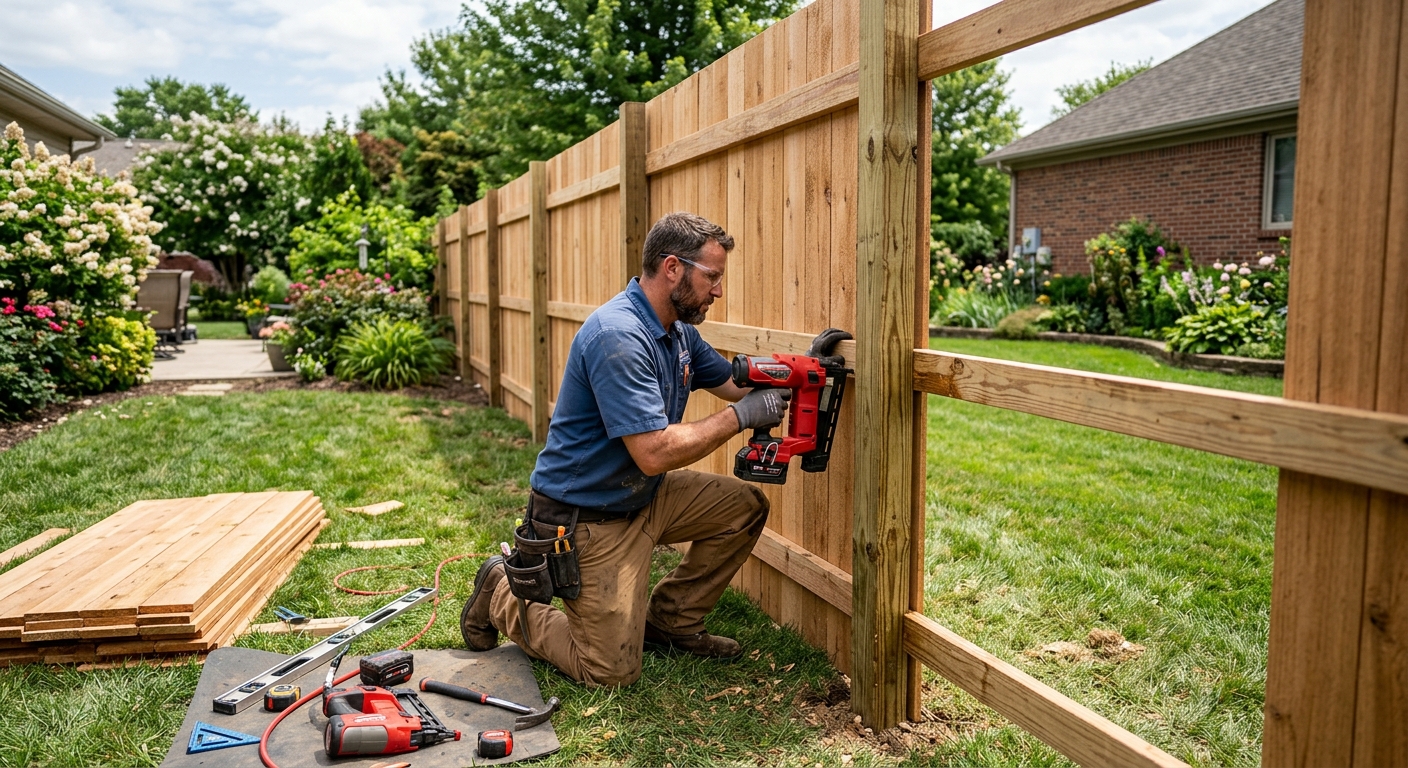
Fencing options and costs in Downtown
In Downtown, Alberta, the right fencing choice comes down to privacy needs, maintenance tolerance, and how your yard gets hit by wind off the open Prairie. With a residential base of 12,423 people (Statistics Canada, 2021 Census) spread through established neighbourhoods, there’s steady demand wherever single-family properties cluster and backyard boundaries need defining. Downtown’s housing mix also matters: even when lots are smaller, homeowners still expect durable fence lines for kids, pets, and seasonal access.
Calgary’s prairie continental climate is a major cost driver. Long freeze–thaw cycles mean fence posts must sit below the regional frost line to limit heaving, so contractors typically set posts about 4 ft (≈120 cm) deep and use concrete footings—especially for 6 ft privacy fences and gate posts. Open exposure across the Calgary area also increases wind loading, which often leads to tighter post spacing and sturdier framing for solid wood or vinyl panels. Availability can vary by season: labour demand is usually higher in spring and early fall when lots are cleared and fence projects are scheduled.
In Downtown, trades tend to be especially busy around Beltline and the inner-city belt where backyards and alley access create frequent install and gate replacement work. If you’re comparing materials, start with the table below—then we’ll break down what pushes quotes up or down.
| Material |
Lifespan |
Maintenance |
Privacy Rating |
Price per Linear Foot |
| Pressure-treated pine (standard wood) |
10–15 years |
Stain/seal every 2–3 years; inspect posts yearly |
7/10 (solid boards) |
$40 – $70 |
| Cedar (natural rot resistance) |
15–25 years |
Light staining as needed; check for warping |
8.5/10 (solid boards) |
$55 – $80 |
| Vinyl / PVC (no-maintenance) |
20–30 years |
Wash as needed; check panel integrity in extreme cold |
8/10 (solid privacy styles) |
$55 – $85 |
| Chain-link (galvanized steel) |
20–30 years |
Minimal; straighten sections if hit; occasional coating checks |
3/10 (low privacy unless added slats) |
$25 – $55 |
| Aluminum ornamental |
25–40 years |
Rinse; occasional hardware checks |
2.5/10 (open look) |
$70 – $120 |
| Composite / recycled material |
20–30 years |
Little to none; clean mould/mildew if needed |
8/10 (solid privacy boards) |
$65 – $100 |
Prices are estimates only and vary by project scope, site access and material selection.
What affects the price of fencing in Downtown
In Downtown, two quotes that sound similar on paper can land 30–50% apart because Calgary’s climate forces contractors to engineer against both frost movement and wind racking. The fencing price band homeowners see in Calgary commonly falls around $40 – $80 per linear foot for wood and mid–upper materials, while chain-link often stays in the lower–mid range around $25 – $55. The jump isn’t usually because of “markup”—it’s mostly post depth, post setting, and the amount of framing needed to keep panels straight through winter.
Frost line depth sets how deep posts must be set. In Alberta’s colder stretches, the practical rule is typically setting posts about 4–6 inches below the design frost depth to prevent heaving, which commonly means 1.5–2.0 m into the ground, with concrete setting and longer posts. That increases excavation time, concrete volume, and material length—so your total rises even if your fence is the same height.
Wind exposure on the Prairies also matters. Solid wood or vinyl privacy panels need closer post spacing and more robust rails to resist gusts and snow-borne pressure; chain-link can often be more forgiving because it lets air pass. By contrast, BC’s wet coastal climate can accelerate wood rot without proper treatment, but that advantage doesn’t apply here—your cost is driven more by freeze–thaw and structure than by rot prevention.
Concrete examples you’ll notice in Downtown: (1) a 6 ft privacy fence with a concreted corner post usually costs more than a 4 ft section because corner posts carry higher lateral load; (2) replacing an old fence line with uneven grade often adds stepped/raked panel labour, increasing total hours. If your fence is on a shorter backyard run with easy rear access, you may come closer to the low end; if access is tight and excavation is difficult, costs move toward the high end.
| Price Factor |
Why It Matters |
Cost Impact |
| Fence length in linear feet |
The primary driver: materials and labour scale directly with footage. |
Highest impact (often 40–60% of total cost) |
| Post depth required |
Frost line determines post length and hole depth to prevent heaving. |
Can increase excavation and materials by 10–25% |
| Post setting method |
Concrete vs. gravel pack vs. driven posts affects durability and labour time. |
Concrete setting can add 8–20%+ |
| Material choice |
Vinyl/wood needs full privacy framing; chain-link is lighter with airflow. |
Shifts you between lower-mid and mid–upper bands |
| Gate count and type |
Gates require reinforced framing, hinges, and latch hardware. |
Often adds 10–30% depending on swing/width |
| Grade and terrain |
Sloped yards need stepped rails or raked panels for consistent height. |
Adds labour; commonly 5–15% |
| Old fence removal and disposal |
Demolition, hauling, and returning the site to grade take time. |
Can add 5–20%+ |
| Permit fees and survey / property line locate |
Some heights require permits; accurate locate reduces disputes and rework. |
Often 0–10% depending on scope |
Permits & regulations in Alberta
In Alberta, fence permits often come into play when you’re installing higher backyard barriers. As a practical guideline, fences above a height threshold—typically 2.0 m (6.5 ft) at the rear and about 1.0–1.2 m (3–4 ft) at the front or corner—may require a building permit. Exact requirements can vary by location and zoning, so treat this as a starting point and confirm with the relevant city processes before you dig.
Regardless of height, you must respect property lines and any applicable municipal setback rules. Before any post holes are dug, call for utility locates through Alberta One-Call (and follow the marked responses). If there’s any uncertainty about the line, get a survey or a locate tied to your pins—this prevents expensive encroachment disputes when neighbouring properties don’t agree on the boundary.
Shared fence ownership and boundary responsibility are handled under Alberta’s line-fences legislation, so it’s worth documenting who’s contributing and what’s being replaced or repaired.
Licence and coverage checks are straightforward: verify the contractor’s Alberta licence status (and confirm active standing via the appropriate online registry tools used by Alberta), request a certificate of insurance showing liability coverage, and ask for workers’ compensation coverage (WCB/WSIB equivalent reporting in Alberta). Look for coverage dates matching your project timeline, and ask for an updated Clearance Letter or proof of account status where applicable.
Choosing the right fence material for Downtown
Choosing fence material in Downtown should start with your priorities: privacy, low maintenance, budget, and expected lifespan—then match those to Calgary’s freeze–thaw and wind environment. Pressure-treated pine is usually the budget-friendly path, but it needs staining or sealing every 2–3 years to slow weathering and keep boards looking uniform. Cedar naturally resists rot and stains more evenly, which can be a strong upgrade if you want long-term appearance with moderate maintenance.
Vinyl/PVC delivers true low maintenance (wash when needed), but it’s not “indestructible.” In extreme cold snaps, panels can become brittle if the framing is undersized—so proper post depth and rail support are essential. Chain-link is the lowest-cost, longest-life option in many Calgary installs because airflow reduces wind pressure, but it won’t deliver privacy unless you add slats or a screening layer. Aluminum ornamental fences have excellent rust resistance and a clean look, though they’re primarily for boundary definition and visibility rather than privacy. Composite/recycled materials fall into the long-life, low-maintenance category, often with solid privacy styles that withstand weather well when installed with correct spacing.
Post depth is the same story across materials: Calgary’s frost movement is why most installs use deep set posts (often around 4 ft into the ground) and frequently concrete footings for privacy fences and gate posts. That engineering choice is what helps fences stay plumb through winter. For wind and snow load, solid panel designs typically need more rigid framing than chain-link.
A real example: if your line is 30 linear feet, moving from chain-link at roughly $25 – $55 per foot to a vinyl privacy fence at about $55 – $85 per foot can be $900 to $2,400 more before upgrades—an amount often justified when you need full yard privacy and stronger wind-racking resistance.
| Material |
Cold Tolerance |
Lifespan |
Annual Maintenance |
Best For |
Price Band |
| Pressure-treated pine |
Good if sealed; boards can warp without proper framing |
10–15 years |
Plan on 1 seasonal inspection; stain every 2–3 years |
Budget privacy with classic look |
$40 – $70 |
| Cedar |
Very good; handles freeze–thaw well with correct post setting |
15–25 years |
Light stain/finish as needed; inspect annually |
Better appearance and rot resistance |
$55 – $80 |
| Vinyl / PVC |
Good when panels and rails are properly supported |
20–30 years |
Rinse/clean when dusty; check fasteners |
Low-maintenance privacy |
$55 – $85 |
| Chain-link |
Excellent; minimal stress on wind loads |
20–30 years |
Minimal; straighten after impacts |
Security and durability |
$25 – $55 |
| Aluminum ornamental |
Excellent; no rust cycle |
25–40 years |
Occasional rinse and hardware check |
Attractive boundaries with visibility |
$70 – $120 |
| Composite / recycled |
Good; performance depends on rail spacing and fastening |
20–30 years |
Little to none; clean mould/mildew if it builds up |
Solid privacy with reduced upkeep |
$65 – $100 |
How to choose a fencing contractor in Downtown
Choosing a contractor in Downtown means verifying three things early: licensing status, liability insurance, and workers’ compensation coverage. Start by asking the contractor for their Alberta licence details and checking that it’s current using the applicable online registry tools used in Alberta (not a PDF screenshot). Next, request a certificate of insurance showing general liability coverage and confirm the policy is active for your exact installation dates. Finally, ask for proof of workers’ compensation coverage (WCB/WSIB coverage as applicable in Alberta) and, if they provide it, a Clearance Letter or equivalent account status document—this matters if anything is damaged or if a worker is injured on-site.
Then get 2–3 itemised written quotes—not lump sums. A proper fence quote should separate excavation/posting labour, materials (posts, rails, pickets/panels, hardware), gate components, concrete, and any hauling/removal. Read the exclusions: ask whether a permit pull is included, whether utility locates are the homeowner’s responsibility, and whether old fence removal and disposal are part of the price or billed separately.
Warranty matters too. Ask for (1) workmanship warranty length for installation, (2) product/manufacturer warranty for material defects, and (3) whether warranties are transferable if you sell. For payment, never pay more than 10–15% upfront; hold back a portion until the gate hardware, alignment, and clean-up are complete. Also request a start date and a completion estimate in writing, with how weather delays are handled in Calgary’s freeze–thaw season.
- Confirm Alberta licence status (active, matching your project scope).
- Request a certificate of insurance with liability coverage and policy dates.
- Ask for workers’ compensation proof (and clearance/account status where provided).
- Get itemised pricing: materials vs labour vs concrete vs disposal.
- Ensure post depth and setting method are specified (not “as required”).
- Check gate reinforcement details (posts, hinges, latch hardware).
- Ask how they handle sloped yards (stepped vs raked panels).
- Verify disposal/hauling is included if removing an old fence.
- Confirm permit responsibility: who pulls it and what’s included.
- Ask who calls for utility locates and how locates are documented.
- Require a written workmanship warranty and product warranty terms.
- Keep a payment schedule: max 10–15% deposit; holdback at completion.
Red flags in Downtown: vague “included” wording that doesn’t mention post depth or concrete setting, refusal to provide insurance/WCB documentation, quoting only per-panel without linear footage and gate breakdown, asking for a large upfront payment (more than 15%), and starting work without confirming property line location when neighbours are close to the boundary.
Frequently asked questions — fencing in Downtown
What is the cost per linear foot for fencing in Downtown?
In Downtown, fencing costs typically land in the same practical ranges seen across Calgary: wood and vinyl/ PVC privacy fences are commonly mid–upper priced at about $40 – $80 per linear foot for wood and roughly $45 – $90 for vinyl, depending on height, access, and whether posts are concreted. Chain-link is usually lower at about $25 – $55 per linear foot because it’s lighter and airflow reduces wind pressure on the frame. The big reason your per-foot number can swing is frost-proofing: in Alberta, fence posts often need to be set well below the frost movement, which increases excavation and concrete volume—especially for 6 ft privacy runs and gates.
Should I repair or replace my old fence in Downtown?
Repair is usually the smarter move when the posts are solid (not heaving, leaning, or rotting at the base), rails are straight, and the damage is limited to a few boards or a gate latch. In Calgary’s freeze–thaw cycles, problems commonly start at the post bases—so if you’re seeing wobble near the bottom or multiple posts have shifted, replacement is often more cost-effective long-term. If your existing fence is chain-link with intact line posts and only minor bends, repair can be economical; for older privacy fences with failing posts, the labour to re-set would approach replacement anyway. A contractor can assess by checking post plumb, fastening failure, and how far sections have racked under wind.
How do I handle a fence dispute with a neighbour in Alberta?
Start by keeping it factual and calm: confirm the boundary with a survey or a property-pin locate before arguing style or placement. In Alberta, fence responsibilities along boundaries are addressed through provincial line-fences legislation, so it’s important not to assume “who built it first” decides ownership or costs. Document your communication, take photos, and get a written site assessment that describes what’s actually on the line and what needs correction. If the disagreement is about repair versus replacement, ask for an itemised recommendation and keep options open (shared-cost repairs can sometimes be more reasonable than full replacement). When the dispute involves safety or major encroachment, consult a professional surveyor early and avoid any work that could worsen the boundary issue.
What fence style offers the best wind resistance in Downtown?
Wind resistance in Downtown is strongly tied to how well the fence resists racking, not just whether it looks solid. Solid privacy panels (wood or vinyl) can perform very well if installed with correct engineering: deeper post setting for frost protection, sturdy framing, and closer post spacing to reduce panel flex. Chain-link often fares better in high wind because it allows airflow, which lowers pressure on the structure—so it’s frequently the most forgiving choice for open Prairie exposure. In practice, the “best” option depends on your goal: if you want maximum privacy, a properly built 6 ft privacy fence with concrete-set posts and reinforced rails often wins; if you want durability with less wind load, chain-link is typically easiest to keep straight through gusts.
How much does a fence cost in Downtown?
Cost depends on linear footage, height, gate count, access for excavation, and how the posts are set for Alberta frost movement. As a quick homeowner reference, installed pricing in the Calgary region often falls around these bands: wood fencing about $40 – $80 per linear foot, vinyl/ PVC about $45 – $90, chain-link about $25 – $55, and aluminum ornamental about $70 – $120. For example, if you’re budgeting a mid-range privacy run and you see a quote near the lower end, double-check that it includes deep post holes, concrete setting where needed, and appropriate rail spacing—those items are what keep the fence stable in freeze–thaw and wind. A good itemised quote is the best way to understand where your cost is coming from.
How deep should fence posts be for Downtown's frost?
For Downtown and the broader Calgary area, fence posts generally need to be set below the region’s frost movement—often around 4 ft (≈120 cm) deep for typical installations as a practical guideline used by local contractors. Because freeze–thaw cycles are a major driver of heaving, many installs aim for roughly 4–6 inches below the design frost depth so posts stay stable when the ground expands and contracts. For 6 ft privacy fences and gate posts, concrete footings are commonly used to improve stability under wind load. The exact depth for your yard should be confirmed in your quote based on soil conditions, fence height, and local frost protection guidance—so insist that the contractor specifies hole depth and setting method, not just “posts set in concrete/gravel.”