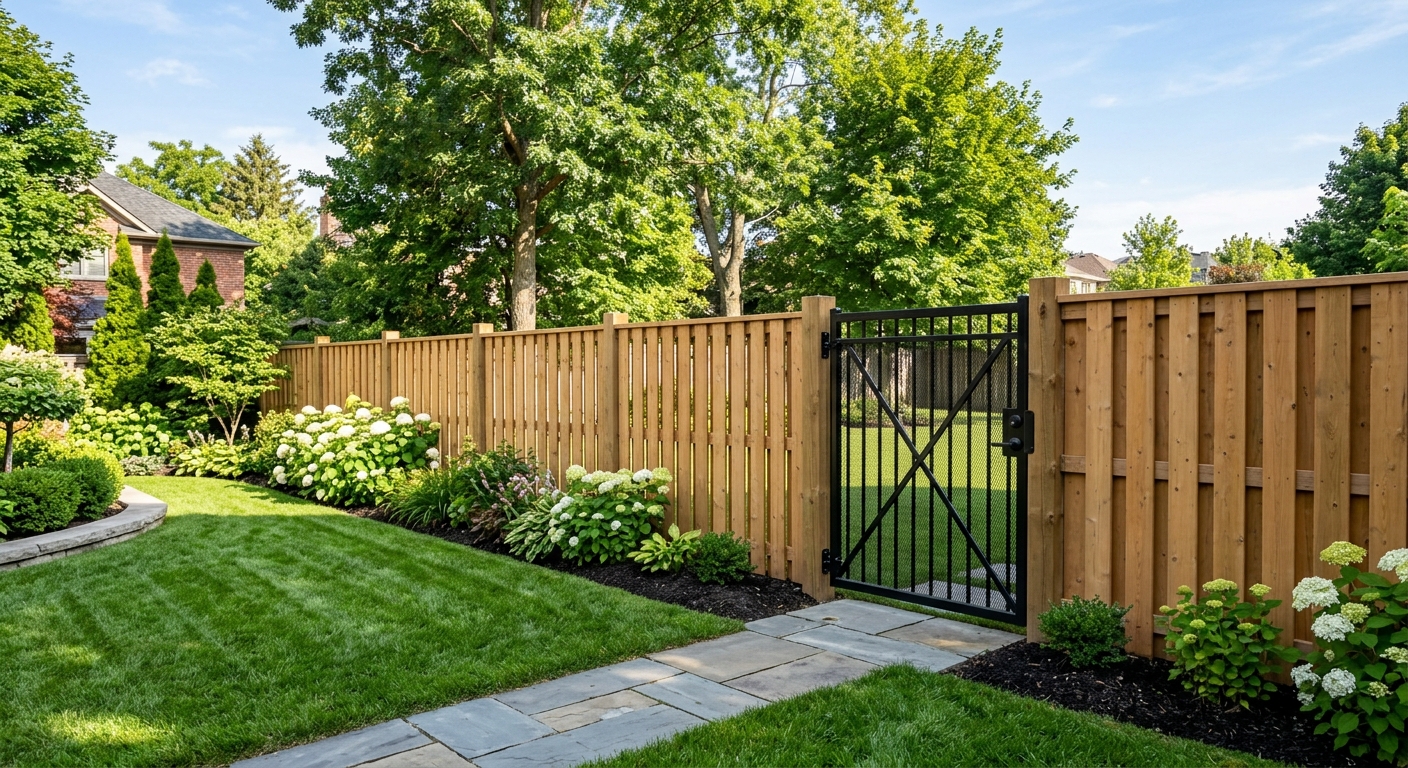
Fencing options and costs in Leduc
Leduc, Alberta is a prime spot for new fencing because many residents own detached homes—single-detached dwellings make up 63.2% of the housing stock (Statistics Canada, 2021 Census). With 9,490 homeowner households (73.2% of households own), there’s consistent year-round demand for boundary fencing, backyard privacy, and pet-friendly runs. That steady base matters when you’re budgeting, because contractors in the Edmonton economic region are often booking installs around weather windows, school schedules, and inventory cycles.
In the Edmonton region, fence pricing depends less on material alone and more on site and climate conditions. Frost depth drives post-hole depth: posts are typically set 4–6 inches below the design frost line to reduce heaving, which often means longer posts and more labour time. Wind exposure is another cost driver on the Prairies; open sites can require tighter post spacing and stiffer builds, especially for privacy fences. If you’re near the airport/industrial corridor or on a more exposed lot edge, you may see higher labour and hardware costs versus a sheltered backyard. In Leduc, demand is especially strong in and around the growing neighbourhoods near Leduc Recreation Centre and the newer subdivisions on the west and south sides, where families tend to upgrade from temporary barrier fencing to permanent privacy or dog-proof systems.
Below is a practical comparison of common fencing materials you’ll see quoted in Leduc, including what homeowners typically pay per installed linear foot.
| Material |
Lifespan |
Maintenance |
Privacy Rating |
Price per Linear Foot |
| Pressure-treated pine (standard wood) |
10–15 years |
Stain/seal every 2–3 years |
Good (solid boards) |
$17 – $30 |
| Cedar (natural rot resistance) |
15–25 years |
Light staining/conditioning every 2–4 years |
Excellent (solid boards) |
$22 – $40 |
| Vinyl / PVC (no-maintenance) |
20–30 years |
Rinse as needed; inspect hardware |
Excellent (solid/privacy styles) |
$26 – $46 |
| Chain-link (galvanized steel) |
25–40 years |
Occasional tightening and top rail checks |
Low to Fair (open mesh) |
$12 – $22 |
| Aluminum ornamental |
25–40 years |
Wash; inspect infill and hinges |
Low (decorative visibility) |
$20 – $40 |
| Composite / recycled material |
20–30 years |
Minimal cleaning; inspect fasteners |
Good (solid panels) |
$24 – $45 |
Prices are estimates only and vary by project scope, site access and material selection.
What affects the price of fencing in Leduc
In Leduc and across the Edmonton economic region, you can see the same basic “6-foot privacy fence” quoted 30–50% apart. The reason is that fence cost is driven by how the installer has to build for Alberta ground conditions and wind, not just by the fence “type.” Frost depth typically sets how deep posts must be set—usually about 4–6 inches below the design frost depth—so on many Leduc lots you’ll still be drilling roughly 1.5–2.0 m down, often with concrete-set posts. That increases both labour time and material costs (longer posts, more concrete, more aggregate prep), which is why two bids for wood can separate quickly even when lumber pricing looks similar.
Wind exposure on the Prairies also matters: heavier rails, tighter post spacing, and more rigid panel construction can be required to prevent racking and “oil-canning” in high gust zones. That’s one reason privacy fences often land closer to the higher end of wood and vinyl bands (for example, wood commonly runs within $3,000–$6,500 installed depending on site conditions, and vinyl often sits higher, roughly within $3,500–$8,000). In colder, drier stretches, the ground can heave and the fence frame works harder, so proper post embedment and straight alignment become non-negotiable.
Concrete examples from Leduc installs: (1) if your fence line includes tree roots or compacted fill, excavation time rises and concrete volume can increase; (2) if you’re on a corner lot with two fence runs, you’ll pay more for gates, bracing, and corner hardware; (3) if you remove an old fence, disposal and salvage time can add cost—or lower it if the crew can reuse usable posts and rails. Newer homes built after 1981 often have cleaner property line access, while older sites (26.6% built before 1981) may have buried obstructions or uneven grades that change post depth and layout effort, affecting the final total by hundreds to a few thousand dollars.
| Price Factor |
Why It Matters |
Cost Impact |
| Fence length in linear feet |
The primary driver—each foot requires posts, rails, and fasteners |
Major (sets the baseline of your budget) |
| Post depth required |
Frost line determines embedment to prevent heaving and shifting |
High (more labour + longer posts/concrete) |
| Post setting method |
Concrete vs. gravel pack vs. driven posts affects stability and time |
High (concrete adds materials and installation time) |
| Material choice |
Vinyl, cedar, and chain-link differ in framing, hardware, and cost per component |
Medium to High (can shift overall budget by thousands) |
| Gate count and type |
Gates require heavier frames, hinges, latches, and often bracing |
Medium (one gate can equal several fence panels) |
| Grade and terrain |
Sloped yards may need stepping, raked rails, and extra materials |
Medium (more labour, more cut/waste) |
| Old fence removal and disposal |
Haul-away, deconstruction, and disposal fees |
Medium (varies widely with access) |
| Permit fees and survey / property line locate |
Compliance steps and locate work prevent disputes and rework |
Low to Medium (often small, but can block timeline) |
Permits & regulations in Alberta
In Alberta, fence permits are commonly required when a fence exceeds a height threshold—often around 2.0 m (6.5 ft) at the rear and roughly 1.0–1.2 m (3–4 ft) at the front or corner, depending on municipal rules. Even when a permit is not required for a lower fence, the fence must respect property lines and any municipal setback bylaws. In Leduc, the safest path is to confirm the applicable height and placement requirements before you order materials, because getting the wrong line or height can result in costly redesign or removal.
Before you dig any post holes, call for utility locates through Alberta One-Call to mark buried services. Also consider obtaining a survey or at least a property pin locate before installing, so you don’t build on a neighbour’s land or run into boundary disputes later. Shared fence ownership generally falls under provincial line-fences principles, which means you should document agreements with neighbours in writing if you’re splitting costs or sharing the fence.
What typically does require a permit: building a fence above the applicable height threshold and/or installing a fence that triggers additional review due to placement (front/corner situations). What typically does not require a permit: replacing an existing fence in like-for-like height and location (still verify locally) and installing standard-height side/rear fencing within permitted limits.
To verify a contractor before signing: check their Alberta licence/registration status using the relevant online registry; request a certificate of liability insurance (make sure it names the work location and includes adequate limits); confirm workers’ compensation coverage (WSIB/WCB coverage) and ask for the clearance letter/reference where applicable. A credible contractor will provide these documents quickly and clearly.
Choosing the right fence material for Leduc
Choosing the right fence for Leduc is about matching material to your priorities—privacy, low maintenance, budget, and lifespan—within Alberta’s freeze-thaw cycle and Prairie wind. Pressure-treated pine is usually the most budget-friendly way to get solid privacy, but it typically needs staining or sealing every 2–3 years to slow grey weathering and protect against moisture cycling. Cedar looks better longer and has natural rot resistance, so it often holds up nicely near the 15–25 year range, though it still benefits from periodic conditioning. Vinyl/PVC is the “set it and forget it” option for many homeowners: no annual staining, and it rinses clean, but it can become brittle if exposed to extreme cold without proper installation hardware and correct framing. Chain-link is the lowest-cost, longest-life fencing for security, but it provides little privacy unless you add slats or a privacy screen. Aluminum ornamental is rust-resistant and mid-range priced, but it’s mainly an appearance/security option rather than a privacy barrier. Composite/recycled boards can offer solid privacy with minimal upkeep, but costs are typically closer to vinyl depending on the system.
Post depth matters as much as material here. Because Edmonton-area frost conditions are significant, concrete-set or properly engineered post placement is commonly used to reduce heaving, especially for privacy styles that act like sails. For wind and snow load considerations, sturdier framing, appropriate rail spacing, and correct post spacing can prevent racking during storms.
A practical dollar example: if you’re deciding between wood and vinyl for a similar privacy layout, wood may land closer to $3,000–$6,500 installed, while vinyl often runs within $3,500–$8,000 depending on height, gate count, and site conditions. That extra upfront cost can be justified when you want to avoid future staining labour and you plan to stay in the home long enough to realize the maintenance savings.
| Material |
Cold Tolerance |
Lifespan |
Annual Maintenance |
Best For |
Price Band |
| Pressure-treated pine |
Good (needs protection from moisture cycling) |
10–15 years |
Low to moderate (stain/seal every 2–3 years) |
Budget privacy with good value |
$3,000 – $6,500 |
| Cedar |
Good (naturally resists rot when installed well) |
15–25 years |
Low to moderate (conditioning every 2–4 years) |
Appearance + long-lasting natural look |
$3,500 – $7,000 |
| Vinyl / PVC |
Good (best with correct temperature-aware installation) |
20–30 years |
Very low (rinse/inspect hardware) |
Low-maintenance privacy in Alberta winters |
$3,500 – $8,000 |
| Chain-link |
Very good (galvanized steel performs well in cold) |
25–40 years |
Very low (tighten and check rails occasionally) |
Security, pets, and boundary definition |
$2,000 – $4,500 |
| Aluminum ornamental |
Very good (resists rust and freeze issues) |
25–40 years |
Very low (wash and inspect) |
Attractive security without heavy privacy |
$4,000 – $9,000 |
| Composite / recycled |
Good (stable boards with proper fasteners) |
20–30 years |
Very low (cleaning; periodic hardware check) |
Solid look with reduced upkeep |
$3,500 – $8,500 |
How to choose a fencing contractor in Leduc
Choosing the right fencing contractor in Leduc starts with proof, not promises. In Alberta, verify licensing/registration status for fence/building work where applicable, and confirm the contractor carries liability insurance and has proper workers’ compensation coverage (WSIB/WCB). What you’re looking for: a certificate of liability insurance (with the policy effective dates and coverage limit), plus a clearance letter or proof of WCB coverage that matches the contractor’s legal name. Ask for copies and check that the certificate lists the type of work you’re hiring them for; if they hesitate or provide only verbal confirmation, move on.
Next, get 2–3 written, itemised quotes—not just one lump sum. A good fence quote breaks labour and materials clearly: posts, rails, pickets/panels, hardware, concrete/aggregate, gates, and disposal. Confirm what’s excluded (for example, survey/property pin locate, permit pulls, damaged ground remediation, or tree removal) so you don’t get surprise change orders. Ask whether they include old fence removal and haul-away and whether they handle utility locate coordination in advance.
Warranty matters too: distinguish workmanship coverage (how long the installer stands behind alignment, posts, and installation) from the product/manufacturer warranty (boards, fasteners, rails). Confirm whether the manufacturer warranty is transferable if you sell the home. For payment, never pay more than about 10–15% upfront; hold back a portion until the fence is complete and cleaned up. Finally, timeline: ensure the start date and an estimated completion window are provided in writing, accounting for Alberta frost and weather delays.
- Confirm insurance certificate of liability (and policy dates).
- Request proof of WCB/WSIB coverage or clearance letter.
- Ask for their Alberta registry/licence reference number and match the company name.
- Get itemised labour/material breakdown (not only totals).
- Ensure post depth and setting method are stated (frost considerations).
- Clarify gate type, hardware brand, and swing direction.
- Confirm who pays for disposal/haul-away of old fencing.
- Ask whether permit pull and utility locate coordination are included or extra.
- Review warranty terms separately: workmanship vs product.
- Check payment schedule: keep most funds until completion.
- Get start and completion estimates in writing.
- Verify how they handle slopes: stepping vs racking method for panels.
Concrete red flags in Leduc: (1) they won’t provide insurance/WCB documentation on request; (2) they quote “one price” without stating post depth or setting method; (3) they ask for large upfront payment (over 15%); (4) they won’t list exclusions (especially disposal, permits/locates); (5) they avoid showing examples of similar privacy fences built for wind exposure.
Frequently asked questions — fencing in Leduc
How tall can my fence be in Leduc?
In Leduc and across Alberta municipalities, the allowable height can depend on whether the fence is in the front, side corner, or rear yard. Many areas require permits when a fence exceeds an approximate threshold—commonly around 2.0 m (6.5 ft) at the rear and roughly 1.0–1.2 m (3–4 ft) near the front or corners—so it’s worth confirming before you order. If you’re planning a privacy fence, measure where it will sit relative to your property line and any setbacks. Because Leduc’s housing includes both newer subdivisions and older lots, access and existing boundary lines can vary, which is why a quick property pin locate can prevent rework. If your plan is near the threshold, ask your contractor to include permit pulls in the quote or confirm whether you need to handle it.
Should fence posts be set in concrete here?
For Leduc, fence post embedment is largely about frost. Edmonton-area frost conditions commonly mean posts should be set below the frost depth to reduce heaving; in practical terms, many installs go about 1.5–2.0 m into the ground and use concrete-set posts or a properly engineered alternative. Concrete placement adds material and labour, so it’s normal to see higher pricing on quote day—especially for privacy fences with heavier panels and rails that catch wind. If a contractor suggests very shallow holes “because it’s only a backyard fence,” ask how they account for frost depth and soil conditions. A credible bid should spell out post depth and setting method clearly, rather than leaving it vague. That clarity is one of the biggest differences between low and high bids.
What's the best fence for privacy?
For privacy in Leduc, a solid-panel privacy fence typically performs best: cedar or pressure-treated wood with solid boards, vinyl/PVC privacy styles, or composite systems that reduce visibility. The key is not just the material, but also how the frame is built to resist Prairies wind—tight post spacing and rigid rails help keep panels aligned through freeze-thaw cycles and gusts. If you want low maintenance, vinyl/PVC often wins because you’re generally not staining every 2–3 years. In terms of cost, wood privacy commonly sits around $3,000–$6,500 installed, while vinyl privacy is often in the $3,500–$8,000 range depending on gate count and site conditions. If wind is a factor on your lot, expect a contractor to recommend sturdier framing even if the material itself is unchanged.
How do I compare fencing quotes?
To compare quotes fairly in Leduc, insist on an itemised breakdown: labour, post materials, rails, panels/pickets, concrete/aggregate, gates, and disposal. Make sure each quote uses the same assumptions for length (linear feet), fence height, and gate count. Look for the post setting method and post depth description—frost depth requirements should be explicit, because shallow installs may fail or shift and can cost more later. Also compare what’s excluded: permit pull, survey/property line locate, utility locate coordination, and removal of an old fence. Pricing can vary 30–50% because wind exposure and terrain change framing labour. As a quick reality check, wood installs often land around $3,000–$6,500, chain-link around $2,000–$4,500, and vinyl around $3,500–$8,000 when site access is similar.
How long does fence installation take in Leduc?
Timelines in Leduc depend on weather, excavation conditions, and scope. A straightforward backyard run with no heavy grading and one gate is often completed in a short crew window once materials are on site, while longer lines, multiple gates, or sloped yards can stretch the install. Winter access can also be a factor: frozen ground can slow digging, which affects scheduling and post-hole production. If you’re removing an old fence, that adds time for deconstruction and haul-away. A good contractor provides a written start date and completion window, and explains whether they’re waiting on post-hole conditions or material delivery. When you compare quotes, also check if they included disposal and any permit steps—those can change timeline as much as the number of panels.
Can I install a fence on a slope in Leduc?
Yes, you can install a fence on a slope in Leduc, but the build method matters. Most privacy and board-on-board fences are either stepped (riser sections) or raked (continuous rail angle) depending on your fence system and the design you’re aiming for. Sloped yards may require extra labour for cutting, extra posts, and additional hardware to keep the fence aligned and stable through Alberta freeze-thaw cycles. Ask your contractor how they will handle grade changes so you don’t end up with gaps underneath or an uneven look. For compliance, confirm the fence still meets height and setback expectations across the slope. Also consider how wind loads act on the “high point” areas—strong posts and proper embedment help prevent lean over time. A good quote will address slopes explicitly rather than assuming flat ground.