Fencing options and costs in Vauxhall
In Vauxhall, Alberta, the “right” fence usually comes down to how much privacy you want, how often you’re willing to maintain it, and how your site deals with Prairie wind. With 80.5% of local dwellings being single-detached homes, each detached yard is a potential fencing project—and that steady base of owner-occupied properties (76.1% of households) supports an active fence-install market. You’ll also feel the age of the housing stock: with 67.0% of homes built before 1981, many lots have older rail lines or worn fence posts that are due for replacement rather than minor repairs.
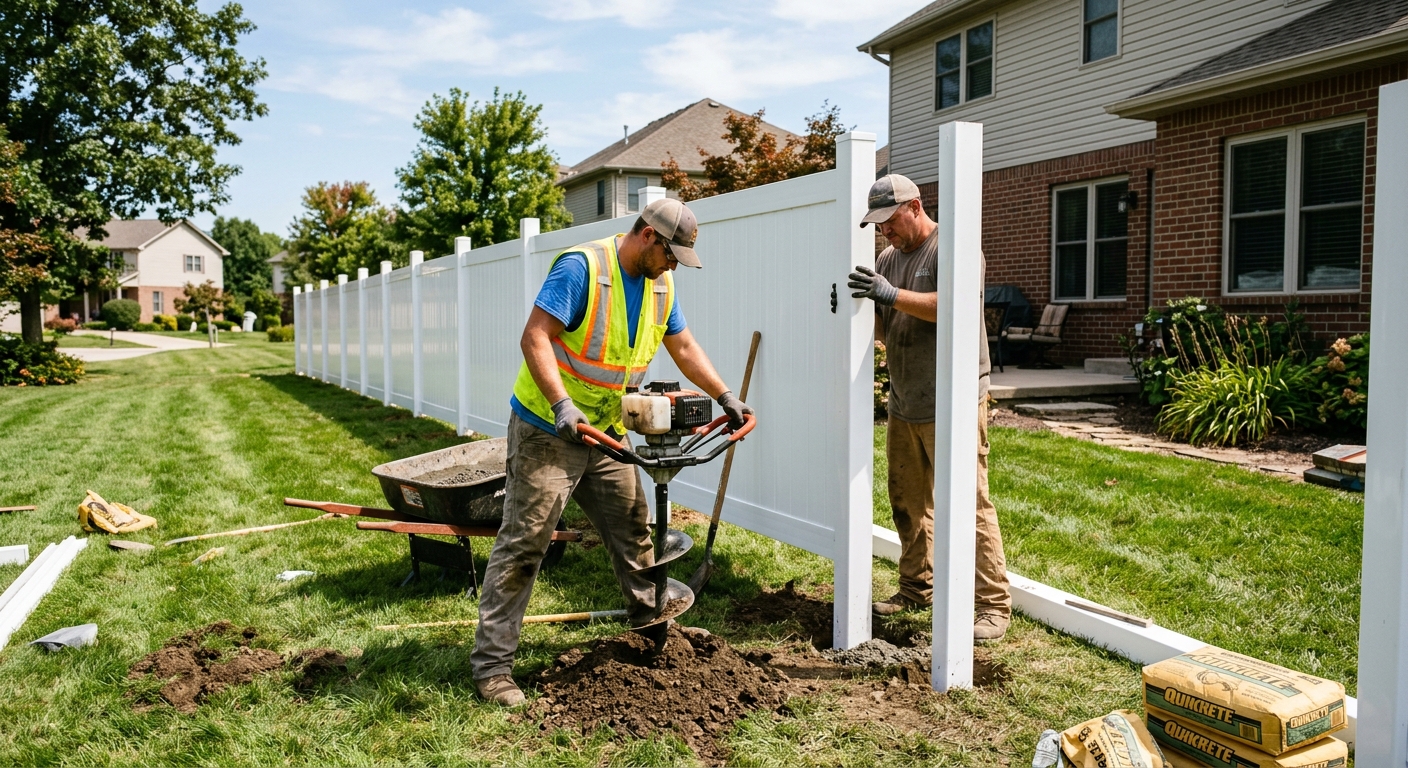
In the Lethbridge–Medicine Hat region, pricing is heavily shaped by freeze–thaw cycles and frost depth. Southern Alberta frost lines typically run around 4 feet, so fence posts often need to be set below frost to reduce winter heave, leaning and early rail sagging. Prairie wind exposure also matters: open yards can create higher lateral load on fences, pushing contractors toward stronger posts, tighter spacing and sometimes reinforced rails—especially for solid privacy wood and vinyl. Because Vauxhall falls into this same market behaviour, you’ll commonly see labour allocations and concrete costs priced into “standard” installs.
Trade demand is especially noticeable around older residential pockets and established subdivisions where lot widths are consistent and replacement jobs cluster—many installers are busiest in areas like central Vauxhall residential streets where drive access and fence lengths are predictable. With that in mind, here’s a practical comparison of the most common materials you’ll see quoted.
| Material |
Lifespan |
Maintenance |
Privacy Rating |
Price per Linear Foot |
| Pressure-treated pine (standard wood) |
10–15 years |
Stain/seal every 2–3 years; replace warped rails as needed |
High (solid panels) |
$35 – $70 |
| Cedar (natural rot resistance) |
15–25 years |
Reseal or stain every 2–4 years; inspect post bottoms |
High (solid panels) |
$50 – $85 |
| Vinyl / PVC (no-maintenance) |
20–30 years |
Occasional rinse; check for impact damage in extreme cold |
High (solid or picket with infill) |
$40 – $80 |
| Chain-link (galvanized steel) |
25–40 years |
Minimal; wash off dust; tighten hardware |
Low to medium (depends on height) |
$25 – $50 |
| Aluminum ornamental |
30–50 years |
Occasional wash; touch up if scraped |
Low (open design) |
$60 – $110 |
| Composite / recycled material |
20–30 years |
Low; clean and replace damaged sections |
High (solid boards) |
$55 – $95 |
Prices are estimates only and vary by project scope, site access and material selection.
What affects the price of fencing in Vauxhall
In Vauxhall and across the Lethbridge–Medicine Hat region, two quotes for the “same” fence can differ by 30–50% because the job details rarely match: post depth, wind conditions, concrete use, gate hardware and how much removal/disposal is required. In Alberta’s colder stretches, frost depth and soil behaviour dictate how contractors set posts. A common target is placing posts about 4–6 inches below the design frost depth to limit heaving and leaning. Practically, that means deeper holes, longer posts and more labour—especially when concrete-set posts are required, which raises both material and installation time. If a site has sandy, dry soils that allow clean excavation, costs can trend lower than sites with heavier clay that requires more effort to dig straight and plumb.
Wind is another major driver. Open yards around the broader Lethbridge–Medicine Hat area can push lateral loads high, so contractors may tighten post spacing and use sturdier rails. That can move you from a “budget” wood range into the upper end quickly; for example, pressure-treated pine might land around the lower side of $35 – $70 per linear foot on simpler runs, but rises toward the high end if the design needs stronger framing and more concrete set points.
Two practical local examples: (1) If your fence requires 1–2 drive/walk gates, the hardware (hinges, latches, reinforcement) typically adds labour and material; (2) If your lot has older fence remnants at the post lines, removal and hauling can add cost because crews must cut off stubborn posts and dispose of debris. Housing age also plays a role here—on lots with pre-1981 builds (67.0% locally), you’ll often be replacing undersized posts that can’t be reused, which removes any “reuse” savings.
| Price Factor |
Why It Matters |
Cost Impact |
| Fence length in linear feet |
The primary measurement for materials and labour. |
Largest driver; scales directly with total footage. |
| Post depth required |
Frost line depth determines how deep holes must be dug to prevent heave. |
Deeper posts increase concrete, post length and labour hours. |
| Post setting method |
Concrete-set, gravel pack or driven posts change time and materials. |
Concrete-set typically costs more than gravel or driven options. |
| Material choice |
Different materials carry different framing weights, fastening methods and wind performance. |
Vinyl often lands above chain-link; cedar and aluminum are typically mid-to-high. |
| Gate count and type |
Gates require extra framing, reinforcement and higher-tension hardware. |
Each gate can add a noticeable lump sum beyond the per-foot rate. |
| Grade and terrain |
Sloped yards require stepped bases or raked panels to keep consistent height. |
More cutting/layout time increases labour cost. |
| Old fence removal and disposal |
Disassembly, hauling and dump fees affect total job time. |
Can add substantial cost, especially for concrete anchors. |
| Permit fees and survey / property line locate |
Paperwork and location verification reduce risk of encroachment. |
Typically adds line-item costs; survey can be especially important on older lots. |
Permits & regulations in Alberta
In Alberta, fences can fall under permit requirements when they’re above local height thresholds—commonly around 2.0 m (6.5 ft) at the rear and about 1.0–1.2 m (3–4 ft) at the front or corners, depending on the municipality’s bylaw. Even when a permit isn’t required, you still need to respect property lines and any municipal setback rules that apply to your specific lot. Before digging any post holes, call for utility locates through Alberta One-Call (and don’t assume it’s only the front yard—utilities can run along sides). For peace of mind, use a survey or a property-pin locate before installation so you’re not “building to an opinion” when pins already exist.
To verify whether a permit is typically needed for your Vauxhall project: if you’re planning a tall privacy fence near rear property lines or any substantial barrier that exceeds common thresholds, plan on checking with your municipality first. A lower decorative fence (or chain-link for containment) often doesn’t trigger the same level of scrutiny, but the safe move is always to confirm height and location in writing.
Step-by-step contractor verification in Vauxhall: (1) Ask for the contractor’s Alberta business licence details (and confirm the contractor operates as a fencing business, not just “a crew”); (2) Request a Certificate of Insurance showing general liability coverage—verify it’s current and matches the named insured; (3) Confirm workers’ compensation coverage (WSIB/WCB) paperwork for Alberta; and (4) Ask for a clearance letter or confirmation of account status when they’re using subtrades. If they can’t provide these documents quickly, treat it as a red flag and move on.
Choosing the right fence material for Vauxhall
Choosing fence material in Vauxhall is easiest when you start with your priorities—privacy, low maintenance, budget and lifespan—then match them to Southern Alberta’s freeze–thaw cycles and strong Prairie winds. Pressure-treated pine is the common budget choice, but it typically needs staining or sealing every 2–3 years to limit grey weathering and keep the boards protected at the post line. Cedar brings natural rot resistance and a nicer look out of the gate; it still benefits from periodic sealing, especially where moisture collects after Chinook melt cycles. Vinyl/PVC is popular for “set it and forget it” installs, but in very cold snaps it can become more brittle to impact, so proper framing and avoiding direct hits matters.
Post depth ties directly into material life. Because frost lines in this region often run around 4 feet, contractors frequently plan concrete-set posts to sit below frost (commonly placing posts about 4–6 inches beneath design frost depth). That reduces winter heave and helps wood, vinyl and composite maintain straight rails over multiple seasons. Wind and snow load also influence the design: solid privacy panels (wood, vinyl and composite) present more sail area than open styles, so expect tighter spacing, sturdier posts and sometimes heavier rails than you’d see with chain-link.
A concrete example: if you budget a chain-link option around $25 – $50 per linear foot, you’re buying longevity and containment more than privacy. If your main goal is screening wind and eyes along a backyard run, upgrading to cedar at roughly $50 – $85 per linear foot can be justified because you gain a solid privacy face and better performance in wind when the framing is installed correctly (deeper set posts and reinforced rails).
| Material |
Cold Tolerance |
Lifespan |
Annual Maintenance |
Best For |
Price Band |
| Pressure-treated pine |
Good (with proper treatment and sealed end grain) |
10–15 years |
Inspect annually; stain/seal every 2–3 years |
Budget privacy with planned upkeep |
$35 – $70 |
| Cedar |
Very good (naturally rot-resistant) |
15–25 years |
Inspect annually; reseal/stain every 2–4 years |
Premium look and long life |
$50 – $85 |
| Vinyl / PVC |
Good (can be impact-sensitive in extreme cold) |
20–30 years |
Minimal; rinse as needed |
Low-maintenance privacy |
$40 – $80 |
| Chain-link |
Excellent (galvanized steel resists corrosion) |
25–40 years |
Minimal; tighten and check tension |
Security and visibility control |
$25 – $50 |
| Aluminum ornamental |
Excellent (won’t rust like steel) |
30–50 years |
Minimal; wash off dust and check fasteners |
Decorative curb appeal |
$60 – $110 |
| Composite / recycled |
Good (designed for freeze–thaw when installed correctly) |
20–30 years |
Low; clean and replace damaged boards |
Solid privacy with low upkeep |
$55 – $95 |
How to choose a fencing contractor in Vauxhall
When you’re hiring a fence contractor in Vauxhall, treat paperwork and clarity as part of the build quality. Start by verifying Alberta coverage documents: ask for a current Certificate of Insurance (general liability) and confirm it includes fencing installation activities. Next, confirm workers’ compensation coverage (WCB in Alberta) and request a clearance letter or confirmation from their account so you know you’re not exposed if a worker is injured. If they use subcontractors, the contractor should still provide proof that those subs are covered.
Then get 2–3 itemised written quotes, not a single “per foot” number. A proper estimate breaks out materials and labour separately so you can see whether a quote used deeper post holes, how many concrete bags were allowed, what gate hardware is included and what’s excluded. Scope reading matters: ask if permit pulls are included (when needed), whether old fence removal and disposal are included, how the contractor handles property line locate, and whether site clean-up includes hauling away concrete chunks and buried debris.
Warranty should be in writing. Look for (1) a workmanship warranty that covers fence alignment/post set issues; (2) product/manufacturer warranty terms; and (3) whether warranty is transferable to future owners. For payment scheduling, never pay more than 10–15% upfront. Hold back until key milestones are done—especially after posts are set and the fence is aligned. Finally, insist on a written timeline with start date and estimated completion in days, since weather can affect concrete-set curing schedules in Southern Alberta.
- Ask for insurance and WCB/WCB-clearance documents before signing.
- Request the contractor’s name on the quote to match the insured entity on the certificate.
- Get itemised labour + materials breakdown (not lump sum only).
- Confirm post depth targets and whether concrete is included.
- Verify gate reinforcement details and included hardware.
- Ask how they handle sloped grades (stepped vs raked panels).
- Confirm disposal/haul-away is included if you’re removing an old fence.
- Check warranty coverage length for workmanship and materials.
- Require a written start/completion timeline and cure/installation schedule assumptions.
- Ensure the quote includes access considerations (tool access, gate clearance, lifting equipment).
- Review permit responsibility: who pulls permits, and what’s the cost and timing?
- Keep payments milestone-based; limit upfront payment to 10–15%.
Red flags in Vauxhall: they won’t show proof of insurance or WCB coverage; they won’t specify post depth or setting method (concrete vs alternatives); they pressure you for a large upfront payment; they provide quotes without an itemised scope for gates/removal; or they won’t put warranty terms and a timeline in writing.
Frequently asked questions — fencing in Vauxhall
What is the cost per linear foot for fencing in Vauxhall?
For Vauxhall homes, fencing pricing typically lines up with regional backbone ranges used by installers in the Lethbridge–Medicine Hat market. Chain-link usually lands around $25 – $50 per linear foot, while wood installs commonly fall near $35 – $70. Vinyl/PVC often prices at about $40 – $80, and aluminum ornamental is higher, commonly $50 – $110. Your final number depends on how many corners and gates you have, how deep posts must be set for Alberta frost, and whether concrete setting and old fence removal are included. If your yard is windy and open, contractors may also reinforce framing, which can move you toward the top of the band.
Should I repair or replace my old fence in Vauxhall?
In Vauxhall, repair can make sense when posts are still solid and the fence is mostly missing boards or has minor rail sag. If you’re seeing leaning sections, loosened post bottoms or repeated board rot near ground level, replacement is usually the more cost-effective long-term option because frost heave can keep damaging the same line. Given that many local homes are older (67.0% built before 1981), it’s common to find posts that were originally set shallower or undersized for today’s wind expectations. A good installer will assess post integrity first; if posts are compromised along multiple runs, replacing the fence often beats patching every season.
How do I handle a fence dispute with a neighbour in Alberta?
Start by documenting everything: measure the fence line, take photos from multiple angles, and compare your fence location to your property pins or a survey. In Alberta, shared fence ownership and responsibilities are governed by provincial line-fences legislation, but the first step is usually confirming where the boundary actually is. If the dispute involves a tall privacy fence, check applicable height rules and setback/bylaw constraints before you act. Try to resolve it cooperatively with a written agreement on changes, cost sharing and materials. If you can’t agree, consider getting a survey and a written contractor assessment of which side of the line the fence should be on—this prevents “guess-and-fix” that becomes expensive.
What fence style offers the best wind resistance in Vauxhall?
In windy Southern Alberta conditions around Vauxhall, the best wind resistance usually comes from a properly engineered structure rather than a single “style.” Solid privacy fences (wood, vinyl, composite) can catch more wind (“sail effect”), so the wind-resistant build is typically solid panels with tighter post spacing, heavier rails and reinforced gate framing—plus concrete-set posts below frost. If you want a style that naturally reduces wind pressure, open styles like chain-link or aluminum ornamental generally experience less sail effect, but they won’t provide privacy. Many homeowners choose a mix: an open boundary fence for wind load reduction and a taller, solid privacy section only where screening is needed most.
How much does a fence cost in Vauxhall?
The total cost in Vauxhall depends primarily on linear feet, gate count, and whether you need concrete-set posts due to frost depth. To sanity-check your budget, use the per-foot bands: chain-link is often about $25 – $50, wood about $35 – $70, vinyl/PVC about $40 – $80, and aluminum ornamental about $50 – $110. As a practical example, a 60-foot run with one walk gate can cost meaningfully more than “just 60 feet” because the gate includes extra reinforcement and hardware. If you also remove an old fence, hauling/disposal and time for cutting concrete-anchored posts can add a noticeable line-item.
How deep should fence posts be for Vauxhall's frost?
For fencing in Vauxhall, Alberta, posts generally need to be set below frost depth to reduce heaving and leaning over time. Regional guidance in Southern Alberta typically targets setting posts about 4–6 inches below the design frost depth; in many cases that lands around roughly 4 feet, depending on soil and local conditions. That often means deeper holes and concrete setting rather than shallow gravel packs on residential projects. In practice, deeper set points require longer posts and more excavation time, which shows up in quotes. A reliable contractor will explain their frost-depth assumption, show how they’ll keep posts plumb, and confirm whether concrete-set construction is included in your scope.