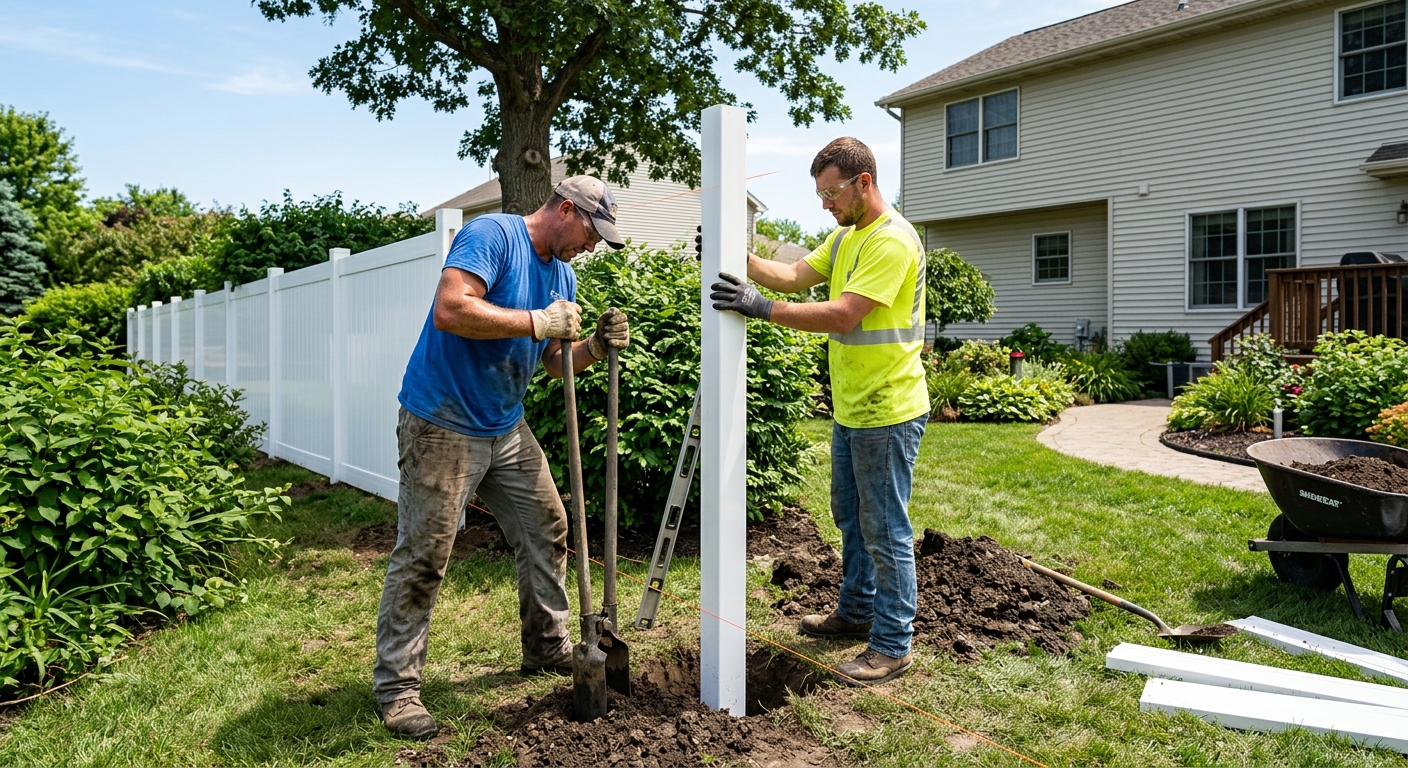
Fencing options and costs in Irricana
Irricana is a small community where fencing decisions tend to reflect how people live at home—yards for kids, pets, and privacy right up against the realities of Alberta winters. With 76.3% of local dwellings being single-detached homes and 89.2% of households owning their property (Statistics Canada, 2021 Census), demand is strongest for fences that can handle long freeze–thaw seasons and occasional high winds.
In the Calgary economic region, fencing costs often change more than homeowners expect because the work isn’t just “build a barrier.” Prairie exposure creates higher wind loading on privacy panels, and winter frost means posts must be set deep enough to resist heaving. That structural requirement drives additional excavation time, concrete volume, and labour—especially for 6 ft privacy fences and gate posts. Availability can also affect scheduling: crews who regularly work in Airdrie, Rocky View County, Cochrane and Calgary tend to prioritise jobs that have clear access and confirmed property lines, so timing and site readiness can shift the final installed price.
In Irricana, trade activity is often especially noticeable around newer subdivisions and established streets close to major routes—places where homeowners frequently update rear yard privacy, add dog runs, or replace ageing boundaries. If you’re comparing options, the price ranges below provide a practical starting point before you request an itemised quote.
| Material |
Lifespan |
Maintenance |
Privacy Rating |
Price per Linear Foot |
| Pressure-treated pine (standard wood) |
10–15 years |
Stain/seal every 2–3 years; inspect annually |
Good to very good (solid or close pickets) |
$40–$65 |
| Cedar (natural rot resistance) |
15–25 years |
Light staining every 3–4 years (or weather-grade natural finish) |
Very good (solid boards or tight spacing) |
$55–$80 |
| Vinyl / PVC (no-maintenance) |
20–30 years |
Minimal cleaning; check hardware and post anchors |
Very good (solid privacy styles) |
$45–$85 |
| Chain-link (galvanized steel) |
25–35 years |
Rinse/inspect tension points |
Low to fair (airflow-friendly) |
$25–$55 |
| Aluminum ornamental |
25–40 years |
Occasional wash; check hinges/latches |
Low to moderate (open pickets) |
$70–$120 |
| Composite / recycled material |
20–30 years |
Low—wash and inspect; replace damaged sections if needed |
Good to very good (solid composite panels) |
$65–$110 |
Prices are estimates only and vary by project scope, site access and material selection.
What affects the price of fencing in Irricana
In Irricana (Calgary region), two quotes for what looks like the same fence can easily differ by 30–50% because the pricing is sensitive to structural requirements, site conditions, and how much work is needed beyond “just the panels.” Contractors price for the reality of winter: frost protection and wind loading aren’t optional. That’s why post depth, post setting method, and gate hardware can swing costs more than the material itself.
First, the frost line depth drives how deep posts must be set. In cold Alberta, posts typically need to be set about 4–6 inches below the design frost depth (and in practical terms, often around 1.5–2.0 m into the ground) to prevent heaving. That means longer posts, deeper auger time, and concrete footings—especially for privacy fences and heavier gate installations. Second, open Prairie exposure increases wind forces; solid wood and vinyl privacy systems usually need closer post spacing and fully concreted posts to reduce racking. By contrast, chain-link is more forgiving in high winds because it allows airflow and typically costs less—one reason chain-link often lands in the lower–mid portion of the local bands.
Concrete examples from typical Irricana jobs: (1) If a yard requires 8–12 inches of extra excavation because the soil is rocky, post-setting time increases and installers may switch to larger post holes (and more concrete). (2) If you’re replacing an old fence built on poorly set posts, removal and disposal can add a noticeable labour line item—particularly when boards are frozen to the ground. (3) If your plan includes two gates instead of one, hardware and structural framing costs rise—often moving a project toward the upper end of the wood/vinyl band (for example, $40–$80 or $45–$90 per linear foot) rather than the lower end.
| Price Factor |
Why It Matters |
Cost Impact |
| Fence length in linear feet |
Most materials and labour scale directly with run length. |
Large (often the biggest swing on total cost) |
| Post depth required |
Frost protection determines excavation and required post length. |
Medium to large (+ labour + materials) |
| Post setting method |
Concrete-set posts resist heaving and improve gate stability. |
Medium (concrete + longer set/curing planning) |
| Material choice |
Vinyl/wood need different framing; chain-link uses different hardware. |
Medium (reflects the per-foot band) |
| Gate count and type |
Drive-through and double gates need heavier posts and bracing. |
Medium to large |
| Grade and terrain |
Slopes require stepped panels or raked top rails. |
Medium (extra labour and fittings) |
| Old fence removal and disposal |
Unloading, disposal fees, and stump removal add time. |
Medium (often variable and job-specific) |
| Permit fees and survey / property line locate |
Documentation and locate work affects scheduling and compliance. |
Small to medium (can be required depending on height/location) |
Permits & regulations in Alberta
In Alberta, fences above the typical height thresholds—often about 2.0 m (6.5 ft) at the rear and 1.0–1.2 m (3–4 ft) at the front or corner—may require a building permit, and you must also respect property line rules and any municipal setback bylaws. In Irricana, it’s smart to treat rear-yard privacy fences and corner lots as the highest-risk cases for permit questions, because height and placement affect approvals. Regardless of height, you should confirm your boundary location before digging: use a survey or a property line locate so posts don’t encroach.
Before you dig any post hole, call for utility locates through the appropriate provincial service (for Alberta, use Alberta One-Call). This is non-negotiable—hitting a buried line can halt the job and create serious costs. If you’re thinking about replacing or upgrading an existing fence, note that shared fence ownership and responsibilities can fall under Alberta line-fences legislation (especially for maintenance and dispute resolution between adjacent owners).
Step-by-step contractor verification in Irricana: (1) Ask for the contractor’s Alberta licence and confirm it using the relevant online registry listed in their paperwork or business profile. (2) Request a certificate of insurance naming you as additional insured where applicable, plus liability coverage details. (3) Confirm WSIB/WCB coverage with documentation (or a clearance letter/statement) that clearly indicates the employer is in good standing. This protects you if an installer is injured or if damage occurs during excavation.
Choosing the right fence material for Irricana
The right fence material in Irricana comes down to balancing privacy, low maintenance, lifespan, and budget—then matching that choice to Alberta’s cold snaps, wind, and freeze–thaw cycle. Pressure-treated pine is usually the most budget-friendly starting point, but it needs staining or sealing every 2–3 years to limit grey weathering and reduce moisture-related issues around fasteners. Cedar typically looks better and has better natural rot resistance, but it still benefits from periodic staining depending on how exposed your yard is to sun and wind.
Vinyl/PVC is a strong “set it and forget it” option: it requires little routine maintenance and won’t rot. However, in extreme cold, vinyl can become more brittle than wood if panels are not installed with proper spacing and secure post anchoring—so the post depth and fastening details matter. Chain-link is the longest-life budget option and handles wind extremely well because airflow reduces pressure. If privacy is your priority, chain-link usually needs privacy slats or a different system. Aluminum ornamental offers a clean, rust-resistant look, but it’s not a privacy fence by default.
For Calgary region frost protection, most installers will still set posts deep and often use concrete footings for solid privacy fences to resist heaving and racking. That’s especially relevant when heights approach privacy ranges and when gates are heavy. If you’re comparing costs, it’s common to see wood or cedar move into the $40–$80 and $55–$80 per linear foot bands, while vinyl often sits around $45–$90. A typical homeowner justification looks like this: paying the mid-range difference between pressure-treated pine and vinyl can be worthwhile if you want fewer maintenance trips and you’re paying for durability across 15–30 years rather than re-staining on a recurring cycle.
| Material |
Cold Tolerance |
Lifespan |
Annual Maintenance |
Best For |
Price Band |
| Pressure-treated pine |
Good (requires proper sealing and hardware) |
10–15 years |
Inspect annually; stain/seal every 2–3 years |
Budget privacy with a willingness to maintain |
$40–$65 |
| Cedar |
Good (naturally rot-resistant in wet freeze cycles) |
15–25 years |
Inspect annually; stain every 3–4 years (typical) |
Better curb appeal and long-lasting wood look |
$55–$80 |
| Vinyl / PVC |
Very good (with correct installation and anchoring) |
20–30 years |
Low—rinse/inspect hardware and posts |
Low-maintenance privacy in windy yards |
$45–$85 |
| Chain-link |
Excellent (airflow reduces wind stress) |
25–35 years |
Low—check tension and wash as needed |
Security with minimal wind-related issues |
$25–$55 |
| Aluminum ornamental |
Very good (won’t rust) |
25–40 years |
Low—occasional wash and hinge check |
Front-yard appearance and durability |
$70–$120 |
| Composite / recycled |
Good (performance varies by panel system) |
20–30 years |
Low—clean and inspect fasteners |
Solid privacy with reduced upkeep |
$65–$110 |
How to choose a fencing contractor in Irricana
Choosing a fencing contractor in Irricana is largely about verifying risk coverage and making sure the quote reflects how your fence will be built in Alberta conditions. Start with licensing and safety paperwork: ask for the contractor’s Alberta licence details and confirm them through the applicable online registry. Next, request a certificate of liability insurance and review the coverage limits and effective dates. For workers on site, confirm WSIB/WCB coverage—then ask for documentation such as a clearance letter or a certificate showing the company is registered and in good standing. If the contractor can’t provide these promptly, treat it as a red flag.
Get 2–3 itemised written quotes, not lump sums. You want a breakdown that separates labour, materials, excavation/post setting, gates, and any removal/disposal. Read the scope carefully: is permit pull included (if required due to height/location), is neighbour fencing accounted for, and is property-line locate surveyed? Ask whether concrete footings are included for privacy panels and gate posts, and whether the quote assumes post depth to address frost heaving.
Warranty is where reputable crews distinguish themselves. Ask for the workmanship warranty length and whether it’s in writing, plus the product/manufacturer warranty terms for panels, rails, and gates. Also check if the warranty is transferable to future owners. For payment, never pay more than 10–15% upfront; hold back a portion until the job is fully complete and gates/straightness meet the agreed layout. Finally, get a start date and completion estimate in writing—weather and curing can affect timelines in Calgary-area freeze–thaw periods.
- Provide licence and confirm it via the Alberta online registry.
- Show current certificate of liability insurance.
- Confirm WSIB/WCB coverage with clearance letter/certificate.
- Use written, itemised estimates (labour, materials, posts, concrete, gates).
- Specify post depth and whether holes are concrete-set for privacy sections.
- State panel type, rail type, and max post spacing for wind loading.
- Clarify slope handling (stepped vs. raked) and who marks the grade.
- Include gate hardware details: hinges, latches, bracing, and swing direction.
- Confirm disposal/removal of the old fence (dump fees included or not).
- Check whether utilities locate service is included or assigned to the homeowner.
- Ask what’s excluded: sod restoration, grading, landscaping ties, or re-level requirements.
- Define warranty terms for workmanship and products (and any transferability).
In Irricana, concrete red flags include: quotes that don’t mention frost-depth post setting; “we’ll pour concrete if needed” wording without a clear allowance; missing insurance or inability to show WSIB/WCB clearance; unclear gate bracing details (common cause of sagging); and requiring a large upfront payment before any layout or measurements are confirmed.
Frequently asked questions — fencing in Irricana
How do I compare fencing quotes?
In Irricana and across the Calgary economic region, the best way to compare quotes is to make them apples-to-apples. Ask each contractor for an itemised breakdown that shows labour, materials, excavation, post depth setting, concrete (if included), and gate hardware. Confirm the material grade (e.g., pressure-treated pine type, cedar panel thickness, vinyl style) and the post spacing for wind loading. Make sure each quote includes utility locates and disposal/removal if you’re replacing an old fence. Finally, compare within the local per-foot bands—wood often lands around $40–$80 and vinyl/PVC around $45–$90—then check whether the “cheaper” quote is using a lighter framing plan or shallower post setting that could fail in Alberta freeze–thaw cycles. (Statistics Canada, 2021 Census)
How long does fence installation take in Irricana?
Install time depends on fence length, ground conditions, and how many gates you’re adding. In Irricana, a straightforward run with chain-link or an open aluminum fence can go faster because there’s typically less complex panel alignment. Privacy fences using solid boards or vinyl often take longer due to deeper post holes for frost protection and the added bracing needed in Prairie winds. If the job includes removal of an old fence, expect additional time for post extraction and disposal. Weather also matters: crews generally avoid heavy pouring or setting right before a hard freeze, since concrete performance and panel alignment need stable conditions. A realistic approach is to get a written start date and completion estimate based on your site access and post-setting plan.
Can I install a fence on a slope in Irricana?
Yes, you can install a fence on a slope in Irricana, but it needs the right layout method. Most installers use either stepped panels (a “stair-step” fence line) or raked panels that follow the grade with consistent top rail pitch. In freeze–thaw conditions, proper post depth is still critical—posts must be set to resist heaving even when the yard is graded. The slope affects both labour time and material waste because you may need additional rails, cut boards, or custom framing at transitions. When you request quotes, ask how the contractor will handle your grade and whether they’ll mark the fence line relative to property pins and the chosen fence height measurement method.
What is the most weather-resistant fence for Irricana's climate?
For Irricana’s Alberta winters and windy Prairie exposure, the most weather-resistant choices are usually vinyl/PVC privacy systems (when properly installed and anchored), well-set cedar, or chain-link with concrete-set corner and line posts. Chain-link is often the toughest under heavy wind because it allows airflow and reduces racking pressure, and it typically sits in the lower–mid cost band (commonly $25–$55 per linear foot). If privacy is the priority, vinyl can perform very well with low maintenance and strong lifespan, often around $45–$90 per linear foot locally. For wood, cedar offers better rot resistance than pressure-treated pine, but it still needs periodic maintenance in Alberta’s freeze–thaw cycles and wind-driven moisture exposure. Whichever you choose, the post-depth and concrete setting plan matters as much as the material.
How do I prevent wood fence rot in Irricana?
Preventing wood rot in Irricana is mainly about moisture control and installation details. Start with proper post depth and setting: deep, stable posts reduce movement that can crack boards and loosen fasteners. Use quality pressure-treated lumber or cedar, and ensure boards are installed with drainage in mind (avoid trapping water in the board ends). Fasteners and hardware should be corrosion-resistant, and you should keep clear of sprinklers that wet fence lines frequently. Maintenance matters: even durable wood benefits from staining/sealing. For pressure-treated pine, plan for staining or sealing every 2–3 years to limit weathering. If you have a fence built before 1981 in your area, you may find older boards were not treated to modern standards, so an upgrade to newer materials plus correct post setting can significantly improve long-term performance.
What is the cost per linear foot for fencing in Irricana?
In Irricana, fencing is commonly priced using local per-linear-foot bands based on material, height, gates, and site access. As a practical reference, chain-link often comes in around $25–$55 per linear foot, pressure-treated wood typically around $40–$80, vinyl/PVC around $45–$90, and aluminum/metal can run higher at about $70–$120. These numbers reflect typical Calgary-area market conditions, including the need for frost-protected post installation and sturdier framing for privacy fences exposed to wind. Your exact figure may move up if you add multiple gates, have sloped terrain requiring stepped panels, or need removal/disposal of an old fence. Use these ranges to sanity-check quotes, but demand itemised scope so you know what’s included.