Fencing options and costs in Fairview
Fairview homeowners typically start by comparing materials, then quickly notice that the “same” fence can land in very different price bands once frost depth, wind, and yard access are accounted for. In Fairview, owner-occupied homes are common—74.6% of households own their home (Statistics Canada, 2021 Census)—and most dwellings are single-detached (77.6%). That mix matters because detached properties usually have longer, more perimeter-heavy fences than condos or apartments, and more owners are budgeting proactively rather than deferring repairs.
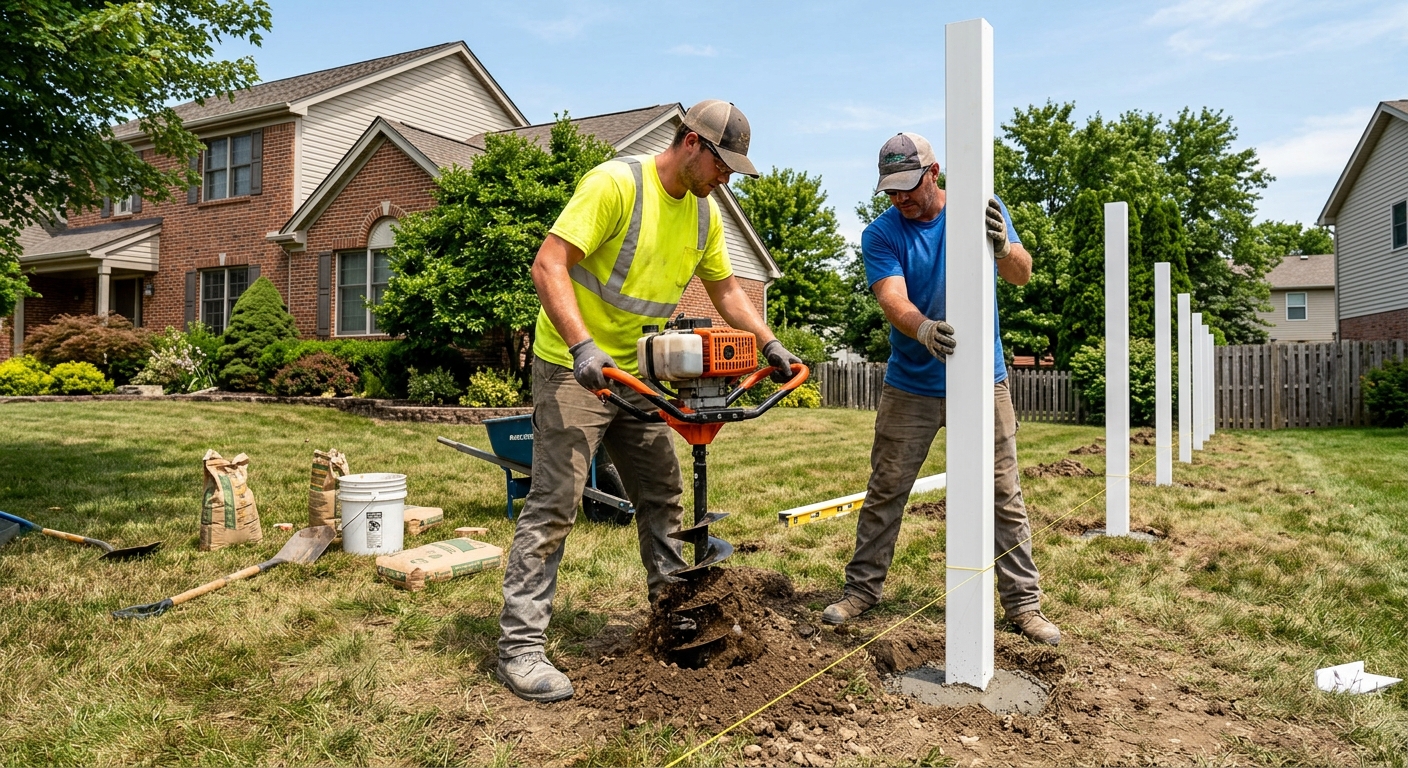
In the Athabasca–Grande Prairie–Peace River region, winter frost routinely pushes the frost line to about 4–6 feet. For fencing, that translates into deeper post holes, longer posts, and often concrete setting to reduce frost heave and leaning over time. Add prairie exposure—open winds that can make privacy panels behave like sails—and contractors tend to tighten post spacing for wood or vinyl, which increases labour and hardware. You’ll also see demand run especially strong around residential pockets near the core of Fairview, where properties sit on serviced lots and access is easier for augers, trailers, and small excavation equipment.
Below is a practical comparison of common materials, including lifespan and typical installed pricing per linear foot, before you compare options with a contractor on your specific layout. Use this table as a baseline, then validate your final budget with an itemised quote.
| Material |
Lifespan |
Maintenance |
Privacy Rating |
Price per Linear Foot |
| Pressure-treated pine (standard wood) |
10–15 years |
Stain/seal every 2–3 years; inspect for warping and fasteners |
High (solid boards) |
$45 – $70 |
| Cedar (natural rot resistance) |
15–25 years |
Light staining or sealing every 3–4 years; periodic tightening |
High (solid boards) |
$60 – $85 |
| Vinyl / PVC (no-maintenance) |
20–30 years |
Minimal cleaning; check for panel contraction in extreme cold |
High (solid privacy styles) |
$55 – $95 |
| Chain-link (galvanized steel) |
20–35 years |
Occasional rinse; replace bent sections as needed |
Low to Medium (open mesh) |
$28 – $50 |
| Aluminum ornamental |
25–40 years |
Wash as needed; inspect gates and hinges |
Low to Medium (ornamental pickets) |
$50 – $85 |
| Composite / recycled material |
20–30 years |
Low maintenance; periodic cleaning; inspect for fastener creep |
High (solid composite boards) |
$70 – $110 |
Prices are estimates only and vary by project scope, site access and material selection.
What affects the price of fencing in Fairview
In Fairview, two fence quotes for the same yard can vary by roughly 30–50% because the “hidden” variables are mostly structural: how deep and how reinforced the posts must be, how many lineal feet you actually need, and how hard the ground is to excavate. Even within the wider Athabasca–Grande Prairie–Peace River region, mobilization and site access can move costs—rural drive time, machine access, and rock or hardpan pockets can add labour hours before material is even installed.
The biggest technical driver is frost depth. With frost lines commonly in the 4–6 foot range, posts are typically set about 4–6 inches below the design frost depth to prevent heaving and gradual leaning. Practically, that means deeper auger holes, longer posts, and often more concrete per post—so even a wood fence that starts in the $35–$70 per linear foot band can move toward the higher end when footing depth and reinforcement requirements increase. Wind exposure across open prairie sites also matters: heavier privacy panels (wood or vinyl) generally require tighter post spacing and sturdier rails, which increases hardware and labour.
Local conditions that raise cost in Fairview often include clay-heavy yards that hold water and freeze unevenly, or areas with buried utilities that slow down digging after locates. Conversely, costs can be lower when you have straightforward access for an auger, shorter runs with fewer corners, and good topsoil that accepts a gravel pack. If your budget is tight and you don’t need privacy, chain-link can stay in the lower $25–$50 range, while full vinyl privacy typically trends higher because it relies on a sturdier post-and-rail framework for wind loading.
Given that many homes here are older (58.3% built before 1981; Statistics Canada, 2021 Census), you may also see more “unknown” property line markers, older stakes, or aged fence remnants—factors that can add removal and layout time before any new material is set.
| Price Factor |
Why It Matters |
Cost Impact |
| Fence length in linear feet |
Most costs scale directly with lineal feet (posts, rails, panels) |
High (primary driver) |
| Post depth required |
Frost line determines post length and hole depth to prevent heaving |
Medium to High (can move the whole budget) |
| Post setting method |
Concrete vs. gravel pack vs. driven posts changes material and labour time |
High (especially in colder, heavier soils) |
| Material choice |
Vinyl/cedar/wood versus chain-link changes panel cost and rail strength needs |
High |
| Gate count and type |
Drive-through double gates require heavier frames and more reinforcement |
Medium to High |
| Grade and terrain |
Slopes require stepped or raked panels and can increase labour |
Medium |
| Old fence removal and disposal |
Debris handling and disposal time affects total labour |
Medium |
| Permit fees and survey / property line locate |
Administrative steps and locating reduce rework risk |
Low to Medium (project-dependent) |
Permits & regulations in Alberta
In Alberta, a fence may require a building permit if it exceeds typical height thresholds—commonly around 2.0 m (6.5 ft) for the rear and about 1.0–1.2 m (3–4 ft) for the front or corner. The exact threshold can depend on location and municipal bylaws, so for Fairview it’s smart to confirm with your local requirements before you order materials. Regardless of permitting, all fences must be built within the property line and comply with setback rules.
Before any post hole is dug, always arrange utility locates using Alberta One-Call. This isn’t optional—hitting a buried service can stop the job and create major liability. Also, I strongly recommend you obtain a survey or locate your property pins before installing, especially for older properties where previous fences may not perfectly align with current pins. Shared fence responsibilities generally follow provincial line-fences rules, but in practice, owners often share maintenance and replacement costs where the fence serves as a boundary.
What typically does require a permit: fences above those height thresholds and certain enclosure-like installations. What typically does not: replacing an existing fence in the same location and similar height (still confirm with your municipality), and most routine repairs like replacing damaged boards or panels.
To verify a contractor in Alberta, check three things: (1) licensing status via the contractor registry you’re directed to in the province/industry context (search their legal name), (2) certificate of insurance (request COI listing you as additional insured if available, and confirm liability coverage limits), and (3) coverage for workers—WSIB/WCB status shown on their certificate or clearance letter. If they can’t produce current paperwork before you sign, treat it as a red flag.
Choosing the right fence material for Fairview
The best fence material in Fairview depends on your priorities—privacy, low maintenance, budget, and lifespan—plus the reality of Alberta winters. With frost commonly pushing deep (often about 4–6 feet), posts need to be set deep and reinforced appropriately, and that matters regardless of whether you choose wood, vinyl, or metal. In windy stretches of the Athabasca–Grande Prairie–Peace River region, heavier privacy panels also require a sturdy post-and-rail framework so wind doesn’t rack the fence.
Pressure-treated pine is usually the most budget-friendly look-and-feel for a private yard, but it needs periodic staining or sealing every 2–3 years to avoid grey weathering and splitting at fastener points. Cedar offers better natural rot resistance and appearance, but you still typically maintain it every few years. Vinyl/PVC is valued for low maintenance, though extreme cold can cause contraction—so you want the correct expansion allowance and a proper rail system. Chain-link is the lowest initial cost and can last a long time with minimal upkeep, but it won’t give privacy in the solid-panel sense. Aluminum ornamental provides a rust-resistant, attractive perimeter that’s best when you want security without a full privacy wall.
On frost-set posts: for Fairview, concrete-set posts are commonly used when the ground is challenging or where fences are exposed to wind and require long-term alignment. While exact installation depth depends on your frost conditions and soil, the market expectation is deeper set than typical southern regions. If you’re installing a solid privacy style in open wind, the extra spend on rail stiffness and correct post spacing usually pays off more than chasing the cheapest panel material.
A concrete example: if pressure-treated wood privacy is priced around the mid-to-upper end of the $35–$70 per linear foot range, upgrading to cedar often moves you toward roughly the $60–$85 range and can be justified when you want fewer appearance-related touch-ups and longer service life. If you don’t need privacy, chain-link in the $25–$50 range can deliver a strong ROI while keeping costs predictable through winter.
| Material |
Cold Tolerance |
Lifespan |
Annual Maintenance |
Best For |
Price Band |
| Pressure-treated pine |
Good (with proper sealing and hardware) |
10–15 years |
Inspection + minor spot touch-ups; stain/seal every 2–3 years |
Budget privacy with a traditional look |
$35 – $70 |
| Cedar |
Good (rot resistance helps in freeze–thaw) |
15–25 years |
Light staining/sealing every 3–4 years; tighten fasteners |
Longer-lasting privacy and a warmer appearance |
$60 – $85 |
| Vinyl / PVC |
Very good (if installed with correct thermal allowances) |
20–30 years |
Minimal (wash/clean as needed; check alignment after storms) |
Low maintenance privacy in windy yards |
$40 – $80 |
| Chain-link |
Excellent (galvanized steel resists corrosion) |
20–35 years |
Occasional rinse; repair bent sections |
Secure perimeter without privacy panels |
$25 – $50 |
| Aluminum ornamental |
Very good (no rust; handles temperature swings) |
25–40 years |
Occasional wash; inspect gates/hinges |
Attractive front security and curb appeal |
$45 – $90 |
| Composite / recycled |
Good (stable boards, but follow correct installation) |
20–30 years |
Low (clean and check fasteners) |
Privacy with reduced upkeep |
$70 – $110 |
How to choose a fencing contractor in Fairview
Choosing a contractor the right way protects your budget in Fairview, where deep frost-set posts and wind-rated spacing are critical for long-term performance. First, verify Alberta licensing: ask for their business details and confirm their status through the relevant provincial/industry registry path (use their legal name). Next, request proof of liability insurance and make sure it’s current—your contractor should be able to provide a certificate of insurance quickly. Finally, confirm workers’ coverage for employees (WSIB/WCB clearance or equivalent certificate), not just a general statement. If they can’t show documentation, it’s not worth the risk.
For pricing, get 2–3 itemised written quotes. A good quote breaks labour and materials separately, shows post count, post spacing, concrete volumes (if used), gate hardware, and disposal/removal costs. Avoid lump sums that don’t explain what happens if the ground is rocky or if the fence line needs re-staking after locates. Read the scope carefully: is permit pull included (if required)? Is the old fence removal and dump fee included? Who handles utility locate coordination?
Warranty matters too. Look for a workmanship warranty (often 1–3 years for installation issues), and separate product/manufacturer warranty terms. Confirm whether the warranty is transferable to future homeowners—many owners sell, especially in growing communities. Payment schedule should be conservative: never pay more than 10–15% upfront, and use a holdback until the job is complete and cleaned up. Insist on a start date and completion estimate in writing so winter delivery realities can be planned.
- They provide a site plan or layout sketch with measurements and post count before ordering materials.
- They detail post setting method (concrete-set vs. gravel pack) and explain why it fits Fairview frost conditions.
- They include utility locate responsibility and confirm they won’t dig until locates are complete.
- They show gate hardware specs (hinge type, latch, gate reinforcement), not just “gate installed.”
- Quotes specify rail style, post spacing, and fastener type (stainless vs. coated), especially for wood.
- They confirm whether removal and disposal of the old fence is included, including dump fees.
- They provide warranty terms in writing for both workmanship and materials, and clarify transferability.
- They list the exact materials (grade/spec) and whether pressure-treated or cedar is pre-stained or factory finished.
- They include timelines and weather-related contingencies (winter post-setting logistics).
- They give an itemised allowance for concrete and augering where frost depth requires it.
- They won’t ask for large upfront payments; you keep a holdback until final walkthrough.
- They clean up thoroughly and remove debris/leftover rails and panels from your property.
In Fairview, four common red flags I’ve seen: the contractor refuses utility locates documentation, their quote uses “estimated” lineal feet without showing a take-off, they won’t specify post depth/setting method, they demand more than 15% upfront before confirming insurance and coverage, or they provide only a single lump-sum number with no removal/disposal scope.
Frequently asked questions — fencing in Fairview
How deep should fence posts be for Fairview's frost?
For Fairview and the Athabasca–Grande Prairie–Peace River region, posts generally need to be set below the local frost line to reduce heaving and fence leaning over time. A common rule of thumb is to set posts about 4–6 inches below the design frost depth; with frost often around 4–6 feet in winter, that can put you roughly 1.5–2.0 m (about 5–6.5 ft) into the ground depending on your soil and the height/strength of the fence. In exposed wind areas, we typically use deeper set and often concrete setting to keep alignment. Your contractor should confirm post depth based on soil type and the fence’s design load (solid privacy needs more rigidity than chain-link). If someone is offering a “standard shallow post” install here, it’s usually not frost-compliant practice.
Wood vs vinyl vs aluminum fence — which is best?
There isn’t one “best” for every Fairview yard, but there is a best match for your priorities. If you want strong privacy and can handle periodic upkeep, pressure-treated pine in the $35–$70 range is often the budget entry point. Cedar typically costs more (roughly $60–$85) but generally offers a longer, better-looking service life with less harsh weathering than cheaper softwoods. Vinyl/PVC is popular in Alberta for low maintenance and typically lands in the $40–$80 range, but it must be installed with the right rail and thermal allowances for cold. Aluminum ornamental is a good mid-to-long-term choice for curb appeal and rust resistance, usually around $45–$90, but it won’t give full privacy like solid board fences. For windy exposed lots, the “best” option is usually the one with the correct post spacing and structural rails, not just the lowest material price.
Do I need a permit to build a fence in Alberta?
In Alberta, permits can be required for fences above common height thresholds—often around 2.0 m (6.5 ft) for rear fencing and about 1.0–1.2 m (3–4 ft) for front or corner areas—depending on municipal bylaws. The safest approach in Fairview is to confirm with the municipality before you finalize materials if you’re planning a tall fence or anything that changes the streetscape. Most routine repairs or fence replacements that match existing height and location typically do not trigger new permitting, but you should still verify. Also, you must respect property lines and setbacks, and you should get an Alberta One-Call utility locate before digging any post holes. A survey or property pin locate helps avoid encroachment disputes, especially on older properties (58.3% of Fairview homes were built before 1981; Statistics Canada, 2021 Census).
How long does a wood fence last in Fairview?
A wood fence in Fairview can last well over a decade when it’s installed correctly for frost and wind. Pressure-treated pine commonly runs about 10–15 years in typical conditions, assuming proper post depth, solid bracing, and routine staining/sealing every 2–3 years to slow weathering. Cedar often lasts longer—roughly 15–25 years—because it has better rot resistance, though it still benefits from maintenance (often every 3–4 years). The biggest accelerators of early failure in this region are shallow post setting, inadequate post spacing for privacy panels in prairie wind, and fastener/rail issues that allow moisture to sit at joints. If your budget starts in the $35–$70 per linear foot range, choosing the right post depth and setting method is what actually protects the lifespan—not just the board choice.
Who owns and maintains a shared fence?
Shared fence boundaries are typically governed by Alberta line-fences principles, but the practical rule is: the boundary fence serves as the dividing line benefit, so both owners may share responsibilities depending on who benefits and what the agreement or local practice is. For homeowners in Fairview, I recommend you start by identifying the boundary pins/survey pins and then documenting fence condition (photos, a short written description) before you plan repairs or replacement. In many real-world situations, one neighbour may want to replace a fence section and the other may share the costs or agree on an arrangement, but it’s best to put any agreement in writing. Even when cost-sharing applies, maintenance expectations can vary—regular inspections after freeze–thaw seasons prevent one side from carrying all the repairs later. If you’re unsure about your specific boundary situation, ask your contractor to reference your layout and locate, and consult a property professional for the legal specifics.
How do I find my property line before fencing?
In Fairview, the cleanest way to find your property line before installing is to use survey pins or commission a survey if pins are missing, moved, or unclear. Even if you “think” the old fence is correct, older installations can drift over time—especially where frost heave has shifted fence posts. Start with your existing paperwork: the deed and any prior survey documents. Then, locate your property pins/markers on-site (or hire a surveyor to re-establish the line). Before any digging, call Alberta One-Call for utility locates—post holes and setbacks should be planned around service corridors. Once you have the line confirmed, mark the fence layout and corners with stakes and string, and take measurements for post count and gate placement. A contractor quote should reflect the line you confirm—not a guess based on the existing fence location.