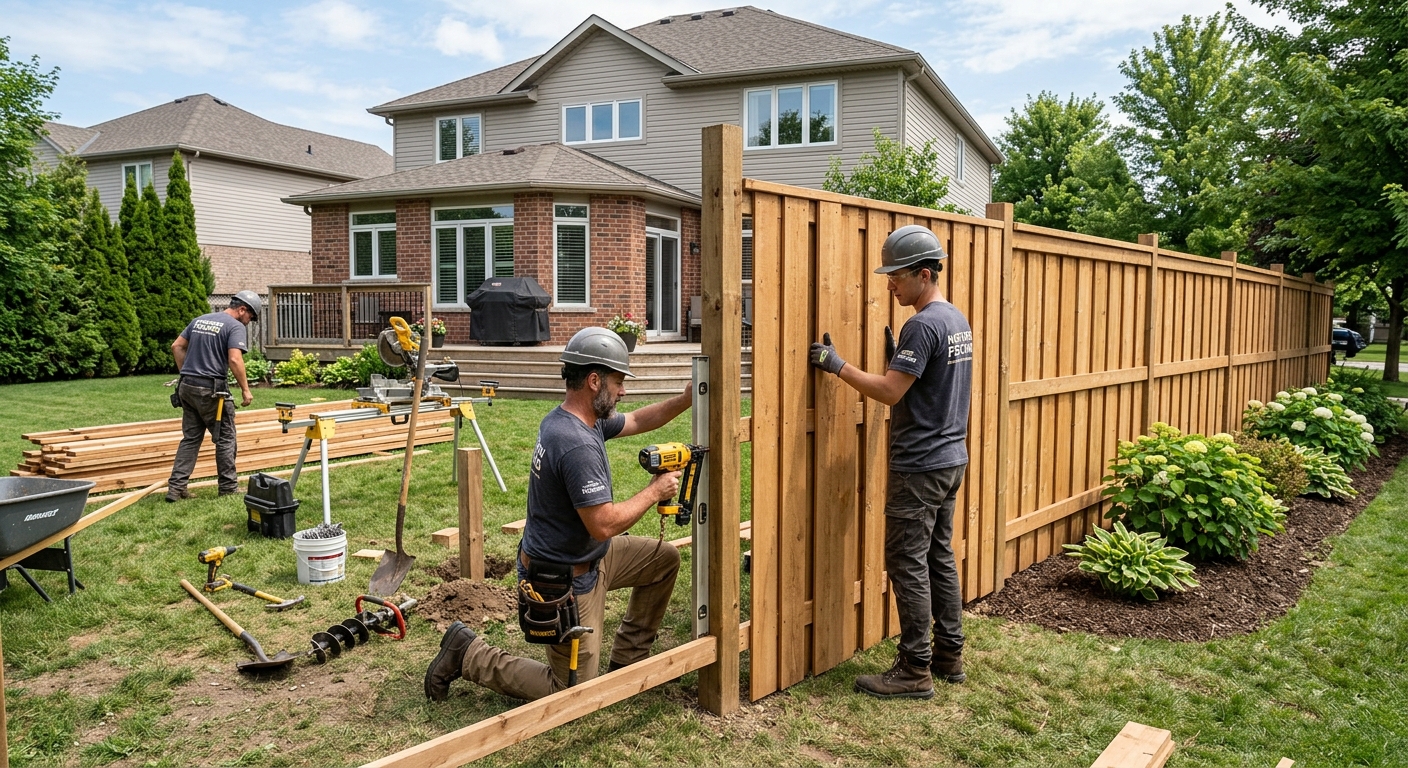
Fencing options and costs in Red Carpet
In Red Carpet, Alberta, choosing the right fence usually comes down to privacy, winter durability, and how well the system handles wind-driven racking and the freeze–thaw cycles common across the Calgary economic region. With a population of just 1,745 (Statistics Canada, 2021 Census), the local market is smaller than big-city Edmonton/Calgary cores, but every new corner lot and backyard renovation is a practical opportunity for fencing contractors—especially where many households live in detached homes (Statistics Canada, 2021 Census), which typically means more boundary length to secure. On the Prairies, solid privacy panels face higher wind loading than more open fence styles, so contractors often tighten post spacing and insist on frost-protected footing depth. That can raise labour and concrete costs compared with lighter, airflow-friendly options like chain-link.
If you’re near the busier residential pockets around Red Carpet’s established subdivisions off the main access routes, demand tends to run strongest in the late spring and summer when crews can dig and pour efficiently. In that same window, quote pricing also reflects access and soil conditions: Calgary-area guidance expects posts to be set about 4 ft (≈120 cm) deep to reduce heaving risk below the regional frost line, which usually means concrete footings for 6 ft privacy fences and gate posts. From there, you can compare material durability and budget fit—then narrow your plan using the price ranges below.
| Material |
Lifespan |
Maintenance |
Privacy Rating |
Price per Linear Foot |
| Pressure-treated pine (standard wood) |
10–15 years |
Stain or seal every 2–3 years; check posts after freeze–thaw |
High (solid boards) |
$40–$80 |
| Cedar (natural rot resistance) |
15–25 years |
Light staining/brightening as needed every 3–4 years |
High (solid boards) |
$55–$95 |
| Vinyl / PVC (no-maintenance) |
20–30 years |
Rinse annually; inspect for panel movement after extreme cold |
High (privacy styles) |
$45–$90 |
| Chain-link (galvanized steel) |
25–35 years |
Minimal; occasional tightening and rust checks at ground line |
Low–Medium (security, airflow) |
$25–$55 |
| Aluminum ornamental |
25–40 years |
Occasional wash; inspect hardware |
Low–Medium (open/ornamental) |
$70–$120 |
| Composite / recycled material |
20–30 years |
Rinse; no staining, but check for warping on heavy wind days |
High (solid privacy styles) |
$60–$105 |
Prices are estimates only and vary by project scope, site access and material selection.
What affects the price of fencing in Red Carpet
In Red Carpet, Alberta, it’s common to see quotes for the “same” fence come in 30–50% apart across the Calgary economic region and the broader Alberta market. The big reason is that the frost-protection and wind-loading requirements don’t scale down politely: once contractors have to dig deeper holes, pour concrete, and install heavier bracing to resist racking, labour and material quantities jump quickly. Even though fence pricing often gets discussed as a per-linear-foot number, the real driver is what changes behind the scenes—post length, footing volume, gate hardware, and how hard the site is to access.
Frost line depth sets how deep posts must be set. In colder prairie regions like ours, posts are typically set roughly 4–6 inches below design frost depth to prevent heaving, which often translates to about 1.5–2.0 m in the ground. That depth increases excavation time and concrete volume, and it also pushes you toward longer, heavier posts. Wind exposure on the Prairies then drives tighter post spacing and more rigid framing, especially for solid wood or vinyl privacy systems. By contrast, chain-link can be cheaper because it’s more open to wind—lower uplift and racking forces—so you can use lighter panel structures.
Concrete examples from Red Carpet-area jobs: (1) A 50 ft run of 6 ft vinyl privacy usually costs more than a similar-length chain-link because the privacy panels need more bracing and typically concrete-set posts; (2) a sloped yard that needs stepped rails often increases labour and hardware even if linear footage stays the same; and (3) removing an old fence with buried posts can add time and disposal costs. In practical terms, homeowners often see wood or vinyl privacy fall around the mid-band of $40–$80 or $45–$90, while chain-link commonly sits nearer $25–$55, because the structural demands are lower.
| Price Factor |
Why It Matters |
Cost Impact |
| Fence length in linear feet |
Directly determines number of posts, rails, and fasteners |
Highest impact (scales cost) |
| Post depth required |
Frost protection governs how long posts must be and how deep to dig |
Can significantly raise labour and materials |
| Post setting method |
Concrete vs. gravel pack vs. driven posts changes footing volume and stability |
Concrete setting usually increases cost |
| Material choice |
Vinyl/cedar require different framing strength than chain-link |
Mid-to-high (vinyl/cedar) vs low-mid (chain-link) |
| Gate count and type |
Gates need thicker hinges, latches, and often heavier posts |
Higher for drive-through (double) gates |
| Grade and terrain |
Slopes require stepping/racking and more fitting time |
Moderate-to-high depending on complexity |
| Old fence removal and disposal |
Demolition, loading, and tipping fees add time |
Moderate; increases if posts are deeply set |
| Permit fees and survey / property line locate |
Required when thresholds are met; prevents encroachment disputes |
Varies; can add noticeable admin and admin labour |
Permits & regulations in Alberta
In Alberta, fences can require a building permit depending on height and location. A common threshold is that fences above about 2.0 m (6.5 ft) at the rear and roughly 1.0–1.2 m (3–4 ft) at the front or corner often trigger permitting. Local setback rules also apply: fences must stay within your property boundaries and respect municipal setback bylaws. Before you dig any post hole in Red Carpet, book utility locates through Alberta One-Call so crews can mark buried services—this is essential because fencing excavation is deep (often around 120 cm) and you don’t want surprises near property service lines.
To avoid encroachment disputes, get a survey or at least a property pin locate before installing. Alberta also has line-fence principles that govern shared boundaries—when fences are shared, expectations for upkeep and responsibility are typically handled under provincial line-fences legislation and any written local agreements.
How to verify a contractor’s Alberta standing: check the contractor’s licence status via Alberta’s online registry, ask for a current certificate of liability insurance (and confirm it names you as an additional insured if offered), and request proof of coverage for workers through WSIB/WCB (as applicable to the contractor’s operations). A clearance letter is another document I like to see—especially for crews working on-site while homeowners are arranging access. Step-by-step, ask for these documents before you sign so you’re not dealing with it mid-project.
Choosing the right fence material for Red Carpet
Choosing a fence material in Red Carpet is easiest when you match it to your priorities—privacy level, low maintenance, budget, and expected lifespan—then account for our prairie freeze–thaw swings and wind. Pressure-treated pine is the budget-friendly starting point, but it benefits from regular staining/sealing every 2–3 years to reduce grey weathering and protect the wood through repeated wetting and freezing. Cedar looks better and resists rot longer thanks to natural oils, but it still benefits from maintenance to keep colour and reduce surface cracking. Vinyl/PVC is attractive for “set it and forget it,” yet in extreme cold panels can become more brittle, so strong installation—especially proper post depth and bracing—matters. Chain-link is usually the longest-life, most economical option, but it’s not a privacy fence; you’ll get security with airflow.
For privacy in our climate, the post system is as important as the board. Because regional frost protection typically requires posts set about 4 ft (≈120 cm) deep, concrete-set footings are common for 6 ft privacy fences and gate posts. In winds, solid systems need sturdier framing and adequate post spacing to resist racking—another reason material choice influences price. If you’re comparing costs, it’s a practical example: upgrading from chain-link at about $25–$55 to a vinyl privacy run around $45–$90 is usually justified when you want real screening from both the wind and the street, plus a more enclosed backyard. Aluminum ornamental sits near the upper end and is best for appearance and longevity, not privacy.
| Material |
Cold Tolerance |
Lifespan |
Annual Maintenance |
Best For |
Price Band |
| Pressure-treated pine |
Good with proper sealing and fasteners |
10–15 years |
Rinse and inspect; stain/seal every 2–3 years |
Budget privacy with solid appearance |
$40–$80 |
| Cedar |
Good; handles Alberta temperature swings well |
15–25 years |
Light staining/brightening as needed (every 3–4 years) |
Premium look with better natural rot resistance |
$55–$95 |
| Vinyl / PVC |
Very good; best with solid installation and bracing |
20–30 years |
Wash/rinse annually; check for panel movement after extremes |
Low-maintenance privacy |
$45–$90 |
| Chain-link |
Excellent; galvanizing holds up in winter |
25–35 years |
Minimal; occasional tension checks |
Security, pet control, airflow |
$25–$55 |
| Aluminum ornamental |
Excellent; won’t rust like steel |
25–40 years |
Wash; check hardware |
Street presence and durability |
$70–$120 |
| Composite / recycled |
Good; relies on correct framing and fastening |
20–30 years |
Rinse; inspect for warping on high-wind stretches |
Modern privacy with low maintenance |
$60–$105 |
How to choose a fencing contractor in Red Carpet
When you’re hiring in Red Carpet, Alberta, you want proof—not promises. Start with licensing: ask for the contractor’s Alberta licence number and verify it through the province’s online registry. Next, request liability insurance and confirm the certificate of insurance is current and covers fencing work (including property damage). For worker coverage, ask for WSIB/WCB documentation that matches how the company employs labour; a clearance letter or current account confirmation helps. If they can’t produce these documents before the site walk, I treat it as a process problem and move on.
For pricing, don’t accept a single lump-sum without structure. Ask for 2–3 itemised, written quotes that separate labour and material, and clearly show: post depth and setting method, linear footage count, gate hardware type, and any concrete quantities when used. Read the scope carefully: what’s excluded (old fence removal, hauling/disposal, permit pulling, property line locate), and what’s included. Warranty matters for workmanship—get the duration in writing, and confirm whether it covers post movement, sagging rails, and gate alignment. Also note whether the manufacturer’s product warranty is tied to the original purchaser or is transferable.
Payment schedule should be conservative. I recommend never paying more than 10–15% upfront. Hold back a portion until the final walkthrough and punch list are complete, with photos of concrete footings if concrete-set posts are used. Finally, insist on a start date and an estimated completion window in writing so you can coordinate landscaping and gate use.
- Verify Alberta licence number online before work begins.
- Ask for a current certificate of liability insurance (and confirm you’re covered as needed).
- Request WSIB/WCB clearance or proof of coverage for workers assigned to your site.
- Get 2–3 written, itemised quotes (labour + materials) rather than one lump sum.
- Confirm post depth and setting method (concrete vs. gravel pack) in the written scope.
- Ensure gate hardware is specified (hinge type, latch, and whether posts are reinforced).
- Ask who handles permits/utility locates if required and what’s included in your quote.
- Confirm disposal/hauling of old fencing and any tipping fees are included or excluded.
- Check whether the contractor includes property line locate or if you must provide a survey.
- Clarify warranty terms: workmanship coverage and what defects qualify.
- Request an installation schedule and completion date estimate in writing.
- Use a payment plan with no more than 10–15% upfront and a holdback until sign-off.
Red flags I see in the Red Carpet market: contractors who won’t provide licence/insurance/WSIB paperwork on request; quotes that don’t specify post depth, concrete setting, or gate hardware; vague “we’ll handle permits” language with no responsibility listed; asking for large upfront payments (more than 25%) without a signed scope; and crews that only discuss price, not how they’ll control frost-heave risk and wind racking with the correct footing and bracing.
Frequently asked questions — fencing in Red Carpet
How deep should fence posts be for Red Carpet's frost?
For Red Carpet and the broader Calgary economic region, frost protection is the key. A common industry approach is to set posts about 4 ft (≈120 cm) deep so the footing sits below the regional frost line, then use concrete footings for many privacy fences and for gate posts. In colder prairie conditions, posts are typically installed roughly 4–6 inches below design frost depth to reduce heaving risk during freeze–thaw cycles. If a quote only says “standard depth” or doesn’t specify excavation depth, it’s a warning sign—because shallow posts are exactly what leads to tilting, gaps, and sagging rails over time.
Wood vs vinyl vs aluminum fence — which is best?
There isn’t one “best” in Red Carpet—there’s a best fit for your goals. If you want privacy and lower long-term upkeep, vinyl privacy is often a good match, with typical installed costs around $45–$90 per linear foot depending on height and access. If you want a more natural look, cedar tends to last longer than standard wood but still needs maintenance; wood pricing often sits around $40–$80. Aluminum ornamental is very durable and won’t rust, but it’s usually not a privacy solution because it’s open by design. If you’re frequently fighting wind visibility from the street, solid privacy panels usually beat ornamental styles.
Do I need a permit to build a fence in Alberta?
In Alberta, permits are commonly required when fence height exceeds typical thresholds—often around 2.0 m (6.5 ft) at the rear, and roughly 1.0–1.2 m (3–4 ft) at the front or corner—though details can vary by location and setbacks. Even when a permit isn’t required, fences must respect property lines and municipal setback bylaws. In Red Carpet, always plan for utility locates before digging through Alberta One-Call. Also consider getting a survey or at least a pin locate so your contractor doesn’t assume the boundary incorrectly—this is how many disputes start.
How long does a wood fence last in Red Carpet?
With proper installation—especially frost-protected post depth and good fastening—wood fences in Red Carpet typically last about 10–15 years for standard pressure-treated pine. Cedar often holds up longer, commonly 15–25 years, because of better natural resistance to rot. Lifespan drops fast if the fence is installed with shallow posts (leading to heaving), poor bracing (leading to racking), or if maintenance is ignored; staining/sealing every 2–3 years for pressure-treated wood helps reduce weathering. In freeze–thaw climates, I also watch the ground line: most premature failure starts where moisture collects around posts.
Who owns and maintains a shared fence?
For shared boundaries in Alberta, ownership and maintenance can be guided by provincial line-fence principles, and sometimes by any written agreements between neighbours. Practically, many homeowners treat shared fences as jointly responsible: both sides benefit, and both may contribute to repairs or replacement depending on the agreement and condition. If you’re planning major work in Red Carpet—especially replacement of posts set deep for frost—confirm the boundary ownership expectations before ordering materials. A survey/pin locate can also help clarify which side the fence belongs on, so you avoid paying for work on a neighbour’s portion.
How do I find my property line before fencing?
In Alberta, don’t rely on guesswork—use your property pins or a survey. Start by locating your registered pins/corner markers (often documented in your land survey paperwork). If you don’t have the documents, ask for a pin locate through an appropriate service rather than letting the contractor “eyeball” the line. A property-line confirmation is especially important in smaller neighbourhoods like Red Carpet, where fence runs can be close to structures and where minor offsets can create disputes. Before digging, call Alberta One-Call for utility locates, then have your contractor set the layout from the verified boundary line.