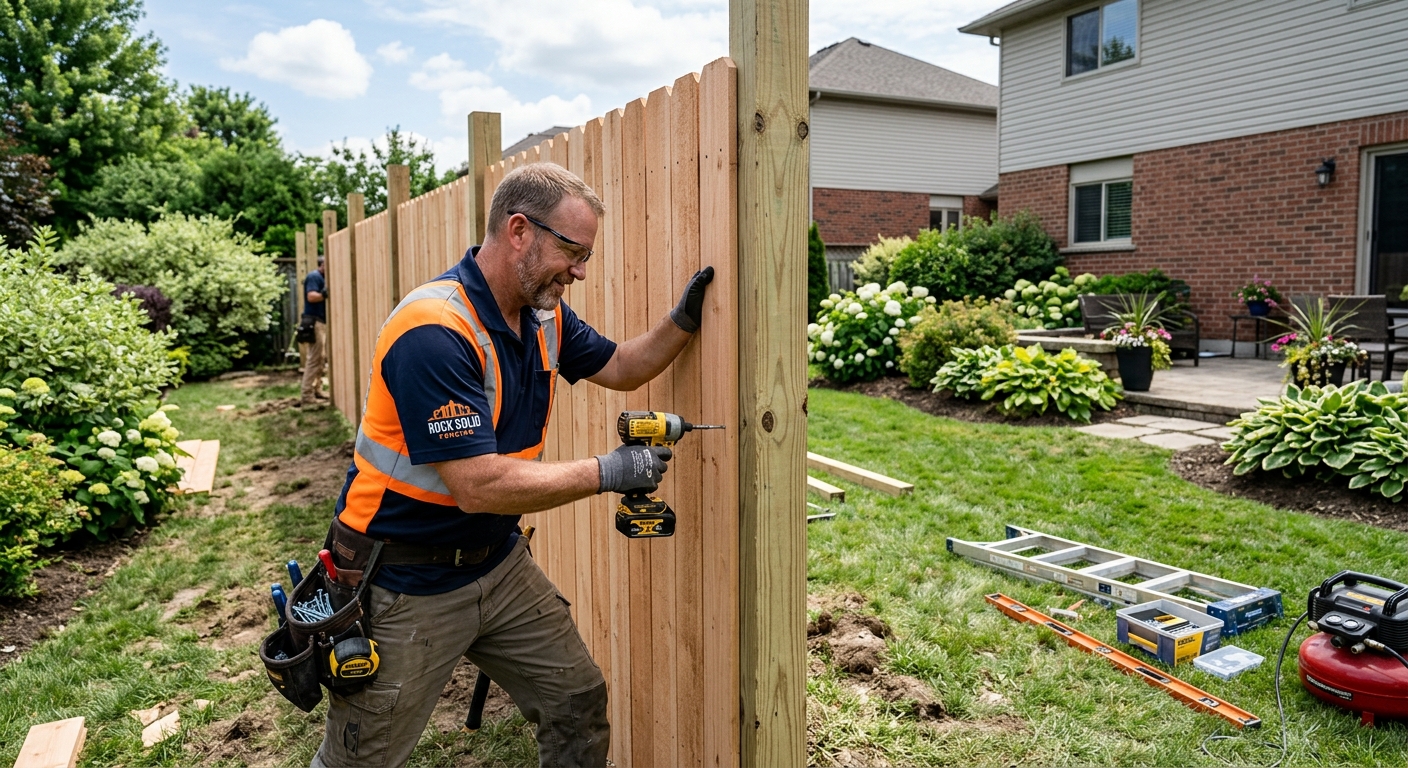
Fencing options and costs in Forest Lawn
In Forest Lawn, Alberta, homeowners typically choose fencing based on wind, privacy needs, and how long the fence must survive Calgary’s long freeze–thaw cycles. With a population of 7,230 (Statistics Canada, 2021 Census), the neighbourhood has a steady stream of family homes, and those single-detached properties are often the ones that need driveway gates, backyard privacy, and pet-friendly runs—making steady local demand for fence installs. At the same time, Calgary-area trade availability and material lead times can swing when weather is mild or when crews are booked solid after freeze-up.
On the Prairies, open exposure means fences take higher wind loading than in more sheltered areas. That pushes up costs for solid panels—wood and vinyl privacy fences often require tighter post spacing and, in many cases, concrete-set footings to reduce racking. Meanwhile, lighter systems like chain-link can cost less because airflow reduces wind pressure.
In Forest Lawn, you’ll see particularly high demand around family-heavy pockets such as the LRT corridor and adjacent residential blocks where backyards face wider open lots. If you’re budgeting for a new fence or replacing an aging run, the material you pick matters—but so does how deep the posts must go in Alberta frost conditions. Use the table below as a practical starting point for what you can expect per linear foot before we talk about the details that drive exact project pricing.
| Material |
Lifespan |
Maintenance |
Privacy Rating |
Price per Linear Foot |
| Pressure-treated pine (standard wood) |
10–20 years (site dependent) |
Stain or seal every 2–3 years; check for warping |
High (solid panels) |
$40 – $80 |
| Cedar (natural rot resistance) |
15–25 years |
Periodic staining/brightening; check fasteners |
High (solid panels) |
$55 – $95 |
| Vinyl / PVC (no-maintenance) |
20–30 years |
Minimal; rinse seasonal debris |
High (privacy styles) |
$45 – $90 |
| Chain-link (galvanized steel) |
25–40 years |
Occasional wash; inspect tension/ends |
Low (open airflow) |
$25 – $55 |
| Aluminum ornamental |
30–50 years |
Wash as needed; touch-up paint if damaged |
Low–Medium (ornamental) |
$70 – $120 |
| Composite / recycled material |
25–30 years |
Low; clean and inspect caps/edges |
High (solid styles) |
$75 – $130 |
Prices are estimates only and vary by project scope, site access and material selection.
What affects the price of fencing in Forest Lawn
Even when you’re comparing the “same” fence, quotes in Forest Lawn can vary by 30–50% across Calgary and the broader Alberta market because costs are driven by site conditions and install details—not just the fence material. Two crews can price similarly on paper, but if one plan includes deeper post holes, concrete footings, or proper gate reinforcement, the labour and materials quickly add up.
In our freeze–thaw prairie climate, frost protection is a primary cost driver. Typical guidance in the Calgary area is to set posts about 4 ft (≈120 cm) deep so the bottom of the footing sits below the regional frost line and reduces heaving risk. That means longer posts, more excavation, and more concrete volume—especially for 6 ft privacy fences and gate posts where loads are higher. Wind exposure also changes the design: in open prairie yards, solid wood or vinyl panels need closer post spacing and sturdier rails to prevent racking. By contrast, chain-link costs less because airflow reduces wind pressure, which allows lighter framing.
Concrete examples from local Forest Lawn installs: (1) A 50 ft backyard run with solid vinyl in a wind-exposed corner typically ends up closer to the mid–upper range (often aligning with the $45–$90 vinyl band) because of more posts and fully concreted gate uprights; (2) A similar-length chain-link replacement along a sheltered side lot can land near the lower–mid range (often matching the $25–$55 chain-link band) because the panels need less reinforcement; (3) If your yard has compacted soil or buried obstacles near the property line, excavation time increases regardless of material.
Finally, consider housing-stock realities. Older lots sometimes have fence lines that were installed shallow or with missing footings, and rebuilding usually requires more demo and deeper settings. In a region where posts are commonly set well below frost, the “small” differences in post depth and setting method are exactly where your quote can swing by thousands.
| Price Factor |
Why It Matters |
Cost Impact |
| Fence length in linear feet |
Every extra foot adds posts, rails, and fasteners |
Major (primary driver) |
| Post depth required |
Frost line determines hole depth and post length |
Major (more excavation/concrete) |
| Post setting method |
Concrete vs. gravel pack vs. driven posts affects stability |
Major (concrete adds labour/material) |
| Material choice |
Vinyl/cedar cost more than chain-link; aluminum is a premium look |
Medium to major (material price swings) |
| Gate count and type |
Double drive gates require heavier hardware and stronger posts |
Medium to major |
| Grade and terrain |
Sloped yards may require stepping/raking and extra labour |
Medium |
| Old fence removal and disposal |
Demo, hauling, and recycling/disposal fees vary by condition |
Medium |
| Permit fees and survey / property line locate |
Some installs need permits and accurate boundary verification |
Low to medium (can be significant if survey needed) |
Permits & regulations in Alberta
In Alberta, fence height and location determine whether you’ll need a permit—especially for taller fences. As a practical rule of thumb, fences above about 2.0 m (6.5 ft) at the rear and around 1.0–1.2 m (3–4 ft) at the front or corner often trigger permit requirements. Regardless of height, you must respect property lines and municipal setback bylaws, so the first step is confirming where your fence is allowed to sit.
Before any post hole digging in Forest Lawn, call for utility locates through Alberta One-Call (or your local province’s equivalent). Even if you’ve lived in the home for years, buried service lines can exist near fences, and accidental strikes can shut down the job.
Step-by-step contractor verification you can do immediately: (1) Request your contractor’s Alberta licence number and confirm it through the relevant online registry; (2) Ask for a current Certificate of Insurance showing liability coverage (and ensure it’s active for your address and dates); (3) Confirm WSIB/WCB coverage documentation and clearances/standing, since fencing crews often use subcontract labour or operate with multiple workers. You should also ask for the actual clearance letter or proof-of-coverage period, not just a verbal statement.
What typically DOES require a permit: new fences over the height thresholds, changes that materially increase height, and any build that impacts setbacks or visibility areas. What typically does NOT: replacing like-for-like fence panels at or below the usual thresholds in the same location (still verify with your contractor and the City requirements). When in doubt, require the contractor to state clearly whether a permit is included in the quote.
Choosing the right fence material for Forest Lawn
Your best fence material in Forest Lawn depends on whether you prioritize privacy, low maintenance, budget, or lifespan. With Calgary-area winters, the frost line and wind loading matter: regardless of material, posts are usually set deep enough to resist heaving, commonly around 4 ft (≈120 cm) for stability in freeze–thaw conditions. That structural requirement is why solid privacy fences often cost more than open systems.
Pressure-treated pine is the budget-friendly route, but it isn’t truly “set and forget.” To prevent grey weathering and splitting, plan on staining/sealing about every 2–3 years. Cedar naturally resists rot and typically holds up better in Alberta’s moisture swings, and it usually looks better longer, though it still benefits from periodic maintenance. Vinyl/PVC is popular for low maintenance and strong privacy styles, but in extreme cold it can become brittle if the wrong profile/installation is used—good installers use appropriate rail stiffness and proper post spacing. Chain-link is the lowest upfront and longest-lasting option, but it offers little privacy, making it better for boundary definition or when you’re pairing it with shrubs.
For curb appeal with minimal rust risk, aluminum ornamental is durable and mid-range in cost—though it’s usually not chosen for privacy unless combined with screening. A concrete cost example: if you’re comparing a 6 ft privacy run, wood or vinyl often land in the mid range (roughly $40–$80 for wood and $45–$90 for vinyl). Paying up toward cedar can be justified if you want longer appearance life and you’re willing to budget for staining, while chain-link can be a smart value if privacy isn’t required.
On Alberta’s prairie exposure, wind and snow load considerations reinforce the need for solid rails, correct post depth, and proper gate hardware. Whether you choose cedar, vinyl, or wood, the install details—especially concrete-set footings for posts and gates—are usually what determine how long the fence stays straight.
| Material |
Cold Tolerance |
Lifespan |
Annual Maintenance |
Best For |
Price Band |
| Pressure-treated pine |
Good with proper sealing and fasteners |
10–20 years |
Low to moderate (spot seal/stain as needed) |
Budget privacy with a willingness to maintain |
$40 – $80 |
| Cedar |
Very good; resists moisture-related rot |
15–25 years |
Low to moderate (stain/brighten periodically) |
Premium look and longer appearance life |
$55 – $95 |
| Vinyl / PVC |
Good when installed with correct spacing |
20–30 years |
Very low (rinse and inspect) |
Low maintenance privacy |
$45 – $90 |
| Chain-link |
Excellent (metal resists freeze effects) |
25–40 years |
Low (inspect tension and coating) |
Security/boundary on a budget |
$25 – $55 |
| Aluminum ornamental |
Excellent (powder-coated performance) |
30–50 years |
Very low (wash and touch-up if needed) |
Appearance with minimal rust risk |
$70 – $120 |
| Composite / recycled |
Good; relies on quality rails and install details |
25–30 years |
Low (clean and inspect edges) |
Long-life solid privacy panels |
$75 – $130 |
How to choose a fencing contractor in Forest Lawn
Choosing the right contractor matters just as much as the fence material—because in Forest Lawn, frost depth, wind resistance, and gate reinforcement are what keep a fence straight through winter. Start by verifying Alberta licensing: ask for the licence number, then check it through the relevant online registry so you can confirm it matches the business name you’re hiring. Next, request liability insurance paperwork (a current Certificate of Insurance) and confirm coverage limits are appropriate for construction work at your address.
For WSIB/WCB coverage, don’t accept a blank promise. Ask for the clearance letter or proof-of-coverage documentation that shows the contractor’s status for the period they’ll be working. If they subcontract labour, ask how WSIB/WCB is handled for the workers who will actually dig post holes and set concrete. Then get 2–3 itemised written quotes: you want a breakdown of labour hours, number of posts/footings, concrete quantity, rail build, gate hardware, and material types (not a single lump-sum number). A transparent quote usually costs less in the long run because it reduces change orders.
Read the scope carefully for exclusions: permit pull included or not, disposal of old fence included or not, and whether grading/stepping/raking on slopes is included. Warranty should specify workmanship (often covering post alignment and rail connections) and product/manufacturer warranty terms, and confirm whether warranties are transferable if you sell your home. For payment, never pay more than 10–15% upfront; hold back a portion until the job is complete and cleaned up. Finally, request the start date and estimated completion timeline in writing.
- Confirm Alberta licence number matches the quoted company name
- Ask for Certificate of Insurance and verify it includes your project dates
- Provide WSIB/WCB clearance or proof-of-coverage (not verbal assurance)
- Get itemised quotes: posts, rails, concrete, gates, labour, and haul-away
- Require a written fence layout plan with measured linear footage
- Ask how deep posts will be set for frost protection (and whether concrete is used)
- Confirm gate reinforcement details (hinge brackets, latch hardware, and post size)
- Request details on removal: demo, hauling, and disposal method
- Clarify who calls Alberta One-Call for utility locates and when
- Check warranty length for workmanship and how it’s documented
- Confirm payment schedule and keep a holdback until completion
- Verify timeline: start date, weather contingencies, and completion target
Red flags I commonly see in Forest Lawn include: vague quotes with no post counts or depth; promises of “no concrete needed” for privacy fences without addressing frost heave; missing WSIB/WCB documentation; warranties that don’t specify workmanship coverage; and contractors asking for large upfront payments beyond 10–15%.
Frequently asked questions — fencing in Forest Lawn
How tall can my fence be in Forest Lawn?
In Forest Lawn, fence height limits depend on where the fence sits (front/corner versus rear) and local setback rules. In Alberta, tall fences often require a permit—commonly around 2.0 m (6.5 ft) for the rear, and roughly 1.0–1.2 m (3–4 ft) for the front or corner—though the final answer depends on your exact location on the lot and how the City applies visibility/setback requirements. The safest approach is to ask your contractor to confirm whether your planned height triggers a permit before digging. If you’re replacing an existing fence, don’t assume “same height” automatically passes; document the height and locate the line with a survey or proper pin locate to avoid encroachment. (Statistics Canada, 2021 Census)
Should fence posts be set in concrete here?
In Forest Lawn and the wider Calgary economic region, concrete-set posts are usually the safer choice for privacy fences and gates because of freeze–thaw and heaving risk. Local guidance commonly calls for setting posts about 4 ft (≈120 cm) deep to sit below the regional frost line, and concrete improves stability—especially for 6 ft privacy fences and all gate posts where loads are concentrated. That’s why quotes for solid wood and vinyl privacy often sit in the mid-to-upper ranges (for example, wood typically aligns with about $40–$80 per linear foot, and vinyl often with $45–$90). For chain-link, some designs can use different setting methods because airflow reduces wind pressure, but the post depth is still critical. A reputable contractor should explain both the depth and the setting method clearly in writing.
What's the best fence for privacy?
For privacy in Forest Lawn, solid-panel wood or vinyl privacy fences are usually the top picks. Both provide high privacy ratings, and with correct installation—especially proper post depth and reinforcement—they hold up well against prairie wind loads. Cedar also performs strongly for appearance and rot resistance, but it still benefits from regular maintenance. Chain-link can be privacy-poor unless you add screening, so if “privacy first” is your goal, it’s typically not the best match on its own. Cost-wise, wood and vinyl privacy fences generally land in the $40–$80 (wood) and $45–$90 (vinyl) per linear foot bands depending on height, terrain, and gate requirements. If your yard is wind-exposed, expect the price to skew higher within those bands due to tighter post spacing and more substantial framing to prevent racking.
How do I compare fencing quotes?
To compare quotes in Forest Lawn fairly, insist on itemised pricing rather than lump sums. Look for line items that show: number of posts, post depth, rail construction, gate hardware details, material grade, and whether concrete footings and disposal are included. Confirm whether the contractor’s plan addresses Calgary-area freeze–thaw by setting posts deep enough (commonly around 4 ft ≈ 120 cm) to reduce heaving. Then compare like-for-like: a “vinyl price” that assumes fewer posts or a different gate build isn’t comparable to a quote that fully reinforces gate uprights. A good check is to see whether the quote matches the realistic local price bands—wood installation commonly falls in the $40–$80 range, chain-link in $25–$55, and aluminum in the $70–$120 range—then see what differences explain the variance. If one bid is dramatically lower, ask what scope is missing.
How long does fence installation take in Forest Lawn?
For most typical residential runs in Forest Lawn, installation time is often measured in days, not weeks, assuming weather cooperates and materials are on hand. A straightforward yard line with a single gate commonly takes less time than a complex perimeter with multiple gates, slope steps, or old fence removal and disposal. The biggest schedule impacts are excavation (especially when posts must be set below the frost line), curing time if concrete is used extensively, and access constraints for moving materials. Freeze–thaw conditions can also affect when crews can dig and pour—so your start date and completion window should be written with weather contingencies. When you compare contractors, ask for an actual timeline in the proposal and confirm whether they include equipment downtime, clean-up, and hauling. A solid, itemised quote usually pairs with a more realistic schedule.
Can I install a fence on a slope in Forest Lawn?
Yes—fences can be installed on sloped yards in Forest Lawn, but the approach affects both cost and appearance. Contractors typically use “stepped” sections or “raked” panels to follow the grade while keeping the fence aligned and structurally sound. Stepping is common with picket/solid panel styles to keep panel bottoms from leaving uneven gaps, while raking may be used depending on the material system. Expect extra labour for layout and extra materials for cut adjustments, and confirm whether your quote includes slope work (it often changes the final price within the local bands). Wind exposure still applies on the Prairies, so whatever method is used, the posts must remain set to the frost-protection depth for stability. If your proposed height varies across the slope, ask about how the height is measured relative to grade, since permits and visibility rules can be impacted.