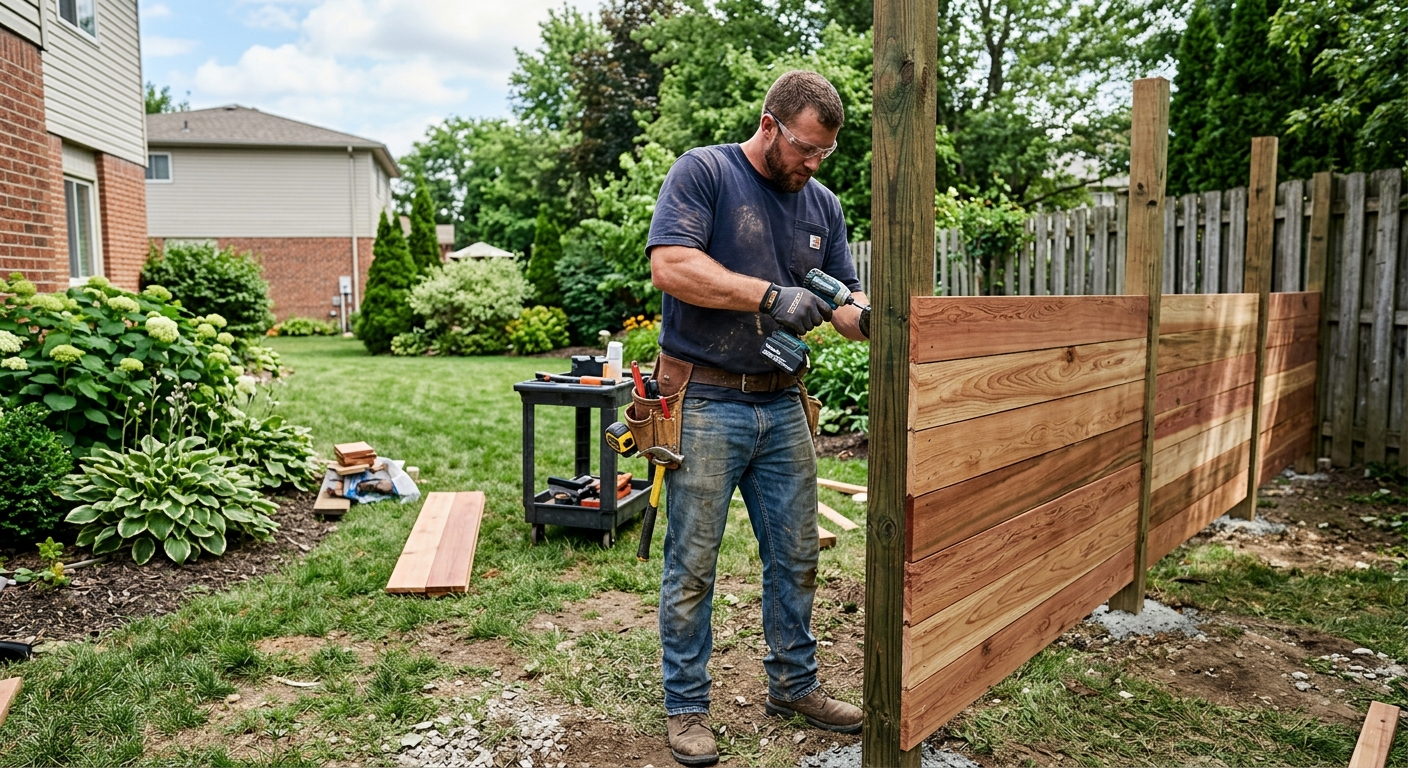
Fencing options and costs in Douglasdale
Douglasdale is a fast-growing community in the Calgary area, and that shows up in how busy the fencing trade is—especially around newer streets where yards are being fully enclosed. With Douglasdale’s population at 12,920 (Statistics Canada, 2021 Census), demand is steady, and it’s closely tied to detached-home growth in the region: each detached property is a potential privacy upgrade, boundary replacement, or gate expansion. In practice, fencing installers tend to be most booked in the newer residential pockets near 64th Avenue and the surrounding neighbourhood blocks where backyards often need privacy panels and added gates.
Costs here are shaped by Alberta’s Prairie continental climate: long freeze–thaw cycles and strong, open exposure mean frost protection and wind-loading are primary drivers. For most privacy fences, contractors plan for posts set about 4 ft (≈120 cm) deep to get below the regional frost line, which increases excavation time, concrete volume, and labour. That structural work also matters for gate posts, where racking stresses are higher. In Douglasdale, that’s why solid wood and vinyl typically land in the mid-to-upper price tier, while chain-link is usually more economical because it lets wind pass through.
To help you compare options quickly, use the table below as a realistic “per linear foot” planning guide for Douglasdale projects, then we’ll break down what shifts the final quote.
| Material |
Lifespan |
Maintenance |
Privacy Rating |
Price per Linear Foot |
| Pressure-treated pine (standard wood) |
10–20 years |
Stain/seal every 2–3 years |
High (solid panels) |
$40–$75 |
| Cedar (natural rot resistance) |
15–25 years |
Light re-stain every 2–4 years |
High (solid panels) |
$55–$85 |
| Vinyl / PVC (no-maintenance) |
20–30 years |
Occasional wash |
Medium–High (depends on picket spacing) |
$55–$90 |
| Chain-link (galvanized steel) |
20–40 years |
Rare: rinse/debris removal |
Low (airflow only) |
$25–$55 |
| Aluminum ornamental |
25–40 years |
Wash as needed |
Low–Medium (decorative infill) |
$70–$120 |
| Composite / recycled material |
20–30 years |
Minimal cleaning; inspect fasteners |
High (solid privacy boards) |
$65–$105 |
Prices are estimates only and vary by project scope, site access and material selection.
What affects the price of fencing in Douglasdale
In Douglasdale, it’s common to see fence quotes swing by 30–50% for what looks like the “same” job—because the real cost is driven by structural details that aren’t obvious in photos. Two crews might price the same 6 ft privacy fence, but one may plan for deeper concrete-set footings to control frost heaving and wind racking, while the other uses a faster installation method that can’t hold up as well across Calgary’s freeze–thaw cycles. Labour availability also matters: when schedules are tight between late spring and early fall, longer lead times can shift scheduling costs and crew productivity.
Frost line depth is one of the biggest price variables. Contractors typically set posts about 4–6 inches below the design frost depth to prevent heaving, which in colder Alberta often means digging closer to 1.5–2.0 m into the ground. That depth increases the excavation effort, concrete use, and the cost of longer posts—pushing solid privacy installations toward the mid-to-upper end of the wood and vinyl ranges (wood is often $40–$80, vinyl about $45–$90). Wind exposure on the Prairies is the other factor: open exposure means heavier panels often need tighter post spacing and robust bracing, while chain-link stays lower cost because it allows airflow.
In Douglasdale, you’ll notice cost differences in a few common scenarios. For example, steep grades often require stepped rails and extra labour, which can add material and time. If your yard has dense frost pockets near downspouts or low spots, crews may increase footing prep and base compaction. On the other hand, shorter runs through easier access lanes (like a straight backyard perimeter with no mature shrubs) can help keep a wood or vinyl privacy fence closer to the middle of the price bands.
| Price Factor |
Why It Matters |
Cost Impact |
| Fence length in linear feet |
Most labour and material quantities scale with length |
Highest impact overall (biggest lever) |
| Post depth required |
Frost protection determines post length and hole depth |
Can add significant excavation and concrete cost |
| Post setting method |
Concrete vs. gravel pack vs. driven posts affects stability |
Concrete-set usually costs more but resists heaving better |
| Material choice |
Different components, fixing systems and panel weights |
Vinyl/cedar often higher; chain-link usually lower |
| Gate count and type |
Gates require heavier posts, hardware and alignment |
Every gate adds labour and stronger framework |
| Grade and terrain |
Slopes may require racking/stepping panels |
Extra layout time and sometimes extra rails/panels |
| Old fence removal and disposal |
Debris haul-away and disposal weigh into scheduling |
Can add a noticeable line item |
| Permit fees and survey / property line locate |
Admin steps and professional location reduce disputes |
Varies; can materially change total |
Permits & regulations in Alberta
In Alberta, many homeowners only think about fences as “property improvements,” but the rules start before the first post hole. Fence height thresholds often trigger permitting requirements: generally, fences over about 2.0 m (6.5 ft) at the rear and about 1.0–1.2 m (3–4 ft) at the front or corner frequently require a building permit. Exact thresholds can vary by location and the fence’s position on the lot, so it’s smart to confirm your specific plan with the City and your contractor before ordering materials.
All fences must respect property lines and municipal setback bylaws. Before digging, arrange utility locates by calling Alberta One-Call so your contractor can identify buried lines. Also, obtain a survey or at least a locate of your property pins before installing—this is one of the most common causes of neighbour disputes. In terms of ownership and boundary responsibilities, Alberta’s line-fences legislation governs shared fence rules (who can require building, upkeep, or contribution where applicable).
Homeowner verification steps for Douglasdale: first, ask the contractor for their Alberta business information and licence documentation (if applicable to their work scope). Next, request certificate of insurance showing liability coverage and confirm whether they carry WSIB/WCB coverage for their workers (or provide a clearance/coverage proof as required). Finally, ask them to list who will pull any required permits and include that in the written scope. Typically, the concrete excavation, post setting, and fence build fall under contractor compliance requirements, while the permit itself (when triggered by height/location) is usually handled as part of the project admin once the final layout is confirmed.
Choosing the right fence material for Douglasdale
Choosing a fence in Douglasdale is really choosing a balance between privacy, low maintenance, and winter durability. Alberta’s freeze–thaw cycles and wind exposure mean posts and panels need solid installation—material alone won’t solve stability issues if footings aren’t set for frost. Still, the right product helps you avoid repeated repairs.
Pressure-treated pine is the budget-friendly route, but it requires staining or sealing every 2–3 years to limit grey weathering and keep fasteners performing well. Cedar costs more upfront, but it typically weathers more evenly and resists rot better, so many homeowners find it’s worth the upgrade if they want a nicer-looking fence with less aggressive maintenance than pine. Vinyl/PVC offers no-stain convenience and usually looks consistent, but in extreme cold it can crack if panels aren’t installed with appropriate flexibility and if posts aren’t truly plumb and stable. Chain-link is the longest-life low-cost option, yet it doesn’t provide privacy unless you add approved privacy slats (which can increase wind load and maintenance considerations). Aluminum ornamental is rust-resistant and clean-looking, but it generally provides lower privacy and higher visibility.
On Calgary-area frost protection: regardless of material, contractors usually set posts deep—often around 4 ft (≈120 cm)—to reduce heaving risk. For Douglasdale’s wind exposure, solid privacy panels (wood/vinyl/composite) should use sturdier posts and appropriate panel spans so the fence doesn’t rack. As a concrete example, if a cedar privacy fence is priced roughly $55–$85 per linear foot while chain-link is $25–$55, spending the additional $30–$40 per foot is justified when you actually need privacy and wind blocking; otherwise, chain-link can keep costs down.
| Material |
Cold Tolerance |
Lifespan |
Annual Maintenance |
Best For |
Price Band |
| Pressure-treated pine |
Good with proper sealing and stable footings |
10–20 years |
Inspect annually; stain as needed (often 2–3 years) |
Budget privacy with active maintenance |
$40–$80 |
| Cedar |
Very good; performs well in wet-to-freeze conditions |
15–25 years |
Light re-stain or seal every 2–4 years |
Natural look and stronger rot resistance |
$55–$90 |
| Vinyl / PVC |
Good if installed correctly and not over-constrained |
20–30 years |
Minimal—wash and check for loose parts |
Low-maintenance privacy |
$45–$90 |
| Chain-link |
Excellent |
20–40 years |
Very low—remove debris occasionally |
Security with maximum airflow |
$25–$55 |
| Aluminum ornamental |
Excellent; won’t rot and won’t rust |
25–40 years |
Minimal—wash as needed |
Attractive curb appeal with light privacy |
$70–$120 |
| Composite / recycled |
Good; stable boards when footings are correct |
20–30 years |
Low—inspect fasteners, clean lightly |
Privacy panels with reduced wood upkeep |
$65–$105 |
How to choose a fencing contractor in Douglasdale
Choosing the right contractor in Douglasdale starts with verification. In Alberta, you should request proof of liability insurance (a certificate of insurance that lists the insured limits and your address as an additional insured may be available). For worker coverage, ask whether they carry WSIB/WCB coverage and request documentation/clearance as applicable—don’t accept “we have coverage” without a certificate you can read. Also ask for their business registration details and confirm their experience with cold-weather installations: the frost-protection approach matters more than marketing.
For pricing, get 2–3 itemised written quotes, not lump sums. A solid fence quote should break out labour and materials clearly (posts, rails, panels/pickets, hardware, gate frames, concrete, excavation, and line-by-line labour). Confirm what’s included: permit pull (when required for height/location), utility locate coordination, old fence removal, disposal/haul-away, and whether survey/property pin locate is included or an allowance. If your contractor won’t clearly list exclusions, expect surprise add-ons.
Warranty matters too. Ask for the workmanship warranty length and whether product/manufacturer warranties apply to the exact components used (posts, rails, fasteners, gates). Also check if warranties transfer when you sell your home. Payment schedule should protect you: typically, never pay more than 10–15% upfront, and use a holdback until the job is complete and cleaned up. Finally, insist on a written start date and completion estimate that accounts for concrete cure time and winter scheduling realities.
- Confirm Alberta coverage documents are current (liability insurance certificate).
- Verify worker coverage (WSIB/WCB documentation or clearance letter as applicable).
- Ask for Alberta business details and contact info matching the quote.
- Request 2–3 itemised quotes with labour/material breakdown.
- Ensure post depth and setting method are stated (concrete-set vs gravel pack).
- Confirm gate hardware and post reinforcement details (especially for double gates).
- Clarify disposal: debris removal and where waste is hauled.
- Ask who coordinates utility locates and whether it’s included.
- Confirm permit scope: who pulls permits when required by height/location.
- Check that the plan respects property pins/locates and includes a layout step.
- Review warranty: workmanship length and product component coverage.
- Use a payment schedule with 10–15% maximum deposit and final holdback.
Red flags to watch for in Douglasdale: a contractor who won’t put post-depth and frost protection in writing; quoting a low “per foot” price without mentioning concrete setting; refusing to provide insurance/coverage certificates; asking for large upfront payments beyond 10–15%; or providing an un-detailed scope that doesn’t list removal, disposal, or permit responsibilities.
Frequently asked questions — fencing in Douglasdale
How do I prevent wood fence rot in Douglasdale?
In Douglasdale, rot prevention starts below grade and at the interface between wood and hardware. Make sure posts are set deep enough for frost protection—crews often plan around 4 ft (≈120 cm) deep to reduce heaving—then use proper concrete-set practice so water doesn’t sit in the footing area. Use pressure-treated lumber rated for ground contact, and keep boards properly spaced for drainage (no trapping moisture). On the visible fence, staining/sealing every 2–3 years helps prevent grey weathering and keeps the surface stable through winter freeze–thaw cycles. If you’re currently dealing with soft rails or loose fasteners, replacing those components early is usually cheaper than rebuilding panels. Cedar can also be a smart upgrade if you want better rot resistance with a nicer long-term appearance.
What is the cost per linear foot for fencing in Douglasdale?
For Douglasdale, homeowners typically see installed pricing fall within regional Calgary bands that reflect frost-depth excavation, wind exposure, and labour. Wood fence installation often lands around $40–$80 per linear foot depending on height, panel type, and whether concrete-set footings are used. Vinyl/PVC privacy fences are commonly $45–$90 per linear foot, while chain-link is usually lower, about $25–$55. If you choose cedar or more rigid privacy systems, you’ll generally be in the mid-to-upper ranges because of heavier panels and more robust bracing needed for Prairie winds.
Should I repair or replace my old fence in Douglasdale?
Repair is worth considering if only a few sections are damaged (for example, one or two rails, a gate latch, or localized board rot) and the line remains plumb with posts still secure. Replacement usually makes sense when posts have shifted, bottoms are rotting, or sections are leaning—especially if wind has racked the fence and the footing integrity has been compromised. In Douglasdale’s freeze–thaw conditions, a fence that’s already heaved once may continue to move unless the post setting method is corrected. A good contractor can do a quick inspection and identify whether the issue is hardware (fasteners/sagging) or structural (post depth/footing). If you’re replacing, ask whether removal and disposal are included to avoid budget surprises.
How do I handle a fence dispute with a neighbour in Alberta?
Start by returning to basics: confirm the property line using your survey pins/locate before anyone moves materials. In Alberta, boundary and shared fence responsibilities are generally guided by provincial line-fences legislation, but the key practical step is getting the correct line established. Document everything—photos, measurements, and your correspondence—and communicate early and calmly. If the dispute is about height, setbacks, or whether the fence is on your land, align on a written plan that shows the fence location and height before any work begins. If your fence needs to be rebuilt and you’re unsure who pays, ask a fencing contractor to prepare a clear scope and cost breakdown and consider getting property records/survey confirmation so decisions aren’t based on assumptions.
What fence style offers the best wind resistance in Douglasdale?
Douglasdale sits in Prairie wind exposure, so “wind resistance” usually means controlling racking (side-to-side movement), not simply blocking air. The most stable setups are typically solid privacy fences (wood, vinyl, composite) installed with sturdy posts, appropriate panel bracing, and concrete-set footings designed for frost protection. For chain-link, airflow reduces wind pressure on the fabric, so it can feel more stable in windy conditions, but it won’t provide privacy. If you want maximum privacy and stability, choose a solid-panel style with properly engineered post spacing and gate posts that are reinforced to handle higher loads. Avoid oversized spans between posts—many fence failures in freeze–thaw cycles show up as loose rails and leaning panels because the structure can’t handle wind-driven stress.
How much does a fence cost in Douglasdale?
Typical installed costs in Douglasdale follow the Calgary market ranges: wood privacy tends to be about $40–$80 per linear foot, vinyl privacy around $45–$90, and chain-link about $25–$55. Your exact total depends on linear feet, fence height, number of gates, terrain (sloped yards often need stepped or raked sections), and whether you’re removing an old fence. Also, in Alberta the frost-protected post depth and the resulting concrete/excavation time can noticeably increase your budget for solid fences. As a rough planning example, a mid-range vinyl privacy section could land near the middle of the band, but the final price will change if you need permits, survey locate, or reinforced double-gate posts.