Fencing options and costs in Swan Hills
Swan Hills is a small Alberta community where fencing work tends to move with the number of owner-occupied homes—there are 350 homeowner households here, and 71.4% of households own their home. With 82.5% of local dwellings being single-detached, most projects are straightforward residential runs around backyards and side lots, plus upgrades to older fences. In fact, 64.3% of homes were built before 1981, so many owners are refreshing weathered boundaries rather than building from scratch.
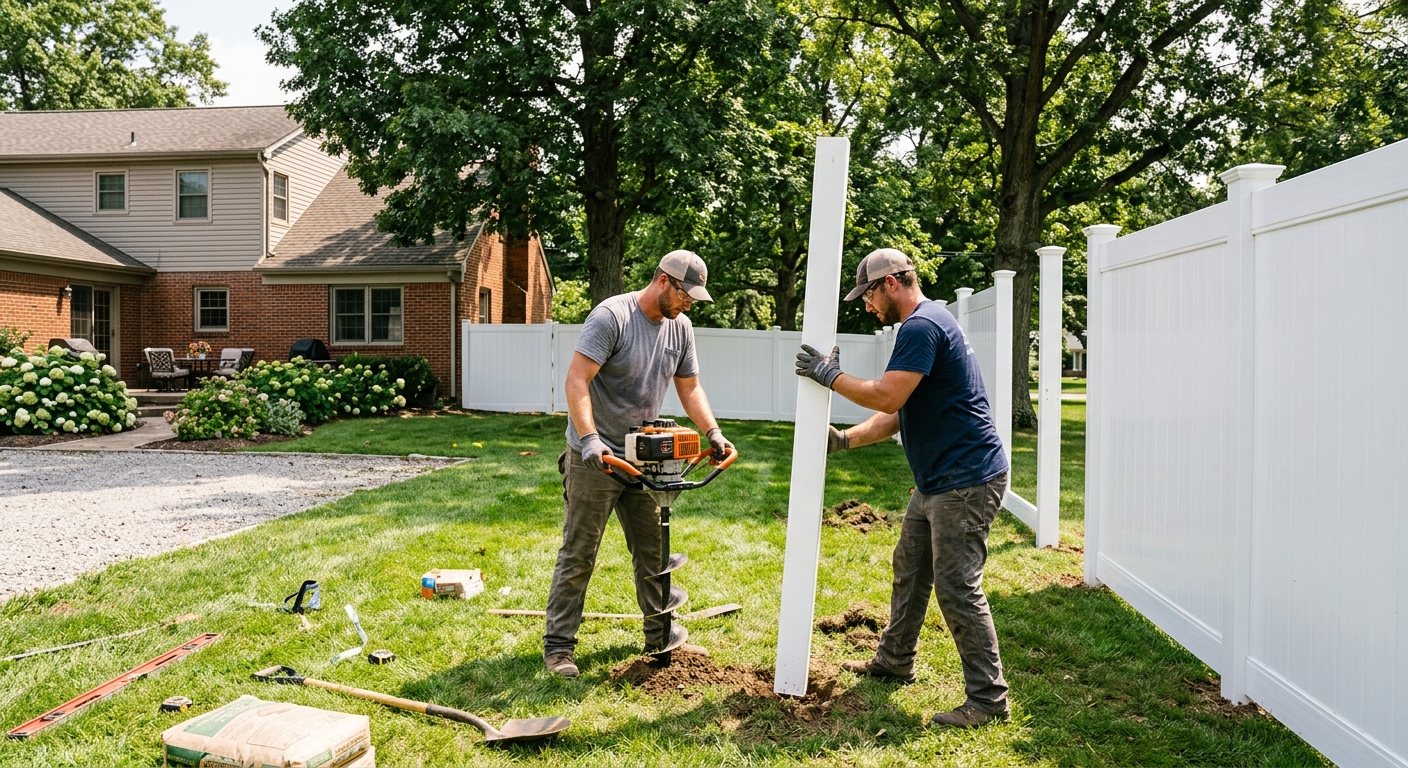
In the Athabasca–Grande Prairie–Peace River region, pricing is heavily shaped by exposure. Frost routinely pushes the design frost line to roughly 4–6 feet, which means posts must be set deep and often concreted to prevent frost heave and gradual leaning. Prairie winds also act like a sail; privacy fences with heavier panels need tighter post spacing and more robust footings, while open styles span a little farther. Contractor availability can vary too—when winter access is tight or the ground is hard-packed, labour time increases (augering deeper holes, more concrete, and careful backfill).
If you’re near the busier residential pockets where homeowners commonly upgrade yard privacy—such as the area around the downtown/central service core—expect the most frequent calls for wood and vinyl privacy upgrades. Below is a quick comparison of typical materials and what they usually cost per linear foot so you can align your shortlist before we talk scope.
| Material |
Lifespan |
Maintenance |
Privacy Rating |
Price per Linear Foot |
| Pressure-treated pine (standard wood) |
10–15 years |
Stain/seal every 2–3 years |
High (solid pickets) |
$35,0 – $70,0 |
| Cedar (natural rot resistance) |
15–25 years |
Light sealing/staining every 3–4 years |
High (solid pickets) |
$45,0 – $90,0 |
| Vinyl / PVC (no-maintenance) |
20–30 years |
Minimal wash-down; avoid impact |
High (solid panels) |
$40,0 – $80,0 |
| Chain-link (galvanized steel) |
20–35 years |
Occasional cleaning; tighten hardware |
Low (open visibility) |
$25,0 – $50,0 |
| Aluminum ornamental |
25–40 years |
Wash as needed |
Medium (decorative spacing) |
$45,0 – $90,0 |
| Composite / recycled material |
20–30 years |
Low; keep free of snow build-up |
High (solid systems) |
$55,0 – $100,0 |
Prices are estimates only and vary by project scope, site access and material selection.
What affects the price of fencing in Swan Hills
In Swan Hills and across the Athabasca–Grande Prairie–Peace River economic region, it’s common to see quote differences of about 30–50% for the “same” fence. The biggest reasons are that frost-driven post depth and wind loading change labour and materials, and site conditions (soil type, rock pockets, and machine access) can slow down installation. Across Alberta, weather exposure also affects when crews can work—hard freeze conditions mean more time augering and more attention to backfill, which pushes costs toward the higher end of typical bands such as wood at roughly $35–$70 and vinyl at $40–$80 per linear foot.
Here’s the key driver: the frost line depth. In cold Alberta regions, posts generally need to be set about 1.5–2.0 m into the ground (often “4–6 feet” design frost depth, then translated into practical hole depth for stability), which typically means longer posts and concrete setting to prevent heaving and leaning. Deeper holes require more labour and auger time, and if you’re on clay or rocky ground, that can raise the installed cost quickly.
Wind exposure on the Prairies also changes engineering details. For heavier privacy panels, contractors usually tighten post spacing and choose sturdier hardware so the fence resists racking during storms. That’s part of why solid wood or vinyl often lands toward the upper end when the yard is open.
Two local examples: (1) if your property has hardpan or shallow rock pockets, augering deeper holes takes longer and increases concrete and material wastage; that can move a cedar or vinyl run closer to the $90 per linear foot end. (2) if your yard is more sheltered from wind in a lower area (some lake/river valley-like siting), privacy panels may tolerate slightly wider spacing, which can help keep wood closer to mid-range rather than top-range. Finally, older housing stock (64.3% pre-1981) often comes with removals—disposal and extra labour can add cost in a way that’s not obvious when only the “new fence” is discussed.
| Price Factor |
Why It Matters |
Cost Impact |
| Fence length in linear feet |
The primary cost driver; labour scales directly with length |
Often 50–70% of total project cost |
| Post depth required |
Frost line determines how deep holes must be for stability |
Can add 10–30% if deep-set posts + extra concrete are needed |
| Post setting method |
Concrete vs. gravel pack vs. driven posts changes labour and materials |
Concrete-set can add 5–20% vs. lighter setting methods |
| Material choice |
Vinyl/cedar cost more than chain-link; heavier systems resist wind better |
Typically shifts you between low and mid/high bands (e.g., chain-link vs. vinyl) |
| Gate count and type |
Double drive gates require more hardware and alignment time |
One gate can add 15–35% to that section’s cost |
| Grade and terrain |
Slopes require stepped rails or raked panels and more layout time |
Often adds 5–15% |
| Old fence removal and disposal |
Hauling, dump fees, and disposal effort add labour |
Commonly adds 10–25% depending on condition |
| Permit fees and survey / property line locate |
Locate work prevents encroachment and protects you from rework |
Varies; can add a few hundred to over a thousand dollars |
Permits & regulations in Alberta
In Alberta, fence requirements are typically tied to height and location, and the rules are set through municipal bylaw and permit triggers. As a practical guideline, fences above a threshold—often around 2.0 m (6.5 ft) at the rear and about 1.0–1.2 m (3–4 ft) at the front or corner—may require a building permit. Even when a permit isn’t required, all fences must stay within your property line and respect any applicable setback rules for your lot.
Before any post hole is dug, call for utility locates. In Alberta, use Alberta One-Call so you know where buried services are before you auger. Also, confirm property pins or obtain a survey/locate before installing—this protects you from boundary disputes, especially on older lots where fence lines may not match current records.
Shared fence situations are handled under Alberta’s line-fences concepts: generally, if a fence benefits two properties, responsibilities for maintenance and repair can be shared, but the specifics depend on how it’s situated and what both parties agree to. If you’re planning a replacement for an existing shared boundary, it’s smart to document who’s responsible before construction begins.
To verify a contractor before signing: (1) check the Alberta licence/registration details online for the fencing contractor or related trades they use; (2) request a certificate of liability insurance showing adequate coverage for the project; and (3) ask for proof of WCB/WSIB-equivalent coverage (or written confirmation if not required). A transparent clearance/certificate package and itemised scope are good signs.
Choosing the right fence material for Swan Hills
Choosing the right fence material in Swan Hills is mostly about balancing privacy, cold-weather performance, maintenance time, and your budget. With long freeze–thaw cycles and deeper frost that can reach 4–6 feet design depth in the region, your system needs solid footings and properly set posts—not just the surface material. Good post depth and bracing matter as much as picking the “best” board.
Pressure-treated pine is usually the budget-friendly option, but plan on staining or sealing every 2–3 years to prevent grey weathering and maintain appearance. Cedar has better natural rot resistance and typically looks nicer longer; however, it still needs maintenance to keep it from drying out and graying. Vinyl/PVC is popular because it’s low maintenance, but in extreme cold it can be more brittle if struck and it still needs careful installation (strong posts, correct expansion allowances where applicable). Chain-link has the lowest material cost and longest life, but it offers minimal privacy—great if you want boundary definition, pets containment, or security without a visual barrier. Aluminum ornamental sits mid-range: it won’t rust and looks sharp, but it won’t provide full privacy due to spacing. Composite/recycled boards can offer strong privacy with less upkeep, though hardware and system quality matter.
Post-depth wise, most Swan Hills installs should assume deep-set posts for stability in frost—often set considerably below grade and typically concrete-set when soil conditions or exposure suggest higher risk of heave. In windy yards, heavier privacy panels (wood/vinyl/solid composite) benefit from tighter post spacing and robust rails.
A simple budgeting example: if chain-link runs are closer to the $25–$50 per linear foot band, switching to vinyl privacy at roughly $40–$80 per linear foot can be justified when you need day-to-day privacy against prairie wind visibility, not just a boundary line. If your priority is security and airflow, chain-link often delivers the best value.
| Material |
Cold Tolerance |
Lifespan |
Annual Maintenance |
Best For |
Price Band |
| Pressure-treated pine |
Good with proper sealing and deep-set posts |
10–15 years |
Inspect yearly; stain/seal every 2–3 years |
Budget privacy with classic look |
$35,0 – $70,0 |
| Cedar |
Very good; resists rot and moisture cycling |
15–25 years |
Inspect yearly; seal/stain every 3–4 years |
Attractive privacy that lasts longer |
$45,0 – $90,0 |
| Vinyl / PVC |
Good; avoid impact and ensure proper installation |
20–30 years |
Minimal; wash as needed |
Low-maintenance privacy |
$40,0 – $80,0 |
| Chain-link |
Excellent in cold; flexible with movement |
20–35 years |
Minimal; tighten hardware |
Security with no privacy requirement |
$25,0 – $50,0 |
| Aluminum ornamental |
Excellent; no rust in freeze–thaw cycles |
25–40 years |
Minimal; occasional wash |
Decorative boundary and curb appeal |
$45,0 – $90,0 |
| Composite / recycled |
Good; designed for freeze–thaw with quality installation |
20–30 years |
Low; keep debris/snow build-up managed |
Solid privacy with reduced upkeep |
$55,0 – $100,0 |
How to choose a fencing contractor in Swan Hills
For Swan Hills homeowners, the safest way to choose a fencing contractor is to verify three things up front: licensing/registration where applicable, liability insurance, and WCB/WSB coverage (workers’ compensation coverage). To check liability insurance, ask for a certificate of insurance naming you (or your property) where possible and confirming coverage limits appropriate to the project. For WCB/WSB coverage, request confirmation/certificates before work begins—don’t rely on verbal assurances. If a contractor uses subcontractors for removal, concrete, or equipment operation, they should still provide proof that the people on site are covered.
Next, get 2–3 itemised written quotes, not lump sums. A proper quote breaks out labour and materials for each fence run, includes gate pricing separately, and clarifies post setting details (concrete vs. gravel pack). Read the exclusions: is permit paperwork included or not? Is old fence removal and disposal included? Are utility locates the homeowner’s responsibility or part of the contractor’s prep? For warranty, confirm workmanship warranty length and whether it’s transferable, and separately confirm product/manufacturer warranty terms for materials like vinyl rails or composite boards.
Payment scheduling matters. Never pay more than 10–15% upfront for mobilization, and hold back a portion until the job is complete and accepted. Finally, insist on a written timeline: start date, estimated completion, and what happens if frost/soil conditions delay digging.
- Ask for proof of liability insurance before signing.
- Request WCB/WSB clearance/certificates for their workers and sub-trades.
- Get an itemised quote by material type and linear foot run.
- Confirm post setting depth and method (concrete-set vs. gravel pack).
- Check gate hardware specs (hinges, latches, and tensioners).
- Confirm whether permit pulling is included or the homeowner’s job.
- Ask who handles Alberta One-Call utility locate responsibilities.
- Verify disposal/removal is included if there’s an old fence.
- Request start and completion dates in writing.
- Make sure the quote includes grade conditions (raked/stepped panels).
- Review warranty details: workmanship vs. material warranty.
- Set a payment schedule with a holdback until final cleanup and punch list.
Red flags I often see in Swan Hills: contractors who won’t show insurance certificates, vague “all-in” pricing with no breakdown, no discussion of deep-set posts and concrete requirements in frost, sketches with no measurements for linear footage and gates, and a request for large upfront deposits beyond 10–15%.
Frequently asked questions — fencing in Swan Hills
How much does a fence cost in Swan Hills?
In Swan Hills, fencing costs usually land inside the regional bands once you account for deeper frost-set posts and wind exposure. For example, chain-link typically comes in around $25,0 – $50,0 per linear foot installed, while vinyl privacy often runs around $40,0 – $80,0 per linear foot depending on panel thickness, post spacing, and gate count. Wood privacy (pressure-treated pine) is commonly in the $35,0 – $70,0 range, but it can climb toward the top end when we’re doing concrete-set posts, adding extra bracing, or removing an older fence. Because Swan Hills has a high share of single-detached homes and many older properties (built before 1981), it’s not unusual to see removal and rework add to the final total.
How deep should fence posts be for Swan Hills's frost?
For Swan Hills, you should assume posts must be set deep enough to resist frost heave, given the regional frost depth of about 4–6 feet. Practically, that usually means digging significantly below grade—often translating to holes roughly in the 1.5–2.0 m range for stable fence posts in cold Alberta conditions. Whether you concrete-set or use a specific post-setting method depends on soil (clay, rocky pockets, or hardpan) and wind exposure around your yard, since heavier privacy panels behave like sails. A reputable contractor will confirm your planned post depth and setting method in writing and show how it matches the frost-driven stability needs. That’s the best way to avoid leaning fences after freeze–thaw cycles.
Wood vs vinyl vs aluminum fence — which is best?
There isn’t a single “best” choice for Swan Hills; it depends on what you value most. Wood (pressure-treated pine) generally offers strong value and a classic look, commonly around $35,0 – $70,0 per linear foot, but you’ll want regular staining/sealing every 2–3 years. Cedar looks better longer and is naturally rot resistant, but still needs maintenance; it often sits in the mid-to-high band (roughly $45,0 – $90,0). Vinyl/PVC is low maintenance and popular for privacy, typically around $40,0 – $80,0, though correct installation is important to handle extreme cold. Aluminum ornamental is usually mid-range to higher (about $45,0 – $90,0) and won’t rust, but it won’t give full privacy due to spacing. For prairie wind and snow, all options perform best when post depth and spacing are done right.
Do I need a permit to build a fence in Alberta?
In Alberta, you may need a permit depending on fence height and location on your lot. As a rule of thumb, fences above about 2.0 m at the rear and roughly 1.0–1.2 m near the front/corner area often trigger permit requirements, though your municipal bylaws govern the specifics. Even when a permit isn’t required, you still must respect property lines and any setback rules. Before digging post holes, you must call Alberta One-Call for utility locates. You should also confirm the property boundary (survey or pin locate) before construction to avoid encroachment disputes—this is especially important in areas with older fencing records. Your contractor should be able to tell you what they’re handling versus what you need to arrange.
How long does a wood fence last in Swan Hills?
A well-built wood fence in Swan Hills commonly lasts around 10–15 years for pressure-treated pine, assuming proper deep-set posts and realistic maintenance. If boards are stained/sealed on schedule (often every 2–3 years), the fence holds up better against moisture cycling and winter weathering. If posts aren’t set deep enough for frost stability, you’ll see leaning or gaps much earlier, sometimes within a few seasons after freeze–thaw heave. Cedar typically lasts longer—often 15–25 years—because it resists rot better, but it still needs maintenance to keep its finish from breaking down. Given how many homes in the area are older (64.3% built before 1981), replacements are frequent, and many failures are about footing and installation, not just board choice.
Who owns and maintains a shared fence?
Shared fence ownership and maintenance in Alberta are generally handled under line-fences principles, but the “who owns what” can depend on how the fence was built and where it sits relative to the boundary. In practice in Swan Hills, many shared fences exist because they’re on or near the property line; if both properties benefit from it, responsibilities for maintenance and repairs may be shared, sometimes by agreement between neighbours. Before replacing an older boundary fence, it’s smart to confirm who owns the fence structure, what each neighbour is contributing, and how costs are split—especially for posts set deep for frost stability and for gate sections. If you’re not sure, your contractor can help with scope clarity (what’s being replaced, including concrete-set posts), but the ownership question is ultimately a legal/property matter between the neighbours.