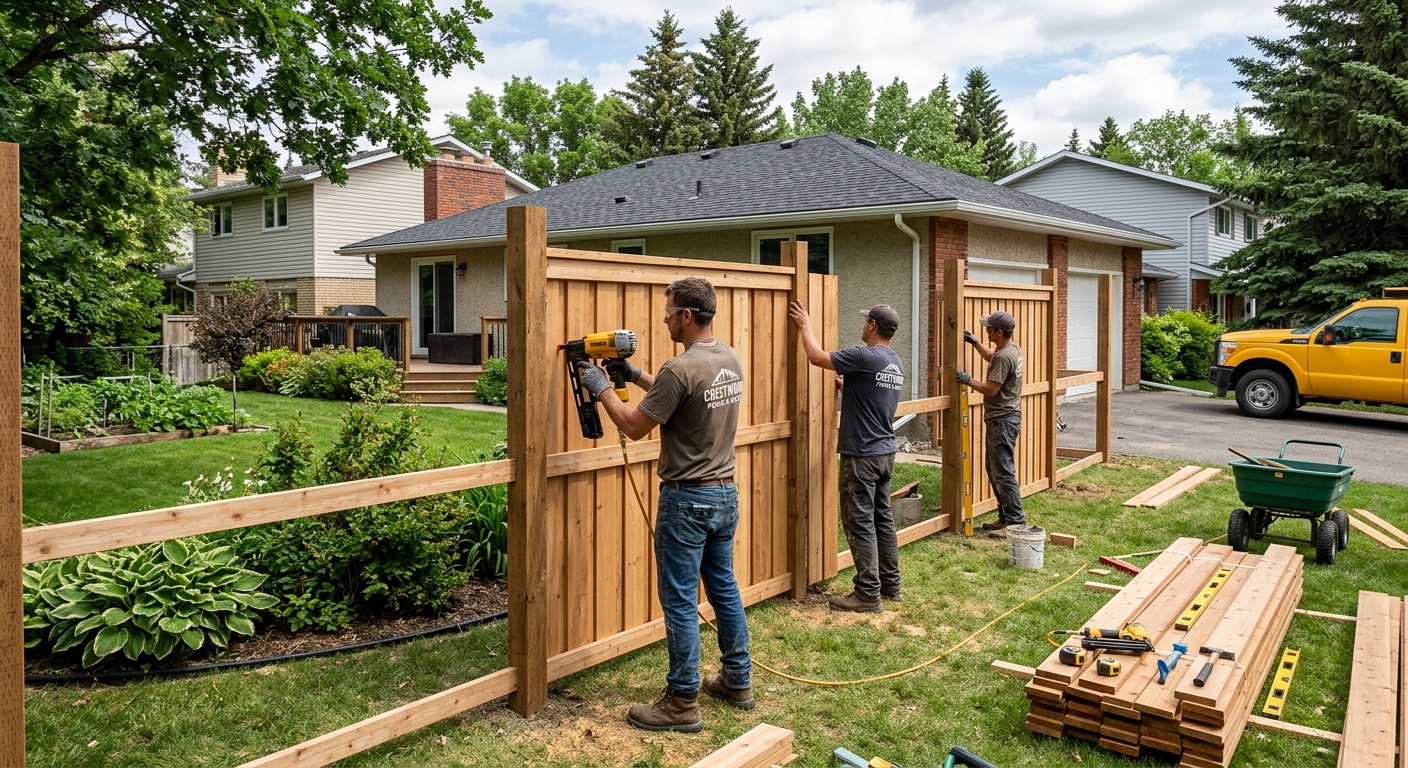
Fencing options and costs in Sunalta
Sunalta, Alberta is a neighbourhood where fenced yards are more than cosmetic—they’re practical. With a population of 1,910 (Statistics Canada, 2021 Census), demand is steady, and every detached or semi-detached property represents a potential fencing project. In Calgary’s Sunalta-area housing mix, fence upgrades often cluster around renovations, back-lane privacy improvements, and replacing older wooden runs that have weathered through multiple freeze–thaw seasons. That’s especially true in areas near busy corridors and inner-city lots where wind exposure is higher and panels take more wind loading.
In the Calgary economic region, the Prairie continental climate shapes cost. Long freeze–thaw cycles drive the need for frost protection: posts are typically set about 4 ft (≈120 cm) deep to get below the regional frost line. For 6 ft privacy fences and gate posts, that usually means concreted footings and heavier bracing to prevent racking. The open exposure around Calgary also means solid wood or vinyl panels often require closer post spacing and sturdier framing than chain-link, which lets air pass through.
Contractor availability also affects pricing: during spring and early summer, excavation demand rises and crews can book out faster, while fall jobs may cost less if weather window holds. For homeowners, the most common “sweet spot” in Sunalta is still wood or vinyl privacy—installed with deep-set posts—and the comparison below will help you budget across materials before you speak with a contractor. Next, use this table to size up lifespan, upkeep, and typical pricing.
| Material |
Lifespan |
Maintenance |
Privacy Rating |
Price per Linear Foot |
| Pressure-treated pine (standard wood) |
10–15 years |
Stain/seal every 2–3 years to slow grey weathering |
High (solid boards) |
$40–$80 |
| Cedar (natural rot resistance) |
15–25 years |
Seal or stain every 2–4 years (helps appearance) |
High (solid boards) |
$55–$95 |
| Vinyl / PVC (no-maintenance) |
20–30 years |
Minimal (rinse; inspect for impact damage) |
High (solid privacy panels) |
$45–$90 |
| Chain-link (galvanized steel) |
20–35 years |
Very low (wash; check tension) |
Low to medium (wire mesh) |
$25–$55 |
| Aluminum ornamental |
25–40 years |
Low (occasional wash; tighten hardware) |
Low to medium (open pickets) |
$70–$120 |
| Composite / recycled material |
20–30 years |
Low (clean; check for warping/edge impacts) |
High (solid or semi-solid styles) |
$60–$110 |
Prices are estimates only and vary by project scope, site access and material selection.
What affects the price of fencing in Sunalta
Even when homeowners ask for “the same fence,” Sunalta pricing can swing by 30–50% across Calgary and broader Alberta. The biggest reasons are structural requirements for our Prairie freeze–thaw cycles, plus how crews stage excavation, set posts, and manage wind loading. In practice, the material you choose is only part of the equation—post depth, concrete setting, terrain, and gate details often drive the difference. That’s why one estimate may land closer to the wood band ($40–$80 per linear foot) while another comes in nearer the vinyl range ($45–$90) or higher if you need heavier bracing and deeper, concreted posts for privacy.
Frost depth sets how deep posts must be. In cold regions, posts are typically set about 4 ft deep (≈120 cm) and, in many builds, concrete setting is used so the footing stays stable through freeze heave. A common rule in cold conditions is placing footings roughly 1.5–2.0 m into the ground; more depth can mean longer posts, more excavation, and more concrete volume—raising material and labour costs. Wind exposure on the Prairies also pushes tighter post spacing and sturdier rails for solid wood or vinyl privacy panels. Coastal BC’s mild but wet climate is the opposite problem—wood rot and moisture management—whereas in Sunalta the main risk is movement and frost pressure, not constant wet rot.
Two cost examples from local jobs: (1) On lots with open back-lane exposure, we often add stronger kick bracing and closer post spacing, which can add roughly 10–20% to a privacy build even when the material cost is similar. (2) In calmer side-yard runs where wind is reduced by mature trees, a contractor may be able to use standard spacing and get closer to the lower end of the chain-link range ($25–$55), while still meeting stability needs. Finally, yard slope affects rails and panel heights—stepped or raked installs add labour, sometimes moving the total toward the upper band even for “mid-range” materials. With Sunalta’s inner-city lots and renovation cycles, those variables are usually present, which is why quotes vary.
| Price Factor |
Why It Matters |
Cost Impact |
| Fence length in linear feet |
The more linear footage, the more posts, rails, and hardware required |
Largest driver (scales directly with total cost) |
| Post depth required |
Frost line determines hole depth and post length to prevent heaving |
Can materially raise excavation and materials cost |
| Post setting method |
Concrete provides stability; gravel pack and driven methods rely on soil conditions |
Concrete typically increases labour and supply costs |
| Material choice |
Vinyl and cedar require different framing and system hardware than chain-link |
Shifts you between the $25–$55 and $45–$90 bands |
| Gate count and type |
Drive-through gates need heavier frames and more robust hinges/latches |
More gates usually add significant complexity |
| Grade and terrain |
Sloped yards require racked panels or stepped footings |
Extra labour and materials to keep alignment |
| Old fence removal and disposal |
Demolition, debris handling, and hauling vary by material |
Often adds 5–20% depending on access |
| Permit fees and survey / property line locate |
Locates reduce encroachment risk; permits may apply to taller fences |
Costs can add on top of installation pricing |
Permits & regulations in Alberta
In Alberta, fence permit requirements often apply when you exceed typical height thresholds—commonly around 2.0 m (6.5 ft) for rear yards and about 1.0–1.2 m (3–4 ft) for front or corner areas, though details can vary by location and bylaws. Even when a permit is not required, all fence work must respect property lines and municipal setback rules. Before digging any post hole, arrange utility locates through Alberta One-Call to protect gas, power, and telecom lines.
Step 1: Confirm whether your proposed height/location likely triggers a permit. If you’re building a solid privacy fence near the rear (especially around 6 ft), expect that permit questions will come up. Step 2: Verify your property boundaries—use a survey or property pin locate before installation. This prevents expensive encroachment disputes, which are common when older fences don’t match the current lot line. Step 3: For shared fences, ownership and maintenance responsibilities are governed by provincial line-fences legislation; don’t rely on past assumptions—ask about shared-fence agreements and boundary clarity before signing.
Licence and insurance checks: verify the contractor’s business licensing status through the appropriate provincial/municipal channels (as applicable), then request a Certificate of Insurance naming you as the certificate holder or additional insured. Ensure liability is current and ask for confirmation of WCB/WSIB coverage (WCB in Alberta) before work starts. A clearance letter or current WCB status document is typically provided when requested, and reputable crews include it in their onboarding package.
Choosing the right fence material for Sunalta
Choosing a fence material in Sunalta is about matching priorities—privacy, low maintenance, budget, and expected lifespan—to a climate that tests everything. With Calgary’s long freeze–thaw cycles and Prairie wind exposure, solid panel systems generally need robust post support. That means your post depth and spacing matter as much as the surface material.
Pressure-treated pine is the budget-friendly approach, but it’s also the most maintenance-intensive: plan on staining or sealing every 2–3 years to reduce greying and keep boards looking uniform. Cedar has better natural rot resistance and holds appearance well, but it still benefits from periodic sealing to maintain colour and reduce surface checking. Vinyl/PVC is the lowest maintenance in day-to-day terms—no routine staining—but extreme cold and flying debris can cause cracking at impact points if the system is undersupported. Chain-link provides maximum airflow and is often the best-value structural choice in heavy wind, yet it offers little privacy unless you add slats or a privacy screen. Aluminum ornamental is attractive and won’t rust, but it’s more “visual barrier” than privacy.
In Calgary’s frost conditions, concrete-set posts are commonly used for privacy fences and gate posts because movement through heave can misalign solid panels. Even when soil is favourable, deeper footings and solid setting reduce callbacks. For a concrete example: if you compare a wood privacy fence at roughly $40–$80 per linear foot to vinyl at $45–$90, the extra cost often makes sense when you want fewer maintenance hours across 5–10 years, or when you expect heavy spring storms and want smoother upkeep. If budget is tight, chain-link at $25–$55 can be justified for long runs where airflow reduces wind load concerns, especially along exposed back yards.
| Material |
Cold Tolerance |
Lifespan |
Annual Maintenance |
Best For |
Price Band |
| Pressure-treated pine |
Good (with proper post setting and staining) |
10–15 years |
Minor inspection; stain/seal every 2–3 years |
Budget privacy with manageable upkeep |
$40–$80 |
| Cedar |
Good (naturally resistant; still benefits from sealing) |
15–25 years |
Light maintenance; seal/stain every 2–4 years |
Longer-lasting privacy with better aesthetics |
$55–$95 |
| Vinyl / PVC |
Very good (can crack on hard impacts) |
20–30 years |
Rinse/inspect; no staining |
Low maintenance privacy |
$45–$90 |
| Chain-link |
Excellent (galvanized steel handles cold well) |
20–35 years |
Occasional wash and tension checks |
Security and airflow in windy exposure |
$25–$55 |
| Aluminum ornamental |
Excellent (non-rusting finish system) |
25–40 years |
Occasional wash; tighten hardware |
Attractive boundary with visibility |
$70–$120 |
| Composite / recycled |
Good (impact resistance varies by brand) |
20–30 years |
Low; clean and inspect edges |
Low-maintenance solid privacy panels |
$60–$110 |
How to choose a fencing contractor in Sunalta
Start with verification, not promises. In Alberta, ask for proof of current liability insurance and WCB coverage (work protection through WCB). To check it: request a Certificate of Insurance and verify the policy is active and covers your project scope; for WCB, ask for a clearance letter or documentation showing the account is in good standing before work begins. Also confirm the contractor is properly registered to do business and can provide references for local fence builds in the Calgary area.
Next, get 2–3 itemised written quotes—not lump sums. A good fence quote breaks down labour and materials (posts, rails, pickets/panels, hardware, concrete, excavation and disposal). Read the scope carefully: what’s included/excluded for permit pulling, utility locate costs, and old fence removal? Make sure disposal/hauling is explicit, especially if you have bulky boards, metal posts, or chain-link that needs recycling or landfill handling.
Warranty matters in Alberta’s freeze–thaw cycle. Ask for both workmanship warranty length (how long the contractor stands behind alignment and post setting) and the product/manufacturer warranty (specific materials coverage). Find out whether the warranty is transferable to future homeowners and whether exclusions apply for impact damage.
Payment schedule: never pay more than 10–15% upfront. Hold back a portion until the gate alignment, final grade, and cleanup are complete. Timeline: get a start date and completion estimate in writing, and ask what weather conditions could shift the schedule.
- Ask for proof of liability insurance and WCB clearance before signing.
- Use itemised quotes: separate labour, concrete, posts, panels, rails, and gate hardware.
- Confirm post depth and setting method (concrete set vs gravel pack) in writing.
- Verify rail spacing and post spacing for wind exposure.
- Confirm gate frame reinforcement, hinge type, and latch hardware.
- Check how they handle slopes (raked panels vs stepped footings).
- Make utility locate responsibility explicit (and timing).
- Clarify whether permit fees and property line locate are included or extra.
- Ensure old fence removal and disposal is listed with quantities or assumptions.
- Ask who supplies concrete, rebar (if used), and any backfill.
- Review warranty terms for both workmanship and materials—get it in writing.
- Agree on payment milestones tied to inspection checkpoints.
Red flags I commonly see with less reliable fencing contractors in Sunalta: (1) they won’t state post depth or setting method clearly; (2) they provide only lump-sum pricing with no breakdown of concrete/excavation; (3) they ask for large upfront payments beyond 10–15% without a written schedule; (4) they can’t produce insurance/WCB documentation on request; and (5) they skip slope planning—then you get uneven gaps after freeze–thaw movement.
Frequently asked questions — fencing in Sunalta
How long does a wood fence last in Sunalta?
In Sunalta, most properly built wood fences last about 10–15 years for pressure-treated pine and closer to 15–25 years for cedar, assuming posts are set below the regional frost influence and the fence is maintained. Calgary’s long freeze–thaw cycles put stress on footings, so the installation method matters as much as the lumber. For a privacy fence, we commonly set posts deep and use solid framing to resist racking in high Prairie wind. If you ignore staining/sealing, expect faster greying and surface checking—pressure-treated pine typically needs re-staining every 2–3 years to keep it looking consistent. If you’re budgeting, wood privacy often falls around the mid range of the $40–$80 per linear foot band, while cedar generally costs more but can reduce early replacement risk.
Who owns and maintains a shared fence?
In Alberta, shared fence ownership and maintenance responsibilities are governed by provincial line-fences legislation. Practically, that means if a fence is built on or along a boundary and both properties benefit from it, the law provides rules for shared responsibilities—often including how costs are assessed and what happens if one party wants repairs or replacement. In Sunalta, where lots are close and older fences may predate current pin locations, boundary clarity is critical before deciding “who pays.” Start by confirming the property line using your survey or pin locate, then document who has rights to the shared section. A good contractor can help you identify fence segments near the boundary and provide a cost breakdown so shared decisions are grounded in clear scope, not assumptions.
How do I find my property line before fencing?
Before you dig a single post hole in Sunalta, confirm the property line using a survey or a pin locate. Many fences end up misaligned when homeowners rely on old markers or neighbour memory. Start with your land title documents and any existing survey you may have from purchase or past renovations. If the pins aren’t obvious, hire a surveyor or request a pin locate so you can establish where the boundary actually runs. This step is especially important for disputes around corner lots and for taller privacy fences, where setbacks and visibility lines can be more scrutinized. In your contractor discussions, ask whether they include a property line locate assumption in the quote or whether it’s an extra. Avoid basing your estimate purely on measurements from a previous fence line.
What's the most low-maintenance fence?
For low day-to-day maintenance in Alberta’s weather, vinyl/PVC is usually the top choice, followed by aluminum ornamental and chain-link. Vinyl is attractive because there’s no routine staining—just occasional rinsing and inspection after impact. Aluminum also stays looking clean with minimal care. Chain-link is low maintenance mechanically, but it doesn’t provide privacy unless you add privacy slats or screens. In Calgary’s climate, the “set-and-forget” benefit is only fully realized when posts are properly set for frost and wind loading—especially for solid panel styles. Price-wise, vinyl privacy typically sits in the $45–$90 per linear foot band, which can be worth it if you don’t want to budget for re-staining every 2–3 years like you would with pressure-treated wood.
How tall can my fence be in Sunalta?
Fence height rules in Alberta are tied to municipal bylaw requirements and whether your fence sits in a rear versus front/corner context. Commonly, rear fences around 2.0 m (6.5 ft) are where permit questions become more likely, while front or corner fences are often limited to about 1.0–1.2 m (3–4 ft). That said, the exact threshold and any permit requirement depend on the location on your property. For Sunalta homeowners planning a 6 ft privacy fence for backyard screening, it’s smart to confirm the height and location before ordering materials. Ask your contractor to review the specific height and placement with you and to clarify whether a permit is expected as part of the job scope. Always ensure your fence respects setbacks and property lines to avoid corrections later.
Should fence posts be set in concrete here?
In Sunalta and across Calgary’s Prairie continental climate, concrete-set posts are very often the best choice for privacy fences and gate posts because frost movement and wind loading can misalign lighter foundations. Posts are commonly set about 4 ft (≈120 cm) deep to stay below the regional frost influence, and concrete footings help stabilize the fence through freeze–thaw cycles. Whether you “must” use concrete depends on soil conditions and the system design, but for solid wood or vinyl panels—especially at 6 ft height—we generally recommend concrete setting to reduce heaving risk and racking callbacks. When you compare quotes, don’t just compare materials; ensure the contractor specifies post depth and setting method. If one estimate includes deep concreted footings and another doesn’t, that difference alone can shift costs within the typical wood ($40–$80) or vinyl ($45–$90) bands.