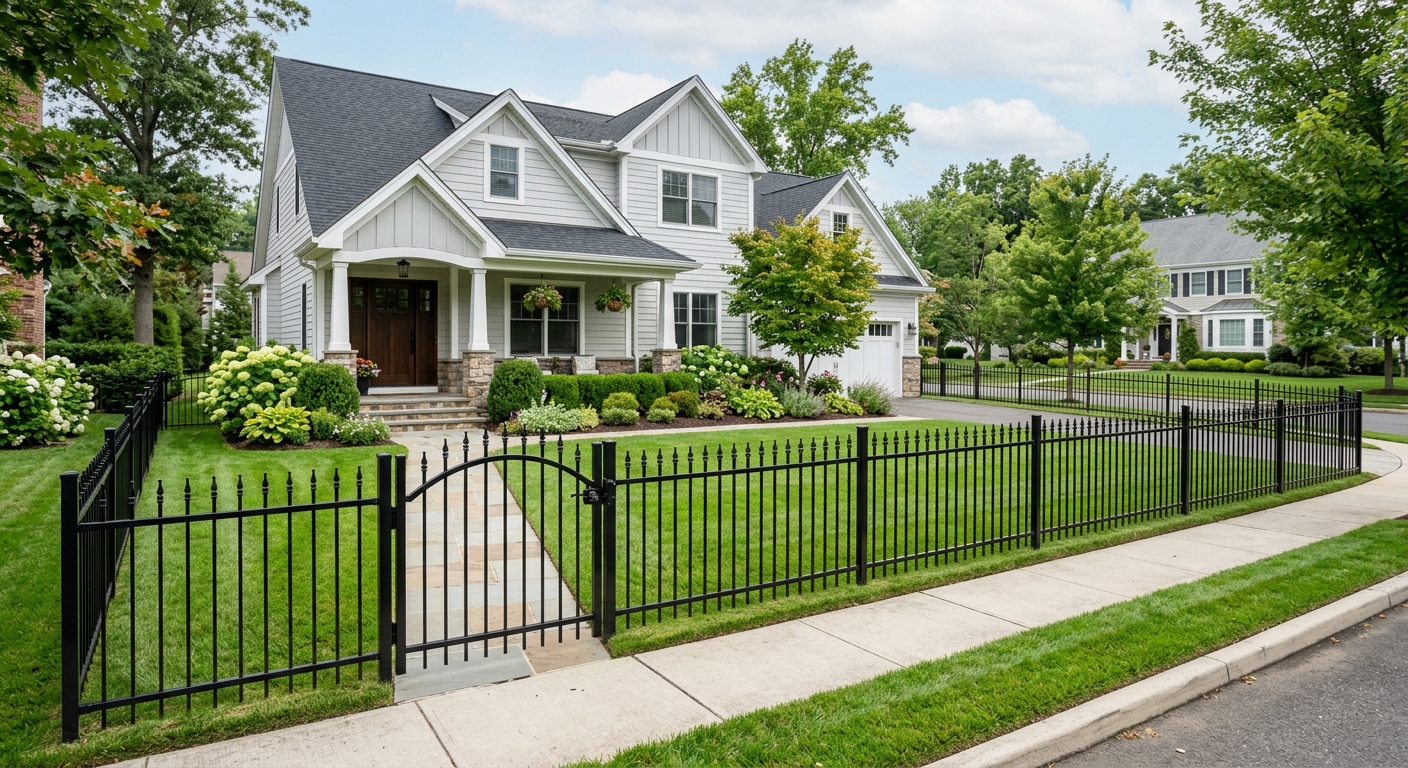
Fencing options and costs in Cambrian Heights
Cambrian Heights homeowners often start by asking, “What will my fence cost here?” With a population of about 2,000 (Statistics Canada, 2021 Census), demand is smaller than downtown Calgary, but fencing is very steady because many streets are lined with detached homes where homeowners actively improve front-yard appearance and privacy. Detached properties are a strong driver of local fence projects because each property typically needs a clear boundary solution, gate strategy, and wind-resistant layout. In the Calgary economic region, the Prairie continental climate creates long freeze–thaw cycles, so frost protection and wind loading are the biggest cost drivers for installed fencing.
That climate reality is why contractors in Cambrian Heights usually price more for 6 ft privacy fences than you’d see in milder parts of Canada. The City of Calgary area expectations commonly include setting posts roughly 4 ft (about 120 cm) deep to reduce the risk of heaving, and solid privacy panels often need tighter spacing and sturdier frames to resist racking. Access also matters: if you’re working in a narrow side yard or need to cross a slope near the back lanes, excavation time increases.
In Cambrian Heights, fencing tends to be especially in demand in busier residential pockets where properties back onto open or exposed areas—wind can push and rack lighter systems, so homeowners often upgrade to vinyl privacy or reinforced wood. Once you’ve narrowed your priorities (privacy vs. budget vs. low maintenance), you can compare realistic price ranges side by side in the table below.
| Material |
Lifespan |
Maintenance |
Privacy Rating |
Price per Linear Foot |
| Pressure-treated pine (standard wood) |
10–15 years |
Stain/seal every 2–3 years |
High (solid panels) |
$40–$80 |
| Cedar (natural rot resistance) |
15–25 years |
Light staining/spot sealing as needed |
High (solid panels) |
$55–$95 |
| Vinyl / PVC (no-maintenance) |
20–30 years |
Rinse occasionally; inspect for cracks after extreme cold snaps |
High (privacy styles) |
$45–$90 |
| Chain-link (galvanized steel) |
20–35 years |
Minimal; occasional re-tension/vegetation trimming |
Low–Medium (open airflow) |
$25–$55 |
| Aluminum ornamental |
25–40 years |
Minimal (wash as needed) |
Low–Medium (decorative pickets) |
$70–$120 |
| Composite / recycled material |
20–30 years |
Low; rinse and inspect annually |
High (when built as solid boards) |
$85–$130 |
Prices are estimates only and vary by project scope, site access and material selection.
What affects the price of fencing in Cambrian Heights
Even when you’re comparing the “same” fence on paper, Cambrian Heights quotes can differ by 30–50% across the Calgary region and broader Alberta. The main reason is that the installed cost is driven less by the fence brand and more by site conditions—how much ground you have to excavate, how deep you must set posts for frost protection, and how much wind resistance the design needs. In the Prairies, open exposure creates high wind loading, so solid wood or vinyl privacy fences often require sturdier framing and fully concreted footings. Chain-link tends to stay in the lower-middle range because airflow reduces racking forces.
Frost line requirements set how deep posts must be installed. Local guidance commonly expects footings around 4 ft (about 120 cm) deep, which is why your contractor may explain that posts need to go well below the frost zone to prevent heaving—especially critical for 6 ft fences and for gate posts that experience repeated stress. Compared with milder regions where frost penetration is less severe, those deeper holes increase excavation time, concrete volume, and labour. Wind exposure also affects layout: privacy panels usually need closer post spacing and better bracing.
Here are concrete examples of what raises or lowers cost in Cambrian Heights: (1) A flat backyard on firm soil may reduce hole-chunking and speed up excavation, keeping wood at the mid-range of the $40–$80 band. (2) A sloped run near the back where panels must be stepped can add material and labour, pushing vinyl privacy toward the $45–$90 band. (3) A removal-and-disposal job (old posts, debris, and hauling) often adds cost regardless of material because labour and dump fees increase.
Finally, don’t forget that housing age and site layout matter. Older lots can have buried services, older post holes that collapse during demo, or tighter side-yard access, all of which translate into dollars on your estimate.
| Price Factor |
Why It Matters |
Cost Impact |
| Fence length in linear feet |
Every extra foot requires materials, hardware, and installation time |
Largest driver—can swing total by thousands |
| Post depth required |
Frost line dictates post length and hole depth to prevent heaving |
Deeper holes increase concrete and labour time |
| Post setting method |
Concrete vs. gravel pack vs. driven posts changes stability |
Concrete-set is typically higher cost but more frost-resilient |
| Material choice |
Vinyl, cedar, and chain-link behave differently in wind and cold |
Vinyl/wood are mid–upper; chain-link is lower-mid |
| Gate count and type |
Double gates and larger openings require heavier hinges/bracing |
More gates = more framing, hardware, and adjustment time |
| Grade and terrain |
Slope requires stepping, racking, or custom panel height changes |
Can add hours and extra rails/panels |
| Old fence removal and disposal |
Demo adds labour and hauling/disposal fees |
Often increases total even if new materials are cheaper |
| Permit fees and survey / property line locate |
Some fence situations require additional paperwork or verification |
Can add administrative cost and scheduling time |
Permits & regulations in Alberta
In Alberta, fences above a height threshold—typically around 2.0 m (6.5 ft) at the rear and about 1.0–1.2 m (3–4 ft) at the front or corners—often require a building permit. Exact requirements can vary by location within the municipality, so for Cambrian Heights homeowners the safest approach is to confirm with the City before you order materials. Regardless of permit needs, all fences must stay within property lines and respect municipal setback rules for your specific lot.
Before digging any post hole, call for utility locates using Alberta One-Call. This is essential because backyard lines, service runs, and old conduits are common in established communities. You should also obtain a survey or locate your property pins before installation to reduce boundary disputes—fencing disputes are one of the most common reasons projects get delayed after excavation.
Shared fence rules are governed by provincial line-fences legislation, but the practical details (who maintains, how disputes are handled, and how costs are allocated) should be discussed in writing when a fence crosses a property line or neighbours rely on it for shared boundary protection.
What typically does require a permit: building or replacing a fence that exceeds the local height thresholds, plus certain boundary or structural situations (for example, when a fence affects sight lines near corners). What typically does not require a permit: low fences below the height threshold that stay fully within setbacks, assuming no special circumstances apply.
To verify a contractor in Cambrian Heights: confirm their Alberta business registration is active (contractors commonly list it online), request a certificate of insurance showing general liability coverage naming you as “certificate holder/ additional insured” when appropriate, and ask for WSIB/WCB clearance documentation (or equivalent coverage evidence). Always ask for current documents before work starts and keep copies for your records.
Choosing the right fence material for Cambrian Heights
The best fence material for Cambrian Heights is the one that matches your priorities—privacy, low maintenance, upfront budget, and realistic lifespan—while also surviving Calgary-area freeze–thaw cycles and windy Prairie conditions. Pressure-treated pine is usually the budget-friendly route, but it depends on proper staining/sealing every 2–3 years to reduce grey weathering and keep boards looking solid. Cedar offers better natural rot resistance and a warmer appearance, though it still benefits from periodic maintenance in Alberta winters and spring thaws.
Vinyl (PVC) is often a “buy once, do less” choice because it doesn’t need painting or staining. The trade-off is upfront cost and the need for correct installation details (proper post spacing, rigid framing, and attention to cold-weather handling) to help avoid cracking in extreme cold. Chain-link is the lowest-cost option that commonly lasts the longest with minimal upkeep, but it doesn’t deliver privacy. Aluminum ornamental looks great and won’t rust like steel, yet it’s typically mid-range and still doesn’t provide high privacy.
Post depth is part of the material decision in this climate. For privacy fences, contractors generally concrete-set posts to get below the frost-affected zone (often around 4 ft deep in the Calgary region guidance) so the fence doesn’t heave after freeze events. Wind and snow load also influence framing choices: solid panels catch more wind than open mesh, so they need sturdier posts and rails rather than relying on a lightweight design.
Dollar example: if you compare wood at roughly $40–$80 per linear foot versus vinyl at $45–$90, the vinyl premium can be justified when you want to eliminate re-staining and keep a consistent look across Alberta’s winters—especially if you’d otherwise be planning staining twice during a longer ownership timeline.
| Material |
Cold Tolerance |
Lifespan |
Annual Maintenance |
Best For |
Price Band |
| Pressure-treated pine |
Good with proper sealing and fastener checks |
10–15 years |
Inspect + minor caulking/spot touch-ups |
Budget privacy with periodic upkeep |
$40–$80 |
| Cedar |
Good; tolerates freeze–thaw well when installed correctly |
15–25 years |
Seasonal visual inspection; light staining as needed |
Natural look with better rot resistance |
$55–$95 |
| Vinyl / PVC |
Good in cold when posts and spacing are correct |
20–30 years |
Rinse and check hardware/rails |
Low-maintenance privacy |
$45–$90 |
| Chain-link |
Very good; steel holds up through cycles |
20–35 years |
Minimal re-tension/vegetation clearing |
Security on a budget with airflow |
$25–$55 |
| Aluminum ornamental |
Excellent; no rust in winter salt residue |
25–40 years |
Wash as needed |
Curb appeal with open visibility |
$70–$120 |
| Composite / recycled |
Good; stable when installed with correct spacing |
20–30 years |
Low—annual inspection and rinse |
Solid privacy with reduced upkeep |
$85–$130 |
How to choose a fencing contractor in Cambrian Heights
Choosing a fence contractor in Cambrian Heights is mostly about proof: proof they can legally work in Alberta, proof they’re insured, and proof their quote matches the job. Start by asking for their Alberta business licence/registration details, then request a certificate of insurance (general liability) and confirm what it covers on a construction site. Also ask for WSIB/WCB coverage evidence and a clearance letter or equivalent confirmation—if they can’t provide it, treat that as a stop sign.
Next, get 2–3 itemised written quotes. You want the breakdown separated into line items such as posts (including depth assumptions), concrete footings, rails, panel materials, hardware, gate framing, labour, and demo/disposal. Avoid lump sums that don’t specify whether post holes are concreted, whether the quote includes grading/levelling for a sloped run, or whether removal and hauling are included. A good contractor will also state whether they’ll do utility locates and how they handle unknown conditions (for example, broken old post sites during excavation).
Warranty matters on two fronts: workmanship and product. Ask how long the contractor’s workmanship warranty lasts, whether the manufacturer’s warranty is separate, and whether it’s transferable to future owners. For payment, don’t agree to pay more than about 10–15% upfront. Hold back the balance until the fence is complete, gates operate smoothly, and any required touch-ups are finished. Finally, insist on a written start date and a completion estimate so weather delays and crew availability are clear from the beginning.
- Request written proof of Alberta registration and active status before signing.
- Confirm general liability insurance and ask for a certificate copy.
- Verify WSIB/WCB clearance documentation (or equivalent coverage evidence) before work begins.
- Get 2–3 itemised quotes—no “all-in” pricing without assumptions.
- Ensure post depth assumptions are explicit (frost-protection expectations for the Calgary region).
- Confirm whether posts are concrete-set versus gravel pack or other methods.
- Check whether gate hardware and framing are included (especially for double gates).
- Ask how slope/grade changes will be handled (stepped vs. racked panels).
- Confirm disposal/dump fees and whether old fence removal is included.
- Ask about permit responsibility: included or extra?
- Verify warranty terms for both workmanship and materials, and whether they’re transferable.
- Set a payment schedule with small upfront deposit (10–15%) and holdback until completion.
Concrete red flags I’ve seen with fencing contractors in Cambrian Heights: (1) vague post-depth language like “standard depth” without frost-protection detail, (2) quoting privacy fences without clarifying concrete footings or bracing for wind racking, (3) no insurance/coverage proof when asked, (4) refusing to provide itemised pricing and exclusions, and (5) pushing for large upfront payments or skipping a written timeline.
Frequently asked questions — fencing in Cambrian Heights
Do I need a permit to build a fence in Alberta?
In Alberta, many fence projects require a permit when the fence height exceeds typical local thresholds—often around 2.0 m (6.5 ft) at the rear and about 1.0–1.2 m (3–4 ft) at the front or corner. In Cambrian Heights, your best move is to confirm the height and location on your specific lot because setback rules and corner sight-line restrictions can change what’s allowed. If your plan involves a tall privacy fence, a corner location, or a boundary situation that affects required clearances, assume you may need a permit until you verify it. Also remember to call Alberta One-Call before digging to protect gas, power, and low-voltage services. A reputable contractor will tell you early whether permits are expected and what they include in the scope.
How long does a wood fence last in Cambrian Heights?
Wood fence lifespan in Cambrian Heights is strongly tied to maintenance and how well posts are protected from frost heaving. With proper installation—posts set deep enough for Alberta freeze–thaw cycles and rails fastened correctly—pressure-treated pine commonly lasts about 10–15 years. If you choose cedar and maintain it with periodic staining/inspection, many homeowners see 15–25 years before boards noticeably fail. In the Calgary area, wind exposure can also stress a fence frame, so sturdier bracing can extend service life. If you’re comparing budgets, pressure-treated wood installation is often in the $40–$80 per linear foot range, while cedar tends to run higher; the longer lifespan can make cedar worthwhile when you’d rather avoid frequent work after spring thaw and snow load seasons.
Who owns and maintains a shared fence?
When a fence is shared along a boundary, ownership and maintenance can be governed by provincial line-fences legislation, but the practical outcome depends on where the fence sits and what your neighbour agreement says. In Cambrian Heights, the safest approach is to confirm the location relative to your property line (using a survey or property pins) before assuming the shared fence is entirely “your neighbour’s responsibility” or entirely yours. Typically, both parties may share obligations for maintenance and repair, but the details can vary if one side built it originally, if there’s a cost-sharing understanding, or if the fence is on one property but benefits both lots. If you’re replacing a shared fence, ask the contractor to work with you on a clear scope, and consider documenting the agreement between neighbours to reduce disputes later.
How do I find my property line before fencing?
To find your property line reliably in Cambrian Heights, don’t rely on visual estimates or older fence positions. Start with your survey documents if you have them, then check for property pins/markers and confirm their location relative to existing landmarks. If you don’t have a recent survey, order a survey or a professional locate so the fence follows the correct boundary. This matters because fencing on the wrong line can trigger costly removal or rework. It also helps when permits or height rules apply, since your fence setbacks may be different depending on whether you’re building near the front/corner. Before any digging, call Alberta One-Call for utility locates so you can excavate post holes with confidence. A good contractor will ask about property line confirmation before they lock in layout.
What's the most low-maintenance fence?
For low maintenance in Alberta’s freeze–thaw climate, vinyl/PVC and aluminum typically top the list. Vinyl is especially popular for privacy because you don’t paint or stain it; you mostly rinse it and inspect hardware after extreme cold snaps or heavy wind events. Aluminum ornamental is also easy to maintain and won’t rust, which is a major advantage across prairie winters. In terms of installed pricing, vinyl privacy often lands in the $45–$90 per linear foot range, while aluminum ornamental is commonly higher, around $70–$120 per linear foot. Chain-link can also be low-maintenance but won’t provide privacy. For a truly “set and forget” goal, the key is pairing the material with proper post depth and framing so the fence doesn’t move and stress itself over time.
How tall can my fence be in Cambrian Heights?
Fence height limits depend on where the fence is located on your lot (rear vs. front/corner) and local bylaw rules. In Alberta, a common guideline is that fences over about 2.0 m (6.5 ft) at the rear and about 1.0–1.2 m (3–4 ft) at the front or corner often trigger permit requirements. For Cambrian Heights homeowners, the practical issue is that corner visibility rules can restrict height even if the rear of the property could allow taller fencing. The only accurate way to confirm is to check your lot’s setback and corner location requirements, then align your design accordingly—especially for privacy panels that are more wind-sensitive. Your contractor should help you confirm the proposed height before construction so you don’t end up reworking panels or re-submitting for approval.