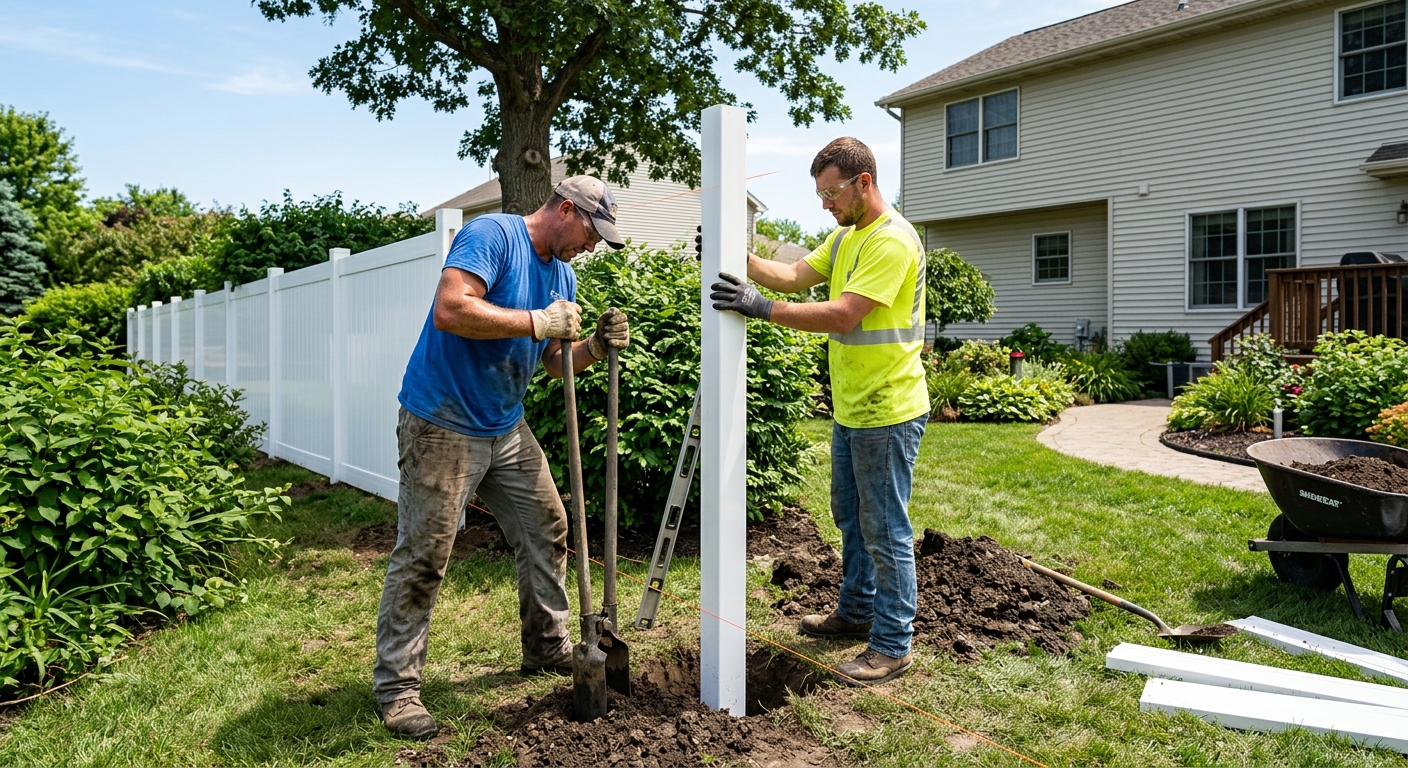
Fencing options and costs in Bentley
Bentley is a small Alberta community where most homes are owner-occupied, so fencing demand is closely tied to the number of detached properties. In the 2021 Census, Bentley showed 80.2% of households are homeowners, and single-detached houses make up 74.7% of dwellings—each property is a potential backyard privacy, pet containment, or wind-break upgrade. That mix helps explain why you’ll see consistent quote requests for wood, vinyl, and chain-link, especially around family yards and farm-style lots on the town’s edges.
In the Red Deer economic region, pricing is affected as much by site conditions as by materials. Alberta frost depth and prairie wind exposure push installers toward deeper post holes (often concrete-set for stability) and sturdier panel construction to resist racking. Home construction age also matters: with 61.5% of homes built before 1981, many properties have older fence lines where post positions, ground hardness, and buried remnants can require extra labour to get posts plumb and properly seated.
Contractor availability and access can vary by area—around downtown Bentley and the older residential blocks near local services, crews commonly run shorter back-lane builds and driveways that restrict equipment, which can add time. Once you factor in access, wind load, and whether your project includes gates or tear-out, the material choice becomes the biggest swing.
Use the table below as a practical baseline for comparing options before you ask for itemised quotes.
| Material |
Lifespan |
Maintenance |
Privacy Rating |
Price per Linear Foot |
| Pressure-treated pine (standard wood) |
10–15 years |
Stain/seal every 2–3 years |
High (solid pickets/boards) |
$45–$85 |
| Cedar (natural rot resistance) |
15–25 years |
Light seal/stain every 3–4 years |
High (solid boards) |
$60–$105 |
| Vinyl / PVC (no-maintenance) |
20–30 years |
Occasional wash; inspect for impacts |
Medium–High (depends on panel style) |
$55–$100 |
| Chain-link (galvanized steel) |
20–35 years |
Rinse/repair as needed |
Low (open mesh) |
$35–$70 |
| Aluminum ornamental |
25–40 years |
Wash periodically; check fasteners |
Low–Medium (ornamental pickets) |
$70–$140 |
| Composite / recycled material |
20–30 years |
Minimal; clean as needed |
High (if using solid privacy panels) |
$85–$135 |
Prices are estimates only and vary by project scope, site access and material selection.
What affects the price of fencing in Bentley
Two bids for what looks like the same fence in Bentley can differ by 30–50% once you account for the Red Deer region realities. On paper, a 6-foot privacy fence seems straightforward; in practice, installers price for frost-related ground conditions, wind exposure, and how much labour is required to set posts reliably. Across Alberta, the swing is commonly driven by material and by whether the crew uses concrete-set posts for stability versus faster methods when soil allows. Labour availability also changes how quickly a crew can mobilize, especially during short spring and fall windows.
Frost depth is a key driver because posts typically must be set about 4–6 inches below the design frost depth to reduce heaving. In cold Alberta conditions, that often translates to roughly 1.5–2.0 m of embedment, meaning longer posts, deeper augers, and more concrete—each adds material and installation time. Wind exposure on the prairies also matters: more exposed lots usually need tighter post spacing and less “sail area,” which can raise costs compared with a sheltered suburban yard.
Concrete examples from Bentley-area jobs: (1) a longer run to the back property line where access forces wheelbarrowing can increase labour even if materials match; (2) heavier clay or areas with standing water after spring melt can require improved drainage or deeper holes, pushing post depth and concrete volumes up. Conversely, some lots with firm, well-draining soil can keep post holes closer to the minimum and reduce concrete volume, lowering the bid toward the lower end—particularly for chain-link projects (often closer to $35–$70 per linear foot).
Finally, older fence tear-out can be costly. Properties built before 1981 (61.5% of the housing stock) often have set-in posts, buried rails, or previous footing remnants that take longer to remove, and that affects the overall price as much as the fence height. If you’re comparing wood options (often around $45–$85 per linear foot) against vinyl (typically $55–$100 per linear foot), make sure both quotes assume the same post embedment and wind-rated spacing.
| Price Factor |
Why It Matters |
Cost Impact |
| Fence length in linear feet |
Everything scales by footage—posts, rails, and labour time. |
High (primary cost driver) |
| Post depth required |
Frost line controls embedment to prevent heaving and post movement. |
Medium–High (more holes + materials) |
| Post setting method |
Concrete vs. gravel pack vs. driven posts changes stability and labour. |
Medium (often a major swing) |
| Material choice |
Vinyl and aluminum cost more up front than wood or chain-link. |
High (biggest pricing variance) |
| Gate count and type |
Drive-through double gates require heavier framing and hardware. |
High (hardware + extra labour) |
| Grade and terrain |
Slopes require stepped sections or raked panels for alignment. |
Medium (re-labour and cut/fit) |
| Old fence removal and disposal |
Tear-out includes detach time and hauling/loading fees. |
Medium–High (varies widely) |
| Permit fees and survey / property line locate |
Locates prevent encroachment and reduce rework if lines are unclear. |
Low–Medium (but can be essential) |
Permits & regulations in Alberta
In Alberta, fencing is regulated through municipal bylaws and height limits, and permits are often required for fences above certain thresholds—commonly around 2.0 m (6.5 ft) in the rear and roughly 1.0–1.2 m (3–4 ft) near the front or corner. The exact threshold can vary by municipality and fence location, so in Bentley you should confirm the applicable front-yard/corner-yard rules with the town office or your permit process before you schedule digging.
Regardless of permit requirements, you must respect property lines and any required setbacks. Before any post holes are dug, arrange utility locates through Alberta One-Call so the crew can mark buried services. Also, get a survey or property line locate to verify where your pins are, because encroachment disputes are expensive when fencing is already installed. If you share a boundary fence, shared fence ownership issues are addressed under Alberta’s line-fences framework—your agreement with the neighbour matters for who pays for repairs or replacement.
What typically DOES require a permit: taller fences beyond the common thresholds, and any project that triggers municipal review (especially in corner areas or where setbacks are involved). What typically does NOT require a permit: smaller, in-bounds repairs or like-for-like replacements below the height threshold, provided you’re not changing the fence footprint.
To verify your contractor in Bentley, ask for (1) their Alberta business registration/licence details (as applicable), (2) an up-to-date certificate of liability insurance, and (3) proof of coverage for worker protection such as WCB/WSIB (Alberta typically uses WCB). Check certificates for validity dates and named insured, and request a clearance letter or coverage confirmation number where available.
Choosing the right fence material for Bentley
Choosing the right fence material in Bentley is about matching your priorities—privacy, low maintenance, budget, and lifespan—to Alberta’s climate reality: freeze-thaw cycles, winter wind, and occasional heavy snow loads. Because a large share of homes are detached (74.7% of dwellings) and many properties are older (61.5% built before 1981), you’ll often be replacing fences with different footing conditions than the original. That’s why the material selection should be paired with proper post embedment (often concrete-set and below the frost-affected zone in exposed areas) so the fence stays straight year after year.
Pressure-treated pine is usually the lowest upfront option, but it needs staining or sealing every 2–3 years to prevent grey weathering and to keep the boards looking good. Cedar resists rot better and tends to age more gracefully, though it still benefits from periodic sealing in our conditions. Vinyl/PVC is marketed as no-maintenance, and for typical residential exposure it’s a strong fit—just remember it can become brittle at extreme cold if the product is low-grade or improperly installed. Chain-link is the most economical and long-lived but gives limited privacy. Aluminum ornamental looks sharp and won’t rust, but it’s generally mid-range to higher cost and doesn’t provide privacy unless you add screening. Composite/recycled boards can offer solid privacy with reduced upkeep, but they’re often priced closer to vinyl and require quality hardware.
On the Red Deer prairie, wind matters. For open lots or fences with large continuous runs, we typically plan tighter post spacing and reduce sail area in the panel design to prevent racking. For example, if you’re choosing between wood at roughly $45–$85 per linear foot and vinyl at roughly $55–$100, the extra cost can be justified if you want to avoid re-staining and if you’re planning a long run that you don’t want to revisit every couple of seasons.
| Material |
Cold Tolerance |
Lifespan |
Annual Maintenance |
Best For |
Price Band |
| Pressure-treated pine |
Good (if properly treated and installed) |
10–15 years |
Inspect; stain/seal every 2–3 years |
Budget privacy with manageable upkeep |
$45–$85 |
| Cedar |
Good (naturally rot-resistant) |
15–25 years |
Inspect; seal/stain every 3–4 years |
Appearance + natural rot resistance |
$60–$105 |
| Vinyl / PVC |
Very good (quality matters in extreme cold) |
20–30 years |
Wash/inspect impacts; no scheduled staining |
Low-maintenance privacy |
$55–$100 |
| Chain-link |
Excellent (steel with coatings) |
20–35 years |
Inspect tension/bracing; occasional rinse |
Security/pets with long service life |
$35–$70 |
| Aluminum ornamental |
Very good (powder-coated finish) |
25–40 years |
Wash periodically; tighten hardware as needed |
Decorative curb appeal and rust resistance |
$70–$140 |
| Composite / recycled |
Good (panel quality impacts performance) |
20–30 years |
Minimal; clean as needed |
Solid privacy with reduced maintenance |
$85–$135 |
How to choose a fencing contractor in Bentley
When you hire a fence contractor in Bentley, verifying coverage is as important as the material price. In Alberta, start by asking for proof of liability insurance (you want it current, not expired) and proof of worker coverage through WCB. If a contractor is active in Alberta, you should also confirm their business registration and any applicable fencing trade licensing or documentation they’re required to carry for work in your area. To check, request the certificates directly and verify the policy dates, coverage limits, and that your name/address can be added as an additional insured if appropriate. If they can’t provide a current certificate of insurance and WCB confirmation, treat that as a serious red flag.
Next, get 2–3 itemised written quotes. An itemised quote separates labour and materials (posts, rails, fasteners, concrete, gate hardware, and finish components), rather than bundling everything into a single line. Read the scope carefully for what’s excluded: permit pull (if required), property line locate or survey, post-hole depth assumptions, and whether disposal and haul-away are included. For example, if you’re replacing an older wood fence and one quote includes tear-out and disposal while another doesn’t, that alone can explain a large price gap.
Warranty matters: confirm the workmanship warranty length, what it covers (posts, alignment, rails, hardware), whether the product manufacturer warranty applies to the specific board/fence system, and if coverage is transferable to future owners. For payments, never pay more than 10–15% upfront; use a holdback until the job is complete and inspected. Finally, ask for an estimated start date and a completion timeline in writing.
- Request itemised labour and materials breakdown (not a lump-sum only).
- Confirm post-hole depth approach in writing (frost stability and embedment).
- Ask whether posts are concrete-set, gravel-packed, or driven and why.
- Verify current liability insurance certificate and coverage limits.
- Verify WCB coverage (and ask for confirmation details).
- Confirm permit pull responsibility if height thresholds trigger permits.
- Ask whether property line locate/survey is included or excluded.
- Confirm old fence tear-out, loading, and disposal are included if needed.
- Get gate hardware listed (latches, hinges, posts reinforcement, hardware grade).
- Require a clear warranty statement for workmanship and product components.
- Use a payment schedule with a holdback until completion and final walkthrough.
- Require a written timeline and start/completion target dates.
Red flags in Bentley include: quotes that omit post-hole depth and setting method, contractors who won’t provide WCB/liability proof, “cash only” requests with no written contract, vague scopes that exclude disposal or permits without noting it, and start dates that keep slipping without a revised schedule.
Frequently asked questions — fencing in Bentley
How do I compare fencing quotes?
In Bentley, compare quotes by matching the scope line-by-line rather than the total number. Ask each contractor to specify fence height, material grade (for wood or vinyl), post spacing, and—most importantly—post-hole depth and the setting method used for Alberta frost stability. For example, a “wood privacy” bid around $45–$85 per linear foot may not be apples-to-apples if one includes concrete-set posts and the other assumes minimal embedment. Also ensure gates are comparable (walk-through vs double drive-through), confirm whether tear-out/disposal is included, and check whether permits or a property line locate are included or excluded. Finally, look for an itemised labour/material breakdown and a clear warranty—cheapest often means the details were left out.
How long does fence installation take in Bentley?
Most residential fence installations in Bentley are completed in a few days, but it depends on length, access, and how many footings and gates are involved. A straightforward run with no heavy slope and limited gates can move quickly, while projects requiring deep frost-appropriate post holes, lots of concrete, or difficult access (back-lane work or narrow driveways) take longer. If you have old fence removal, plan extra time for detach, haul-away, and site prep. Weather matters in Alberta—teams typically avoid pouring concrete in freezing conditions or adjust methods when temperatures drop. Ask your contractor for a written start date, completion estimate, and a note on how they handle temperature constraints.
Can I install a fence on a slope in Bentley?
Yes, you can install a fence on a slope in Bentley, but the approach should be chosen based on the yard’s grade and the fence style. Common options are stepped panels (each section changes height in increments) or raked panels (gradual change in height along the run). Privacy fences with board spacing typically suit stepped installs to keep alignment and reduce board stress. If you’re aiming for ornamental aluminum or chain-link, racking is often easier to achieve, but the hardware must be set precisely. Your contractor should visit the site, confirm the grade plan in the proposal, and ensure post embedment still reaches the frost-stable depth even on sloped ground.
What is the most weather-resistant fence for Bentley's climate?
For Bentley’s Alberta winters—freeze-thaw cycles and wind—the most weather-resistant choices are usually chain-link with proper galvanized coatings or vinyl/PVC from a reputable system, because they don’t rot like untreated wood. Vinyl/PVC can perform very well when installed with correct hardware and spacing, while chain-link holds up with minimal upkeep for years. If you prefer solid privacy, cedar can be resilient due to natural rot resistance, but it still benefits from periodic sealing. Whatever you choose, the foundation detail is what protects the fence from heaving and wind blowouts—proper post depth and secure post setting matter as much as the material. In exposed lots, contractors often design for wind load with sturdier post spacing and panel framing.
How do I prevent wood fence rot in Bentley?
Wood rot prevention starts with materials and installation details. Choose pressure-treated pine rated for ground contact or use cedar, and ensure the bottom portions of posts and rails are protected and properly installed. In Bentley, the freeze-thaw cycle can stress joints, so correct post embedment below the frost-affected zone reduces movement. Concrete-set posts can improve stability, especially in clay or wetter areas. For boards, use proper spacing for airflow and avoid trapping moisture against surfaces. Finish protection matters too: stain or seal regularly—often every 2–3 years for pressure-treated pine—so water doesn’t penetrate and lift fibres. When contractors describe a “low maintenance wood” option, confirm what finish is being used and what maintenance schedule is expected.
What is the cost per linear foot for fencing in Bentley?
In Bentley and the Red Deer economic region, fencing cost per linear foot typically clusters around the local price bands by material and project complexity. As a general baseline: wood installation tends to land around $45–$85, vinyl/PVC around $55–$100, chain-link around $35–$70, and aluminum/metal around $70–$140. Your actual number will move up or down based on frost-depth post hole requirements, wind-exposed yard design (tighter spacing and stronger framing), gate count, and whether tear-out/disposal is included. If you want accurate budgeting, request an itemised quote showing linear footage, post embedment assumptions, and concrete quantities so you can compare bids fairly.