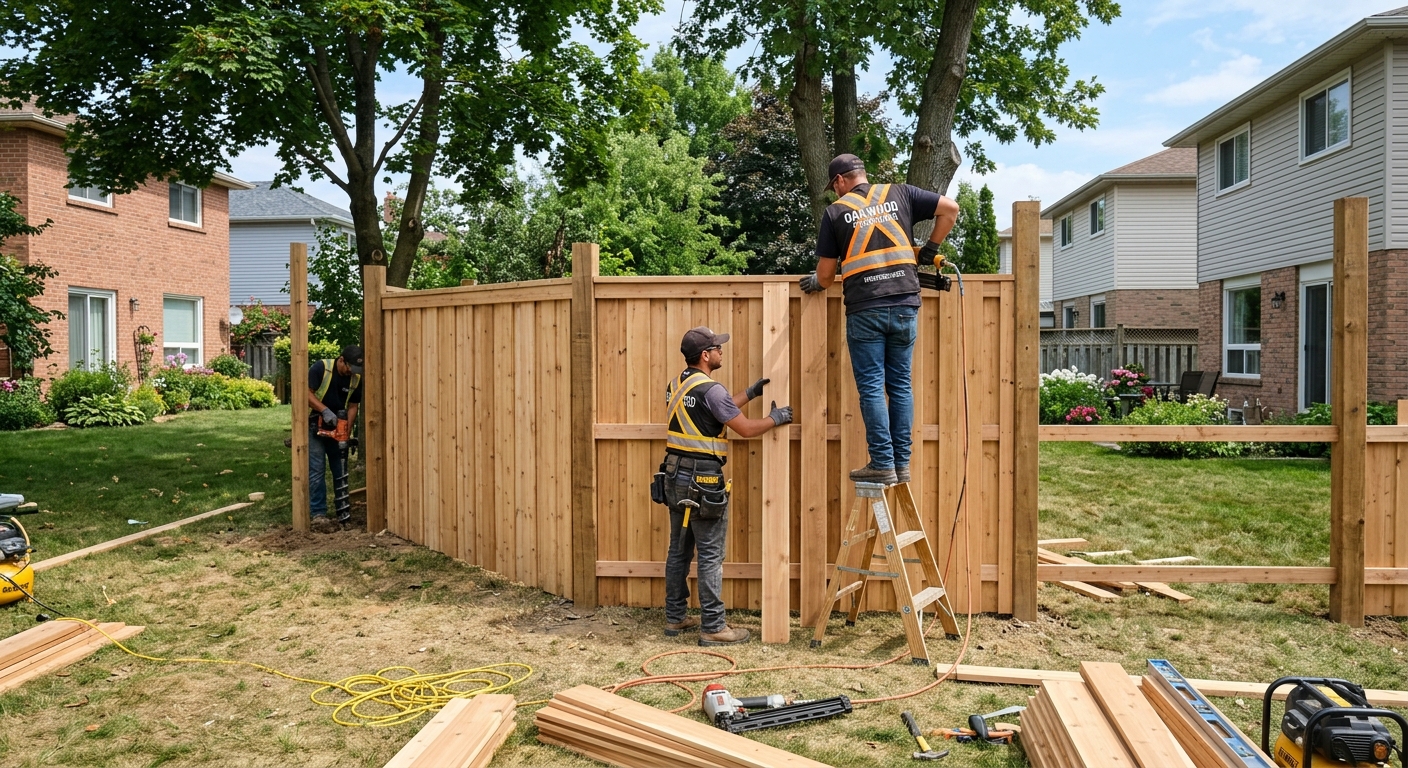
Fencing options and costs in Stony Plain
In Stony Plain, fence choice starts with your goals—privacy, curb appeal, or keeping costs predictable—and then it quickly becomes a site-and-climate project. With 58.1% of local dwellings being single-detached houses (Statistics Canada, 2021 Census), many homeowners are planning boundary and backyard upgrades, especially as lots age and families reconfigure outdoor space. Homeownership is also strong, with 73.0% of households owning their homes (Statistics Canada, 2021 Census), which typically means more long-term fence investments rather than temporary fixes.
In the Edmonton economic region, fencing costs are driven less by material alone and more by install conditions. Contractors account for Alberta’s frost depth by setting posts below the frost line to reduce heaving; that usually means deeper holes, longer posts, and often concrete-set footings. Wind exposure across the Prairies also matters—more open sites need sturdier posts and tighter spacing to keep panels from racking. Availability of experienced crews can influence lead times, and those extra hours show up in labour line items.
Demand is especially active in established residential pockets near the core and along major corridors where lots are larger and fences tend to be both visible and exposed to wind, such as around the downtown area and the Planters Ridge / Westpointe-style growth zones. From there, the comparison below helps you map typical installed pricing to durability and privacy.
Use the table to benchmark your quote against common Stony Plain installs, then ask your contractor what changes for your specific yard.
| Material |
Lifespan |
Maintenance |
Privacy Rating |
Price per Linear Foot |
| Pressure-treated pine (standard wood) |
10–20 years |
Stain/seal every 2–3 years to slow greying and warping |
High (solid privacy) |
$18 – $34 |
| Cedar (natural rot resistance) |
15–25 years |
Periodic seal/stain (every 2–4 years depending on sun exposure) |
High (solid privacy) |
$22 – $40 |
| Vinyl / PVC (no-maintenance) |
20–30 years |
Rinse as needed; rare repairs |
High (privacy styles available) |
$24 – $50 |
| Chain-link (galvanized steel) |
20–40 years |
Minimal; occasional tension/repairs |
Low (limited privacy) |
$12 – $24 |
| Aluminum ornamental |
25–40 years |
Wash annually or as needed |
Low–Medium (depends on spacing) |
$22 – $48 |
| Composite / recycled material |
20–30 years |
Occasional wash; no routine staining |
Medium–High (solid panel options) |
$25 – $55 |
Prices are estimates only and vary by project scope, site access and material selection.
What affects the price of fencing in Stony Plain
If you’re getting multiple quotes for the same fence style in the Edmonton region, it’s common to see a 30–50% spread—not because contractors “charge more,” but because the real work changes with conditions. Two yards can both be “6 ft privacy fences,” yet one might need deeper, concrete-set posts due to frost considerations and another might have easy access and stable ground, lowering installation time. Also, labour availability and how a crew plans bracing, gates, and removals can shift costs substantially between bids.
Frost line depth is a major driver in Alberta. To reduce heaving, posts typically need to be set about 4–6 inches below the design frost depth; in practical terms for Edmonton-area installs, that often translates to post embedment around 1.5–2.0 m. Deeper holes mean more excavation time, longer treated boards, and more concrete if you’re using concrete-set posts. Wind exposure on the Prairies then pushes contractors to tighter post spacing and heavier frames—especially for privacy fences—so panels don’t rack.
Here are common Stony Plain examples that raise costs: (1) a yard with rocky or frozen ground can extend labour for hole digging and footing prep; (2) a property with an unexpected grade change often needs stepped rails or raked sections, adding fabrication time; and (3) gate builds (especially drive-through double gates) add hardware and bracing. Conversely, costs can come down when there’s clear access for a skid/vehicle near the fence line and when you’re reusing sound footing locations (for example, replacing a section rather than building from scratch).
Budget planning usually follows the regional bands: wood installations often land around $3,000 – $6,500 depending on length and site conditions, while vinyl privacy typically sits closer to $3,500 – $8,000 for comparable projects.
| Price Factor |
Why It Matters |
Cost Impact |
| Fence length in linear feet |
More material, more labour hours, more post holes and hardware |
Largest driver (often determines total price) |
| Post depth required |
Frost depth controls embedment to prevent heaving |
Can add significant labour + concrete |
| Post setting method |
Concrete-set posts typically improve stability in freeze/thaw cycles |
Concrete + longer setting time increases cost |
| Material choice |
Strength, framing, and weathering performance vary by product |
Vinyl/cedar/aluminium cost more than basic pressure-treated wood |
| Gate count and type |
Gates require bracing, hinges, latches and often heavier posts |
More gates can add hours and hardware costs |
| Grade and terrain |
Slope requires stepping/racking and extra rail fabrication |
Higher labour, more cut waste |
| Old fence removal and disposal |
Breakdown, haul-away, and disposal fees |
Can materially change bid price |
| Permit fees and survey / property line locate |
Verification work reduces boundary disputes |
Small but can be meaningful in total |
Permits & regulations in Alberta
In Alberta, the need for a building permit often depends on fence height and location. As a practical rule of thumb in many Alberta municipalities, fences above about 2.0 m (6.5 ft) at the rear and roughly 1.0–1.2 m (3–4 ft) at the front or corner commonly trigger a permit requirement. However, the final determination is location-specific, so don’t rely on assumptions—your contractor should confirm the requirement for Stony Plain based on your exact height and where the fence sits relative to streets and corners.
All fences must respect property lines and municipal setback bylaws. Before you dig any post hole, call for utility locates through Alberta One-Call (formerly commonly referenced as “Alberta One-Call”) to mark gas, power, communications and any buried services. In addition, obtain a survey or at least have the property pins/locates confirmed before installation—this protects you from encroachment disputes with neighbours and reduces change-order risk.
Shared fence ownership and responsibilities are governed by provincial line-fences legislation, so if you’re replacing or building where a shared boundary is involved, document what’s shared (and what’s not) before work starts.
How to verify your contractor in Stony Plain: confirm their Alberta business licence/registration where applicable, ask for a current certificate of insurance (general liability), and ensure coverage is in place for workers (WSIB/WCB). Request the certificate directly and keep it on file; a legitimate contractor can also provide proof of clearance where required and will not resist answering basic compliance questions. If they can’t provide documentation, pause and re-check.
Choosing the right fence material for Stony Plain
Choosing a fence material in Stony Plain is about balancing privacy, maintenance, and how the product handles cold snaps, freeze/thaw, and wind across the Prairies. Pressure-treated pine is usually the most budget-friendly way to get a solid privacy fence, but it’s not “set and forget.” You’ll typically need staining or sealing every 2–3 years to slow greying and keep boards from warping. Cedar offers better natural rot resistance and often looks sharper for longer, yet it still benefits from periodic maintenance—especially if your fence faces strong sun or prevailing winds.
Vinyl/PVC is popular for low maintenance and clean appearance, but Alberta’s cold can make expansion/contraction management important—good installation details and proper post spacing matter. Chain-link is typically the lowest-cost option and can last a long time, but it doesn’t provide privacy unless you add privacy slats or plant screening. Aluminum ornamental fencing is durable and rust-resistant, but it’s mainly for curb appeal and boundary definition rather than privacy. Composite/recycled materials sit in the “higher upfront, less maintenance” category and can be a good fit when you want a modern look without routine staining.
On post depth: because frost heaving is a real risk, many Edmonton-area installs benefit from concrete-set posts or at minimum properly engineered post setting to reach below the frost line. If you’re building a taller privacy fence in a wind-exposed yard, plan for sturdier framing and tighter spacing so panels don’t rack.
For a concrete cost example, switching from pressure-treated pine to vinyl often moves you from the wood band (roughly $3,000 – $6,500 for many installs) toward the vinyl band (often $3,500 – $8,000), but the price can be justified when you want minimal upkeep and long-term consistency in appearance.
| Material |
Cold Tolerance |
Lifespan |
Annual Maintenance |
Best For |
Price Band |
| Pressure-treated pine |
Good (if properly set below frost line) |
10–20 years |
Low to moderate (stain/seal every 2–3 years) |
Budget privacy |
$3,000 – $6,500 |
| Cedar |
Good (natural resistance improves outcomes) |
15–25 years |
Low to moderate (periodic seal/stain) |
Premium look with better rot resistance |
$3,500 – $7,500 |
| Vinyl / PVC |
Very good (works best with correct installation) |
20–30 years |
Very low (rinse as needed) |
Low-maintenance privacy |
$3,500 – $8,000 |
| Chain-link |
Excellent (galvanized) |
20–40 years |
Very low |
Security and long life (with limited privacy) |
$2,000 – $4,500 |
| Aluminum ornamental |
Excellent (powder-coated) |
25–40 years |
Very low (wash annually) |
Curb appeal and boundary definition |
$4,000 – $9,000 |
| Composite / recycled |
Good (product-dependent, generally stable in cold) |
20–30 years |
Low (wash; no staining) |
Modern low-maintenance privacy |
$4,000 – $9,000 |
How to choose a fencing contractor in Stony Plain
Choosing the right contractor in Stony Plain is mostly about proof and process. Start with Alberta compliance: request their certificate of insurance (general liability) and confirm workers are properly covered (WSIB/WCB coverage as applicable). How to check—ask for documents directly and verify details match the legal name on their quote. A credible contractor should also be able to provide any relevant clearance letter or coverage confirmation without delay.
Next, collect 2–3 itemised written quotes. “Itemised” should mean separate line items for excavation/post holes, post setting (concrete vs. gravel pack vs. other method), rails and pickets/panels, gates and hardware, plus removal/disposal if you’re replacing an existing fence. Get clarity on what’s excluded: stump/grind, disposal location, concrete amounts, and any extra charges for difficult access or after-hours work.
Warranty matters too. Ask for both workmanship warranty length and product/manufacturer warranty details, and whether the warranty is transferable to you. Then look at payment scheduling: never pay more than 10–15% upfront. Hold back the balance until the job is complete and inspected.
Finally, insist on a written timeline: start date, estimated completion date, and how delays from weather or material lead times are handled. In freeze/thaw conditions, delays can be unavoidable, but good contractors communicate them early.
- Confirm they provide a certificate of insurance (general liability) before work starts.
- Verify WSIB/WCB coverage for workers and request proof/clearance documentation.
- Ask for an itemised quote separating labour, materials, gates, and disposal.
- Ensure post setting method is stated clearly (concrete-set vs. alternative).
- Confirm permit responsibility if your height/location triggers a permit in Alberta.
- Ask who pulls/coordinates utility locates and whether they reference Alberta One-Call markings.
- Get a gate hardware list (hinges, latches, posts/bracing) in writing.
- Check warranty terms in writing: workmanship vs. manufacturer, and transferability.
- Make sure the quote includes grading solutions for slopes (raked vs. stepped sections).
- Agree on material spec (grade, thickness, framing size, fastener type) so you can compare bids fairly.
- Use a payment schedule with a 10–15% maximum deposit and a holdback until completion.
- Require start/completion dates and a weather-delay plan in the contract.
Red flags to watch for in Stony Plain: contractors who won’t provide insurance/coverage documents, quotes that are a single lump sum without post setting details, promises to “skip” utility locates, vague warranty language (“full coverage” without durations), and asking for large upfront payments or insisting you don’t need a written scope.
Frequently asked questions — fencing in Stony Plain
How deep should fence posts be for Stony Plain's frost?
In Stony Plain and the broader Edmonton area, the goal is to set posts below the frost-affected zone to reduce heaving. Contractors typically plan holes about 4–6 inches below the design frost depth, which often works out to roughly 1.5–2.0 m embedment in practice for many Alberta installs. Depth also depends on soil stability—rocky or frozen ground may require different prep, and wind-exposed yards often justify stronger post/bracing rather than just deeper holes.
When you compare quotes, ask: What is the post depth and diameter, and is it concrete-set or gravel-packed? Those answers explain why fencing jobs can land anywhere from wood ranges around $3,000 – $6,500 up to higher options like vinyl privacy closer to $3,500 – $8,000 for similar lengths.
Wood vs vinyl vs aluminum fence — which is best?
“Best” depends on your priorities in Alberta. Pressure-treated wood is often the most budget-friendly to install and can deliver strong privacy, but it usually needs staining/sealing every 2–3 years to prevent greying and reduce warping. Cedar offers better natural rot resistance and a premium look, though it still benefits from periodic maintenance. Vinyl/PVC is popular in Stony Plain because it’s low maintenance and handles freeze/thaw well when properly installed with correct spacing and sturdy framing; the upfront cost is usually higher (commonly within the vinyl band of $3,500 – $8,000).
Aluminum is excellent for durability and rust resistance and usually costs mid-to-high (often overlapping $4,000 – $9,000), but it’s usually best for ornamental boundary fencing rather than full privacy due to its spacing. If wind racking is a concern, ask how each material is framed and braced.
Do I need a permit to build a fence in Alberta?
In Alberta, many fence builds can proceed without a permit, but a permit is commonly required when the fence exceeds height thresholds—often around 2.0 m (rear) and about 1.0–1.2 m (front or corners), depending on the situation. Because requirements can be location-specific in Stony Plain, your safest approach is to have your contractor confirm whether your exact height and placement triggers a permit before work starts.
Regardless of permits, you must respect property lines and municipal setback bylaws. Before digging, ensure utility locates are completed via Alberta One-Call so crews don’t hit buried services. If your fence aligns with a shared boundary, confirm responsibility and rules under provincial line-fences legislation so you and your neighbour are on the same page.
How long does a wood fence last in Stony Plain?
A properly installed wood fence in Stony Plain typically lasts around 10–20 years for pressure-treated pine, and roughly 15–25 years for cedar, assuming good post depth, secure framing, and reasonable exposure conditions. Longevity is strongly influenced by how posts are set below the frost line and whether the fence is maintained. In Alberta freeze/thaw cycles, shallow or poorly set posts can heave, leading to sagging rails and faster board wear.
Maintenance affects outcomes: sealing/staining every 2–3 years for pressure-treated wood helps slow greying and cracking. If your fence sits in heavy wind or direct sun, plan on more frequent attention to top rails, fasteners, and any areas where water collects at the base.
Who owns and maintains a shared fence?
Shared fence ownership and maintenance responsibilities are governed by provincial line-fences legislation, not just neighbour-to-neighbour tradition. In Stony Plain, the practical takeaway is that you should determine whether the fence is considered shared on the boundary and what portion each party is responsible for repairing or replacing. If you’re replacing an existing shared fence, document the condition and agree on scope before anyone tears things apart.
For many homeowners, disputes come from assumptions—like who pays for corner bracing, who owns the gate, or whether a new privacy fence changes the “shared” aspect. Ask your contractor to help you confirm the layout and location, and consider getting a survey or at least a property pin locate before the work begins to avoid encroachment issues.
How do I find my property line before fencing?
Before installing a fence in Stony Plain, confirm property lines rather than guessing from old markers or the current fence location. Start with a survey if you have one from when the home was purchased. If not, arrange a property pin/locate or hire a professional to locate boundary pins so you can identify the true line. This reduces the risk of encroachment disputes—especially where older fences may have drifted over time.
Also remember utility locates: call Alberta One-Call before digging post holes so the contractor can mark buried services. When you compare quotes, ask whether the contractor includes property line locate/survey coordination or whether it’s your responsibility—this affects cost and timing. A clear layout also helps keep fencing installs within your budget band (for example, wood often estimates around $3,000 – $6,500 depending on length and site conditions).