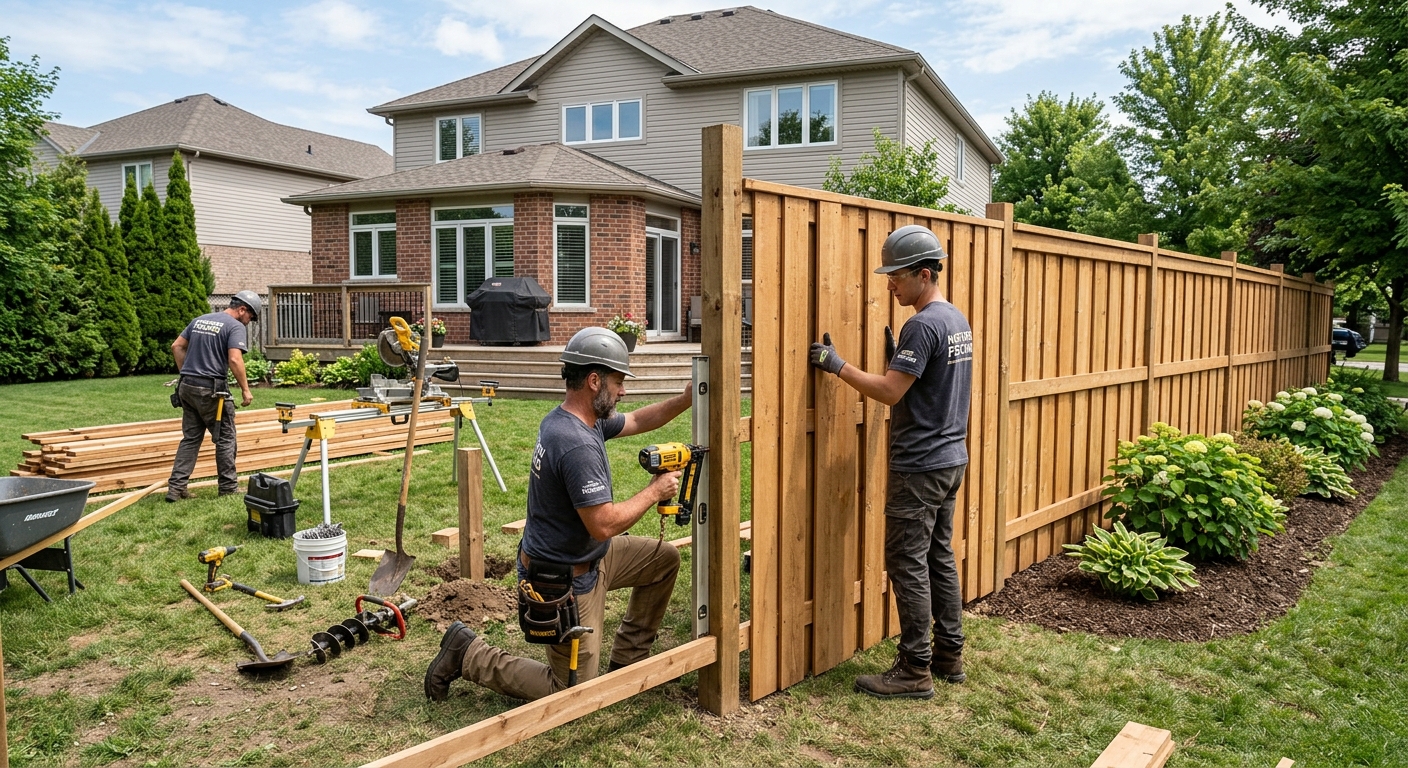
Fencing options and costs in Kelvin Grove
In Kelvin Grove, Alberta, the right fence choice usually comes down to wind firmness, winter longevity, and whether you want privacy or simply boundary definition. With a community population of 1,805 (Statistics Canada, 2021 Census), demand is smaller than Calgary proper, but the growth in detached housing means steady work for perimeter upgrades—every detached lot is a potential fencing project. As your neighbours re-shape yards for family use, pets, and winter storage, the strongest cost swing is driven by Calgary’s Prairie continental freeze–thaw cycles and open exposure.
In this part of the Calgary economic region, frost protection is not optional. Local expectations typically call for setting fence posts about 4 ft (≈120 cm) deep—often with concrete footings for privacy fences and gate posts—so the fence doesn’t heave during spring melt. That deeper excavation increases labour hours and concrete volume, and it also affects material sizing and post length. At the same time, Prairie wind loads encourage tighter bracing and closer post spacing for solid panels (wood or vinyl), while more open styles (chain-link) cost less because wind passes through.
Contractors are especially busy around established residential pockets near the Kelvin Grove/NE Calgary commuter corridor where lots are older and property line fences are commonly replaced. If you’re comparing options, the table below summarizes typical lifespans and realistic installed pricing bands per linear foot for Kelvin Grove-area projects.
| Material |
Lifespan |
Maintenance |
Privacy Rating |
Price per Linear Foot |
| Pressure-treated pine (standard wood) |
12–20 years |
Stain/seal every 2–3 years |
High (solid panels) |
$40–$80 |
| Cedar (natural rot resistance) |
15–25 years |
Light stain/seal every 2–3 years |
High (boards or solid privacy styles) |
$55–$95 |
| Vinyl / PVC (no-maintenance) |
20–30 years |
Rinse as needed; inspect posts and caps |
High (solid privacy panels) |
$45–$90 |
| Chain-link (galvanized steel) |
20–35 years |
Occasional wash; tension checks |
Low–Medium (open mesh) |
$25–$55 |
| Aluminum ornamental |
25–40 years |
Wash periodically; check fasteners |
Low (decorative pickets) |
$70–$120 |
| Composite / recycled material |
20–30 years |
Minimal cleaning; occasional hardware checks |
Medium–High (depends on slat design) |
$60–$110 |
Prices are estimates only and vary by project scope, site access and material selection.
What affects the price of fencing in Kelvin Grove
In Kelvin Grove, Alberta, two quotes for the same fence height can still differ by 30–50% because the “same fence” on paper often has different ground conditions, access constraints, and structural requirements. In the Calgary economic region, deep frost protection, wind loading, and the need for rigid post bracing all push the labour and materials side of the estimate upward—especially when you move from open fencing (chain-link) to solid privacy panels (wood/vinyl). That’s why a project that lands near the lower band (chain-link) can look like a totally different budget when you choose wood privacy or vinyl privacy.
Frost line depth sets how deep posts must be set—typically 4–6 inches below the design frost depth—so the soil doesn’t heave and break the alignment. In cold Prairie conditions, that commonly means posts go roughly 1.5–2.0 m into the ground, often with concrete setting and longer posts, which increases both material cost (longer posts) and excavation time. Wind exposure on the Prairies also drives tighter post spacing and heavier panels for solid privacy fences, while chain-link can be less expensive because airflow reduces racking pressure.
Concrete examples from Kelvin Grove: (1) A 60 ft wood privacy run often costs more than a similar chain-link run not only because of the boards, but because the crew usually concreted additional gate and corner posts. (2) If your yard is sloped near the back property line, stepped rails and additional labour for raking can push a “standard” vinyl quote toward the upper end of the $45–$90 band. (3) If your existing fence is rotted and partially concrete-embedded, demolition and disposal can turn a moderate job into an estimate closer to the upper end of the $40–$80 wood installation range.
| Price Factor |
Why It Matters |
Cost Impact |
| Fence length in linear feet |
More footage means more posts, rails, brackets, and fasteners. |
Highest driver; small changes multiply cost. |
| Post depth required |
Frost protection determines hole depth and post length. |
Deeper holes raise excavation and material. |
| Post setting method |
Concrete vs. gravel pack vs. driven posts affects stability and prep. |
Concrete setting increases labour and volume. |
| Material choice |
Vinyl/cedar/wood require different framing and weather resistance. |
Moves your budget across common bands. |
| Gate count and type |
Double-drive gates need heavier hardware and bracing. |
Often adds significant labour and structural costs. |
| Grade and terrain |
Slopes require stepping or raked panels and extra measurement time. |
Can add hours and extra materials. |
| Old fence removal and disposal |
Hauling debris and handling embedded posts costs time and equipment. |
Can increase the quote substantially on older installs. |
| Permit fees and survey / property line locate |
Required documentation affects pre-construction time and risk management. |
Varies by project; affects scheduling and admin costs. |
Permits & regulations in Alberta
In Alberta, fences above a height threshold—typically around 2.0 m (6.5 ft) at the rear and 1.0–1.2 m (3–4 ft) at the front or corner—often require a building permit. Your fence must also respect property lines and the applicable municipal setback requirements. Before digging any post hole, call for utility locates through Alberta One-Call; even a “small” fence trench can hit buried services. If you’re not 100% certain where your pins/property line are, get a survey or a property line locate first—encroachment disputes are expensive once posts and concrete are already in the ground.
For shared boundary fencing, line-fences rules in Alberta govern ownership and maintenance responsibilities, so it’s smart to confirm who maintains the fence and how costs are handled before removing an existing structure.
To verify a contractor in Kelvin Grove: check Alberta licensing where applicable for their trade/contracting category, confirm they carry general liability and provide a certificate of insurance, and ensure workers’ compensation coverage is in place (WSIB/WCB equivalent coverage in Alberta). Ask for (1) their insurance certificate showing your job site coverage, (2) their clearance or account confirmation document for worker coverage, and (3) their licensing/registration details from the appropriate online registry so you can match company legal name and address. Then keep these documents with your signed contract and quote.
Choosing the right fence material for Kelvin Grove
Choosing a fence material in Kelvin Grove is about balancing privacy, maintenance, and winter durability in a Prairie climate. Pressure-treated pine is the budget-friendly route, but it typically requires staining or sealing every 2–3 years to reduce grey weathering and protect boards from moisture cycling. Cedar naturally resists rot and often looks better longer, though it still benefits from periodic stain to maintain colour and reduce surface checking.
For low maintenance, vinyl/PVC is a strong fit—there’s no routine staining, and it generally tolerates Alberta winters well when installed with proper expansion gaps and sturdy framing. However, vinyl can become brittle if the system is undersized for wind and not adequately braced on the Prairies. Chain-link is usually the lowest upfront option and can be long-lived because it lets wind through, reducing racking pressure; the trade-off is minimal privacy. Aluminum ornamental is attractive and rust-resistant, but like most open styles it won’t give the privacy level many neighbours want.
In Calgary-area frost conditions, post-depth requirements drive the “real” cost of any fence. Concrete-set posts are commonly used for privacy fences and gate posts because they help keep alignment through freeze–thaw movement; for chain-link, some installers use alternate methods, but the stability payoff is still influenced by how deep holes go and whether corners/gates are engineered for wind load. For example, if you’re comparing wood privacy to chain-link, a chain-link run around the $25–$55 band may look cheaper, but if you need privacy and solid wind screening, spending closer to the $40–$80 wood band (or vinyl near $45–$90) is usually justified by fewer replacement repairs and a more functional yard.
| Material |
Cold Tolerance |
Lifespan |
Annual Maintenance |
Best For |
Price Band |
| Pressure-treated pine |
Good with proper sealing and top caps |
12–20 years |
Seasonal inspection; stain/seal every 2–3 years |
Budget privacy with classic look |
$40–$80 |
| Cedar |
Good; benefits from routine surface protection |
15–25 years |
Inspect and re-stain as needed (typically every 2–3 years) |
Privacy + better appearance |
$55–$95 |
| Vinyl / PVC |
Very good when installed correctly for temperature swings |
20–30 years |
Minimal; wash and inspect after harsh winters |
Low maintenance privacy |
$45–$90 |
| Chain-link |
Excellent; mesh handles temperature swings well |
20–35 years |
Low; tension checks and occasional rinse |
Security and boundary definition |
$25–$55 |
| Aluminum ornamental |
Excellent in freeze–thaw cycles |
25–40 years |
Low; wash and inspect hardware |
Curb appeal with open perimeter |
$70–$120 |
| Composite / recycled |
Good; relies on quality fasteners and framing |
20–30 years |
Low; clean and check fittings |
Privacy or semi-private designs with minimal upkeep |
$60–$110 |
How to choose a fencing contractor in Kelvin Grove
To hire well in Kelvin Grove, I recommend verifying three things before you sign: licensing/registration where required, liability insurance, and worker coverage for Alberta. Start by asking for their certificate of insurance (general liability) and confirming the certificate shows the correct legal company name and lists your job site or project description. Next, request proof of workers’ compensation coverage (Alberta WCB clearance/account documentation) to reduce your risk if someone is injured on site. Finally, confirm their contractor registration/licensing details from the appropriate online registry and match it to the company name on your quote and invoice.
Then get 2–3 written, itemised quotes—not just lump sums. A proper fence quote should show labour and material quantities, including post count, post depth strategy, rail framing, gate hardware, and any concrete/footing amounts. Read the scope carefully: is permit pulling included or excluded? Is removal of your existing fence and hauling/disposal included, and where does waste get dropped? A workmanship warranty should be clearly stated (for example, a period covering post alignment/rail attachment failures), separate from manufacturer warranty on material components. Ask if the warranty is transferable to you as the homeowner.
On payment, never pay more than 10–15% upfront. Hold back the remainder until the work is complete, inspected, and cleaned up. Also request a written start date and completion estimate—Prairie weather can shift excavation schedules, but you should still get a realistic timeline tied to materials and crew availability.
- Confirm their insurance certificate is current and matches the quote’s legal business name.
- Verify workers’ compensation coverage (WCB clearance/account proof).
- Ask whether they set posts to the region-appropriate depth and how they protect from frost heave.
- Require post layout drawings or a written post spacing plan.
- Get an itemised breakdown: labour, concrete, hardware, and fencing material.
- Clarify what’s included for gate reinforcement (hinges, latch, bracing, posts).
- Ask who calls for utility locates and whether it’s done before digging.
- Confirm whether permits are included, excluded, or handled by you.
- Make sure disposal/haul-away of old fence materials is specified.
- Request a workmanship warranty length and what it covers in plain language.
- Review the payment schedule; keep a holdback until final completion.
- Ask for a written schedule window and weather contingency approach.
Red flags I commonly see in Kelvin Grove: (1) they won’t show proof of current insurance or workers’ coverage, (2) they quote “standard post depth” without discussing frost protection, (3) they avoid itemisation and only provide a lump sum, (4) they require large upfront payments (more than 10–15%), and (5) they start excavation without confirming utility locates and property line layout.
Frequently asked questions — fencing in Kelvin Grove
Who owns and maintains a shared fence?
In Alberta, shared boundary fencing is typically handled under provincial line-fences legislation, which outlines responsibilities for ownership and maintenance. In practice, that means you should identify whether the fence is truly on a shared boundary, then agree (in writing if possible) on who maintains it and how costs are split. In Kelvin Grove, older neighbourhood fences are often replaced because posts have shifted after freeze–thaw cycles, so it’s especially important to clarify responsibilities before removing an existing fence and setting new concrete footings. If you’re planning a privacy upgrade (wood or vinyl), the cost difference versus chain-link can also change how neighbours negotiate maintenance contributions.
How do I find my property line before fencing?
Before you dig fence post holes in Kelvin Grove, confirm the exact property line—don’t rely on guesses or neighbour memory. If you don’t have a recent survey, order a survey or request a property line locate based on your pins and official boundaries. A proper locate is valuable because a fence isn’t easily corrected once concrete is in. Also, do utility locates through Alberta One-Call before any excavation so you don’t accidentally hit buried services during post digging. This matters for any style—whether you’re installing a low-cost chain-link boundary around the $25–$55 band or a solid privacy system—because setbacks and accurate placement can determine what you’re allowed to build and how disputes are handled.
What's the most low-maintenance fence?
For many Kelvin Grove homeowners, vinyl/PVC is the most low-maintenance choice because it doesn’t need annual staining like wood. You still want an inspection after harsh winters to check caps, post anchors, and gate hardware, but the day-to-day upkeep is minimal. Vinyl privacy typically runs near $45–$90 per linear foot depending on height and how many posts/gates are included. The key is correct installation for Prairie freeze–thaw movement and wind loads—if posts and bracing aren’t sized properly, you can get alignment issues that increase repair effort. Chain-link is also low maintenance, but it won’t provide the privacy many households want.
How tall can my fence be in Kelvin Grove?
In Alberta, fence height rules often vary by location on the property and can trigger permit requirements. A common threshold used for permitting is roughly 2.0 m (6.5 ft) for rear fencing and about 1.0–1.2 m (3–4 ft) for front or corner areas, but you must confirm the exact municipal bylaw for your parcel. Practically, if you’re aiming for a privacy fence that screens wind and view lines, most Kelvin Grove homeowners target the rear-height range and plan for a permit review where required. Taller fences also face higher wind-loading; that affects post depth, post spacing, and hardware strength, which influences cost—especially when you’re choosing wood or vinyl privacy styles.
Should fence posts be set in concrete here?
In Kelvin Grove and the wider Calgary area, concrete-set posts are commonly recommended for privacy fences and especially for corners and gate posts. The reason is frost protection: freeze–thaw cycles can heave improperly set posts, and local guidance often aligns with setting posts about 4 ft (≈120 cm) deep so they sit below regional frost movement. For privacy fences (wood or vinyl), solid panels catch more wind, so rigid anchoring helps prevent racking. While some chain-link installs can use alternate methods in certain conditions, concrete setting is often the safest approach where alignment and durability matter most. If you’re getting estimates, ask how deep the holes are and what setting method is used for each post type—gate posts and corner posts should be treated differently than standard fence posts.
What's the best fence for privacy?
For privacy in Kelvin Grove, the best options are typically solid wood privacy panels or vinyl privacy systems, provided the installation is designed for Prairie wind and frost movement. Solid panels deliver a high privacy rating because they block sightlines and reduce noise, but they also require sturdier framing and usually closer attention to post spacing and concrete footings where needed. A vinyl privacy fence often lands around $45–$90 per linear foot, while pressure-treated wood privacy commonly sits in the $40–$80 band depending on height, length, and gate complexity. Chain-link can be made more private with slats or screening, but it usually doesn’t match the same level of visual privacy as true solid systems. If you’re prioritizing privacy and winter durability, prioritize correct post depth, solid rails, and reinforced gate hardware over saving on concrete alone.