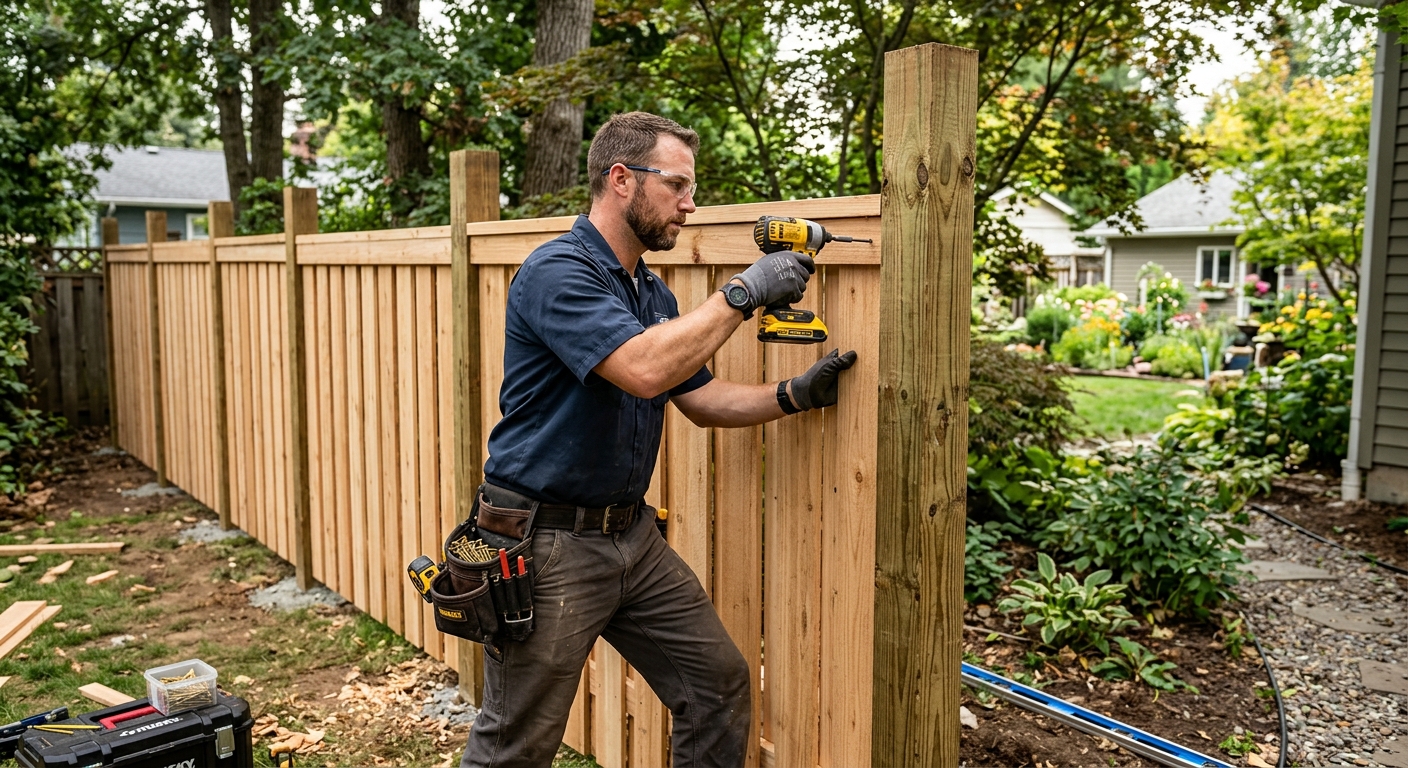
Fencing options and costs in Albert Park/Radisson Heights
Fencing in Albert Park/Radisson Heights, Alberta is a practical upgrade—especially if you want clear property lines, safer yards for kids and pets, and a tidy look along mature streets. This neighbourhood is home to about 6,740 residents (Statistics Canada, 2021 Census), which means steady local demand without the “boom-and-bust” swings you see in faster-growing pockets. Most homeowners here are living in established residential areas, and one detached property often leads to the next: your fence line can become a community project that multiple neighbours plan around in the same season.
Calgary’s Prairie continental climate directly shapes price. Long freeze–thaw cycles mean posts must be set deep enough to reduce heaving, commonly around 4 ft (≈120 cm) for frost protection. That excavation and concrete work is the biggest reason solid fences cost more than airy systems. Open Prairie exposure also increases wind loading, so privacy panels usually require closer post spacing and sturdier brackets to resist racking during gusty winter storms. In practical terms, wood and vinyl privacy fences typically sit in the mid-to-upper part of the market band, while chain-link stays lower because it’s lighter and lets wind pass through.
In Albert Park/Radisson Heights, trade activity is especially strong around busier residential corridors where homeowners frequently replace aging boards and add gates for garages and backyard access. The quickest way to compare your options is to look at how each material performs over time and what you can expect per linear foot, then match that to your privacy needs.
| Material |
Lifespan |
Maintenance |
Privacy Rating |
Price per Linear Foot |
| Pressure-treated pine (standard wood) |
10–15 years |
Stain/seal every 2–3 years; periodic board replacement |
High (solid boards) |
$40 – $70 |
| Cedar (natural rot resistance) |
15–20 years |
Stain as needed (often 2–4 years); occasional maintenance |
High (solid boards) |
$55 – $80 |
| Vinyl / PVC (no-maintenance) |
20–30 years |
Wash annually or as needed; no staining |
High (solid panels) |
$45 – $90 |
| Chain-link (galvanized steel) |
20–40 years |
Rare repairs; occasional tensioning |
Low–medium (open airflow) |
$25 – $55 |
| Aluminum ornamental |
25–40 years |
Occasional wash; hardware checks |
Low–medium (decorative pickets) |
$70 – $120 |
| Composite / recycled material |
20–30 years |
Low—wash/spot clean; monitor posts and fasteners |
Medium–high (depends on style) |
$60 – $100 |
Prices are estimates only and vary by project scope, site access and material selection.
What affects the price of fencing in Albert Park/Radisson Heights
In Albert Park/Radisson Heights, two quotes for what looks like the “same fence” can still differ by 30–50%. That’s because fencing price is driven less by the name of the material and more by how the job is built for Calgary’s Prairie conditions—especially post depth, wind loading, and labour time for excavation and setting. Even when homeowners choose similar materials, contractors may budget different post spacing, different footing sizes, or different gate hardware depending on what they expect the wind and snow loads to do over the next decade.
The frost line is the biggest cost equalizer. Calgary’s freeze–thaw cycles often require posts to be set about 4 ft deep (≈120 cm) to sit below regional frost effects, and many builds add concrete footings so posts don’t heave. When that means deeper holes, you’re paying for more digging, more concrete volume, and longer posts—all of which rise labour and material costs. On the Prairie, wind exposure also pushes solid panel systems to tighter post spacing and stronger bracing; airy chain-link, by contrast, typically costs less because it needs less rigid support to prevent racking.
Local examples: (1) If your yard is shaded and has heavier snow drift accumulation, solid privacy panels often need braced centres and sturdier hardware, adding cost versus a lighter fence line. (2) If you have lots of frozen/rocky spots, excavation time can jump, which affects wood at the low–mid band (often around $40 – $80 for wood installation) more than chain-link because wood systems are more post-intensive for privacy. (3) If you’re replacing an old fence, removal and disposal can add time and hauling fees; chain-link jobs may be faster to strip, while dense wood boards take longer.
That’s why budget decisions should be paired with site realities. A project that’s “only” 40 linear feet can end up priced like a larger job once deeper concrete-set posts, extra gates, or terrain changes are included.
| Price Factor |
Why It Matters |
Cost Impact |
| Fence length in linear feet |
The primary driver; more feet means more posts, rails, and fasteners |
Largest variable; proportional to cost |
| Post depth required |
Frost protection determines hole depth and required post length |
Can add major excavation and material cost |
| Post setting method |
Concrete-set posts resist heaving; gravel pack and driven methods vary by soil |
Concrete typically increases cost; driven posts can reduce it |
| Material choice |
Different stiffness and airflow change how much structure is required in wind |
Vinyl/wood often mid–upper; chain-link typically lower |
| Gate count and type |
Drive-through gates are heavier and need more robust frames and latching |
Generally one of the biggest adders |
| Grade and terrain |
Slopes require stepping or raking to keep panels aligned |
More labour and extra materials for rails and shaping |
| Old fence removal and disposal |
Scrap/hauling time and disposal fees vary by volume and access |
Often a significant one-time charge |
| Permit fees and survey / property line locate |
Paperwork and staking prevent encroachment issues and rework |
Can be modest but adds administrative time |
Permits & regulations in Alberta
In Alberta, fence permitting is often triggered by height and location. As a practical rule of thumb, fences above roughly 2.0 m (6.5 ft) at the rear and around 1.0–1.2 m (3–4 ft) at the front or corner may require a building permit, depending on how the fence is classified and where it sits on the lot. Regardless of permit requirements, all fencing must respect property lines and municipal setback bylaws.
Before digging post holes in Albert Park/Radisson Heights, call for utility locates through Alberta One-Call so you don’t hit buried services. Homeowners should also consider a survey or at least a property line locate before install—especially if the current fence is older or shifted—so you don’t end up in disputes with neighbours or your contractor can’t re-stake the line mid-project.
Shared fence ownership is handled under Alberta’s line-fence principles. If you’re replacing a fence that separates properties, ask neighbours early about responsibility for the dividing line fence, the style, and whether costs are shared.
To verify a contractor’s Alberta compliance, do this step-by-step: (1) confirm their business and trade credentials through official online listings (if applicable for the scope), (2) request a current certificate of insurance showing general liability and confirm coverage limits, (3) ask for WSIB/WCB clearance where required for the work and workers involved, and (4) get the contract and scope in writing so liability and job responsibilities are clear before any excavation begins.
Choosing the right fence material for Albert Park/Radisson Heights
Choosing the right fence material in Albert Park/Radisson Heights is mostly about matching your priorities—privacy, low maintenance, budget, and lifespan—to Calgary’s freeze–thaw winters and Prairie wind exposure. Pressure-treated pine is usually the entry-level option: it can look great at install, but it typically needs staining or sealing every 2–3 years to slow down grey weathering and warping. Cedar has better natural rot resistance and often looks warmer and more uniform, but it still benefits from periodic maintenance to keep colour and prevent surface checks.
Vinyl/PVC is a strong “set it and forget it” choice because it doesn’t need staining, and most owners just wash it and keep an eye on hardware. The catch in extreme cold snaps is that vinyl can become brittle if the product isn’t rated for the local temperature range or if it’s not installed with correct tensioning and fasteners—so quality rails and proper spacing matter. Chain-link is the most budget-friendly and longest-lasting option in harsh weather because airflow reduces wind pressure; however, it provides little privacy unless you add privacy slats, greenery, or lattice overlays. Aluminum ornamental offers a rust-resistant, attractive look, but it won’t block views like a solid panel style.
For most Calgary-style builds, post depth and concrete-set footings are important for stability. When you’re building privacy (wood or vinyl), deeper concrete-set posts and solid bracing help prevent racking during gusty winter winds and spring thaw settling. If you’re comparing costs, the justification often comes down to “what problem are you buying solved?” For example, moving from chain-link (often around $25 – $55 per linear foot installed) to a vinyl privacy fence (often around $45 – $90) usually costs more because you’re paying for additional structure and sturdier posts to handle the same wind, just without the airflow benefit.
| Material |
Cold Tolerance |
Lifespan |
Annual Maintenance |
Best For |
Price Band |
| Pressure-treated pine |
Good with proper treatment and top cap/venting |
10–15 years |
1–2 seasonal checks; stain/seal every 2–3 years |
Budget privacy with a willingness to maintain |
$40 – $70 |
| Cedar |
Good; performs well against moisture cycling |
15–20 years |
Spot seal/stain as needed (often every 2–4 years) |
Premium look with rot resistance |
$55 – $80 |
| Vinyl / PVC |
Good if installed with correct spacing and rated components |
20–30 years |
Wash as needed; no staining |
Low-maintenance privacy |
$45 – $90 |
| Chain-link |
Excellent in freeze–thaw due to flexible mesh |
20–40 years |
Minimal; occasional tension/fastener checks |
Security and pet control with airflow |
$25 – $55 |
| Aluminum ornamental |
Excellent (non-rusting) |
25–40 years |
Wash and hardware checks |
Curb appeal and boundary definition |
$70 – $120 |
| Composite / recycled |
Good; depends on product grade and fastening system |
20–30 years |
Low—periodic wash/inspection |
Durable privacy with reduced maintenance |
$60 – $100 |
How to choose a fencing contractor in Albert Park/Radisson Heights
Choosing the right contractor in Albert Park/Radisson Heights starts with verification. First, confirm Alberta business credentials that apply to the scope, then request proof of liability insurance and review the certificate before work begins. Next, ask for WSIB/WCB coverage or a clearance letter where applicable—this matters because it protects you if a worker is injured on your property. When you request documents, don’t accept expired certificates; ask for dates and match the company name on the paperwork to the contract.
Then get 2–3 itemised written quotes. The best quotes break down labour and materials separately (posts, rails, panels, concrete, hardware, gates), and they clearly describe excavation depth and post setting method. Avoid “lump sum only” pricing where the details aren’t there, because that’s where scope creep hides. Read the exclusion list carefully: does the price include permit pull (when required), utility locates, property line locate, and disposal? In Edmonton/Calgary-type markets, disposal and access can swing the final bill if it’s not included.
Warranty should be specific: ask for a workmanship warranty length and whether product warranties are manufacturer-backed. Also check if warranties are transferable to future owners—many fencing systems are registered to the original purchaser. For payment scheduling, never pay more than 10–15% upfront; hold back until the job is complete and gates/levels are confirmed.
- Ask for written fence layout drawings or measurements including gate locations.
- Confirm post spacing, post type, and whether footings are concrete-set where frost protection requires it.
- Request disposal included or excluded for old fence boards and concrete.
- Verify insurance certificate limits and that it names your property/address as applicable.
- Get WSIB/WCB clearance/coverage documentation in writing.
- Ensure quote includes hardware grade (hinges, latches, tension wire/brace systems).
- Confirm whether the contractor will do utility locates and who books them.
- Ask for how they handle slopes—stepped vs. raked panels—and show an example.
- Confirm gate sizes, swing direction, and whether driveway gates need double-frame reinforcement.
- Check start date, completion estimate, and weather-stop/reschedule terms.
- Look for a clear warranty on workmanship plus any manufacturer warranty details.
- Verify payment schedule: small deposit only; final payment after punch list.
Red flags to watch for in Albert Park/Radisson Heights: (1) they can’t provide insurance/WSIB/WCB proof on request, (2) they won’t specify post depth or setting method in writing, (3) they quote a “standard” fence without considering frost protection and wind racking risk, (4) they ask for a large upfront payment (more than 10–15%), and (5) the quote has vague terms like “materials as required” without listing what you’re actually getting.
Frequently asked questions — fencing in Albert Park/Radisson Heights
Should fence posts be set in concrete here?
In Albert Park/Radisson Heights (Calgary area), concrete-set posts are commonly recommended for stability because long freeze–thaw cycles can lift posts that aren’t below effective frost influence. For privacy fences (solid wood or vinyl) and for gate posts, concrete helps prevent heaving and reduces racking in Prairie wind exposure. Your contractor should specify post depth and footing approach in the quote; a typical target is around 4 ft (≈120 cm) below grade, with deeper requirements depending on soil and fence height. If you’re quoted in the chain-link range (often $25 – $55 per linear foot), the lighter system may sometimes use alternative setting, but privacy fences usually justify the extra footing work.
What's the best fence for privacy?
For maximum privacy in Alberta, a solid-panel fence is the best match—typically wood boards or vinyl/PVC privacy styles. Wood and vinyl give you high privacy ratings because the panels are solid rather than airy, which is important in open Prairie exposure where wind can otherwise reveal gaps. That said, solid fences cost more because they need sturdier posts, closer spacing, and often concrete-set footings for longevity. In the local market, wood privacy commonly lands around $40 – $80 (installation band), while vinyl privacy is often higher, roughly $45 – $90 depending on height, gate complexity, and site access.
How do I compare fencing quotes?
Compare quotes like-for-like: length, height, gate count, post spacing, and the post setting method. Ask each contractor to provide an itemised labour + materials breakdown rather than a single lump sum, including excavation depth, concrete volume (if used), brackets/hardware grade, and whether disposal is included. Confirm whether they include utility locates and a property line locate (survey) if needed, especially if your existing fence is older or possibly off the line. Also check scope exclusions and warranty terms—workmanship coverage should be clear, and manufacturer warranty details should match the exact product being installed.
How long does fence installation take in Albert Park/Radisson Heights?
Time depends on linear footage, number of gates, terrain, and whether old fence removal and concrete-set posts are required. As a practical guide, shorter backyards with straightforward access and no removal can move faster; longer privacy runs with multiple gates and excavation for deep frost protection take longer. A two-person crew can often set and brace a moderate-length fence over a few working days, but freeze–thaw conditions can pause excavation and concrete work if the ground is too hard or wet. The best quote will include a start date, completion estimate, and weather contingencies, so you’re not left guessing if delays occur.
Can I install a fence on a slope in Albert Park/Radisson Heights?
Yes, you can build on a slope in Albert Park/Radisson Heights, but the method matters for both appearance and long-term stability. Contractors typically use stepped panels (each section set at different heights) or raked panels (gradual slope adjustment) depending on the fence style and material. Privacy fences may require additional labour to keep rails level and to prevent uneven loads on posts. In your quote, ask how they will handle grade changes and whether they’ll adjust post lengths, bracket points, or rail elevations—especially when using concrete-set posts where depth needs to remain consistent for frost protection.
What is the most weather-resistant fence for Albert Park/Radisson Heights's climate?
In Calgary-area winters with freeze–thaw cycles and Prairie wind, the most weather-resistant options are typically metal-based systems and properly built privacy fences with stable footings. Chain-link (galvanized steel) often performs very well over decades because the mesh flexes under wind and doesn’t rot like wood; it also tends to be less maintenance-heavy than solid fences. Aluminum ornamental is also durable because it won’t rust like steel. If you want privacy specifically, high-quality vinyl or pressure-treated/cedar built with correct post depth and concrete-set stability is very competitive for long-term performance—just expect higher installed costs than chain-link, often within the local bands of $25 – $55 for chain-link versus $45 – $90 for vinyl privacy.