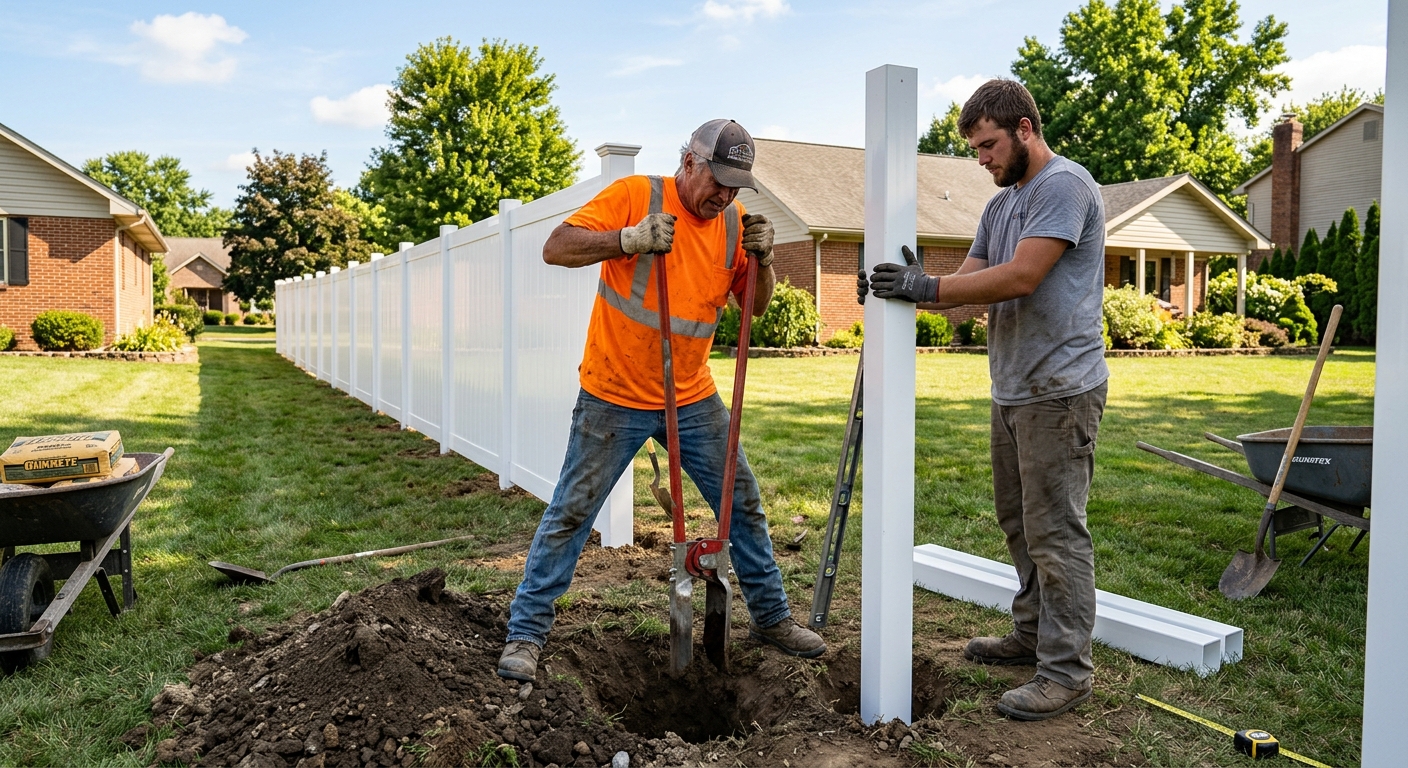
Fencing options and costs in Fort McMurray
Fort McMurray is a northern Alberta city where fencing needs to perform in real winter conditions—deep frost, freeze-thaw cycles, and frequent wind off the open landscape. With a population of 66,573 (Statistics Canada, 2021 Census), there’s steady demand from homeowners replacing older panels or upgrading to more durable privacy systems. Local housing stock is also a major driver of fence installs because detached properties are typically where fencing is most used for side-yard containment, pets, and backyard privacy. In the Wood Buffalo–Cold Lake economic region, labour availability and turnaround times can vary by season because access and soil conditions change fast once the ground freezes.
Cost differences here are usually less about the “brand” and more about installation depth and wind resilience. In cold climates, posts must be set below the design frost depth (commonly about 4–6 inches below it) to reduce frost heave, which often means deeper holes, more excavation time, and concrete-set posts for stability. Prairie winds also push contractors toward tighter post spacing and heavier, more rigid panels—especially for taller privacy fences—while chain-link and metal options are often chosen where you want durability with lower “sail” area. You’ll see particularly strong contractor demand around areas like Timberlea and Beacon Hill, where ongoing property maintenance and upgrades are common.
Below is a homeowner-friendly comparison of common fence types and typical pricing for Fort McMurray projects.
| Material |
Lifespan |
Maintenance |
Privacy Rating |
Price per Linear Foot |
| Pressure-treated pine (standard wood) |
10–15 years |
Stain/seal every 2–3 years in harsh weather |
High (solid boards) |
$22–$40 |
| Cedar (natural rot resistance) |
15–25 years |
Light staining every 2–4 years |
High (solid boards) |
$26–$48 |
| Vinyl / PVC (no-maintenance) |
20–30 years |
Wash as needed; inspect fasteners in extreme cold |
High (solid panels) |
$30–$55 |
| Chain-link (galvanized steel) |
20–35 years |
Occasional tensioning and hardware checks |
Low to Medium (depends on privacy slats) |
$18–$32 |
| Aluminum ornamental |
25–40 years |
Occasional wash; tighten hardware |
Low (open pickets) |
$38–$70 |
| Composite / recycled material |
20–30 years |
Minimal; occasional cleaning |
High (solid styles) |
$28–$60 |
Prices are estimates only and vary by project scope, site access and material selection.
What affects the price of fencing in Fort McMurray
In Fort McMurray and across Wood Buffalo–Cold Lake, it’s common to see quotes for the “same” fence vary by 30–50%. The biggest reason is that northern installation is less forgiving: frost depth drives how deep posts must be set, wind determines how rigid the system needs to be, and soil/terrain affects excavation time. For example, a backyard run that needs concrete-set posts in frozen ground can cost far more than a shorter, simpler run where conditions allow a faster install method.
Frost is the main pricing lever. Contractors typically set posts about 4–6 inches below the design frost depth to prevent heaving, which often means placing posts roughly 1.5–2.0 m into the ground in Alberta’s colder zones. That drives longer posts, deeper holes, and usually concrete setting for stability—especially for gates. Wind exposure on the Prairies also pushes tighter post spacing and heavier panel assemblies. If you choose taller privacy systems or vinyl/PVC in a gustier, open yard, expect the installer to build for “sail” loads, which can raise labour and hardware costs. By contrast, chain-link tends to stay competitive because it has less wind resistance and can be installed with a lighter structural approach—often aligning more closely with the chain-link band of $30–$60.
Concrete examples in Fort McMurray: (1) a 6–8 ft run through uneven or frozen soil commonly adds excavation time and may require stepped panels, raising the project beyond the typical wood backbone $40–$80 band; (2) removing an old fence—especially posts encased previously—can double labour because you may need extra drilling and disposal handling; (3) gate-heavy layouts (double drive gates) add structural posts and more bracing, pushing the total toward the higher end of metal pricing like $70–$140 for aluminum/metal systems.
| Price Factor |
Why It Matters |
Cost Impact |
| Fence length in linear feet |
The primary driver of materials, labour hours, and number of posts |
Highest influence on total cost |
| Post depth required |
Frost line determines hole depth and post length, affecting excavation and concrete use |
Can add significant labour and material costs |
| Post setting method |
Concrete vs. gravel pack vs. driven posts changes both stability and excavation time |
Concrete-set posts usually increase cost |
| Material choice |
Vinyl/PVC and cedar generally cost more upfront than chain-link; wood needs more ongoing care |
Shifts project into different price bands |
| Gate count and type |
Drive-through and double gates need stronger posts, hinges, latches, and bracing |
Often one of the largest “extras” |
| Grade and terrain |
Sloped yards require stepped or raked panels and extra layout time |
More labour and sometimes more materials |
| Old fence removal and disposal |
Debris hauling, cutting posts, and breaking out concrete adds time and equipment |
Can materially increase total price |
| Permit fees and survey / property line locate |
Verification of boundaries prevents rework and disputes |
Typically a smaller but important swing factor |
Permits & regulations in Alberta
In Alberta, fences above a height threshold—often around 2.0 m (6.5 ft) at the rear and roughly 1.0–1.2 m (3–4 ft) at the front or corner—can require a building permit. Even when a permit isn’t required, fences must still respect property lines and municipal setback requirements. Before any post hole is dug, arrange utility locates by calling Alberta One-Call so underground services are marked—this is essential for safety and to avoid costly rework. It’s also smart to get a survey or at least a property line locate so your fence sits exactly within your boundaries; this prevents encroachment disputes and “fence moved” scenarios that come up more often when neighbours have older survey records.
Shared fence ownership is handled through Alberta’s line-fences framework. Practically, that means if you’re building on or near a shared boundary, you should confirm who is responsible for costs, maintenance, and any future replacement.
What typically DOES require a permit: taller fences that exceed local height limits, fences in sensitive locations (often corner/visibility areas), and projects with structural elements that trigger additional review. What typically does NOT: short run-of-yard fencing that stays under the common height thresholds and is within required setbacks (but you should still confirm with your local permitting office for your specific site).
To verify your contractor in Fort McMurray, ask for their Alberta licence reference (where applicable for fencing-related trade work), proof of liability insurance (COI naming you or showing coverage limits), and confirmation they have WCB/WSIB coverage for their workers (WCB in Alberta). Request the clearance letter/coverage confirmation directly and verify details match the company on the quote.
Choosing the right fence material for Fort McMurray
Choosing the right fence material in Fort McMurray comes down to matching your priorities—privacy, low maintenance, budget, and lifespan—to a climate that punishes weak posts and loose structural connections. With frost requiring posts to be set well below the frost line (often achieved with deeper holes and, in many cases, concrete-set posts), materials that warp, rot, or lose fastener integrity will disappoint sooner. Wind and snow also matter: heavier privacy panels can act like sails, so spacing, bracing, and panel rigidity are important for stable performance.
Pressure-treated pine is usually the most budget-friendly entry option, but it needs staining or sealing every 2–3 years to reduce grey weathering and surface breakdown. Cedar looks great and resists rot naturally, yet it still benefits from periodic maintenance to keep colour and prevent splitting. Vinyl/PVC has the lowest day-to-day work and is popular for privacy, but it can crack if it’s not properly installed and anchored for extreme cold; good contractors use the right hardware and allow for material behaviour in winter. Chain-link is the lowest cost and often the longest-lasting mechanically, but it doesn’t deliver privacy unless you add slats or an additional privacy screen. Aluminum is a mid-range ornamental choice: it doesn’t rust, stays tidy, and works well where you want security with an open look. Composite/recycled materials can deliver solid privacy with less upkeep, but they’re priced higher and should be installed with strong attention to post depth.
As a dollar example, if you’re comparing wood privacy within the typical wood installation band of $40–$80 to vinyl/PVC within $55–$110, the higher upfront vinyl cost can be justified where you want fewer maintenance visits and a cleaner long-term look—especially if you’re replacing aging fencing before winter. In many yards, contractors will also prefer concrete-set posts due to frost stability needs, regardless of material choice.
| Material |
Cold Tolerance |
Lifespan |
Annual Maintenance |
Best For |
Price Band |
| Pressure-treated pine |
Good when posts are set deep and fasteners are correct |
10–15 years |
Low to moderate (typically 0–1 annual check; staining every 2–3 years) |
Budget-focused privacy |
$40–$80 |
| Cedar |
Good; performs well in freeze-thaw with proper assembly |
15–25 years |
Moderate (typically 0–1 annual check; stain every 2–4 years) |
Premium look with better rot resistance |
$50–$95 |
| Vinyl / PVC |
Fair to good; requires correct anchoring and winter-rated installation |
20–30 years |
Very low (annual wash/inspection) |
Low-maintenance privacy |
$55–$110 |
| Chain-link |
Very good; galvanized steel handles Alberta winters |
20–35 years |
Low (hardware checks, re-tensioning as needed) |
Security and pets with minimal upkeep |
$30–$60 |
| Aluminum ornamental |
Excellent (no rust in snow and freeze-thaw) |
25–40 years |
Low (occasional wash; tighten hardware) |
Decorative security and curb appeal |
$70–$140 |
| Composite / recycled |
Good; stable panel performance when posts are installed properly |
20–30 years |
Low (cleaning; inspect connections) |
Solid privacy with less upkeep |
$60–$120 |
How to choose a fencing contractor in Fort McMurray
Choosing a fencing contractor in Fort McMurray is mostly about verifying coverage, then matching the quote to a clear scope. Start by confirming Alberta coverage and accountability: request their liability insurance certificate (COI) and confirm the limits and that coverage is active for the contract period. Next, verify WCB/WSIB coverage (in Alberta, it’s WCB) by asking for the clearance letter or proof of current account status. For licensing and compliance, ask for any applicable provincial registration details and ensure the company name on the quote matches the insured legal entity on your paperwork. A contractor should be comfortable providing these documents immediately—if they hesitate, that’s a red flag.
Get 2–3 itemised written quotes, not just one lump sum. A good quote breaks labour and materials, lists post depth/setting method, confirms the exact gate hardware, and clarifies how they handle uneven grade (stepped vs. raked panels). Read exclusions carefully: is permit pulling included (if needed), is old fence removal and disposal included, and what happens if they uncover buried obstructions? Warranty matters too—ask for a workmanship warranty length (commonly framed in terms of structural fasteners and post setting) and a manufacturer warranty for materials, and check whether it’s transferable to future owners.
Payment schedule should protect you: never pay more than 10–15% upfront, and use a holdback until completion and final walkthrough. Also require timeline details in writing: a start date target, estimated duration, and what weather or access factors could delay work.
- Ask for liability insurance COI and verify it’s current and covers fencing work.
- Get WCB/Alberta clearance letter or proof of active coverage for workers.
- Confirm the contractor’s legal company name matches the quote and invoice.
- Require 2–3 itemised quotes (labour + materials separately).
- Verify post depth, post spacing, and whether posts are concrete-set.
- Ensure gate types are specified (walk-through vs. drive/double) and hardware is listed.
- Confirm grade handling method: stepped vs. raked panels.
- Ask whether old fence removal and disposal are included.
- Clarify permit pulling responsibility if fence height/placement triggers a permit.
- Confirm site cleanup standards and debris haul-away method.
- Review warranty: workmanship term, manufacturer coverage, and transferability.
- Keep payments capped: max 10–15% upfront; holdback until final completion.
Red flags to watch for in Fort McMurray: (1) quotes that don’t state post depth or setting method; (2) contractors who won’t provide COI or WCB/clearance documents; (3) no clear itemisation (materials and labour combined with no explanation); (4) promises of “no concrete needed” without acknowledging frost-heave risk; and (5) a request for a large upfront payment (well beyond 10–15%).
Frequently asked questions — fencing in Fort McMurray
Should fence posts be set in concrete here?
In Fort McMurray and the wider Wood Buffalo–Cold Lake area, concrete-set posts are commonly recommended because Alberta frost and freeze-thaw can cause frost heave if posts sit too shallow. A typical rule of thumb is setting posts about 4–6 inches below the design frost depth, which often translates to roughly 1.5–2.0 m into the ground; deeper holes plus concrete increase both material and labour cost, but they help the fence stay plumb and strong after winter cycles. That said, the “best” method depends on soil conditions, fence height, and gate loads. For heavier systems (privacy fences with larger panel area), concrete setting is especially common. If you’re targeting a lower-cost chain-link installation band (often $30–$60), some contractors may use alternative methods in suitable soil, but you should still ask how frost heave risk is managed for your specific yard.
What's the best fence for privacy?
For privacy in Fort McMurray, solid board privacy fences or vinyl/PVC privacy panels are usually the most effective because they block line of sight and resist wind-driven panel flex when installed correctly. If you want low maintenance and consistent appearance, vinyl/PVC privacy is often chosen, and it typically fits the $55–$110 per-linear-foot band depending on height, gate complexity, and installation method. Cedar and pressure-treated pine can also provide excellent privacy, generally aligning with the $40–$80 wood band for standard pressure-treated builds, but they require more ongoing maintenance—typically staining or sealing every 2–3 years in northern conditions. Wind exposure is real here, so privacy fences should use appropriate post spacing and rigid bracing, especially on the prairies-side of yards. If your main concern is privacy plus minimal upkeep, vinyl/PVC usually wins; if budget is the driver, pressure-treated or cedar privacy with deep, stable posts is a practical solution.
How do I compare fencing quotes?
When comparing quotes in Alberta, don’t compare only the total—compare the scope. Ask each contractor for an itemised breakdown that states fence length, material type, post spacing, post depth, and post setting method (concrete vs. gravel pack vs. driven posts). Confirm whether gates are included and whether the quote covers walk-through gates only or also drive/double gates, since gates add labour, bracing, and hardware. Check if permit pulling is included where height/place can trigger it, and whether old fence removal and disposal are included. For example, if one quote lands around the wood band of $40–$80 while another is closer to vinyl/PVC at $55–$110, that gap is typically explained by material and installation choices—like panel rigidity for wind, and concrete-set structural posts for stability. A good contractor should be able to explain differences line-by-line and show you how their design reduces winter failure risks (warping, loosening, or heaving).
How long does fence installation take in Fort McMurray?
For typical single-yard runs in Fort McMurray, installation often takes a few days to about a week, depending on length, number of gates, and access. The schedule can expand when post holes require more excavation time due to frozen ground, when there’s uneven terrain that needs stepped panels, or when removal and disposal are part of the job. Cold-season access can also affect equipment setup and safe footing for crews. The bigger factor than calendar weather is soil and frost readiness for your site—deep post placement is common in northern Alberta to reduce heaving. If your quote includes concrete setting, there may be additional time for curing before gates are fully loaded or before final adjustments are made. Your best move is to request a start date and completion estimate in writing, plus a plan for how delays from frozen soils or utility locating results are communicated.
Can I install a fence on a slope in Fort McMurray?
Yes, fences can be installed on slopes in Fort McMurray, and it’s common to do so. The key is choosing the right method: stepped panels (each section sits at a different height) or raked panels (where the top follows the slope). Stepped styles tend to look cleaner on uneven ground and can be easier to align with consistent privacy heights. Raked systems can be done, but they require more layout precision and the correct hardware so panels don’t twist in wind. On sloped yards, contractors should also confirm post depth and foundation stability—frost heave risk doesn’t disappear just because the ground slopes. Ask how they’ll handle grade changes while maintaining required fence heights and keeping the fence within property lines. If your yard also has older ground features or buried debris, expect additional layout time.
What is the most weather-resistant fence for Fort McMurray's climate?
The most weather-resistant approach in Fort McMurray is usually a metal or vinyl system installed on properly set posts (often concrete-set) below frost depth, with correct spacing and bracing for wind. Aluminum ornamental is excellent for freeze-thaw and won’t rust in wet snow cycles, and vinyl/PVC can perform very well when installed with winter-appropriate hardware and proper anchoring—both typically fit the higher-end bands (aluminum often aligns with the $70–$140 band, vinyl/PVC commonly with $55–$110). Chain-link is also highly durable and handles Alberta winters well; it can last 20+ years with minimal issues, though it doesn’t provide privacy unless you add slats. Wood can still be a strong option if maintained, but in northern conditions it generally requires more upkeep to prevent weathering and splitting. If “set it and forget it” is your goal, vinyl or aluminum with deep, stable post installation is usually the best bet.