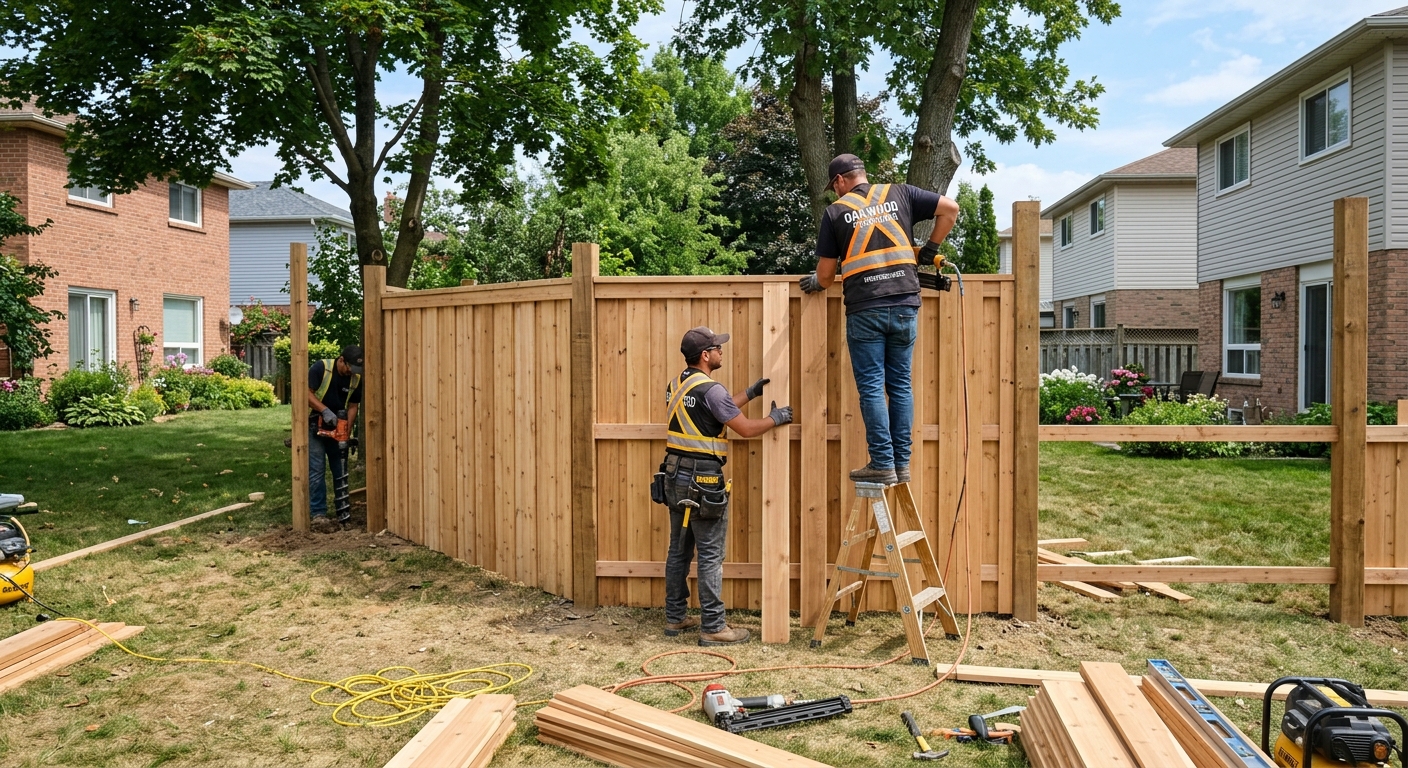
Fencing options and costs in Cameron Heights
Cameron Heights, Alberta is a small community by Calgary-area standards, with a 2021 population of 1,123 (Statistics Canada, 2021 Census). In places like this, fence demand tends to track closely with the number of detached properties—each yard boundary creates an opportunity for privacy, pets, and curb appeal upgrades. That’s also why you’ll often see fencing activity in the same neighbourhood pockets year after year, especially around family-oriented residential blocks where backyard privacy is a priority.
In the Calgary economic region, pricing is shaped by the Prairie continental climate: long freeze–thaw cycles and open wind exposure. Those conditions push contractors to set posts about 4 ft (≈120 cm) deep to sit below the regional frost line, commonly with concrete footings for 6 ft privacy fences and gate posts. Add wind loading, and heavier panels (wood and vinyl privacy) typically need closer post spacing and sturdier rails to reduce racking. The result is that privacy fences usually cost more than airy chain-link, while solid wood/vinyl tends to sit in the mid-to-upper part of the local range.
In Cameron Heights, trade demand is especially noticeable around the more established residential sections near the core where mature fence lines are being replaced after weathering and sagging. If you’re comparing materials, the table below uses typical Calgary-area installed ranges and reflects the local frost-depth and wind-loading reality.
| Material |
Lifespan |
Maintenance |
Privacy Rating |
Price per Linear Foot |
| Pressure-treated pine (standard wood) |
10–15 years |
Stain/seal every 2–3 years |
High (solid) |
$45 – $75 |
| Cedar (natural rot resistance) |
15–25 years |
Light stain every 2–4 years (as needed) |
High (solid) |
$55 – $90 |
| Vinyl / PVC (no-maintenance) |
20–30 years |
Rinse occasionally; inspect for cold-brittleness |
High (solid) |
$55 – $95 |
| Chain-link (galvanized steel) |
20–40 years |
Minimal; periodic coating touch-ups |
Low–Medium (airflow) |
$30 – $55 |
| Aluminum ornamental |
25–40 years |
Wash yearly; check hardware |
Low–Medium (visual openness) |
$80 – $120 |
| Composite / recycled material |
20–30 years |
Low; clean and inspect fasteners |
High (solid) |
$65 – $105 |
Prices are estimates only and vary by project scope, site access and material selection.
What affects the price of fencing in Cameron Heights
In Cameron Heights and across the Calgary economic region, it’s common to see fencing quotes for what looks like the same job swing by 30–50% once you account for frost protection, wind loading, and site conditions. A big reason is that Alberta’s freeze–thaw cycles and open Prairie exposure don’t forgive shortcuts: a “quick install” often turns into taller post materials, deeper holes, more concrete, and additional labour for bracing and straight runs.
Frost line depth is the first cost driver. To prevent heaving, posts typically need to be set about 4–6 inches below the design frost depth—often meaning roughly 1.5–2.0 m into the ground in colder Alberta settings. That increased excavation and concrete volume usually pushes privacy fence projects upward, especially for 6 ft panels and gate posts. Wind exposure then drives tighter engineering: solid wood or vinyl panels need sturdier posts and rails to resist racking, while chain-link allows airflow and usually stays cheaper because it reduces wind sail.
Here are a few local examples that can raise or lower cost in Cameron Heights:
- Hard, rocky ground slows digging, increasing labour and equipment time.
- Long, straight runs with easy backyard access can keep wood and vinyl closer to the mid-range of the $40–$80 (wood) and $45–$90 (vinyl) installed ranges.
- Yards with frequent gate openings or corner returns often add posts, rails, and hardware—pushing total cost higher even if the overall footage is modest.
Finally, contractor availability matters. When winter freeze approaches, crews prioritize jobs with ready access and clear property lines, which can tighten scheduling and affect unit pricing. As a result, your best estimate becomes easier when the material and footing approach are clearly defined up front, not just the final fence height.
| Price Factor |
Why It Matters |
Cost Impact |
| Fence length in linear feet |
Most labour, posts, and rails scale directly with footage |
High (primary driver) |
| Post depth required |
Frost line determines how deep holes must be dug |
High (more excavation + longer posts) |
| Post setting method |
Concrete vs. gravel pack vs. driven posts changes materials and labour |
Medium–High (concrete adds cost) |
| Material choice |
Vinyl/cedar/privacy panels add weight and need robust supports |
Medium (wood/vinyl mid-upper, chain-link lower) |
| Gate count and type |
Gates require reinforced framing and heavier hardware |
Medium–High |
| Grade and terrain |
Slope requires stepped frames or raked sections |
Medium (extra labour and waste) |
| Old fence removal and disposal |
Demolition, hauling, and disposal fees can add time |
Low–Medium (varies a lot) |
| Permit fees and survey / property line locate |
Admin time, survey work, and compliance checks must be scheduled |
Low–Medium (often a necessary add-on) |
Permits & regulations in Alberta
In Alberta, fence permits can apply when you’re building taller fences—commonly when the height threshold is exceeded (often around 2.0 m / 6.5 ft at the rear and about 1.0–1.2 m / 3–4 ft at the front or corner). Local bylaws and setback requirements still govern where you can place fence lines on your property, so the “right” height depends on location within your lot, not just the overall design. Before any post hole is dug, call for utility locates through the Alberta One-Call process to mark buried services; this is also when many contractors schedule their excavation crews.
Step-by-step, a homeowner in Cameron Heights can verify a contractor and avoid encroachment disputes:
- Confirm your planned fence height and location on your property relative to setbacks.
- Ensure a survey or property locate is done (pins found and line verified) before installation so you don’t build across an easement or incorrect boundary.
- Check contractor credentials: verify the Alberta licence/registration status via the relevant online registry listings, then request a certificate of liability insurance.
- Ask for proof of workers’ compensation coverage (WSIB/WCB) coverage and keep it on file for your records.
- Request the insurance certificate showing the effective dates and the insured entity name matching the contractor on your estimate.
Shared fence ownership rules are typically handled under provincial line-fences legislation, so if your fence ties into a shared boundary, confirm responsibilities in writing before work starts.
Choosing the right fence material for Cameron Heights
Choosing a fence material in Cameron Heights is really about matching your priorities—privacy, low maintenance, upfront budget, and lifespan—to Calgary’s freeze–thaw climate and wind exposure. Pressure-treated pine is usually the most budget-friendly option, but it needs staining every 2–3 years to prevent grey weathering and slow down surface decay. Cedar looks better longer and has natural rot resistance, though it still benefits from periodic maintenance to keep edges and face boards protected.
Vinyl/PVC is the go-to for low maintenance: it typically doesn’t need staining, and a simple rinse keeps it looking clean. The trade-off is that in extreme cold snaps, vinyl can become more brittle than wood if panels aren’t installed with appropriate expansion considerations and properly aligned hardware. Chain-link is usually the lowest installed cost and tends to last 20–40 years because wind passes through it; however, privacy is limited unless you add privacy slats or screening systems. Aluminum ornamental offers a clean look and corrosion resistance, but it’s more visual than private.
Post depth is where Alberta frost protection meets material choice. For privacy fences in Calgary, concrete-set posts are common because solid panels catch wind loads and require stable support below frost line depth; that means longer posts and more excavation regardless of whether you choose wood or vinyl. If your yard is exposed—common in Prairie settings—plan for tighter post spacing and heavier rails to prevent racking during storms and snow loads.
As a practical example: if your choice is pressure-treated pine versus cedar, you might see a spread of roughly $10–$25 per linear foot depending on height and access. That difference can be justified if you want a longer-lasting fence face with better natural appearance, without switching to a full high-end ornamental system.
| Material |
Cold Tolerance |
Lifespan |
Annual Maintenance |
Best For |
Price Band |
| Pressure-treated pine |
Good (with proper sealing) |
10–15 years |
Inspect; light cleaning, stain as needed |
Budget privacy with repainting schedule |
$40 – $80 |
| Cedar |
Very good (natural rot resistance) |
15–25 years |
Clean; stain/coat every 2–4 years |
Premium appearance and natural durability |
$55 – $90 |
| Vinyl / PVC |
Good (install expansion correctly) |
20–30 years |
Occasional rinse and hardware check |
Low maintenance privacy |
$45 – $90 |
| Chain-link |
Excellent |
20–40 years |
Minimal; check tension and coating |
Security with airflow |
$25 – $55 |
| Aluminum ornamental |
Excellent |
25–40 years |
Wash yearly; inspect fasteners |
Front-yard curb appeal |
$70 – $120 |
| Composite / recycled |
Good (panel stability matters) |
20–30 years |
Low; clean and inspect |
Solid privacy with reduced upkeep |
$60 – $105 |
How to choose a fencing contractor in Cameron Heights
When you’re hiring a fencing contractor in Cameron Heights, start by verifying three essentials: Alberta licensing/registration (where applicable), liability insurance, and workers’ compensation coverage (WSIB/WCB). Ask for documentation before you sign—don’t rely on verbal confirmation. For liability insurance, request a certificate of insurance that lists the insured legal name and current coverage limits. For workers’ compensation, request proof of coverage for the crew working on your site. If they can’t provide current certificates or clearance documentation, consider it a major red flag.
Next, get 2–3 itemised written quotes rather than one lump sum. A proper quote breaks labour and materials down clearly—posts, rails, panels, gates, hardware, concrete/footings, and any accessory like hinges and latch systems. Read the scope for what’s excluded: permit pulls, utility locate fees, survey/property pin locate, disposal of your old fence, and any extra charge for difficult access or extensive digging.
Warranty matters too. Ask for the workmanship warranty length (how long they stand behind the installation), the manufacturer product warranty, and whether the warranty is transferable to you if the ownership changes. For payment schedule, never pay more than 10–15% upfront; use milestone payments tied to measurable progress, and keep a holdback until the fence is fully complete and properly aligned.
Finally, request a firm start date and a completion estimate in writing, along with how they handle winter conditions and freeze-limited days. Transparent scheduling is usually a sign of organized crews—something you want when Calgary wind and frost depth drive the work.
- Request proof of Alberta licensing/registration (where applicable) and confirm it matches their contract name.
- Verify certificate of liability insurance is current and ask for the effective dates.
- Confirm workers’ compensation coverage (WSIB/WCB) for the crew that will be on your site.
- Ask whether permit work is included, or who pulls it if required for your height and location.
- Get utility locate included or scheduled before excavation (no exceptions).
- Require an itemised quote listing posts, rails, panel type, gates, concrete, and fasteners.
- Confirm post depth method (and whether concrete footings are used for privacy/gate posts).
- Clarify removal and disposal of your old fence (dump fees and hauling costs).
- Ask how they handle slope—stepped or raked panels—and whether it changes material pricing.
- Verify warranty details in writing: workmanship duration and product warranty terms.
- Set a payment schedule with a maximum 10–15% deposit and a holdback until completion.
- Get a start/completion timeline and a written plan for freeze-thaw delays.
Common red flags in Cameron Heights include: vague “lump sum” pricing with no footing/post depth detail, refusing to provide proof of insurance or workers’ compensation, starting excavation without utility locates, leaving out old fence removal/disposal terms, and offering a workmanship warranty that’s shorter than typical industry expectations without explanation.
Frequently asked questions — fencing in Cameron Heights
How long does fence installation take in Cameron Heights?
In Cameron Heights (and the broader Calgary area), most residential fence installs take a few days for standard lengths, assuming utilities are located, access is straightforward, and footing conditions are normal. A simple run of chain-link can be quicker because posts and panels install fast, while 6 ft wood or vinyl privacy fences take longer due to deeper post holes for frost protection (often around 4 ft depth for stability) and more bracing against wind racking. Gates also add time: hardware alignment and reinforced framing usually mean an extra day for layout and final adjustments. Weather can shift timelines when freeze–thaw cycles prevent digging; a reputable crew will schedule to minimize downtime and keep you informed.
Can I install a fence on a slope in Cameron Heights?
Yes, fences can be installed on slopes in Cameron Heights, but the approach matters for both appearance and structural stability. For privacy fences, contractors typically use stepped panels (each section changes elevation) or raked systems (one continuous angle) depending on the design and how the rails are built. Stepped installations look cleaner on more noticeable grade changes, while raked options can work well for gentle slopes. Because Calgary’s wind loads can push on solid panels, proper post placement and consistent spacing are critical—especially when one side of the yard is noticeably higher. In your quote, ask how slope affects labour time and whether it changes the price per linear foot.
What is the most weather-resistant fence for Cameron Heights's climate?
For Cameron Heights Alberta conditions—cold snaps, freeze–thaw cycles, and wind exposure—the most weather-resistant choices are usually chain-link (galvanized steel) and aluminum ornamental, mainly because they handle moisture and airflow well. Chain-link often performs exceptionally because wind passes through, reducing racking stress on posts. Wood and vinyl privacy fences can also be very durable when posts are set below frost depth and footings are done properly, but they require material-appropriate upkeep: wood benefits from regular staining, and vinyl needs correct installation to manage cold-temperature movement. If you compare costs, chain-link commonly lands around the $25–$55 per linear foot band, while wood privacy is often higher (roughly $40–$80) because of solid-panel wind loading and sturdier post settings.
How do I prevent wood fence rot in Cameron Heights?
Wood rot prevention in Cameron Heights starts below grade and continues at the face boards. First, ensure posts are set with proper frost protection—typically concrete footings for privacy fences—because stable anchoring reduces wobble and trapped moisture around joints. Second, use pressure-treated lumber rated for ground contact (and ask what grade and treatment they’re installing). Third, keep the fence top edge protected: stain/seal every 2–3 years helps slow greying and moisture penetration. In Calgary conditions, end-grain areas and any cut edges are frequent failure points, so ask whether the contractor applies end-cut protection. Finally, regular inspections after heavy snow/wind seasons can catch early loosened boards before water works into the structure.
What is the cost per linear foot for fencing in Cameron Heights?
For fencing in Cameron Heights, typical installed pricing follows the Calgary-area market range, heavily influenced by frost-depth post installation and wind loading. Chain-link often sits around $25–$55 per linear foot, making it a common value option. For wood privacy (pressure-treated pine), many installed projects land roughly in the $40–$80 per linear foot band, while vinyl/privacy often runs $45–$90 per linear foot. Aluminum ornamental typically comes in at the higher end (about $70–$120 per linear foot) because of material and framing requirements. Your actual price can shift based on gate count, terrain, and whether concrete footings and old fence removal are included in the scope.
Should I repair or replace my old fence in Cameron Heights?
Repair is often worth it when the fence posts are solid, the rails are still straight, and the damage is localized (for example, a few loose boards or one sagging section). Replacement is usually the better long-term choice when you see multiple leaning posts, widespread rot at the board ends, repeated hardware failures, or a fence line that has become misaligned from freeze–thaw movement and wind racking. In Cameron Heights Alberta, the biggest question is how stable the post bases are; if posts weren’t set with frost-protected footings or the concrete has failed, repairs can cost more later. Get a contractor to inspect from ground level up and ask for a straight recommendation with photos, then compare the repair estimate against the installed replacement cost per linear foot.