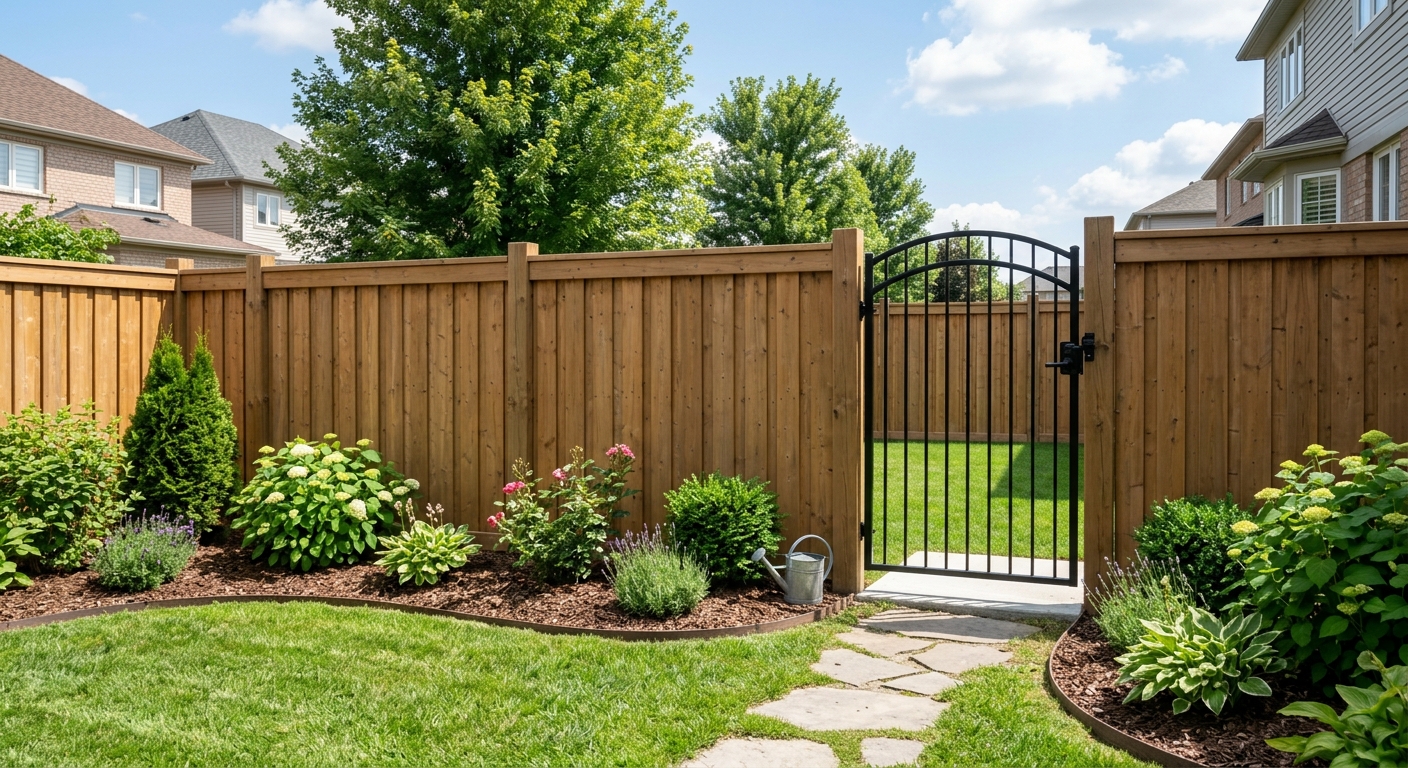
Fencing options and costs in Calgary
Calgary, Alberta homeowners typically have several fencing options that look great and stand up to the Prairie freeze–thaw cycle. With a population of 1,306,784 (Statistics Canada, 2021 Census) and 345,690 homeowner households (Statistics Canada, 2021 Census), there’s steady local demand for backyard privacy, pet containment, and perimeter security—especially because more than half of local dwellings are single-detached homes, which often have room for full runs of fencing.
In Calgary, cost is shaped less by “decor” and more by weatherproofing and structure. The long winter season, wind exposure, and the need to set posts deep enough to resist heaving add labour, excavation, and concrete volume. For 6 ft privacy fences, this usually means concrete-set posts and tighter attention to post alignment and bracing to reduce racking. Contractors are also busiest in established inner suburbs and family-oriented areas where property lots are larger and renovations are common.
For example, communities such as Mahogany (SE Calgary) often see frequent fence builds alongside landscaping—particularly where homeowners want privacy from open views and wind off the Plains. If you’re comparing materials, use the local price bands as your baseline before you request a detailed, itemised quote.
Below is a practical comparison of common materials and what you can expect for a typical installed fence in Calgary—then we’ll break down what pushes your final price up or down.
| Material |
Lifespan |
Maintenance |
Privacy Rating |
Price per Linear Foot |
| Pressure-treated pine (standard wood) |
10–15 years |
Stain/seal every 2–3 years; check rails after freeze–thaw |
Medium–High (good with solid boards) |
$40–$80 |
| Cedar (natural rot resistance) |
15–20 years |
Light staining every 2–4 years; inspect for warping |
High (solid privacy panels) |
$50–$95 |
| Vinyl / PVC (no-maintenance) |
20–30 years |
Wash occasionally; fastenings and rails only |
High (solid styles available) |
$45–$90 |
| Chain-link (galvanized steel) |
20–35 years |
Minimal; rinse salt/grit buildup, check tension |
Low (security only) |
$25–$55 |
| Aluminum ornamental |
25–40 years |
Minimal; occasional cleaning |
Low–Medium (open pickets) |
$70–$120 |
| Composite / recycled material |
20–30 years |
Minimal; clean and inspect fasteners |
High (solid/composite privacy options) |
$55–$100 |
Prices are estimates only and vary by project scope, site access and material selection.
What affects the price of fencing in Calgary
In Calgary, it’s normal to see the same fence concept priced 30–50% differently across neighbourhoods and contractors—even when the material looks “identical” on paper. That swing usually comes from installation fundamentals: how deep posts must be set for frost protection, how wind loading is handled with bracing and post spacing, and how much excavation and concrete are required. With Calgary’s large homeowner base (Statistics Canada, 2021 Census) and a mix of older and newer lots, contractor availability and site conditions can change fast from one job to the next.
Frost depth is a major cost driver. In cold Prairie conditions, posts are typically set about 4–6 inches (≈10–15 cm) below the design frost depth to reduce heaving and loosened panels. Practically, that means longer posts and deeper holes than milder regions. When we’re setting posts at roughly 1.5–2.0 m and using concrete footings for privacy fences and gate posts, labour time and concrete volume rise together.
Wind exposure is the second driver. Solid wood or vinyl privacy panels often need sturdier posts, closer spacing, and fully concreted bases to prevent racking in prairie gusts. In contrast, chain-link fences allow airflow and usually demand less structural reinforcement. That’s why chain-link commonly lands around the lower-mid range (for example, $25–$55 per linear foot), while wood and vinyl privacy typically sit higher (often $40–$80 for wood installations, with vinyl commonly in the mid range).
Two concrete examples from Calgary that can change your total: (1) a backyard with rock or heavy clay can add excavation time and equipment; (2) a fence line with multiple gate locations increases hinge-post sizing and concrete setting, pushing costs toward the upper band.
| Price Factor |
Why It Matters |
Cost Impact |
| Fence length in linear feet |
The main materials and labour driver (posts, rails, panels). |
Most estimates scale directly; longer runs raise cost quickly. |
| Post depth required |
Frost line determines hole depth and post length. |
Deeper holes increase excavation time and post material. |
| Post setting method |
Concrete vs. gravel pack vs. driven posts affects stability. |
Concrete setting typically adds cost but reduces heaving risk. |
| Material choice |
Strength and airflow characteristics change bracing and spacing. |
Vinyl/cedar and privacy panels usually cost more than chain-link. |
| Gate count and type |
Gates need stronger hardware and heavier framing posts. |
Each additional gate can add labour, hardware, and concrete. |
| Grade and terrain |
Slopes require stepping, racking, or special panel alignment. |
More labour and off-standard components raise costs. |
| Old fence removal and disposal |
Haul-away, demolition time, and potential replacement materials. |
Can add a noticeable surcharge, especially for large runs. |
| Permit fees and survey / property line locate |
Required approvals or confirmation prevent encroachment disputes. |
Often modest, but can increase total and scheduling time. |
Site-specific conditions (soil type, access, gates, and layout) often explain the largest quote differences in Calgary.
Permits & regulations in Alberta
In Alberta, fencing rules generally depend on height and location. As a homeowner in Calgary, you should plan for the fact that fences above a typical threshold—often 2.0 m (6.5 ft) at the rear and 1.0–1.2 m (3–4 ft) at the front or corners—may require a building permit. Even when a permit isn’t required, your fence still has to respect property lines and municipal setback bylaws.
Before digging any post hole, call for utility locates so you don’t hit buried services. In Alberta, homeowners use the one-call service through Alberta One-Call. Next, obtain a survey or at least a property-line locate so your posts aren’t encroaching onto a neighbour’s yard or a utility/utility easement.
Shared fence ownership and maintenance are commonly handled under provincial line-fences legislation. Practically, that means neighbours may share costs where fences are truly “shared,” but you should document what’s being built, who pays for materials, and who maintains it going forward.
To verify a contractor properly: ask for their Alberta licence details (and any applicable registration info), a certificate of liability insurance with the correct insured name and active dates, and proof of coverage for workers. For the latter, request confirmation that they have the required coverage under Alberta’s workers’ compensation system (commonly referenced as WCB). Where possible, obtain a clearance letter or current account confirmation, and keep copies for your records.
Choosing the right fence material for Calgary
Choosing the right fence material in Calgary is mostly about matching your priorities—privacy, low maintenance, budget, and lifespan—to Prairie conditions that stress fastenings and stress-test post stability. Because Calgary experiences long freeze–thaw cycles, solid privacy designs need proper post depth and concrete setting more often than in milder climates, and wind can encourage racking if the structure isn’t braced correctly.
Pressure-treated pine is usually the budget-friendly choice, but it benefits from staining/sealing every 2–3 years to reduce grey weathering and keep the surface protected. Cedar has naturally better rot resistance and tends to look warmer and more attractive, though it still needs periodic staining and inspection for warping. Vinyl/PVC is popular for “set it and forget it” because it usually requires only occasional washing; however, in extreme cold, you must install with the correct thermal expansion allowances to prevent cracking or buckling. Chain-link offers the lowest installed cost and very long life, but it won’t provide privacy unless you add slats or an additional screen system. Aluminum ornamental gives curb appeal, won’t rust, and is low maintenance, but it’s typically open for visibility. Composite/recycled materials can deliver privacy with low maintenance, though the initial cost is generally higher than basic pressure-treated wood.
For frost protection, Calgary installs commonly set posts roughly 1.5–2.0 m deep, especially for 6 ft privacy fences and gate posts. That structural step often matters more than material choice. For a dollar example: if a pressure-treated wood privacy run is in the $40–$80 per linear foot range, moving to cedar or vinyl can add material and post hardware costs, often landing closer to the mid–upper bands—so it’s justified when you value appearance and maintenance reduction over the next decade.
| Material |
Cold Tolerance |
Lifespan |
Annual Maintenance |
Best For |
Price Band |
| Pressure-treated pine |
Good (proper staining and installation required) |
10–15 years |
Inspect yearly; stain/seal every 2–3 years |
Budget privacy with a willingness to maintain |
$40–$80 |
| Cedar |
Good (still needs protection and fastener care) |
15–20 years |
Inspect yearly; stain every 2–4 years |
Natural look and better rot resistance |
$50–$95 |
| Vinyl / PVC |
Good if expansion allowances are followed |
20–30 years |
Wash 1–2 times per year; check hardware |
Low maintenance privacy |
$45–$90 |
| Chain-link |
Excellent (galvanized steel is resilient) |
20–35 years |
Minimal; rinse and check tension |
Security with lowest upfront cost |
$25–$55 |
| Aluminum ornamental |
Excellent (no rust; good in freeze–thaw) |
25–40 years |
Wash as needed; check gate alignment |
Curb appeal and long-term reliability |
$70–$120 |
| Composite / recycled |
Good (varies by product; install correctly) |
20–30 years |
Minimal; inspect fasteners |
Privacy with low maintenance |
$55–$100 |
How to choose a fencing contractor in Calgary
Start by verifying the basics for Alberta work. Ask for (1) proof of Alberta business registration and licensing where applicable, (2) liability insurance—request a certificate of insurance showing active dates and limits, and confirm the correct legal entity is insured, and (3) workers’ compensation coverage for their crews. To check insurance, you can call the insurer/agent and confirm the certificate isn’t expired. For workers’ compensation, request current clearance/coverage documentation and match it to the contractor’s legal name; if they won’t provide it, that’s a serious warning sign.
Next, get 2–3 itemised written quotes rather than one lump sum. You want a line-by-line breakdown covering labour, excavation, post setting (concrete quantity/footings), materials (rails, pickets/panels), gates and hardware, and disposal. Read the scope for exclusions: Is permit pulling included? Is old fence removal and hauling included or an add-on? Does the quote include site protection, restoration of grass/rock, or only “rough placement”?
Warranty matters in Calgary because wind and freeze–thaw can reveal installation weaknesses after the first winter. Ask for the workmanship warranty length, whether it covers post movement, sagging rails, and gate alignment, and whether any product warranty is transferable to a future owner.
On payment, a safe schedule is never more than 10–15% upfront. Hold a portion until completion and confirm payment is tied to milestones. Finally, insist on a start date and completion estimate in writing.
- Ask for their certificate of liability insurance and confirm dates.
- Request proof of workers’ compensation coverage (clearance/active account documentation).
- Confirm Alberta business/legal name matches the quote and invoices.
- Require itemised labour + material breakdown (posts, rails, concrete, gates).
- Verify post depth and setting method in the scope (concrete setting vs gravel pack).
- Make sure wind/bracing details are included for solid privacy panels.
- Confirm who handles utility locates and where responsibility sits if delays occur.
- Clarify disposal/removal: landfill haul-away included or extra.
- Ask whether permit pull (if needed) is included and who applies.
- Confirm warranty: workmanship term, product term, and transferability.
- Check payment schedule: keep upfront to 10–15% and holdback until final walk-through.
- Get a written timeline with expected start and completion dates.
Red flags I see in Calgary include contractors who won’t provide insurance/coverage documents, quotes that omit post depth and concrete setting for privacy fences, vague scopes that don’t list gate hardware specifics, “cash-only” payments with no invoice trail, and promises of unusually low pricing that don’t account for excavation, frost protection, or disposal.
Frequently asked questions — fencing in Calgary
How deep should fence posts be for Calgary's frost?
In Calgary and most of Alberta’s colder Prairie conditions, frost protection is the deciding factor. A common best practice is to set fence posts roughly 4–6 inches (≈10–15 cm) below the design frost depth, which often results in post holes around 1.5–2.0 m deep depending on soil and local design assumptions. For solid 6 ft privacy fences and gate posts, many quality installations use concrete-set footings to reduce heaving and panel racking during freeze–thaw cycles. If your quote doesn’t clearly state post depth and setting method, ask for it in writing before work begins. This is especially important in Calgary where windy exposure can add lateral forces.
Wood vs vinyl vs aluminum fence — which is best?
“Best” depends on your priority. If you want affordability and don’t mind maintenance, pressure-treated wood is often a solid value, commonly falling in the $40–$80 per linear foot range for installed fencing. Vinyl/PVC is popular for low maintenance and can fit a similar mid-to-upper price band, while aluminum ornamental is usually the higher end (often $70–$120 per linear foot) because it’s more material-intensive for a decorative/open look. For Calgary’s weather, vinyl performs well if installed with proper expansion allowances, and aluminum performs well because it won’t rust. If privacy is your main goal, wood/vinyl privacy styles usually outperform aluminum ornamental unless you add screening.
Do I need a permit to build a fence in Alberta?
In Alberta, permits can be required based on fence height and location (front/corner vs rear). As a practical Calgary guideline, many projects over about 2.0 m (6.5 ft) at the rear and about 1.0–1.2 m (3–4 ft) at the front or corner often trigger permit requirements. Even when a permit isn’t needed, your fence still must follow property line rules and municipal setback bylaws. Don’t assume: ask your contractor to confirm whether your specific layout requires a permit and what drawings/documentation they’ll provide. Also, before digging, ensure utility locates are done through the Alberta one-call process. When there’s uncertainty, a survey or property-line locate helps prevent expensive disputes.
How long does a wood fence last in Calgary?
With proper installation—especially correct post depth for frost protection, solid bracing for wind, and good fastening—wood fences in Calgary often last about 10–15 years for pressure-treated pine, while cedar commonly runs 15–20 years. The lifespan isn’t only about material; it’s about maintaining the surface. Pine typically needs staining or sealing every 2–3 years to reduce grey weathering and protect the wood from moisture cycling. Calgary’s long winters and freeze–thaw movement can loosen rails if the posts aren’t set deep enough. If you see leaning sections after one season, the cause is often installation depth, concrete setting quality, or inadequate bracing rather than just the type of wood.
Who owns and maintains a shared fence?
Shared fence ownership and maintenance in Alberta are governed by provincial line-fences legislation. In general, if a fence is truly shared—serving both properties—neighbour responsibilities can be cost-shared depending on circumstances, but the exact allocation can vary by how the fence was established and what’s considered “shared” versus “entirely on one side.” In Calgary, the best approach is to document the situation: confirm the fence location relative to property lines, and put any agreement in writing before replacement. Even if you’re doing repairs, keep photos and records of discussions and payments. If your fence is on your side of the line, you’re typically responsible for maintenance. Clarifying this early can prevent disputes when one neighbour wants an upgrade.
How do I find my property line before fencing?
Before you install posts, you want to confirm property boundaries—not just rely on old markers. The most reliable method is a survey or a professional property-line locate using your pins. If you can’t locate markers on-site, a locate can re-establish where your fence should sit, which helps avoid encroachment disputes with neighbours—common whenever older neighbourhoods have shifted fences over time. In Calgary, it’s also smart to confirm any utility easements before digging. After you have the line confirmed, you can mark post centres and plan for stepped sections on slopes. Finally, make sure your contractor includes a clear post layout in the quote so you can compare it to your locate/survey measurements.