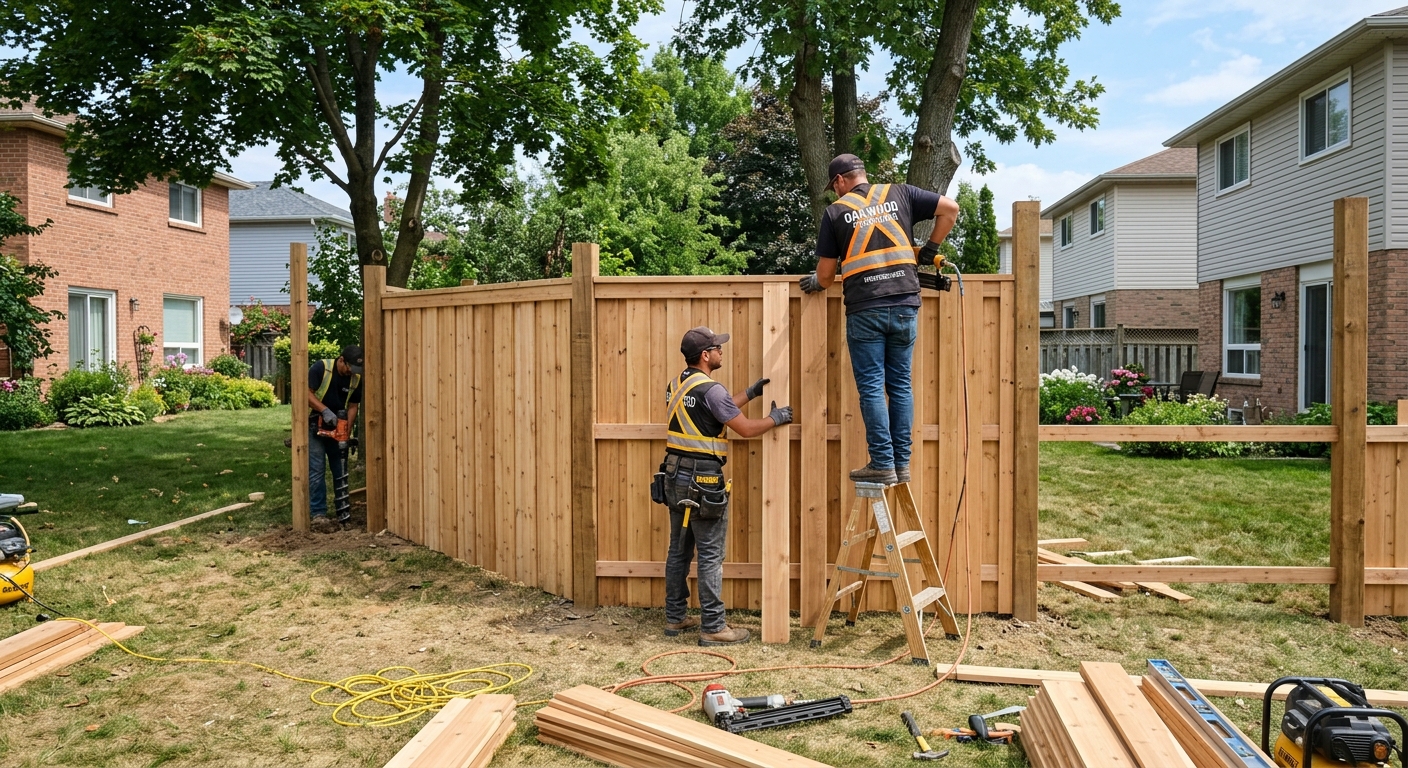
Fencing options and costs in Kenilworth
Kenilworth homeowners typically ask for fences that look good from the street and hold up to Prairie wind and freeze–thaw. With a population of 2,489 (Statistics Canada, 2021 Census), the town is small, so local contractors often rely on Calgary-area dispatch; that can be an advantage for scheduling when weather is favourable. Demand is also strongly tied to detached housing stock—each single-detached home is effectively a long-term “fence customer” because backyard boundaries tend to need periodic repairs and upgrades as lots change over time.
In the Calgary economic region, fencing costs are shaped less by material alone and more by frost protection and wind loading. The freeze–thaw cycle drives the need for deeper post holes—often about 4 ft (≈120 cm) down—to reduce heaving. Wind exposure across open Prairie lots also increases racking risk, so privacy panels usually need sturdier posts and tighter spacing than more open designs. Availability can vary seasonally: spring and late summer installs often price higher because demand concentrates when ground is workable.
In Kenilworth, fencing trade interest is especially common on larger estate-style lots on the edge of town and on properties with open wind exposure where privacy and windbreak performance matter. If your goal is to balance curb appeal, privacy, and long-term stability, the option you choose will largely determine where your project lands within common Calgary pricing ranges. Use the comparison table below to line up material choices with expected lifespan and typical installed pricing.
| Material |
Lifespan |
Maintenance |
Privacy Rating |
Price per Linear Foot |
| Pressure-treated pine (standard wood) |
12–18 years |
Stain or seal every 2–3 years; inspect posts after freeze–thaw |
High (solid pickets/rails) |
$40 – $75 |
| Cedar (natural rot resistance) |
18–25 years |
Light staining or sealing every 2–4 years (varies by sun exposure) |
High (solid style boards) |
$55 – $90 |
| Vinyl / PVC (no-maintenance) |
20–30 years |
Rinse as needed; check post hardware after extreme cold |
High (privacy panels available) |
$50 – $95 |
| Chain-link (galvanized steel) |
25–40 years |
Occasional rinse; straighten sagging sections if needed |
Low–Medium (airflow-through) |
$25 – $50 |
| Aluminum ornamental |
25–35 years |
Very low; wash and check gate alignment |
Low–Medium (open pickets) |
$70 – $120 |
| Composite / recycled material |
20–30 years |
Low; periodic wash, check for fastening loosening |
Medium–High (depends on panel design) |
$60 – $100 |
Prices are estimates only and vary by project scope, site access and material selection.
What affects the price of fencing in Kenilworth
In Kenilworth, two quotes for what looks like the same fence can still swing by about 30–50% across the Calgary area and other parts of Alberta. The main reason is that frost depth, wind loading, and ground conditions change the “hidden” parts of the job—post length, excavation time, concrete volume, and bracing—while some estimates only focus on fence panels and visible rails. If one contractor is sizing posts and spacing for Prairie wind and freeze–thaw while another is using lighter assumptions, you’ll see a meaningful price gap.
Frost protection sets the pace. Even if the design board height is constant, posts often need to be set roughly 4–6 inches (≈10–15 cm) below the design frost depth to prevent heaving. In the colder Alberta winters, that commonly translates to about 1.5–2.0 m into the ground, which means deeper holes, more labour, and more material (especially when concrete footings are used). Wind exposure on open Prairie lots also pushes for tighter post spacing, sturdier rails, and fully braced corners—especially for solid privacy panels.
Local examples that raise cost in Kenilworth: (1) a 6 ft (≈1.8 m) privacy fence typically costs more than a chain-link line because it needs closer spacing and more robust, concrete-set posts; (2) gate installs near driveways often require more excavation and careful alignment, particularly where the approach is uneven; and (3) removing an old fence can add hauling and disposal time.
Conversely, costs can come down when the run is short, the ground is level, and you choose more open systems like chain-link. In Calgary, it’s common to see wood or vinyl privacy land around the mid–upper band (roughly $40–$80 or $45–$90 per linear foot), while chain-link typically stays lower (often $25–$55 per linear foot). Housing age also matters—older lots sometimes have buried fence remnants or uneven base grading, which can add rework costs before material even goes up.
| Price Factor |
Why It Matters |
Cost Impact |
| Fence length in linear feet |
Every panel, rail, post and fastening system scales directly with total length |
Highest impact; small measurement differences can change material totals |
| Post depth required |
Frost protection determines post length and hole depth to reduce heaving |
Can significantly increase excavation and concrete needs |
| Post setting method |
Concrete vs gravel pack vs driven posts affects stability in freeze–thaw and wind |
Concrete-set posts usually cost more but improve long-term rigidity |
| Material choice |
Vinyl/cedar require different rails and post capacities; chain-link is more forgiving |
Shifts you between lower and higher provincial price bands |
| Gate count and type |
Drive-through (double) gates need stronger posts, hinges and alignment |
Gates add hardware cost and extra labour for setup and bracing |
| Grade and terrain |
Slopes require raked or stepped layouts to keep the top line straight |
More cutting, layout time and sometimes extra posts |
| Old fence removal and disposal |
Removal adds labour and waste handling before new materials can install |
Often a noticeable add-on, especially with buried posts |
| Permit fees and survey / property line locate |
Higher fences and complicated boundaries may require additional paperwork and verification |
Variable; can add time and a direct fee component |
Permits & regulations in Alberta
In Alberta, fence permit requirements are commonly tied to height and location. As a practical rule in many municipalities, fences at or above about 2.0 m (6.5 ft) at the rear may trigger a building permit, while front yard or corner fences around 1.0–1.2 m (3–4 ft) can also be subject to review depending on the exact property and municipal bylaw. Your local permitting decision is ultimately municipality-specific, so for a Kenilworth property you should verify with the town/council office or your contractor’s permit process before you dig.
All fences must respect property lines and municipal setback rules. Before drilling any post holes, call for utility locates through Alberta One-Call to mark buried services; this is essential because fence lines often cross areas with drainage runs, buried cable, or older infrastructure. Also consider getting a survey or property pins located so you don’t accidentally build over a boundary—fence disputes can cost more than the fence itself to resolve.
Step-by-step, here’s how to verify a contractor’s Alberta compliance for a Kenilworth install: (1) ask for their Alberta business licence number (if applicable to their contracting type), then confirm it through the relevant online registry; (2) request a current certificate of insurance (liability coverage) and ensure dates are active; and (3) confirm workers’ compensation coverage (WSIB/WCB coverage is required for many labour-involved contractor operations in Alberta). A cleared, up-to-date clearance letter and matching insured details on the certificate are key—don’t accept a verbal promise.
Choosing the right fence material for Kenilworth
Choosing a fence material in Kenilworth is really about matching performance to Alberta weather. With long freeze–thaw cycles and frequent Prairie wind, the “system” matters: solid posts set deep for frost protection, rails designed to resist racking, and panel materials that won’t degrade quickly under snow load and wind stress.
Pressure-treated pine is usually the budget-friendly option upfront, but it typically needs staining or sealing every 2–3 years to prevent grey weathering and to protect against moisture cycling. Cedar has better natural rot resistance and often looks nicer over time, but it still benefits from periodic staining—especially on windward sides that see higher moisture exposure. Vinyl/PVC offers no painting and fast visual consistency, yet it can be more sensitive to extreme cold if the install hardware and post movement aren’t handled correctly; proper post setting and rail/bracing are important. Chain-link is the lowest-cost, long-life choice, and it lets wind pass through—so it’s excellent for reducing wind-pressure on your boundary while still defining the edge. Aluminum ornamental has a mid-range cost profile with excellent corrosion resistance, but it’s typically open (lower privacy) unless you pair it with landscaping.
For privacy, a solid wood or vinyl system often makes the most sense. You usually pay more than chain-link, but the extra stability and denser panels are exactly what you’re buying in the Calgary market. For example, if chain-link comes in around the $25–$55 per linear foot range, a vinyl privacy fence may run roughly $45–$90 per linear foot; that jump is justified when you want true screening and reduced wind-blast into your backyard.
Because Calgary’s frost protection guidance often leads to deeper post holes, concrete-set posts are commonly used for 6 ft privacy fences and for gate posts to maintain alignment through heave cycles. If your yard has a slope or wind funnel, ask your contractor how they’ll design the post spacing and whether they’ll use raked/stepped sections to keep top lines even.
| Material |
Cold Tolerance |
Lifespan |
Annual Maintenance |
Best For |
Price Band |
| Pressure-treated pine |
Good (with proper sealing and good post setting) |
12–18 years |
Low to moderate (inspect fasteners; minor touch-ups as needed) |
Budget privacy with classic look |
$40 – $80 |
| Cedar |
Good (naturally rot-resistant but still needs care) |
18–25 years |
Low to moderate (periodic stain/seal) |
Better curb appeal and longer wood life |
$55 – $90 |
| Vinyl / PVC |
Very good (avoid poor anchoring in extreme cold) |
20–30 years |
Very low (wash/rinse) |
Low-maintenance privacy |
$45 – $90 |
| Chain-link |
Excellent (flexible in freeze–thaw) |
25–40 years |
Very low (occasional tightening) |
Security/containment with airflow |
$25 – $55 |
| Aluminum ornamental |
Excellent (no rust) |
25–35 years |
Very low (wash; adjust gates if needed) |
Front yard definition and curb appeal |
$70 – $120 |
| Composite / recycled |
Good (performance depends on anchoring and fastening) |
20–30 years |
Low (rinse; check hardware) |
Low-care fence with solid appearance |
$60 – $100 |
How to choose a fencing contractor in Kenilworth
For a Kenilworth fence, the contractor you pick affects more than appearance—it affects how posts survive frost heave, wind loading, and winter alignment. Start by confirming Alberta coverage and credentials. Ask for their liability insurance certificate and verify the policy is current and lists the correct business name. Then check workers’ compensation coverage (WCB/WSIB coverage depending on how they operate and invoice)—request a clearance letter or proof that the coverage is active. If they’re doing contracting work that requires licensing or registration, ask for their Alberta business licence details and verify through the appropriate online registry.
Next, get 2–3 itemised written quotes. “Itemised” should mean a breakdown of labour and materials: excavation and post setting method, post depth, concrete quantity (if used), rail construction, panel material, gate hardware, and finishing items like caps or tension adjustments. Avoid lump-sum quotes that don’t show what’s included. Carefully compare scope exclusions: is permit pulling included (when required), is survey/property line locating included, and is old fence removal and disposal included? Disposal often changes the true cost.
Warranty matters in Alberta winters. Ask for the workmanship warranty length (how long they guarantee installation), plus the manufacturer’s product warranty (and whether it transfers to a new homeowner). Payment terms should stay reasonable: never pay more than 10–15% upfront; request a holdback until the job is complete and gates are aligned. Finally, get a start date and completion estimate in writing so weather delays are discussed up front and nobody’s left guessing mid-project.
- Request proof of active liability insurance with correct project address/name.
- Verify workers’ compensation coverage and obtain a clearance letter or equivalent document.
- Confirm the contractor’s Alberta business details via an online registry before signing.
- Insist quotes include post depth targets aligned to frost protection (not “standard holes”).
- Ask whether footings use concrete and how much; concrete quantity should be stated or clearly implied.
- Confirm post spacing for your chosen privacy height and wind-exposed yard.
- Require line item allowances for excavation, hauling, and disposal (especially for old fences).
- Check gate hardware specifications (hinges, latches, reinforcement) and confirm it’s included.
- Ensure the quote states whether your contractor will pull permits when height triggers requirements.
- Ask who is responsible for utility locates and how it’s documented.
- Verify warranty details: workmanship duration and product warranty coverage terms.
- Set payment schedule in writing; plan for a holdback until gates and alignment are finished.
Red flags to watch for: quotes with no mention of post depth/frost protection, “we’ll handle permits” without confirming responsibility and fees, unusually low pricing versus the local bands (for example, pricing that ignores privacy-panel structural needs), refusal to provide insurance/WCB proof, and vague scope language like “materials supplied as needed” without specs.
Frequently asked questions — fencing in Kenilworth
How tall can my fence be in Kenilworth?
In Kenilworth, fence height is usually limited by municipal bylaws and the fence’s location (rear vs front/corner). As a starting point, Alberta projects often see extra scrutiny for fences around 2.0 m (6.5 ft) in the rear and for lower heights in the front yard or corner (commonly around 1.0–1.2 m). Whether a permit is needed often depends on height and placement, so confirm with the town office or through your contractor’s permitting process before you order materials. The reason it matters: privacy fences on the Prairies are structurally demanding and typically require robust post setting to handle wind loading, so design decisions should align with the allowable height.
Should fence posts be set in concrete here?
For most privacy fences and gate posts in Kenilworth, concrete-set posts are commonly the best approach because Calgary-area freeze–thaw cycles can push on fence systems. Guidance used by contractors in the Calgary region typically targets deeper post setting (often about 4 ft / ≈120 cm) to reduce heaving risk. Concrete adds stability, helps maintain gate alignment through winter, and reduces racking when wind hits solid panels. That said, installers sometimes use alternative methods for specific lightweight/non-solid systems, like chain-link, where airflow reduces wind stress. If you’re comparing quotes in the $45–$90 per linear foot vinyl range versus the $25–$55 chain-link range, make sure both contractors specify how they’re setting posts—not just the fence material.
What's the best fence for privacy?
For privacy in Kenilworth, the best choices are usually solid wood or vinyl/PVC privacy styles, installed with sturdy rails and wind-resistant bracing. Chain-link is excellent for boundary definition, but it won’t give true screening because it allows wind and sightlines through. Wood (pressure-treated or cedar) and vinyl typically rank higher for privacy rating because they block views and buffer wind. The trade-off is cost and structural requirements: in the Calgary market, wood privacy often lands around roughly $40–$80 per linear foot, while vinyl commonly falls around $45–$90 per linear foot, partly because solid panels need closer post spacing and deeper, more stable footings in frost conditions.
How do I compare fencing quotes?
When comparing quotes in Kenilworth, don’t focus only on the headline price per linear foot—compare the scope and the “hidden” installation details. Ask for an itemised breakdown: post depth/setting method (including whether concrete is used), post spacing, rail type and thickness, gate hardware specs, and what’s included for excavation and disposal. Confirm whether permits and property line locate/survey work are included where required. Also compare warranty terms: workmanship duration and manufacturer coverage. A quote that looks cheaper can become expensive if it uses lighter posts, shorter hole depth, or leaves out disposal. As a sanity check, many Calgary-area projects land within typical material bands (for example, chain-link often $25–$55, while aluminum/metal can be $70–$120).
How long does fence installation take in Kenilworth?
Install time in Kenilworth depends mainly on fence length, number of gates, site access, and how difficult excavation is (rocks, old buried posts, or soft spots). A straightforward, level run can move quickly—many jobs are completed within a couple of working days once materials arrive and post holes are set. Complex work—like multiple gates, sloped grades requiring raked/stepped sections, or removal of an old fence with buried hardware—adds hours and sometimes requires a second day. In winter or during wet thaws, curing time and ground conditions can stretch schedules. Your contractor should provide a written start date, estimated completion window, and a plan for weather-related delays.
Can I install a fence on a slope in Kenilworth?
Yes, you can install a fence on a slope in Kenilworth, but the layout method matters for both appearance and stability. Contractors typically use stepped sections (each post height changes while keeping the fence boards level within each “step”) or raked panels (boards follow the slope angle). Stepped layouts are common where you need more consistent board-to-grade spacing; raked can look smoother but requires careful cutting and consistent rail alignment. Because Calgary-area frost and wind can amplify misalignment, proper post depth planning becomes even more important on sloped yards. Ask your contractor how they’ll handle post setting depth and whether the design keeps the top line visually consistent while maintaining structural performance through freeze–thaw.