Fencing options and costs in Huntington Hills
In Huntington Hills, Alberta, choosing a fence usually starts with how much privacy and weather protection you want—then quickly turns into a real conversation about winter frost depth and wind. With a population of 13,120 (Statistics Canada, 2021 Census), the neighbourhood has plenty of detached homes where families regularly upgrade side and backyard runs as trees mature, lots get redeveloped, and kids’ and pets’ safety becomes a priority. In many parts of the Calgary area, fence demand is especially steady around busy residential corridors such as 37 Street SE and the surrounding local streets, where homeowners often expand or replace fencing after landscaping changes.
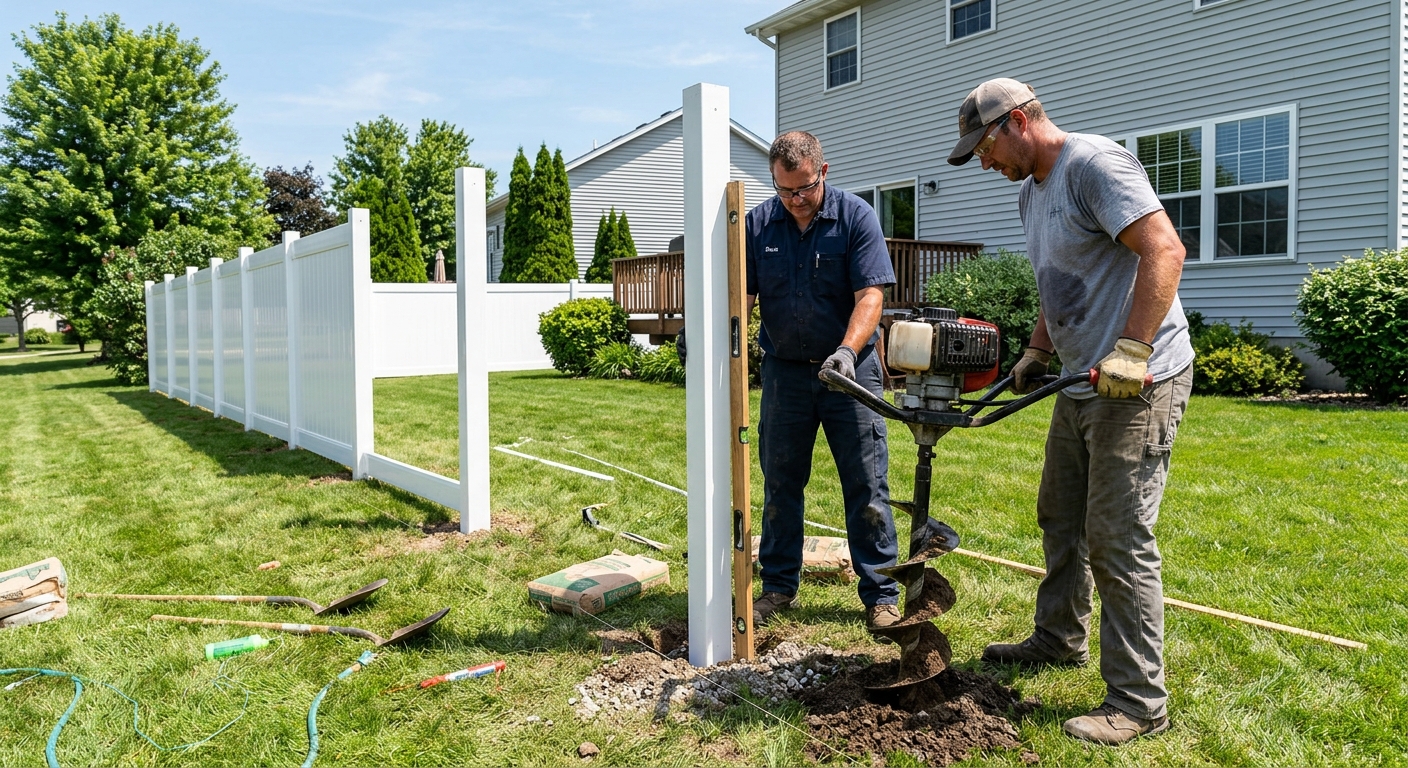
Calgary’s Prairie continental climate is the reason costs aren’t “one-size-fits-all.” Long freeze–thaw cycles mean fence posts must be set deep enough to sit below the frost line, typically about 4 ft (≈120 cm) in our area, often with concrete footings for 6 ft privacy fences and gate posts. That extra excavation, concrete volume, and longer posts are major drivers. At the same time, open exposure across the region creates strong wind loading, so solid privacy panels usually need tighter post spacing and sturdier hardware to prevent racking.
Contractor availability can also affect your final price. When crews are booked ahead (commonly in the spring and early summer), schedules tighten and mobilization costs rise. Chain-link systems, which allow wind to pass through, tend to be less labour-intensive than solid wood or vinyl privacy fences, so they often price lower—while ornamental aluminum sits toward the high end because it’s more material-heavy and detail-focused.
Use the table below to compare typical options and what homeowners in Huntington Hills usually pay per linear foot.
| Material |
Lifespan |
Maintenance |
Privacy Rating |
Price per Linear Foot |
| Pressure-treated pine (standard wood) |
10–20 years |
Stain/paint every 2–3 years to slow weathering |
High (solid panels possible) |
$40–$65 |
| Cedar (natural rot resistance) |
15–25 years |
Light staining or sealing every 3–5 years |
High (solid panels possible) |
$55–$80 |
| Vinyl / PVC (no-maintenance) |
20–30 years |
Occasional wash; inspect posts/hardware |
High (solid privacy styles) |
$55–$90 |
| Chain-link (galvanized steel) |
20–35 years |
Minimal; occasional tension/repair |
Low–Medium (privacy slats optional) |
$25–$55 |
| Aluminum ornamental |
25–40 years |
No rust; rinse and inspect annually |
Medium (ornamental pickets) |
$70–$120 |
| Composite / recycled material |
20–30 years |
Low; periodic cleaning |
Medium–High (depends on panel style) |
$65–$110 |
Prices are estimates only and vary by project scope, site access and material selection.
What affects the price of fencing in Huntington Hills
In Huntington Hills, two homeowners can receive quotes for what looks like the “same” fence and still see a 30–50% swing. That gap usually comes down to whether the quote includes deep frost-rated post holes, full concrete setting for key posts, the number and type of gates, and how challenging the access is for a skid steer or mini-excavator. In Calgary and surrounding areas, winter frost behaviour and open wind exposure push costs toward the upper end of typical regional ranges, while simpler runs with chain-link or partial privacy often land lower.
First, frost line depth sets how deep posts must be installed. In colder Canadian regions like Alberta, posts are commonly set about 1.5–2.0 m into the ground, which means longer posts, deeper augers, and more concrete when you choose concrete setting. That’s a real cost driver compared with milder provinces where frost doesn’t penetrate as deeply. Second, Prairie wind loading matters: solid wood or vinyl privacy panels usually need tighter post spacing and stronger bracing, while chain-link costs less because airflow reduces racking forces.
Here are a few concrete examples that change price in Huntington Hills. If your fence line runs along an exposed backyard edge, we typically spec stronger posts and may increase bracing, which moves you up within wood and vinyl pricing (for example, wood often sits around the $40–$80 band installed). If your yard has stable access for machinery and mostly flat grade, we can excavate efficiently, keeping labour efficient. If you’re removing an old fence and hauling it away, disposal and extra labour often add noticeable cost regardless of material—especially for older pressure-treated lumber.
Finally, material choice interacts with climate. Vinyl is popular for low maintenance, but in freeze–thaw conditions it still depends on correct post depth and solid hardware installation. Cedar can be priced higher upfront (often near the mid–upper range within wood), but fewer cosmetic issues over time can justify the difference for long-term homeowners.
| Price Factor |
Why It Matters |
Cost Impact |
| Fence length in linear feet |
The biggest driver: labour, posts, rails, and materials scale directly |
Highest; small per-foot differences become large totals |
| Post depth required |
Frost line determines hole depth and post length to prevent heaving |
Can increase excavation time and material quantities |
| Post setting method |
Concrete vs. gravel pack vs. driven posts changes durability |
Concrete setting typically raises cost but improves stability |
| Material choice |
Different hardware, panel weight, and installation complexity |
Vinyl and cedar usually land above chain-link; aluminum higher |
| Gate count and type |
Gates require heavier posts, stronger hinges/latches |
Each gate can add significant labour and hardware cost |
| Grade and terrain |
Sloped yards require stepped or raked panels and extra layout time |
More fitting time and sometimes more waste material |
| Old fence removal and disposal |
Hauling and demolition add labour and disposal fees |
Often a meaningful add-on, especially for large, aged runs |
| Permit fees and survey / property line locate |
Documentation reduces risk and prevents boundary disputes |
May add cost depending on scope and municipality requirements |
Permits & regulations in Alberta
In Alberta, fences can fall under permit requirements depending on height and location. A practical rule of thumb homeowners use in the province is that fences above a height threshold—typically around 2.0 m (6.5 ft) for rear yards and about 1.0–1.2 m (3–4 ft) for front yards or corners—often trigger a building permit in many municipalities. Regardless of permit needs, every fence must respect property lines and local setback bylaws (so the “fence on the lot” assumption is not enough—orientation and corners matter).
Before digging any post holes, arrange utility locates through Alberta One-Call. This is the step that prevents damage to buried services and keeps your project from turning into an emergency. Next, get a survey or a property pin locate before installation so you don’t build on a neighbour’s land by mistake—disputes are one of the most expensive fencing “surprises,” because correcting them can mean moving posts and panels.
Shared fence ownership and boundary responsibilities are guided by provincial line-fences legislation, but your best first step is still to confirm the boundary before the crew starts.
What typically DOES require a permit: taller fences (commonly above ~2.0 m in back yards and lower thresholds in front/corner locations), larger gate structures, and any project your municipality flags during review. What typically does NOT: replacement of an existing fence with the same height and location, and standard fence installations that stay within permitted height limits (confirm in writing with your municipality for your exact address).
To verify contractor readiness in Huntington Hills: check the Alberta online contractor/licensing registry for fence/deck related registration (as applicable to the work being performed), request proof of liability insurance (certificate of insurance listing the insured business and coverage limits), and confirm workers’ coverage as required (WSIB/WCB coverage as applicable). Ask for documentation before work starts—copies, clearance letters, or current certificates—then keep them with your contract.
Choosing the right fence material for Huntington Hills
Choosing the right fence material in Huntington Hills comes down to balancing privacy, maintenance, budget, and long-term durability in Calgary’s freeze–thaw cycles and wind exposure. Pressure-treated pine is often the budget choice, but it typically needs staining or painting every 2–3 years to prevent grey weathering and to keep the wood looking uniform. Cedar is naturally rot-resistant and usually holds its look longer; it still benefits from periodic sealing, but many homeowners find it’s easier on the appearance over time. Vinyl/PVC is popular for low maintenance—wash it occasionally and inspect hardware—but in extreme cold snaps it still relies heavily on correct installation and quality post/hardware support to avoid issues during thermal expansion and contraction.
For privacy, solid panels are the answer with wood, cedar, vinyl, and composite. In our Prairie climate, privacy fencing usually benefits from concrete-set posts where required, especially for gate posts and end/corner posts. Calgary’s frost behaviour means deep post holes are not optional—setting depth is what keeps the fence from heaving or leaning after freeze cycles. Chain-link is the lowest cost and can last a long time, but it’s low privacy unless you add privacy slats (which can also reduce airflow and increase wind loads slightly). Aluminum ornamental offers an attractive, no-rust option with good longevity, but it’s best for partial privacy and visibility rather than solid backyard screening.
A good example of when price differences are justified: if you’re replacing a 30 ft run for a privacy goal, wood or vinyl can cost materially more than chain-link. In many Huntington Hills projects, wood installed may land around the mid range of the $40–$80 per linear foot band, while chain-link can be in the lower–mid range (about $25–$55 per linear foot). If you need real privacy and wind stability, paying for a solid privacy fence is usually worth it—even if chain-link is cheaper—because you’re buying panel coverage and bracing, not just fencing “presence.”
| Material |
Cold Tolerance |
Lifespan |
Annual Maintenance |
Best For |
Price Band |
| Pressure-treated pine |
Good when properly installed and sealed |
10–20 years |
Light inspection; stain/paint every 2–3 years |
Budget-conscious privacy |
$40–$65 |
| Cedar |
Excellent rot resistance in damp-to-freeze cycles |
15–25 years |
Inspect; seal/stain every 3–5 years |
Longer-lasting beauty |
$55–$80 |
| Vinyl / PVC |
Very good in cold when post depth and hardware are correct |
20–30 years |
Occasional wash; hardware check |
Low maintenance privacy |
$55–$90 |
| Chain-link |
Very good; flexible enough for temperature swings |
20–35 years |
Minimal; tension and spot repairs |
Security on a tighter budget |
$25–$55 |
| Aluminum ornamental |
Excellent |
25–40 years |
Rinse; check fasteners annually |
Curb appeal with partial visibility |
$70–$120 |
| Composite / recycled |
Good, but depends on panel design and fastening details |
20–30 years |
Low; clean and inspect |
Durable privacy with wood-like look |
$65–$110 |
How to choose a fencing contractor in Huntington Hills
Choosing a fencing contractor in Huntington Hills should start with proof, not promises. In Alberta, verify the business registration/licensing that applies to your project and request liability insurance certificates before any work begins. Look for a current certificate of insurance showing the insured contractor name, policy period, and coverage limits. For worker coverage, ask for proof of WSIB/WCB coverage as applicable; the key is that it’s current and matches the contractor company doing the work—not just a subcontractor’s old certificate.
Next, get 2–3 itemised written quotes, not lump sums. A proper fence quote breaks down labour and materials separately (posts, rails, panels, gates, hardware, concrete, excavation/haul-away, and any supervision costs). It also clarifies whether the price includes a permit pull, utility locates, and disposal of the old fence. If removal is included, ask for how much and what’s excluded (for example: buried posts, concrete chunks, or landscaping restoration).
Read the scope carefully: confirm fence height, post spacing, and whether concrete is included for line posts, corner posts, and gate posts—Prairie wind and freeze–thaw cycles often mean those structural details matter as much as the material. Warranty is another big differentiator. Ask for the workmanship warranty length, the manufacturer warranty coverage, and whether the warranty transfers to you if you sell the home.
Payment schedule matters too. Never pay more than 10–15% upfront. Hold back a portion until the job is complete and you’ve confirmed alignment, gate operation, and final clean-up. Finally, timeline: get a start date and completion estimate in writing, including weather-related contingency for excavation days.
- Request current certificate of liability insurance and verify the contractor name matches the quote.
- Confirm WSIB/WCB coverage is active (ask for clearance/confirmation letters where available).
- Ask for an itemised quote that lists posts, rails, panels, gates, concrete, and disposal line-by-line.
- Verify post depth approach for Calgary frost—confirm concrete-set plan where required.
- Check gate hardware specs (hinges, latches, bracing) and whether gate posts are reinforced.
- Confirm who pulls any permits and whether the permit fee is included or extra.
- Ask if utility locates are included or if you’re responsible to call Alberta One-Call.
- Confirm material grades and panel thickness/spacing (especially for privacy slats or solid panels).
- Ask what’s excluded: landscaping restoration, extra demolition, stump removal, or buried obstacles.
- Get a workmanship warranty in writing (how long, what it covers, and response expectations).
- Use a payment schedule with only small deposit (10–15%) and final holdback until completion.
- Ensure a written start/completion timeline and a plan for weather delays.
Red flags I see in Huntington Hills include: contractors who won’t provide insurance/coverage documents upfront, quotes that omit post depth or concrete details, “all-in” lump sums with no scope breakdown, unrealistic timelines that ignore frost/excavation realities, and payment requests that exceed 10–15% deposit without a signed contract and staged milestones.
Frequently asked questions — fencing in Huntington Hills
What's the most low-maintenance fence?
In Huntington Hills and across the Calgary area, vinyl/PVC is often the lowest-maintenance choice because it doesn’t rot or need annual staining. After installation, most homeowners only wash panels occasionally and check gate hardware. Aluminum ornamental is also low-maintenance—no rust and minimal upkeep—but it usually provides partial privacy rather than a solid screen. If your priority is “set it and forget it,” vinyl typically lands in the mid–upper installed range, often around the $55–$90 per linear foot band depending on height, gates and post setting. Chain-link is also low maintenance, but it won’t give you privacy unless you add slats or a privacy screen, which changes airflow and can affect wind performance.
How tall can my fence be in Huntington Hills?
Fence height rules can vary by municipality and where the fence sits on your property, but Alberta homeowners commonly run into permit thresholds around 2.0 m (6.5 ft) for rear-yard fences and lower limits in front yards or corners (often 1.0–1.2 m). In Huntington Hills, the safest approach is to confirm your exact address and corner/front-yard context with your municipal requirements before you order materials. If your project is above the common thresholds, plan on a permit and possibly additional documentation. If you’re replacing an existing fence that already meets the allowed height in the same location, requirements are often simpler—but still verify in writing. Your contractor should tell you whether the permit is included in the quote and what happens if the height triggers review.
Should fence posts be set in concrete here?
For many Huntington Hills privacy fences, especially those with 6 ft solid panels and gates, concrete setting is commonly used to keep posts stable through Calgary’s freeze–thaw cycles and wind loads. The key issue is frost protection: posts generally need to be set deep enough to sit below the regional frost line (often about 4 ft / ≈120 cm or deeper depending on the design), and concrete footings help resist heaving and shifting. That doesn’t mean every fence requires concrete for every post—some chain-link systems can use alternate methods—but for solid privacy runs and gate posts, concrete is often the prudent choice. Concrete setting can move you toward the higher end of the wood and vinyl installed bands, such as the mid to upper portions of $40–$80 (wood) or $55–$90 (vinyl), because labour and material volumes increase.
What's the best fence for privacy?
For real backyard privacy in Huntington Hills, you’ll usually want a solid panel design: wood (pressure-treated or cedar), vinyl/PVC privacy panels, or composite privacy systems. Solid fencing blocks sightlines and, with correct post spacing, handles wind better than decorative styles. Chain-link can be used for security, but privacy typically requires slats or screens, which may not give the same “solid wall” feeling. Vinyl and cedar are popular when homeowners want a clean look longer-term; pressure-treated wood is often the more budget-friendly option among privacy fences. In many projects, homeowners compare wood in the $40–$80 per linear foot band versus vinyl in the $55–$90 range; the difference is usually justified when you want longer low-maintenance performance or a more uniform finish.
How do I compare fencing quotes?
Compare quotes in Huntington Hills the way you’d compare roofing: don’t judge by the total alone—judge by what’s included. Ask each contractor for an itemised breakdown covering labour and materials (posts, rails, panels, gate hardware, concrete, excavation, and disposal). Verify post depth and whether posts—especially corners, ends, and gate posts—are concrete-set for frost protection. Confirm fence height, panel type (solid vs. lattice), post spacing, and how sloped yards are handled (stepped vs. raked). Also compare warranties (workmanship vs. product), who pulls permits, and whether utility locates are included. If one quote is dramatically lower, it may be missing concrete depth, disposal, or gate bracing—issues that become expensive after installation.
How long does fence installation take in Huntington Hills?
Most fence installations in Huntington Hills take anywhere from a couple of days to about a week, depending on fence length, how many gates you have, access for equipment, and whether you’re removing an old fence. Short runs with chain-link can be quicker, while solid privacy fences with deep post holes (often concrete-set in Prairie conditions) take more time for excavation and setting. Weather also matters: freeze–thaw seasons can make ground conditions unpredictable, so crews plan around frost and moisture. If you’re scheduling in peak season, ask for a start date in writing—mobilization and layout time can shift. When comparing quotes, don’t just look at price per linear foot; ask for an estimated timeline that matches the scope, especially around concrete setting and any required permit work.