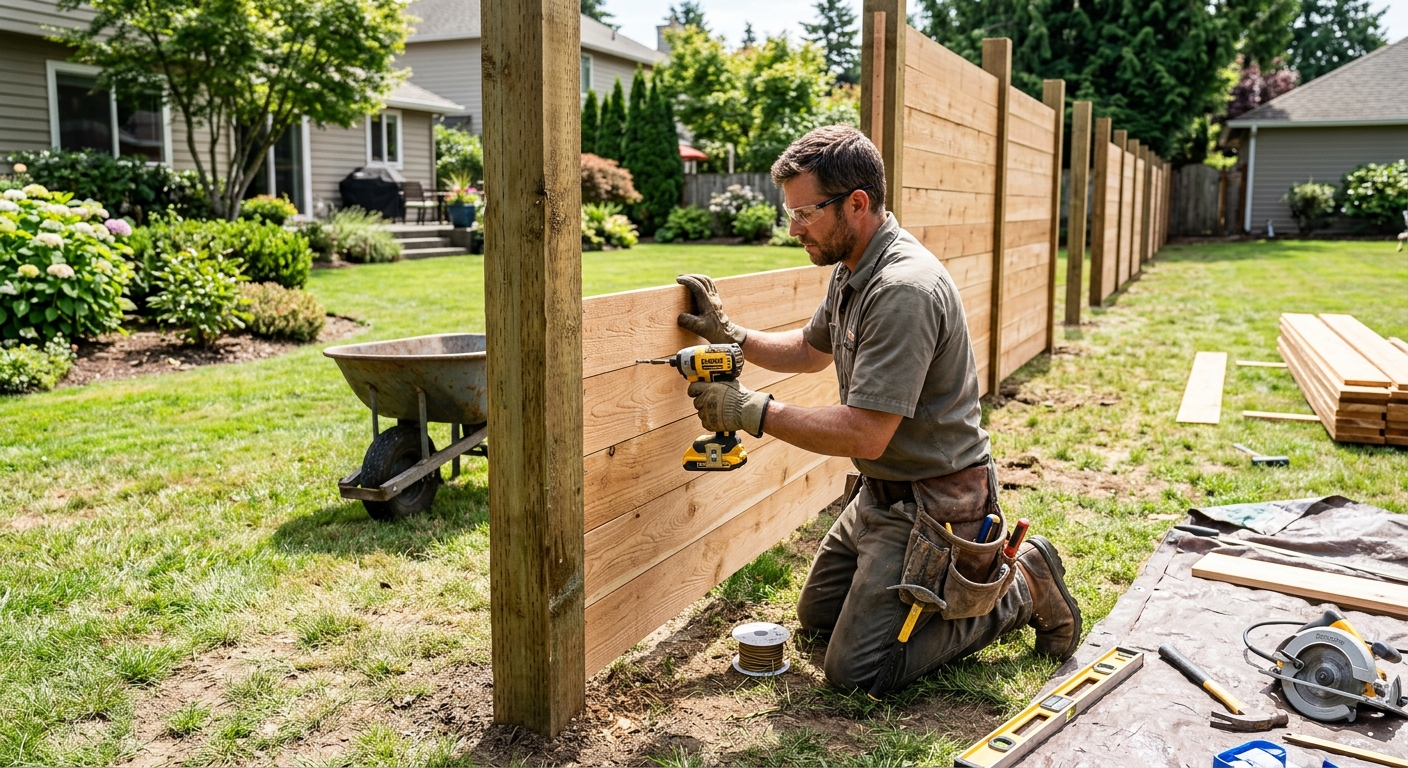
Fencing options and costs in Inglewood
Inglewood, Alberta is a small, well-established community (population 6,255, Statistics Canada, 2021 Census), and that usually means steady demand for residential fence upgrades—especially around detached properties where owners want clear boundary lines and privacy. Calgary-area neighbourhoods with more established homes tend to see more fence replacement cycles, and the same is true in Inglewood: when roofs, siding and landscaping get refreshed, fences often follow. With Inglewood’s Prairie continental conditions, fencing costs are shaped by long freeze–thaw cycles and frequent wind exposure, so contractors price for frost protection and structural rigidity, not just materials.
In the Calgary economic region, the main budget pressure is how deep posts must go to reduce heaving. Local guidance commonly targets about 4 ft (≈120 cm) below grade with concrete footings for many privacy-style layouts, especially for 6 ft fencing and gate posts—this adds excavation time, concrete volume and labour compared with milder parts of Canada. Wind loading also matters: solid panels rack more under Prairie gusts, which can push post spacing tighter and hardware stronger than a lightweight system. Chain-link, by contrast, often costs less because airflow reduces pressure on the fence line.
Within Inglewood, trade demand is especially noticeable near established residential pockets along 9 Avenue SE and the core streets connecting toward the downtown direction, where homeowners frequently replace older pickets and privacy boards with sturdier, weather-ready installs. Use the table below to compare typical lifespans, upkeep needs and cost expectations before you line up quotes.
| Material |
Lifespan |
Maintenance |
Privacy Rating |
Price per Linear Foot |
| Pressure-treated pine (standard wood) |
10–15 years |
Stain/coat every 2–3 years; inspect posts after winters |
High (solid boards) |
$40–$80 |
| Cedar (natural rot resistance) |
15–20 years |
Light staining or oil as needed; periodic checks for fasteners |
High (solid boards) |
$55–$95 |
| Vinyl / PVC (no-maintenance) |
20–30 years |
Rinse as needed; check alignment after freeze–thaw |
High (solid/walled panels) |
$60–$100 |
| Chain-link (galvanized steel) |
20–30 years |
Occasional wash; replace bent sections if impacted |
Low–medium (open mesh) |
$25–$55 |
| Aluminum ornamental |
25–35 years |
Rinse/wash; no rust staining |
Low (decorative pickets) |
$70–$120 |
| Composite / recycled material |
20–30 years |
Minimal cleaning; occasional fastening checks |
Medium–high (solid profiles) |
$75–$115 |
Prices are estimates only and vary by project scope, site access and material selection.
What affects the price of fencing in Inglewood
Inglewood fence quotes can differ by 30–50% for the same-looking job because contractors price for the conditions that change from lot to lot: how long the run is, how hard it is to excavate, how windy the line is, and how deep posts must be set for frost protection. Even within the Calgary region, crew productivity and material availability can shift the labour portion of your estimate, and that labour intensity is higher than in milder provinces because frost heave risk is taken seriously. Chain-link is often at the lower end of the market (for example, $25–$55 per linear foot), while wood and vinyl privacy systems typically land more mid–upper range (about $40–$80 and $45–$90 respectively) once posts and concrete footings are included.
Frost line depth sets how deep posts must be installed. As a practical rule used by many Alberta builders, post holes often need to be about 4–6 inches below the design frost depth to prevent heaving—meaning many projects end up needing roughly 1.5–2.0 m into the ground, concrete setting, and longer posts than you’d buy for a milder climate. Wind exposure on the Prairies also drives tighter post spacing and heavier frames for solid panels, because racking movement is a real risk during snow season and spring thaw. In colder areas, materials that stay rigid without fastener loosening matter, and that’s why the “same height” can still price differently.
Concrete examples in Inglewood: (1) A straight 40 ft privacy fence on level ground may cost far less than a similar-length run on a sloped lot requiring stepped panels and extra layout labour. (2) Removing an old fence with embedded posts or broken concrete collars can add disposal fees and time, pushing totals upward even if the replacement material is similar. (3) Installing gate hardware (and especially double gates) can increase costs disproportionately because the frame and bracing requirements change. Taken together, older housing stock and frequent upgrade cycles in the area often lead to full replacement jobs where excavation and post depth dominate the bill.
| Price Factor |
Why It Matters |
Cost Impact |
| Fence length in linear feet |
Material and labour scale directly with total linear footage |
Most significant driver; can swing totals by hundreds to thousands |
| Post depth required |
Frost protection affects post length and hole depth |
Deeper holes increase excavation and concrete use |
| Post setting method |
Concrete vs gravel pack changes stability and labour time |
Concrete footings typically raise costs but reduce heaving risk |
| Material choice |
Different stiffness, wind resistance and panel design affect framing |
Vinyl/cedar usually higher; chain-link often lower |
| Gate count and type |
Gates require heavier posts, hinges and stronger bracing |
Double drive-through gates cost substantially more than walk-through |
| Grade and terrain |
Slopes require raked/stepped sections and more layout work |
Adds labour; may increase scrap from panel cutting |
| Old fence removal and disposal |
Access issues and buried hardware increase time and dump fees |
Often adds a noticeable surcharge beyond “new build” pricing |
| Permit fees and survey / property line locate |
Some fence heights and locations trigger paperwork; accurate boundaries prevent disputes |
Small but real adders; survey can be a one-time cost |
Permits & regulations in Alberta
In Alberta, fencing rules commonly hinge on height and location. As a homeowner starting in Inglewood, plan on the likelihood of a building permit if you’re building higher fence sections—often around 2.0 m (6.5 ft) for rear areas, and roughly 1.0–1.2 m (3–4 ft) for front or corner sides, depending on where the fence sits relative to your property line and the relevant municipal requirements. Even when a permit isn’t required, your fence still must respect property lines and municipal setback bylaws. If you’re unsure, it’s worth confirming before posts go in, because moving a fence after concrete cures is expensive.
Before you dig, call for utility locates using Alberta One-Call. This is essential for safety and to avoid damage to buried services. You should also verify property pins or obtain a professional locate/survey so you don’t encroach on a neighbour’s parcel. Shared fence ownership and maintenance responsibilities generally follow line-fences principles under provincial legislation—so if you’re replacing a shared section, confirm who is responsible for costs and ongoing repairs.
What typically DOES require a permit: higher fences near the commonly referenced thresholds (around 2.0 m rear; 1.0–1.2 m front/corner), and any situation where your municipality flags the installation for review. What typically does NOT: standard-height, straightforward backyard replacements that stay within typical thresholds and are built entirely within the property line with no special variance.
To verify your contractor in Inglewood: ask for their Alberta licence/registration details, request a current certificate of insurance with liability coverage, and confirm workers’ compensation coverage (WSIB/WCB coverage). Where possible, look up the contractor’s licence/registration online, and request a certificate of insurance directly—if they can’t provide it promptly, consider it a major red flag.
Choosing the right fence material for Inglewood
Choosing fence material in Inglewood comes down to matching your priorities—privacy, low maintenance, lifespan, and budget—to a climate with cold snaps, freeze–thaw cycles and windy Prairie weather. Pressure-treated pine is usually the most budget-friendly in the wood category, but it’s not a “set and forget” option: you’ll typically need staining or coating every 2–3 years to slow grey weathering and protect exposed faces. Cedar offers better natural rot resistance and looks warmer over time, but it still benefits from periodic finishing—especially on post tops and board ends where moisture sits.
For low upkeep, vinyl/PVC can be attractive because it doesn’t need staining, but it’s not immune to extreme cold conditions; proper installation matters. Posts still need to be set correctly for frost movement, and panels should be framed to resist racking in wind. Chain-link is the lowest-cost option and tends to last a long time because airflow reduces the stress that solid panels see; it’s ideal for security and containment, but it won’t give the privacy many Inglewood homeowners want unless you add slats or landscaping screening. Aluminum ornamental is rust-resistant and clean-looking, but it provides limited privacy and is often chosen for curb appeal rather than enclosure.
On frost depth: in the Calgary market, posts often need deeper setting (commonly targeting about 4 ft/≈120 cm) and many crews will use concrete footings for privacy fences and gate posts. That means material savings alone won’t eliminate the structural cost difference between options.
A practical dollar example: if a wood privacy fence comes in around $40–$80 per linear foot but vinyl is closer to $60–$100, the additional $20–$30 per foot can be justified if you want fewer maintenance visits over a decade and you prefer the consistent appearance in wind-driven weather. If you’re comfortable maintaining wood, cedar or treated pine often delivers the best value-to-appearance balance for Inglewood homeowners.
| Material |
Cold Tolerance |
Lifespan |
Annual Maintenance |
Best For |
Price Band |
| Pressure-treated pine |
Good when properly sealed and installed on correctly set posts |
10–15 years |
Inspect after winter; plan staining every 2–3 years (seasonal check) |
Budget privacy with classic appearance |
$40–$80 |
| Cedar |
Very good; holds up well in wet/cold cycles with proper finishing |
15–20 years |
Seasonal inspection; light re-oiling/staining as needed |
Natural look and longer rot resistance |
$55–$95 |
| Vinyl / PVC |
Good with correct framing and post setting; avoid loose panel fit |
20–30 years |
Rinse/clean; visual checks for alignment |
Low-maintenance privacy in windy climates |
$60–$100 |
| Chain-link |
Excellent; galvanized components resist freeze-related movement |
20–30 years |
Minimal; wash and check tension points |
Security and containment with budget control |
$25–$55 |
| Aluminum ornamental |
Excellent; no rust performance in cold/wet cycles |
25–35 years |
Rinse/clean; check fasteners |
Curb appeal and pet/safety fencing |
$70–$120 |
| Composite / recycled |
Good; performs well when framed correctly and kept level |
20–30 years |
Low; occasional cleaning and fastener checks |
Solid look with reduced maintenance |
$75–$115 |
How to choose a fencing contractor in Inglewood
Choosing the right contractor in Inglewood starts with verifying credentials and then confirming details in writing. For Alberta work, request proof of their Alberta registration/licensing status (as applicable to their trade category), current liability insurance, and workers’ compensation coverage (WSIB/WCB). Check these before you sign anything: look for the contractor’s registration/licence information through online directories, confirm the certificate of insurance matches the correct legal name and address of the project, and ensure their clearance letter/coverage is valid for the timeframe of your build. If they only send screenshots after you ask twice, that’s a sign to slow down.
Next, get 2–3 itemised written quotes. You want a breakdown that separates labour, materials, post setting (concrete vs gravel pack), gate hardware, and any hauling/disposal. Avoid “lump sum” quotes that don’t explain what’s included—especially because Inglewood and the Calgary region often require deeper, more labour-intensive post installation for frost protection. Your scope should explicitly state whether permits are pulled and who pays, and whether old fence removal and disposal are included.
Warranty matters: ask for the workmanship warranty length and whether the manufacturer warranty is included for materials (and if it’s transferable to you). Payment terms should be conservative: never pay more than 10–15% upfront, and hold back a portion until completion and final cleanup. Finally, require a written timeline with a start date and a realistic completion estimate—fencing is affected by weather, drying times for concrete, and access constraints, so clear scheduling protects both sides.
- Confirm they’ve built privacy fences with concrete-set posts suitable for Alberta freeze–thaw conditions.
- Ask for their liability insurance certificate before any work starts.
- Verify workers’ compensation coverage (WSIB/WCB) for their crew.
- Request an Alberta registration/licensing reference and check it online.
- Get itemised quotes: labour, materials, posts, concrete, gates, hardware, and disposal.
- Ensure the quote specifies post depth targets and setting method (concrete vs gravel pack).
- Confirm permit pull responsibility and whether permit fees are included or extra.
- Ask how they handle property line questions and whether they request a locate/survey.
- Review the warranty terms for both materials and installation workmanship.
- Set payment milestones: max 10–15% deposit; holdback until final walk-through.
- Require a written start date, completion estimate, and weather contingency.
- Ask who supplies and places compacted backfill and topsoil restoration (if needed).
Common red flags in Inglewood include: contractors who won’t provide insurance/coverage documents up front; vague “permit included” language with no specifics; missing post-depth or concrete-setting details; quotes that don’t itemise gate hardware or disposal; and promises to start quickly without a written schedule or clear timeline for curing/drying.
Frequently asked questions — fencing in Inglewood
Wood vs vinyl vs aluminum fence — which is best?
For Inglewood and the broader Calgary area, the “best” choice depends on what you’re optimising. If you want privacy and traditional look, wood (often pressure-treated) is typically the most budget-friendly; many projects land around $40–$80 per linear foot once posts and frost-safe installation are included. Cedar looks better longer but still needs periodic finishing. Vinyl can be the best low-maintenance privacy option, but it’s usually higher upfront (often around $60–$100 per linear foot) and must be installed with correct post setting for freeze–thaw movement. Aluminum ornamental is excellent for rust resistance and curb appeal, yet it won’t give much privacy because it’s open pickets, and pricing is commonly higher (often $70–$120 per linear foot).
Do I need a permit to build a fence in Alberta?
It depends on the fence height, location on your property, and how your municipal rules classify it. In Alberta, permits are commonly required when fencing goes above typical thresholds—for example, fences around 2.0 m (6.5 ft) at the rear and roughly 1.0–1.2 m (3–4 ft) at the front or corners can trigger permitting. Even if a permit isn’t required, you must still respect property lines and municipal setbacks. In Inglewood, I recommend asking your contractor to confirm whether your exact height and placement needs a permit and to list that responsibility clearly in the quote (permit pulled vs not included). Also remember Alberta One-Call for utility locates before any postholes—this is safety-critical in every backyard, regardless of permit status.
How long does a wood fence last in Inglewood?
In Inglewood’s freeze–thaw and wind exposure, a wood fence’s lifespan depends heavily on post setting and maintenance. When posts are installed at appropriate depth for frost protection and hardware is installed correctly, pressure-treated pine often lasts around 10–15 years, while cedar can stretch to 15–20 years. Many owners underestimate maintenance—untreated wear shows up faster on board ends and near the ground, where moisture collects. If you stain or finish on a 2–3 year rhythm, you reduce grey weathering and help protect the wood fibres against Alberta wet periods. If you’re seeing leaning sections after winter, it often points to inadequate post depth or poor concrete setting rather than “bad wood.”
Who owns and maintains a shared fence?
Shared fence responsibilities are typically governed by Alberta line-fences principles rather than just neighbour-to-neighbour custom. In practice, who owns what can depend on the property line arrangement and any agreements established when the fence was built. If the fence is on or near the boundary, both sides may have rights and shared maintenance obligations, but the exact cost responsibility can vary based on local circumstances and how the original fence was erected. For Inglewood homeowners, the best approach is to clarify ownership and cost sharing in writing before demolition. If you’re replacing a shared section, ask your contractor to include removal and disposal scope separately, and keep a paper trail of any agreements (who pays for which sections and who handles future repairs).
How do I find my property line before fencing?
Before you install fence posts in Inglewood, you need a reliable way to confirm the property line. The safest approach is to use your survey (if you have one) and verify property pins with a professional locate when needed. You can also identify the pins if they’re visible, but many yards have pin locations that have shifted under landscaping or buried with time—so don’t guess. If there’s any disagreement risk, a survey locate is worth it because moving a fence after concrete cures is costly. A good contractor will ask early whether you have a survey and whether your property pins can be verified. Keep in mind that utility locates (Alberta One-Call) are separate—those are about buried services, not boundary lines.
What's the most low-maintenance fence?
In Inglewood, the lowest-maintenance options are usually vinyl/PVC and aluminum ornamental, with chain-link also ranking well for minimal upkeep. Vinyl typically has the “cleanest” routine—rinsing or washing as needed and visual checks for alignment after heavy freeze–thaw periods—often without the periodic staining that wood needs. Aluminum won’t rust, so it usually only requires occasional cleaning and fastener inspection. Chain-link is also low-maintenance because it withstands wind and weather well, but it doesn’t provide privacy unless you add slats or landscaping screening. For pricing context, vinyl privacy often sits around $60–$100 per linear foot, while chain-link can be closer to $25–$55. If your top priority is privacy without maintenance, vinyl plus properly concreted posts for frost protection is usually the best fit.