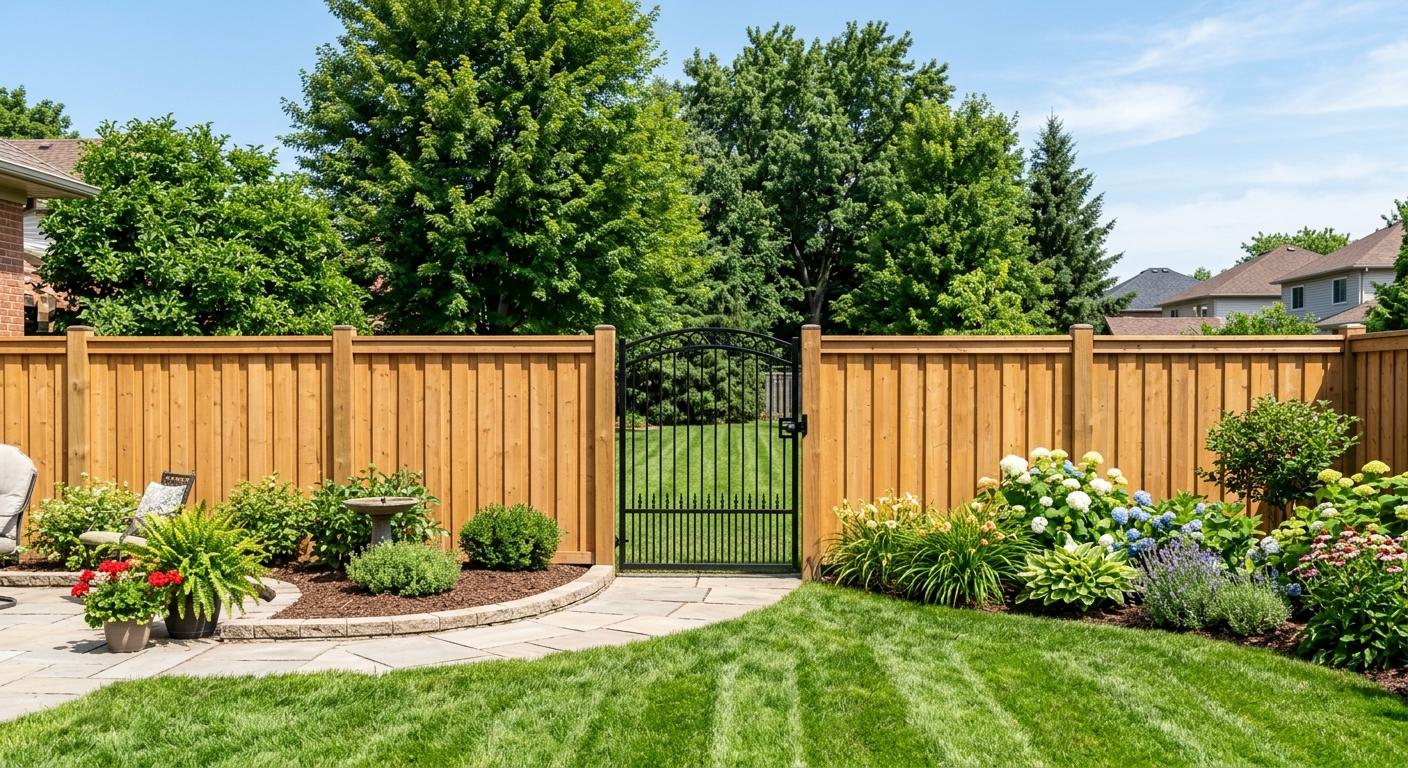
Fencing options and costs in Wildwood
Wildwood, Alberta is where fencing decisions tend to be practical: you want a fence that holds up in a Prairie freeze–thaw cycle, stands to wind, and still looks right beside newer neighbourhood build styles as well as older lots. With a population of 2,765 (Statistics Canada, 2021 Census), demand is concentrated around the homes and acreage edges where homeowners need both boundary clarity and daily privacy. That’s especially true when you consider how many detached properties locally create a steady need for perimeter upgrades.
In the Calgary economic region, long winter stretches mean frost protection matters. Calgary-area guidance commonly expects fence posts to be set about 4 ft (≈120 cm) deep to sit below the regional frost line, and many installers use concrete footings for 6 ft privacy fences and for gate posts. That extra excavation, concrete volume, and labour raises costs compared to milder parts of Canada. On top of that, open Prairie exposure increases wind loading; solid wood or vinyl panels usually need closer post spacing and fully concreted posts to prevent racking.
We also see trade demand pick up around Wildwood’s more exposed residential pockets near the main roads, where wind exposure is higher and privacy fencing is common. If you’re ready to budget, the next step is comparing typical material lifespans and installed prices per linear foot—so you can match your goal (privacy, maintenance, or lowest initial cost) to what the market actually charges.
| Material |
Lifespan |
Maintenance |
Privacy Rating |
Price per Linear Foot |
| Pressure-treated pine (standard wood) |
10–15 years |
Stain/finish every 2–3 years to reduce grey weathering; inspect posts after thaws |
High (solid rails/panels) |
$40–$80 |
| Cedar (natural rot resistance) |
15–25 years |
Annual visual checks; stain or seal periodically (commonly every 2–4 years) |
High (solid privacy styles) |
$55–$95 |
| Vinyl / PVC (no-maintenance) |
20–30 years |
Rinse as needed; occasional cleaning; avoid impact damage |
High (privacy panel systems) |
$45–$90 |
| Chain-link (galvanized steel) |
20–35 years |
Minimal; tighten hardware and rinse salt/dust buildup if needed |
Low to Medium (airflow, not fully private) |
$25–$55 |
| Aluminum ornamental |
25–40 years |
Minimal; wash and check for loose fittings after wind storms |
Low (decorative pickets) |
$70–$120 |
| Composite / recycled material |
15–25 years |
Low; occasional wash; inspect for fastener issues |
Medium to High (style-dependent) |
$60–$110 |
Prices are estimates only and vary by project scope, site access and material selection.
What affects the price of fencing in Wildwood
If you’re getting fencing quotes in Wildwood, it’s normal to see the same “type” of fence come back 30–50% apart across the Calgary area and Alberta. The differences usually aren’t just material—they’re about how contractors handle frost depth, wind exposure, and ground conditions, plus what’s included in the scope (and what’s treated as an extra). In the Calgary market, quotes often land within the common bands: wood installations are frequently in the $40–$80 range, while vinyl/PVC commonly sits around $45–$90, depending on panel type and post spacing.
The biggest cost driver is the required post depth for freeze–thaw. In cold Alberta, posts typically need to be set well below the design frost depth—often 1.5–2.0 m into the ground—so they don’t heave during spring thaw. That means longer posts, deeper holes, and more concrete setting where required, especially for taller privacy runs.
Second is wind exposure on the Prairies. Open exposure pushes installers to use tighter post spacing and sturdier rails for solid panels, while chain-link can stay cheaper because it lets wind pass through (so the fence resists racking better without “beefing up” structure as much). For context, coastal BC’s wetter climate can accelerate rot if wood is not properly treated, but in Wildwood the problem isn’t constant moisture—it’s how freeze cycles stress the support system.
Concrete examples from typical Wildwood/Calgary-area conditions: (1) if your line runs through hard soil or rocky ground, excavation time increases and hoisting costs rise; (2) if you have a gate with a latch post, builders often must reinforce that post footing with more concrete because gates see higher leverage loads; (3) if you’re on a more exposed corner lot, contractors may increase post spacing or choose heavier rails—pushing wood toward the upper $40–$80 end or vinyl toward the upper $45–$90 end.
| Price Factor |
Why It Matters |
Cost Impact |
| Fence length in linear feet |
Every run adds labour, posts, rails and hardware; small differences multiply |
Highest overall driver; prorated pricing still varies with complexity |
| Post depth required |
Frost line determines hole depth and post length; protects against heaving |
Deeper means more excavation, more concrete, higher materials cost |
| Post setting method |
Concrete vs gravel pack vs driven posts affects stability in freeze–thaw |
Concrete-set posts usually add labour and material but reduce future callbacks |
| Material choice |
Vinyl/wood need different rails and bracing; chain-link uses lighter components |
Shifts you across common bands (e.g., chain-link vs vinyl vs aluminum) |
| Gate count and type |
Drive-through double gates require bigger frames and reinforced posts |
Gates can add substantial cost beyond the fence per-foot rate |
| Grade and terrain |
Slope requires stepped posts/panels or careful racking to keep a straight top line |
More layout time, extra posts and cut labour; often increases the per-foot rate |
| Old fence removal and disposal |
Debris handling, hauling and site restoration take time |
Can add hourly labour and dump fees; sometimes quoted separately |
| Permit fees and survey / property line locate |
Setbacks and property line accuracy reduce rework and disputes |
Survey/locate can prevent costly corrections; permit work adds admin time |
Permits & regulations in Alberta
In Alberta, fences above a height threshold—often 2.0 m (6.5 ft) at the rear and 1.0–1.2 m (3–4 ft) at the front or corner—may require a building permit, depending on the location and how the fence impacts site setbacks. Regardless of height, all fencing must respect property lines and the applicable municipal setback bylaw. If you’re unsure whether your planned height triggers a permit in Wildwood, it’s worth confirming with your municipality before anyone digs.
Before digging any post hole, homeowners should call for utility locates. In Alberta, that’s done through Alberta One-Call so contractors can avoid damaging buried services. Also, get a survey or at least a property pin/locate done before installing—fences built even slightly over a property line can turn into expensive rework, especially on shared lines.
For shared fence ownership, Alberta line-fences rules govern responsibilities—so if your fence forms a boundary with a neighbour, clarify who maintains what and how repairs or replacements are handled.
How to verify a contractor’s credentials (step-by-step): (1) confirm their Alberta business presence and status via the appropriate online registry entry; (2) request a certificate of insurance showing general liability coverage that matches your job value and scope; (3) obtain proof of workers’ compensation coverage (WSIB/WCB) and keep a copy for your records. A legitimate contractor should also provide documentation promptly, not “after the first day.”
Choosing the right fence material for Wildwood
Picking a fence in Wildwood is about balancing privacy, maintenance time, and long-term performance in a Prairie freeze–thaw cycle. Pressure-treated pine is the budget-friendly route, but it needs staining or sealing every 2–3 years to limit grey weathering and help it last through winter cycles. Cedar costs more up front, yet it has natural rot resistance and usually looks better for longer, though it still benefits from periodic sealing. Vinyl/PVC offers low maintenance and strong privacy options, but in extreme cold it can be more vulnerable to impact damage—so footing stability and careful panel installation matter. Chain-link is usually the lowest initial cost and offers excellent long life with minimal upkeep, but it won’t provide true privacy unless you add screening or slats. Aluminum ornamental is rust-resistant and long-lived, but it’s typically a mid-range or higher option and provides limited privacy because of picket spacing.
On the post system: because Calgary-area frost guidance commonly expects posts set about 4 ft (≈120 cm) deep, concrete-set posts are often the safer choice for 6 ft privacy fences and for gate posts. When posts are set deeper and stabilized, you reduce the chance of heaving and racking, which directly protects your investment—especially with heavier solid panels in windy Prairie exposure.
Here’s where the price difference can be justified. If you’re choosing between pressure-treated pine (often $40–$80 per linear foot) and cedar (commonly higher, depending on style and labour), the extra cost is worth it if you value appearance and want fewer “mid-cycle” repairs—particularly on exposed runs where wind can loosen imperfect hardware. If you’re mainly budget-focused, chain-link at $25–$55 per linear foot can be an excellent foundation, then you can add privacy later with approved screening while keeping airflow in high wind.
| Material |
Cold Tolerance |
Lifespan |
Annual Maintenance |
Best For |
Price Band |
| Pressure-treated pine |
Good (with proper post depth and sealing/finish) |
10–15 years |
Low effort; inspect and stain/finish every 2–3 years |
Budget privacy with a classic look |
$40–$80 |
| Cedar |
Good (resilient in freeze–thaw; still sensitive to mechanical damage) |
15–25 years |
Moderate; seal or stain periodically (often every 2–4 years) |
Longer-lasting privacy with better natural appearance |
$55–$95 |
| Vinyl / PVC |
Fair to good (stable if installed correctly; avoid impact) |
20–30 years |
Very low; rinse/clean as needed |
Low-maintenance privacy in Alberta winters |
$45–$90 |
| Chain-link |
Excellent |
20–35 years |
Low; check tension and hardware, rinse dust build-up |
Security with airflow; budget perimeter fencing |
$25–$55 |
| Aluminum ornamental |
Excellent (no rust) |
25–40 years |
Very low; occasional wash and hardware check |
Front-yard curb appeal with durable, low-rust framing |
$70–$120 |
| Composite / recycled |
Good (installation quality matters; can be brittle with impacts) |
15–25 years |
Low; wash and check fasteners |
Privacy with low maintenance and modern appearance |
$60–$110 |
How to choose a fencing contractor in Wildwood
Choosing the right fencing contractor in Wildwood starts with verifying Alberta credentials and coverage—before you sign anything. First, ask for proof of their Alberta licence/registration status and confirm it’s active. Next, request a certificate of liability insurance: it should name you (or at least show coverage applicable to your site) and list adequate limits for the job value and material type. Finally, confirm workers’ compensation coverage (WCB/WSIB) so you’re not exposed if a worker is injured on site.
Then get 2–3 written, itemised quotes. A real fencing quote should break out labour (excavation, setting posts, rail installation, gate hardware), materials (posts, rails, panels, fasteners), and site work (removal, disposal, grading, and any racking/stepped panel solutions). Avoid lump-sum-only estimates where scope is vague; you want clarity on exclusions like “not responsible for buried rock” or whether disposal is included. Also ask whether permits are pulled by the contractor or by the homeowner—permit handling can be a cost and timing factor if your fence height crosses the common Alberta threshold.
Warranty matters: confirm workmanship warranty length and what’s covered (posts, rails, panel warping, gate alignment). Ask whether product/manufacturer warranty is included with the build and whether it transfers to future owners. Payment terms should be conservative: never pay more than 10–15% upfront; hold back a portion until completion and final cleanup. Get the start date and estimated completion in writing, tied to weather windows.
- Verify Alberta licence/registration is active and matching the company name on the quote.
- Request a current certificate of liability insurance (not expired) before work begins.
- Confirm WCB/WSIB coverage and request documentation for your records.
- Insist on itemised pricing (labour vs materials vs gates vs removal/disposal).
- Ask how posts will be set for frost protection (concrete-set vs gravel pack) and depth plan.
- Confirm post spacing and bracing method for solid privacy panels in wind exposure.
- Clarify exclusions: buried rock, utility markings, soil conditions, and extra excavation.
- Confirm whether permit fees (if required) and property line locate are included or separate.
- Request a detailed layout plan and confirm property line markers/pins are located before build.
- Get warranty details in writing: workmanship, product warranty, and transferability.
- Use a payment schedule aligned to milestones; keep at least 80–90% for after completion.
- Get start/completion timeline in writing, including weather-related allowances.
Red flags to watch for in Wildwood include: (1) a quote that promises “no concrete needed” for 6 ft privacy fences without explaining frost strategy; (2) missing insurance/WCB documentation or refusing to provide it; (3) vague scope language like “we’ll just adjust on the day” without details; (4) asking for large upfront payments (well over 10–15%); and (5) no written warranty terms or no clear gate/hinge hardware specifications.
Frequently asked questions — fencing in Wildwood
How do I compare fencing quotes?
To compare fencing quotes in Wildwood, start by lining up the scope: the same fence height, the same material grade, and the same post depth and setting method. Quotes should be itemised into labour, materials, gate hardware, and site work like old fence removal/disposal. Pay close attention to how each contractor plans for frost protection—Calgary-area guidance commonly expects posts to be set about 4 ft (≈120 cm) deep, and deeper hole depth can change the price meaningfully. Also compare wind-structure choices: solid privacy panels usually need tighter post spacing and heavier rails in Prairie exposure. As a quick sanity check, if one quote is far below chain-link pricing (often around $25–$55 per linear foot) but claims “privacy,” it’s often underbuilt or missing items. The best quote isn’t always the cheapest—it’s the one that matches your exact fence spec and includes what you need.
How long does fence installation take in Wildwood?
Typical fence installation timing in Wildwood depends on length, access, and ground conditions. For a straight run with good access, a small crew can often complete a portion in a day, but full installs usually require multiple days when you add excavation for frost-depth holes and concrete setting. Gates and any slope work (stepped or raked panels) add setup and layout time. Weather matters too: extreme cold can slow concrete work, and wet ground can affect excavation and base stability. If you’re removing an old fence, plan extra time for dismantling, hauling, and site cleanup. When comparing estimates, make sure each contractor lists a start date and completion window in writing; that protects you if schedule adjustments happen due to Prairie wind, snowfall, or frozen soil. Longer projects are best planned early so materials arrive on time and the crew can keep to the schedule.
Can I install a fence on a slope in Wildwood?
Yes, you can install a fence on a slope in Wildwood, and it’s a common situation on Prairie lots. The key is how the fence is stepped or racked so the top line looks straight while the posts are set at the correct depth for frost protection. Installers generally use either stepped panels (each section adjusts to the grade) or raked panels (the panel follows the slope with a consistent angle), but the right choice depends on the material—vinyl and wood handle slope differently than chain-link. Because frost depth is still required, sloped yards don’t reduce post depth; they increase layout time and sometimes require more careful concrete setting or added bracing. When you receive quotes, confirm the contractor has a plan for your slope and won’t “figure it out later.” A professional layout reduces gaps, prevents uneven tension issues on gates, and avoids a fence that looks off after the first freeze–thaw cycle.
What is the most weather-resistant fence for Wildwood's climate?
For Wildwood’s Alberta freeze–thaw cycles and windy Prairie exposure, the “most weather-resistant” choice usually comes down to support stability. Chain-link is extremely durable and handles weather well with minimal maintenance, often lasting decades because it’s lighter and airflow reduces wind racking (commonly priced around $25–$55 per linear foot). For true privacy, vinyl/PVC and properly installed pressure-treated wood can be very resilient when posts are set below frost depth and panels are braced for wind load. Cedar can also perform well because of natural rot resistance, but it still benefits from good finishes and hardware inspection. The fence’s lifespan is often limited by how well the posts were installed rather than the panel material alone—so even the best vinyl system can fail early if post holes aren’t deep enough or if gate loads aren’t reinforced. If you want maximum longevity with minimal upkeep, vinyl or chain-link are strong candidates in this region.
How do I prevent wood fence rot in Wildwood?
Preventing wood rot in Wildwood is mostly about keeping wood and fasteners protected and ensuring the support system stays stable through freeze–thaw. Use pressure-treated pine or cedar boards from reputable suppliers, and make sure end grain is properly treated where possible. The most important step is correct post installation: posts set too shallow can heave, causing hardware stress and creating gaps where water sits against wood. For Calgary-area conditions, posts are commonly set about 4 ft (≈120 cm) deep, with concrete footings often used for privacy and gate posts. Also, apply a stain/sealer on a schedule—pressure-treated wood typically needs staining every 2–3 years to slow weathering. Finally, keep vegetation off the fence line and check after spring thaws for loose screws, leaning posts, or warped rails. If you catch minor movement early, you can prevent it from turning into rot.
What is the cost per linear foot for fencing in Wildwood?
In Wildwood, fencing cost per linear foot generally aligns with the Calgary economic region’s market bands, but the exact number depends on height, material, gate count, terrain, and how deep the posts must be set for frost. As a practical range: pressure-treated wood installations often land around $40–$80 per linear foot, while vinyl/PVC privacy systems commonly sit around $45–$90. Chain-link is usually the lowest, often around $25–$55, and aluminum ornamental tends to be higher, often around $70–$120. Your quote may come closer to the low or high end depending on whether you need reinforced gate posts, slope adjustments, or old fence removal/disposal. If your contractor is including deeper concrete-set footings for a 6 ft privacy fence, that’s typically a legitimate reason the per-foot number is higher—because it reduces heaving and racking in Alberta’s freeze–thaw environment.