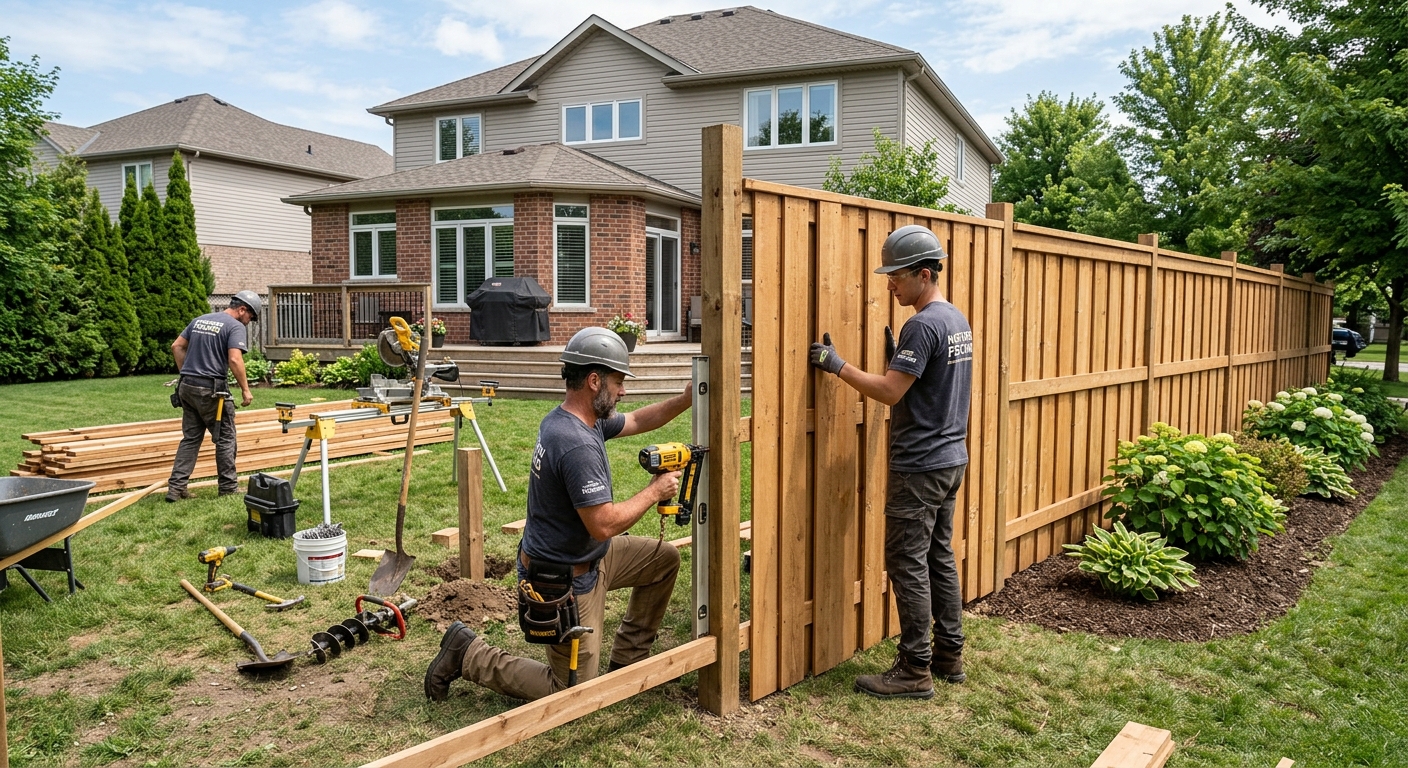
Fencing options and costs in Westgate
In Westgate, Alberta, homeowners typically choose a fence that balances privacy, wind stability, and long-term maintenance. With a population of 3,225 in 2021 (Statistics Canada, 2021 Census), Westgate is a smaller community where many yards are close to each other—so fences often serve double duty: boundary definition and visual buffering for everyday living. Calgary’s housing stock also drives consistent demand; detached homes are common in the wider area and represent the most frequent fencing projects (Statistics Canada, 2021 Census). On the Prairies, contractors see repeated quote requests for backyard privacy and side-yard wind breaks—especially in exposed pockets near major road corridors and open lots.
Cost in the Calgary economic region is shaped by the Prairie continental climate: long freeze–thaw cycles mean frost protection and wind loading are primary cost drivers. That’s why local practice expects fence posts to be set about 4 ft (approximately 120 cm) deep, often with concrete footings on 6 ft privacy fences and gate posts. More excavation, more post material length, and concrete volume all increase labour and total project cost compared with milder regions. At the same time, open exposure means chain-link can be cheaper (more airflow), while solid wood and vinyl typically need sturdier construction and closer post spacing to reduce racking.
In Westgate, demand tends to spike on the newer infill streets where homeowners are finishing landscaping and upgrading side-yard boundaries—many of these jobs are booked around peak spring installation windows. Use the table below to compare typical lifespan, maintenance, privacy, and price-per-foot ranges for the materials most requested in Westgate.
| Material |
Lifespan |
Maintenance |
Privacy Rating |
Price per Linear Foot |
| Pressure-treated pine (standard wood) |
10–20 years |
Stain or seal every 2–3 years; inspect posts and rails annually |
High (solid panels) |
$40–$80 |
| Cedar (natural rot resistance) |
15–25 years |
Light seal/stain every 3–4 years (grey-weathering still needs attention) |
High (solid panels) |
$55–$90 |
| Vinyl / PVC (no-maintenance) |
20–30 years |
Wash with water; inspect for panel or post stress after extreme cold |
High (solid privacy styles) |
$45–$90 |
| Chain-link (galvanized steel) |
20–40 years |
Occasional rinse; tighten hardware as needed |
Low–Medium (airflow open) |
$25–$55 |
| Aluminum ornamental |
25–40 years |
Rinse seasonally; inspect for damage and touch up if needed |
Low–Medium (decorative openness) |
$70–$120 |
| Composite / recycled material |
20–30 years |
Minimal cleaning; keep an eye on fasteners and expansion gaps |
Medium–High (solid or semi-solid styles) |
$60–$110 |
Prices are estimates only and vary by project scope, site access and material selection.
What affects the price of fencing in Westgate
In Westgate and across the Calgary economic region, two contractors can quote the “same” fence and still land 30–50% apart because the hidden variables are usually the site prep and the structural build for wind and freeze–thaw. The band often tightens when both quotes include identical post depth, concrete scope, rail bracing, gate hardware, and disposal—yet those items are frequently missing from a first pass. Labour rates also vary by crew availability and how quickly a contractor can schedule trenching and concrete work during spring and early summer.
Most Westgate projects are driven by frost protection. In Calgary’s Prairie continental climate, fence posts should generally be set about 4–6 inches below the design frost depth to help prevent heaving. Practically, that often means setting posts roughly 1.5–2.0 m into the ground, which requires longer posts, deeper auger work, and concrete setting (especially for 6 ft privacy fences and gate posts). Open prairie exposure also pushes tighter post spacing and sturdier panels for solid wood or vinyl privacy—so the cost climbs in the mid-to-upper parts of the $40–$80 (wood) and $45–$90 (vinyl) per linear foot ranges. In contrast, chain-link can stay closer to the lower–mid band of $25–$55 per linear foot because airflow reduces wind racking.
Concrete examples from local job sites: a straight backyard run on level grade might require fewer deep holes, keeping excavation efficient and labour closer to the low end of the range. But a corner with two gates often means extra bracing posts and heavier-duty hardware, which can add a noticeable premium versus a similar length of fencing without gates. Also, removing an old fence that’s partially buried or leaning (common after freeze cycles) increases demo time and disposal fees—raising the total even if the new fence material is inexpensive.
Finally, housing age can affect how quickly crews work: older properties may have buried landscape timbers, mature roots, or irregular access paths, which means more time for careful post-hole drilling. The result is that even a small 10–20 linear foot difference in complexity can move your quote by hundreds of dollars, not just tens.
| Price Factor |
Why It Matters |
Cost Impact |
| Fence length in linear feet |
The primary cost driver for materials, labour, and post counts |
Often the biggest swing; more length scales every other line item |
| Post depth required |
Frost line determines post length and hole depth to reduce heaving |
Deeper frost protection increases excavation time and post material |
| Post setting method |
Concrete vs. gravel pack vs. driven posts changes stability and labour |
Concrete-set posts typically add cost but improve freeze–thaw performance |
| Material choice |
Vinyl, cedar, chain-link, and aluminum have different installation and bracing needs |
Vinyl/wood usually sit mid-range; chain-link is lower; aluminum is higher |
| Gate count and type |
Gates require stronger posts, hinges, latches, and sometimes diagonal bracing |
Each additional gate adds hardware and extra structural labour |
| Grade and terrain |
Slopes require stepped/raked panels and more layout time |
Stepped sections increase material waste and labour |
| Old fence removal and disposal |
Demo time, haul-away, and potential underground obstructions affect schedule |
Can add significant labour and dump fees, especially for wood |
| Permit fees and survey / property line locate |
Required planning and locate work prevents encroachment disputes |
Varies by project; survey/locate is often a meaningful one-time add-on |
Permits & regulations in Alberta
In Alberta, fence rules hinge on height thresholds and placement. As a homeowner in Westgate, you should expect that fences above a typical height threshold—often 2.0 m (6.5 ft) in the rear and around 1.0–1.2 m (3–4 ft) at the front or corner—may require a building permit. Even when a permit is not required for your exact height, all fences still must respect property lines and municipal setback bylaws.
Before any post-hole digging, get utility locates done through Alberta One-Call. Also, verify your property boundaries first—either by obtaining a survey or by locating your property pins—so you don’t build into a neighbour’s yard or an easement. Where shared boundaries are involved, shared fence ownership and responsibilities are handled under Alberta’s line-fences framework, so it’s smart to confirm who’s responsible for repairs and replacement costs.
What typically does require a permit: a new fence that exceeds the height threshold (especially in front/corner areas), fences with special structures or posts that change the footprint, and projects that trigger additional review due to placement. What typically does not require a permit: like-for-like replacement that stays within the allowed height and setbacks, and routine repairs that don’t change height, location, or materials in a way that alters compliance.
To verify a contractor in Westgate: confirm the contractor’s Alberta licence status via the appropriate online registry, request proof of liability insurance (certificate of insurance showing your property address/job site), and ensure workers are covered under WSIB/WCB. Ask for the clearance letter or coverage confirmation and keep copies with your contract.
Choosing the right fence material for Westgate
Choosing a fence in Westgate is mostly about matching material performance to Alberta’s freeze–thaw cycles, wind exposure, and your maintenance tolerance. Pressure-treated pine is usually the most budget-friendly look, but it needs staining or sealing every 2–3 years to slow grey weathering and protect against moisture uptake. Cedar offers better natural rot resistance and often looks warmer and more premium, though it still benefits from periodic sealing to keep it looking sharp. Vinyl/PVC is the low-maintenance favourite for many families—typically just rinse-and-inspect—but in extreme cold it can become more brittle and may require careful installation with correct expansion gaps. Chain-link is the practical, longest-life choice with the lowest upfront cost, but it doesn’t provide privacy unless you add slats or plant screening. Aluminum ornamental fences stay rust-resistant and attractive with relatively low maintenance, but they won’t meet privacy goals on their own.
In Calgary’s climate, post-depth matters regardless of material. Because frost protection is key, many projects use concrete-set posts and solid footing where required—especially for 6 ft privacy runs and gate posts. Solid panels take more wind load than airy fencing, so privacy fences often need tighter post spacing and sturdier rail/bracing to reduce racking during Prairie gusts and snow buildup. A vinyl privacy system may cost more than chain-link, but the stability and reduced maintenance can justify the difference over time.
For a simple example: if your run is “privacy-first,” a solid wood option might fall in the $40–$80 per linear foot band, while vinyl privacy commonly sits mid-to-upper, around $45–$90 per linear foot. The extra cost is most justified when you’re avoiding recurring staining trips and you have exposed wind conditions where proper concrete setting and bracing will protect the fence for decades.
| Material |
Cold Tolerance |
Lifespan |
Annual Maintenance |
Best For |
Price Band |
| Pressure-treated pine |
Good with proper concrete-set posts and regular sealing |
10–20 years |
Inspect yearly; stain/seal every 2–3 years |
Budget-friendly privacy that you can maintain |
$40–$80 |
| Cedar |
Good; responds well to proactive sealing and tight fasteners |
15–25 years |
Inspect yearly; seal/light stain every 3–4 years |
Premium look with better rot resistance |
$55–$90 |
| Vinyl / PVC |
Very good, but needs correct installation in cold snaps |
20–30 years |
Wash/inspect after winter; check panel stress |
Low-maintenance privacy |
$45–$90 |
| Chain-link |
Excellent in cold; flexible structure handles frost well |
20–40 years |
Occasional rinse and hardware checks |
Security with airflow (wind-friendly) |
$25–$55 |
| Aluminum ornamental |
Excellent; no rust with proper installation |
25–40 years |
Rinse seasonally; inspect for impact damage |
Attractive boundary with security |
$70–$120 |
| Composite / recycled |
Good; expansion gaps and fastener selection matter |
20–30 years |
Minimal cleaning; inspect fasteners |
Solid looks with reduced maintenance |
$60–$110 |
How to choose a fencing contractor in Westgate
Start by verifying the contractor’s Alberta coverage and accountability. Ask for their Alberta licence (and confirm the status via the relevant online registry), then request a current certificate of liability insurance naming your project and showing active coverage limits. For worker protection, confirm WSIB/WCB coverage and ask for the clearance letter or coverage confirmation before work begins. A legitimate fence contractor should provide these documents without pushing back.
Next, get 2–3 itemised written quotes (not lump sums). The best quotes break down labour + materials and specify the scope that affects long-term performance: post depth, post spacing, whether concrete is included, rail/bracing details, gate hardware type, and any raking/stepping for slopes. Make sure the quote clearly states what’s excluded (for example, permit fees, survey/property pin locate, underground utility checks beyond Alberta One-Call, and restoration like sod/seed or topsoil). Confirm whether disposal of the old fence is included or if you’ll pay for hauling separately.
Look at warranty terms. You want a workmanship warranty with a stated length and clear coverage, plus the product/manufacturer warranty details for the specific fence system. Ask whether the warranty is transferable to future homeowners if you sell your property.
For payment, never agree to more than 10–15% upfront. Use a payment schedule that releases progress payments as milestones are completed, and include a holdback until the final walkthrough is done. Get a written start date and completion estimate so scheduling is clear before excavation begins.
- Ask for proof of Alberta licence status and confirm it in an online registry.
- Request certificate of liability insurance before any work starts.
- Confirm WSIB/WCB clearance and keep a copy with your contract paperwork.
- Require an itemised quote that lists post depth, setting method, and post spacing.
- Make sure gate posts include heavier-duty bracing and proper hinge/latch hardware.
- Confirm whether concrete is included (and the pour scope) for privacy fences and gates.
- Check if disposal and dump fees for old fence removal are included.
- Verify whether grading/levelling and raked/stepped sections are included for slopes.
- Ask how they handle utility locates and mark-out before digging.
- Confirm the warranty: workmanship length, product warranty length, and exclusions.
- Put a payment schedule in writing with a holdback after completion and punch list.
- Request start date, completion estimate, and weather-related pauses in writing.
Red flags we see on fence projects in Westgate include contractors who won’t provide insurance/coverage documents, quotes that omit post depth or concrete setting details, vague “fence only” scopes that don’t mention gates or disposal, and payment demands higher than 10–15% upfront. Another warning sign: they avoid a written timeline or refuse to include slope/stepping plans when your yard isn’t perfectly level.
Frequently asked questions — fencing in Westgate
How do I find my property line before fencing?
In Westgate and across Alberta, you shouldn’t rely on old stakes, fence lines, or neighbour memory when setting new posts. The safest approach is to obtain a survey or locate your property pins (or engage a surveyor for a locate) before digging. Also, confirm whether your fence will land near any easements that can limit where structures are placed. Before any post holes are dug, call Alberta One-Call for utility locates so you don’t strike service lines. If you’re replacing an existing fence, still verify the boundary—older fences sometimes drift after freeze–thaw ground movement. A clear boundary check can prevent costly rework and neighbour disputes.
What's the most low-maintenance fence?
For most Westgate homeowners, vinyl/PVC is the most low-maintenance option because it typically doesn’t require staining like wood. You generally wash it and do seasonal inspections for loose hardware or panel stress after extreme cold snaps. In the Calgary area, that convenience often places vinyl near the mid-to-upper per-foot pricing—commonly around the $45–$90 per linear foot band depending on height, style, and gate scope. Chain-link can also be very low maintenance, but it doesn’t provide privacy unless you add slats or screening. The “lowest maintenance” winner depends on whether your priority is privacy or just boundary/security with long-term durability.
How tall can my fence be in Westgate?
Fence height limits in Alberta typically depend on location (rear vs front/corner) and can trigger permitting. As a practical guideline, fences above roughly 2.0 m (6.5 ft) in the rear and around 1.0–1.2 m (3–4 ft) in the front or corner often require a building permit, and setbacks still apply. In Westgate, you should confirm the exact requirements with your local municipal rules for your address before ordering materials. If you’re aiming for a privacy fence around 6 ft, plan for the extra structural needs too—privacy styles usually require solid post setting and bracing in the Prairie freeze–thaw environment, which affects total cost.
Should fence posts be set in concrete here?
In Westgate, concrete-set posts are commonly recommended for privacy fences and for gate posts because Calgary’s Prairie freeze–thaw cycles can cause soil heaving if posts aren’t set deep and stable. Local guidance in the Calgary region often expects posts to be set around 4 ft (about 120 cm) deep so the base stays below the frost line, which frequently means using concrete footings—especially on 6 ft privacy runs where wind loading is significant. For some lighter, more flexible systems like chain-link, posts may be set with different methods depending on soil and fence type, but you’ll still want a contractor to match the method to local frost protection requirements. A good quote should clearly state the post depth and setting method.
What's the best fence for privacy?
For privacy in Westgate, solid wood, vinyl/PVC, or composite panels usually outperform chain-link and ornamental aluminum because they block sightlines. Vinyl privacy is often chosen for a “set it and forget it” approach, while cedar can deliver a premium look with good rot resistance. Budget-wise, wood privacy typically lands in the $40–$80 per linear foot band, while vinyl privacy commonly runs in the $45–$90 range depending on height, post spacing, and gate hardware. Privacy fences also need stronger construction in Calgary’s wind-exposed conditions—expect tighter post spacing and proper concrete setting on key posts and gates to reduce racking over winter.
How do I compare fencing quotes?
When comparing quotes in Westgate, avoid judging by the total price alone—make sure you’re comparing the same scope. Ask for itemised details: material type and grade, fence height, post spacing, post depth (including frost protection), and the post setting method (concrete vs alternative). Confirm whether gate hardware is included and whether gate posts are reinforced. Also check what’s excluded: permit pulling, survey/property line locate, utility mark-out beyond Alberta One-Call, and disposal of the old fence. Warranty terms matter too: workmanship duration and product/manufacturer warranty coverage. If one quote prices a privacy fence at the low end of the $40–$80 wood band but omits concrete setting or required post depth, it may be cheaper short-term and costlier long-term.