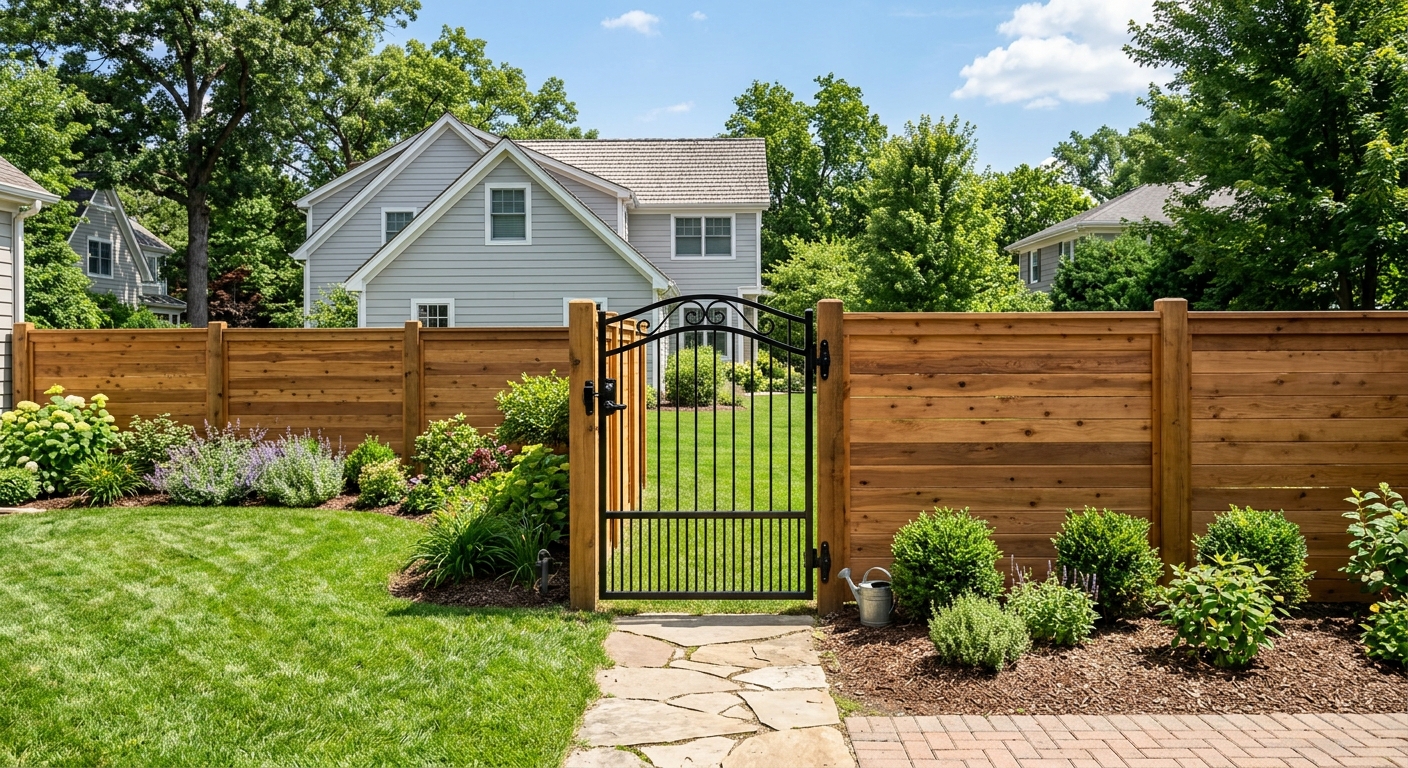
Fencing options and costs in Drayton Valley
Drayton Valley homeowners can choose from several practical fencing styles, but costs usually don’t come down to material alone. With 71.3% of local households owning their homes and 63.0% of dwellings being single-detached, there’s steady demand for yard privacy, pets, and snow-safety boundaries (Statistics Canada, 2021 Census). That demand shows up especially around established residential pockets like the West End/industrial-edge neighbourhoods where driveways and backyards are frequently fenced to manage windblown debris and keep dogs off equipment access areas.
In the Edmonton economic region, Alberta’s frost depth is the big driver of installed price. Contractors typically set posts about 4–6 inches below the design frost depth to reduce heaving, which often means concrete setting, longer posts, and more labour time than homeowners expect. Wind exposure on the Prairies also matters: more open sites put extra stress on panels and fasteners, so privacy fences often need tighter post spacing and sturdier framing to prevent racking and sagging. Availability of crews can also affect pricing—busy spring schedules (especially after freeze-up) can push up labour rates when multiple projects start at once.
Below is a realistic comparison of common fence materials and what they typically cost installed in the Drayton Valley area, before you consider extras like gates, removal, or property-line locate.
| Material |
Lifespan |
Maintenance |
Privacy Rating |
Price per Linear Foot |
| Pressure-treated pine (standard wood) |
10–15 years |
Stain or seal every 2–3 years; fastener checks |
Medium to high (solid boards) |
$18–$32 |
| Cedar (natural rot resistance) |
15–20 years |
Light staining or oiling every 3–4 years |
High (solid boards) |
$22–$40 |
| Vinyl / PVC (no-maintenance) |
20–30 years |
Wash as needed; inspect hinges/gates |
Medium to high (slat style) |
$20–$38 |
| Chain-link (galvanized steel) |
20–30 years |
Minimal; occasional tension/repairs |
Low (security only) |
$12–$22 |
| Aluminum ornamental |
25–35 years |
Rinse/clean; tighten annually |
Low to medium (more see-through) |
$22–$45 |
| Composite / recycled material |
25–35 years |
None to light cleaning; avoid impact damage |
High (solid privacy panels) |
$24–$48 |
Prices are estimates only and vary by project scope, site access and material selection.
What affects the price of fencing in Drayton Valley
Even when you’re comparing “the same fence,” quotes in the Edmonton area can swing by 30–50% because site conditions and build details drive labour and install time. In Drayton Valley, the frost line often forces deeper post holes and more robust post setting. That means longer posts, more excavation, and frequently concrete—so a fence that looks simple on paper can cost significantly more once it’s built to handle Alberta freeze-thaw cycles.
As a practical rule for this region, posts are typically set about 4–6 inches below the design frost depth to prevent heaving. In colder parts of Alberta and Ontario, that commonly translates to posts going roughly 1.5–2.0 m into the ground; here, that extra depth tends to push crews toward concrete-set posts for stability. Wind exposure on the Prairies also affects design: to resist racking, contractors may use heavier rails, more bracing, and tighter post spacing—especially for privacy fences that act like sails. In contrast, coastal climates like BC’s mild but wet areas can accelerate wood rot if treatment is inadequate, but Edmonton-region builds focus more on freeze stability than mildew control.
Concrete examples from Drayton Valley: (1) A flat backyard with easy access might land in the “wood installation” band of $3,000–$6,500, while a sloped lot needing stepped rails and careful alignment often adds significant labour time. (2) If your fence requires wind-rated construction and additional diagonal bracing, privacy-oriented vinyl may land closer to $3,500–$8,000 even when the linear footage is similar. (3) Older neighbourhood builds—45.6% of homes built before 1981—often include buried remnants (old posts, roots, or buried materials) that increase excavation time, which can push total costs up even before you add gates or removal.
| Price Factor |
Why It Matters |
Cost Impact |
| Fence length in linear feet |
The main driver; everything scales with length |
High (commonly the biggest portion of the quote) |
| Post depth required |
Frost conditions determine hole depth and post length |
Medium to high (can materially increase labour and materials) |
| Post setting method |
Concrete-set posts resist movement better in freeze-thaw |
Medium (concrete and extra time raise the total) |
| Material choice |
Vinyl/cedar require different framing, hardware, and handling |
High (material prices vary widely by type) |
| Gate count and type |
Gates need heavier posts, hardware, and alignment |
Medium to high (drive-through gates cost more than walk gates) |
| Grade and terrain |
Slopes require stepped/raked panels and more layout time |
Medium (extra labour for trimming and alignment) |
| Old fence removal and disposal |
Hauling and sorting add labour and tipping/disposal costs |
Medium (can add several hundred to over $1,000 depending on volume) |
| Permit fees and survey / property line locate |
Some fencing heights need permits; locate reduces boundary risk |
Low to medium (varies; can be significant on complicated sites) |
Permits & regulations in Alberta
In Alberta, fences above certain height thresholds typically require a building permit—often around 2.0 m (6.5 ft) at the rear and about 1.0–1.2 m (3–4 ft) at the front or corner (height and location rules depend on local bylaws). Regardless of permit requirements, all fences must respect property lines and applicable setback bylaws, and your design should be built to avoid creating safety hazards at driveways and intersections.
Before you dig any post hole, arrange utility locates through Alberta One-Call. This is the step that prevents accidental damage to buried services. Also, confirm your property pins or obtain a survey/locate so you install on the correct line; fence disputes are common when homeowners assume where a line “should be,” especially in older subdivisions.
Shared fence ownership and maintenance are handled under Alberta’s line-fences principles, so it’s smart to document agreements in writing when neighbours contribute. For practical homeowner clarity: build permits are commonly required when you’re going over the local height threshold, while smaller, lower fences that stay within the applicable front/side/rear limits typically do not trigger a permit—though you should still confirm with Drayton Valley’s bylaw rules.
To verify an Alberta contractor, ask for their licence details, certificate of liability insurance, and WCB/WSIB coverage proof. Look for these on their website or the relevant online registry where licensing is listed, and request the insurer’s certificate showing the company name and active policy dates. A clearance letter (where applicable) should match the contractor’s legal entity. Don’t proceed until those items are provided and align with the quote and contract.
Choosing the right fence material for Drayton Valley
Choosing a fence in Drayton Valley is mostly about matching material performance to weather and your lifestyle: privacy needs, how much time you’ll spend maintaining it, budget, and how long you want it to last. Because the Edmonton region’s freeze-thaw cycle can heave poorly set posts, all good installs start with proper post depth and sturdy framing—even if you choose a low-maintenance product.
Pressure-treated pine is usually the lowest upfront option, but it wants attention: staining or sealing every 2–3 years helps limit grey weathering and keeps boards looking consistent. Cedar costs more, yet it offers better natural rot resistance and usually a nicer look; it still benefits from periodic maintenance, but it tends to weather more attractively than basic pine. Vinyl/PVC is popular for low maintenance—no yearly staining—but extreme cold can make some styles more prone to cracking at stress points if the fence isn’t built rigidly; wind on the Prairies makes proper post spacing and bracing especially important. Chain-link is the lowest cost and longest-lived for security-only fencing, but it won’t deliver privacy unless you add slats or screening. Aluminum ornamental is mid-range and won’t rust, giving you a clean appearance with minimal upkeep, but it’s typically more see-through. Composite/recycled boards can deliver strong privacy with less maintenance, but you still need to protect from blunt impact at the base.
For post depth, plan for the Alberta frost line approach—posts set about 4–6 inches below the frost depth, often concrete-set in this region to reduce movement. Where wind and snow load are concerns (open lots, larger spans, or privacy panels), sturdier construction usually costs more upfront but reduces repairs later.
A dollar example: if you’re deciding between wood and vinyl for privacy, the installed wood band of $3,000–$6,500 can look attractive—until you factor in recurring staining and likely board replacement over time. If you expect long-term ownership and want fewer maintenance weekends, vinyl in the $3,500–$8,000 range is often the better “cost-per-year” choice.
| Material |
Cold Tolerance |
Lifespan |
Annual Maintenance |
Best For |
Price Band |
| Pressure-treated pine |
Good, if properly spaced and sealed |
10–15 years |
Seasonal checks; stain/seal every 2–3 years |
Budget-friendly privacy |
$3,000–$6,500 |
| Cedar |
Good; handles moisture cycles better than pine |
15–20 years |
Inspect annually; stain/oil every 3–4 years |
Premium look with natural resistance |
$3,500–$7,000 |
| Vinyl / PVC |
Good if built rigid and well-posted |
20–30 years |
Wash as needed; check gates/fasteners |
Low-maintenance privacy |
$3,500–$8,000 |
| Chain-link |
Excellent (metal resists freeze effects) |
20–30 years |
Minimal; occasional tension check |
Security and pet control |
$2,000–$4,500 |
| Aluminum ornamental |
Excellent (no rust) |
25–35 years |
Rinse/clean; tighten hardware annually |
Front curb appeal with moderate separation |
$4,000–$9,000 |
| Composite / recycled |
Good; performs best with solid framing |
25–35 years |
Light cleaning; replace damaged boards if impacted |
Long-life privacy with minimal upkeep |
$4,000–$9,500 |
How to choose a fencing contractor in Drayton Valley
Choosing the right contractor matters in Alberta because a “cheap” quote can still fail if posts aren’t set for frost movement or if gates aren’t framed correctly for wind. Start by verifying Alberta licensing (or the applicable registration for their trade), then confirm liability insurance and WCB/WCB-coverage. How to check: (1) ask for the licence/registration number and verify it on the relevant online registry; (2) request a certificate of insurance that lists the company’s legal name and shows active coverage; (3) confirm WCB coverage with the clearance letter or proof documents that match the contractor’s entity, not a subcontractor’s generic certificate.
Next, get 2–3 itemised written quotes. You want a breakdown separating labour from materials, along with line items for posts, rails, panels, hardware, gate(s), concrete (if used), and any removal/disposal. Make sure the scope is complete: does the price include the permit pull (when required), a property-line locate/survey allowance, and utility locate coordination? Ask whether fence post holes include concrete forms and whether debris hauling is included, especially if you’re removing an old fence that may contain buried stakes or deteriorated sections.
Warranty should be specific: workmanship warranty length and what it covers (post movement, panel warping, gate sag). Separate the product/manufacturer warranty from the install warranty, and confirm whether the warranty is transferable if you sell your home. For payment, never pay more than 10–15% upfront; hold back the balance until the job is complete and you’ve confirmed measurements, alignment, and gate operation. Finally, get the start date and completion estimate in writing, so weather delays and material lead times are communicated up front.
- Ask for itemised quotes (labour + materials) not a single lump-sum number.
- Confirm post depth and setting method in the written scope (frost-safe depth; concrete vs. gravel pack).
- Require a site plan or layout sketch showing corners, gates, and how the fence will follow grade.
- Check whether the quote includes utility locates and any changes if lines are found.
- Verify debris removal/disposal and whether old fence removal is priced separately.
- Confirm the hardware brand/type (hinges, latches, braces) and whether it’s rated for wind exposure.
- Ask for gate construction details (heavier posts, reinforcement, and swing clearance).
- Request the insurance certificate and confirm liability coverage amount.
- Verify WCB/WCB coverage with a clearance letter or equivalent proof tied to the contractor’s entity.
- Clarify permit responsibility: who pulls it, what fees are included, and when it must be obtained.
- Review warranty terms in writing (workmanship vs. product) and whether it covers reinstall/replacement.
- Set payment milestones in writing with a holdback until completion and walkthrough sign-off.
Red flags we see in the Drayton Valley area: contractors who won’t put frost-depth post specs in writing, quotes that omit gate hardware details, vague exclusions for permit/locate/disposal, insisting on large upfront payments, or refusing to provide insurance/WCB proof before starting.
Frequently asked questions — fencing in Drayton Valley
Wood vs vinyl vs aluminum fence — which is best?
In Drayton Valley, “best” depends on whether you’re optimizing for privacy, appearance, or maintenance. Pressure-treated pine is typically the most budget-friendly approach, often landing in the $3,000–$6,500 installed range, but it usually needs staining or sealing every 2–3 years to keep it looking consistent in Alberta’s freeze-thaw weather. Vinyl/PVC is the low-maintenance privacy option for many homeowners and commonly falls in the $3,500–$8,000 band; it generally performs well in cold when installed with rigid framing and correct post spacing. Aluminum ornamental is durable and low-maintenance, but it’s usually more see-through and often better for front yards where curb appeal matters more than full privacy. For wind-exposed lots, I often recommend vinyl or sturdier wood with tighter post spacing to reduce racking.
Do I need a permit to build a fence in Alberta?
Often, yes—if the fence exceeds the local height thresholds. In Alberta, fences above roughly 2.0 m (6.5 ft) at the rear and about 1.0–1.2 m (3–4 ft) at the front or corner frequently require a building permit, but the exact rule is tied to municipal bylaws and the fence’s location. In Drayton Valley, don’t rely on a contractor’s “it usually doesn’t matter” answer. Before you start, ask whether a permit is required for your proposed height and placement, and who is responsible for pulling it. Regardless of permitting, you should confirm your property line (pins or a locate/survey) and call Alberta One-Call before digging any post holes. Shared fence arrangements may have additional neighbour-consent steps under line-fence principles.
How long does a wood fence last in Drayton Valley?
A properly installed wood fence in Drayton Valley commonly lasts about 10–15 years for standard pressure-treated pine, with cedar sometimes reaching 15–20 years. Lifespan is less about the board type alone and more about frost-safe post installation and build quality. If posts are set too shallow or the post setting method doesn’t account for freeze-thaw heaving, boards loosen and rails rack much sooner. Wind exposure on the Prairies can also accelerate fastener fatigue if braces are underbuilt. Maintenance matters: sealing or staining every 2–3 years helps slow grey weathering and keeps boards from drying out and checking. If your old fence is in poor condition, that can also affect removal labour, which can influence the total installed cost when you replace it.
Who owns and maintains a shared fence?
In Alberta, shared fence ownership and maintenance are governed by line-fences principles. Practically, that means the fence’s ownership and responsibilities can depend on how it was originally built and the agreement between neighbours (and sometimes how it has been maintained over time). For homeowners in Drayton Valley, the safest approach is to confirm in writing who is responsible for repairs, replacement, and ongoing maintenance, especially if you plan to replace deteriorated sections or add height. When you’re planning a new fence near a property line, ask your contractor to note shared-fence locations clearly on the layout plan. If there’s any ambiguity, get a property line locate so you’re not replacing your neighbour’s fence or building over the line—both situations are stressful and costly to correct.
How do I find my property line before fencing?
Before any fence is built in Drayton Valley, you should confirm the boundary so your fence isn’t encroaching. Start by locating your property pins or monuments—many homeowners can find them on their land or via a recent survey marker. If you’re unsure, book a property-line locate or hire a surveyor to mark the corners and line. This matters because Edmonton-region fence installs often include deeper post holes (frost-safe depth), so mistakes are expensive to correct once excavation begins. Also call Alberta One-Call before digging so you can avoid hitting buried utilities. If a contractor offers “we’ll just measure to where it looks right,” ask for a locate or survey allowance in the quote. It’s worth it for peace of mind and to avoid neighbour disputes.
What's the most low-maintenance fence?
For low maintenance in Alberta, vinyl/PVC is usually the top choice for homeowners who want privacy without yearly staining. Many homeowners choose vinyl because it doesn’t require painting or staining and is typically easier to clean after snow and dust season. That said, performance depends on build quality: in wind-exposed areas (common on the Prairies), the fence still needs solid bracing, correct post spacing, and proper post setting for frost movement. Chain-link is also low maintenance and often has a long service life, but it provides little privacy without additional slats or screening. If you want the best balance of appearance and upkeep in the front yard, aluminum ornamental is another low-maintenance option. Budget-wise, compare the $3,500–$8,000 vinyl band versus the $2,000–$4,500 chain-link band to match your goals.