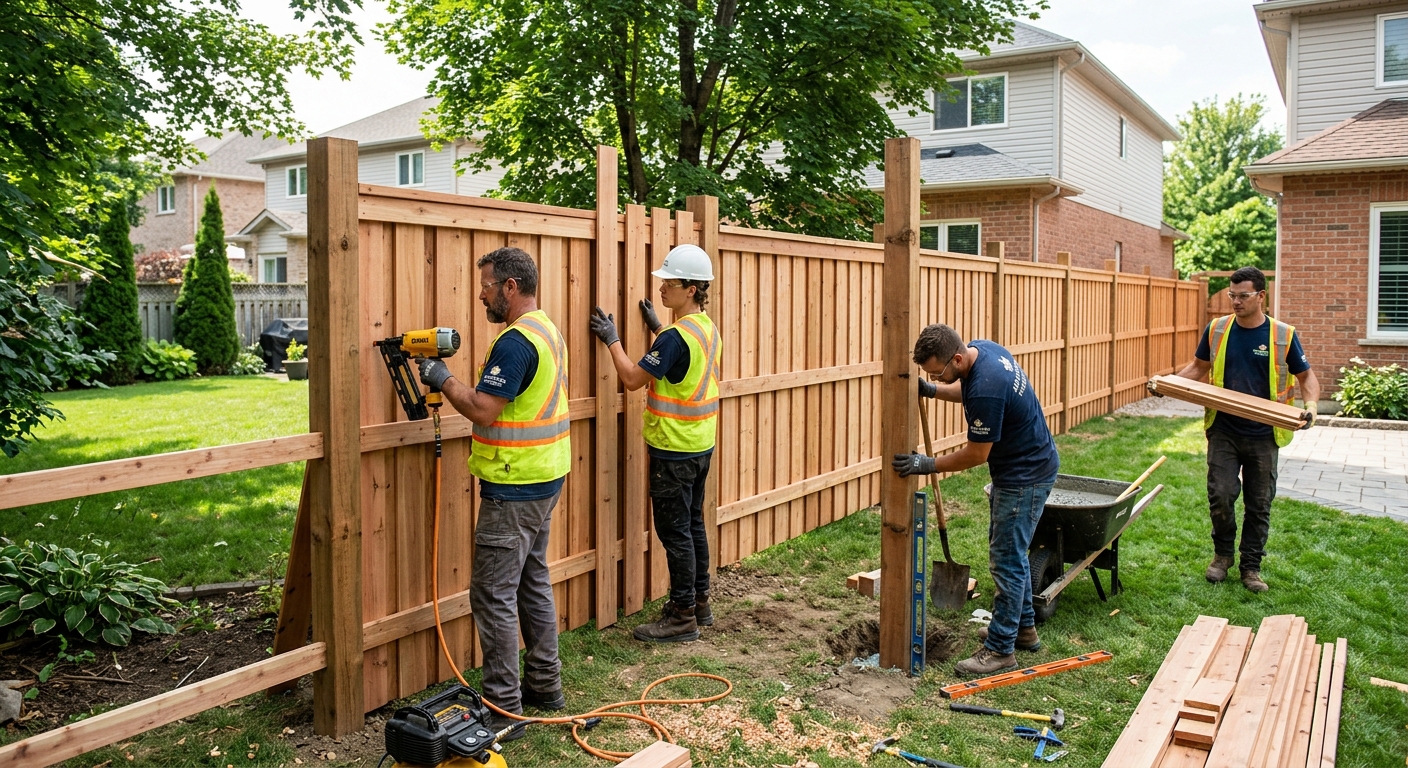
Fencing options and costs in Sweet Grass
In Sweet Grass, Alberta, choosing a fence starts with matching your priorities—privacy, maintenance time, and wind protection—to what the Prairies will do to the materials. With a population of 2,636 (Statistics Canada, 2021 Census), Sweet Grass is small, so pricing is influenced by contractor availability from the wider Calgary area and by how quickly trades can mobilize for installs. Locally, detached housing remains the strongest driver of fencing demand, because each detached property typically needs its own boundary solution; in many Calgary-area service lines, that demand concentrates around residential pockets where homeowners refresh curb appeal and privacy along their front edges and back yards.
Cost in the Calgary economic region isn’t just about material. Prairie continental conditions bring long freeze–thaw cycles, which means frost protection is a primary cost driver. For most 6 ft privacy fences and gate posts, contractors typically set posts about 4 ft (≈120 cm) deep using concrete footings to reduce heaving and movement. Open exposure also means higher wind loading and tighter installation details—especially for solid wood or vinyl panels—so you should expect sturdier posts and more bracing. Chain-link tends to cost less because it allows airflow, reducing racking pressure during gusts.
In practice, many Sweet Grass homeowners see the most installer attention in the residential edges facing prevailing winds—often where new privacy lines are added near driveways and back-yard patio zones—then pricing is compared across material types. Use the table below as a realistic starting point for comparing fence systems.
| Material |
Lifespan |
Maintenance |
Privacy Rating |
Price per Linear Foot |
| Pressure-treated pine (standard wood) |
10–15 years (paint/stain dependent) |
Stain or seal every 2–3 years; inspect posts annually |
High (solid panels) |
$40–$80 |
| Cedar (natural rot resistance) |
15–20 years |
Light sealing/staining every 3–4 years; periodic fastener checks |
High (solid panels) |
$55–$95 |
| Vinyl / PVC (no-maintenance) |
20–30 years |
Rinse seasonally; inspect for impact cracking |
High (solid/close pickets) |
$45–$90 |
| Chain-link (galvanized steel) |
25–40 years |
Minimal; tighten and replace damaged sections as needed |
Low to medium (airflow) |
$25–$55 |
| Aluminum ornamental |
20–35 years |
Wash as needed; periodic inspection of hinges/latches |
Low (open design) |
$70–$120 |
| Composite / recycled material |
25–35 years |
Occasional wash; check post anchors after freeze–thaw |
High (depending on board spacing) |
$75–$120 |
Prices are estimates only and vary by project scope, site access and material selection.
What affects the price of fencing in Sweet Grass
In Sweet Grass and across the Calgary area, it’s common to see quotes for the “same” fence vary by 30–50%. That spread usually comes from differences in how contractors handle frost-depth post setting, wind-loading bracing, and access logistics—not just from the material line itself. Even small changes like adding a second gate, removing an old fence, or working through a narrow side yard can swing labour hours, disposal fees, and crew productivity. Because frost protection is non-negotiable on the Prairies, a contractor who budgets only for surface-level installs will often look cheaper until you factor in the longer posts, concrete volume, and more frequent inspection/set-up time.
On the Prairies, the post-depth requirement is shaped by the regional frost line: posts are commonly set about 4–6 inches below the design frost depth to prevent heaving. Practically, this often means posts set roughly 1.5–2.0 m into the ground (depending on the final design), with concrete footings especially for solid privacy styles. When you increase hole depth and concrete, both labour and material costs rise—often pushing solid wood privacy from mid-range toward the upper end (for example, wood or cedar typically lands in the $40–$80 range, while higher-end installations can exceed it when braces, gates and concrete footings are heavier).
Wind exposure also drives design. Open Prairie exposure encourages tighter post spacing and heavier rails for solid wood or vinyl, while chain-link can be less expensive because airflow reduces racking forces; that’s why chain-link is often closer to the lower–mid range (about $25–$55).
Two local examples I see frequently in Sweet Grass: (1) yards with long, straight runs on exposed lots require stronger line posts and intermediate bracing, which adds time; (2) properties with icy clay or rocky soil slow excavation, increasing labour and sometimes requiring additional concrete for a stable footing. If you’re replacing a fence that’s already leaning from freeze–thaw movement, removal plus re-building from solid footings can raise the project closer to the upper end of vinyl/wood estimates.
| Price Factor |
Why It Matters |
Cost Impact |
| Fence length in linear feet |
Most costs scale directly with total run length |
Large multiplier; typically the biggest driver of final price |
| Post depth required |
Frost line determines hole depth and usable post length |
Deeper frost-safe setting adds excavation time and more materials |
| Post setting method |
Concrete provides consistent anchoring in freeze–thaw cycles |
Concrete-set posts usually cost more than gravel packs; driven posts can reduce excavation in some soil conditions |
| Material choice |
Wind resistance and panel stiffness affect rail/post sizing |
Vinyl vs. cedar often shifts you into higher mid-range; chain-link stays lower because it’s more airflow-friendly |
| Gate count and type |
Gates require heavier framing, hinges, and sometimes additional posts |
Each additional gate adds labour and hardware; drive-through double gates cost the most |
| Grade and terrain |
Slope needs stepping or raked panel layout |
More layout time and sometimes more material cut-offs/adjustments |
| Old fence removal and disposal |
Debris handling, hauling, and time on site |
Can add hours and dumping costs; concrete footings increase labour |
| Permit fees and survey / property line locate |
Correct placement avoids rework and neighbour disputes |
Sometimes modest add-ons, but re-stakes or rework can be expensive if skipped |
Permits & regulations in Alberta
In Alberta, fence requirements are primarily about property lines and—when certain heights are exceeded—whether a building permit is required. As a practical rule of thumb for many Alberta municipalities, fences above about 2.0 m (6.5 ft) at the rear and 1.0–1.2 m (3–4 ft) at the front or corner often trigger a permit review. Even if you don’t need a permit, you still must comply with municipal setback bylaws and keep the fence within your property line (or follow any shared fencing rules).
Before digging any post holes, call Alberta One-Call for utility locates. If your fence runs near buried services or overhead lines, the locate helps prevent costly damage and delays. Then, confirm your property pins or obtain a survey/property line locate so your posts don’t encroach. Shared fence ownership is typically handled by provincial line-fences legislation and local rules on how maintenance responsibilities are split—especially where neighbours share a boundary line.
What typically DOES require a permit: taller fences (especially those exceeding common rear and front/corner thresholds), certain corner/visibility situations, and projects that may affect permitting for site conditions. What typically does NOT: replacing an existing fence in the same location with similar height and materials (still verify with your local office).
To verify a contractor before signing in Sweet Grass: check their business registration and licensing status via the Alberta contractor licensing/registry tools relevant to fencing/installation work, request a current certificate of insurance, and confirm coverage includes liability for property damage and workers’ compensation (WCB) where required. Ask for a clearance letter or proof document that matches the company name and the project location.
Choosing the right fence material for Sweet Grass
For Sweet Grass, Alberta, the best fence material is the one that matches how you live—and how the Prairie weather behaves. In freeze–thaw conditions, the system matters as much as the surface finish: properly set posts, correct rail spacing, and wind-rated construction are what keep panels straight through winter. Pressure-treated pine is usually the most budget-friendly option, but it needs staining or sealing every 2–3 years to prevent grey weathering and premature wear. Cedar looks more natural and resists rot better, but it still benefits from periodic sealing to maintain its finish and reduce surface cracking.
Vinyl/PVC is popular in Calgary because it’s low maintenance, yet extreme cold snaps can crack material if the installation is too flexible or if posts don’t provide proper support. Chain-link is often the best budget choice for long runs: it typically costs less (often around $25–$55 per linear foot) and lasts a long time because airflow reduces wind stress. Aluminum ornamental is rust-resistant and durable, but it provides minimal privacy and usually sits at the higher end of the price spectrum (often $70–$120 per linear foot) for the look and strength.
Post-depth also ties directly to material performance. In the Calgary frost zone, most solid privacy styles are built with concrete-set posts set below the regional frost line (commonly about 4 ft depth for many 6 ft runs) to reduce heaving. That foundation choice is often justified regardless of whether you select wood or vinyl, because wind racking and winter movement show up more in solid panels than in open styles like chain-link.
A practical dollar example: if your run length is 50 linear feet, moving from chain-link at roughly $25–$55 per foot to vinyl/wood privacy at about $45–$90 per foot can add approximately $1,000 to $2,250 total—money that’s often worth it when privacy and sun/wind blocking are priorities. If you mostly want boundary definition and airflow, chain-link usually delivers the better value.
| Material |
Cold Tolerance |
Lifespan |
Annual Maintenance |
Best For |
Price Band |
| Pressure-treated pine |
Good when posts are frost-set correctly; requires finish |
10–15 years |
Quick inspections; stain/seal every 2–3 years |
Budget privacy with traditional look |
$40–$80 |
| Cedar |
Good; stable when anchored and ventilated |
15–20 years |
Inspect fasteners; seal/stain every 3–4 years |
Natural appearance and better rot resistance |
$55–$95 |
| Vinyl / PVC |
Very good in cold if properly supported and installed |
20–30 years |
Rinse; check for impact cracks and alignment |
Low-maintenance privacy |
$45–$90 |
| Chain-link |
Excellent; metal tolerates freeze–thaw well |
25–40 years |
Minimal; tighten hardware and inspect coatings |
Security/boundary definition with airflow |
$25–$55 |
| Aluminum ornamental |
Excellent; corrosion-resistant |
20–35 years |
Wash; lubricate hinges/adjust gates as needed |
Curb appeal without heavy maintenance |
$70–$120 |
| Composite / recycled |
Good; solid boards can rack without stout framing |
25–35 years |
Wash; inspect anchors after winter |
High privacy with durable, low-fuss boards |
$75–$120 |
How to choose a fencing contractor in Sweet Grass
Choosing the right contractor in Sweet Grass starts with proof—not promises. In Alberta, verify the company’s legitimacy and coverage before work begins. Ask for a current certificate of insurance showing liability coverage appropriate for your project scope (and confirm it matches the legal business name). For workers’ compensation, confirm they carry WCB coverage where required; request a clearance letter or coverage proof document, especially if you see subcontractors listed. Also verify the contractor’s Alberta registration/licensing status relevant to their trade activity using the appropriate online registry and ensure the staff assigned to your job match the insured entity.
Then get 2–3 itemised written quotes. You want labour and materials broken out, not a lump sum that hides the real assumptions. Pay close attention to what’s included: permit pull responsibilities, utility locate costs (usually called by the contractor or homeowner through Alberta One-Call, depending on the agreement), excavation, concrete, post depth, rail spacing, and whether disposal/hauling is included for old fencing. A solid workmanship warranty should be clearly stated—how many years, what defects are covered, and whether it covers post movement or only material defects.
For payment, don’t exceed about 10–15% upfront for materials scheduling, and set a holdback until key milestones are complete (for example, after posts are set and aligned, and again near substantial completion). Request a written start date and an estimated completion timeline so you’re not left waiting during freezing weather transitions.
- Confirm insured liability coverage on the COI matches your contract holder.
- Verify WCB coverage (clearance letter or proof document) before crews arrive.
- Ask for a written scope: post depth, concrete quantity approach, and post spacing.
- Ensure quotes state whether labour includes permit/paperwork or only construction.
- Check whether disposal/hauling of old fence and concrete rubble is included.
- Request details on gates: hardware brand/type, gate frame material, and swing direction.
- Confirm footing method: concrete-set vs gravel pack vs driven posts (and why).
- Require measurement and layout steps, including property line locate or survey reliance.
- Ask for warranty length for workmanship and whether product warranties transfer.
- Keep a clear change-order process for extra excavation, unexpected rock, or grade changes.
- Use a realistic payment schedule with a holdback for final alignment and cleanup.
- Get start/completion dates in writing and confirm crew availability around freeze periods.
Red flags I see in the Sweet Grass market: contractors who won’t explain post depth and frost-safe setting, quotes that don’t include removal/disposal assumptions, vague warranty terms (“lifetime” without wording), refusing to provide proof of WCB/liability coverage, and pushing for large upfront payments without a signed schedule and milestone plan.
Frequently asked questions — fencing in Sweet Grass
How deep should fence posts be for Sweet Grass's frost?
In Sweet Grass and the Calgary economic region, frost protection is the reason many fences cost more than you might expect. Contractors typically set posts about 4 ft (≈120 cm) deep for common privacy heights, or at least about 4–6 inches below the design frost depth, to reduce heaving during repeated freeze–thaw cycles. For many 6 ft privacy fences and gate posts, concrete footings are commonly used because they stabilize the post in winter movement and wind loading. If a quote doesn’t specify post depth and the setting method, ask—those details usually separate a “low bid” from a fence that stays plumb for years.
Wood vs vinyl vs aluminum fence — which is best?
“Best” depends on whether you want privacy, low maintenance, or a decorative look. For privacy, wood (pressure-treated pine or cedar) and vinyl/PVC usually win because they offer solid panels; vinyl is often priced around the $45–$90 per linear foot range, while wood commonly sits around $40–$80 depending on height, gates and concrete footings. Aluminum is great for durability and curb appeal, but it’s open—so privacy is limited. In Sweet Grass’s wind exposure, solid styles require stout framing and frost-safe post setting; open styles like aluminum or chain-link experience less racking, which can make them easier to keep straight.
Do I need a permit to build a fence in Alberta?
Many Alberta fence projects do require a permit once height thresholds are exceeded. As a guideline many municipalities follow, fences above roughly 2.0 m (6.5 ft) at the rear and about 1.0–1.2 m (3–4 ft) at the front or corner often need a building permit. Even when a permit isn’t required, you must still respect property lines and local setback rules, and you should confirm visibility requirements at corners. Before digging, call Alberta One-Call for utility locates and rely on a survey/property line locate if you’re unsure of pin locations. If you’re planning a taller privacy run, ask your contractor whether they handle permit submissions and what’s included in the quote.
How long does a wood fence last in Sweet Grass?
A well-installed wood fence in Sweet Grass can last about 10–15 years for pressure-treated pine and often 15–20 years for cedar, assuming posts are set for frost conditions and maintenance is done. In Calgary-area Prairie weather, the biggest early risks are post heaving (from incorrect depth), rail movement from wind loads, and finish breakdown from wet–freeze cycling. That’s why proper concrete-set footings for privacy fences matter. If you choose pressure-treated pine, plan for staining or sealing every 2–3 years; skipping that step can shorten the life because the coating protects against weathering and surface degradation.
Who owns and maintains a shared fence?
Shared fence ownership and responsibility in Alberta are commonly governed by provincial line-fences rules and any applicable municipal policies. Practically, the “who pays and maintains” depends on whether the fence is treated as a boundary structure and how neighbours agree to contributions. If your fence sits directly on or near the property line, confirm the arrangement before build-out—especially if one side expects a privacy upgrade or taller panels. When neighbours share a fence, communication about maintenance schedules, replacement triggers (e.g., after frost heaving or damage), and what each party covers helps prevent disputes. A proper property line locate before installation also reduces the chance that a “shared” assumption is based on incorrect stakes.
How do I find my property line before fencing?
Before fence installation in Sweet Grass, confirm your boundary using one or both of these approaches: locate existing property pins/markers (often with help from a surveyor or your property documentation) and/or order a formal property line locate/survey. Many neighbour disputes start because stakes were assumed “close enough.” For safety, contractors should work from clear reference points, not guesswork. If your yard has older fencing or shifting lines from past renovations, re-locating pins matters even more. Also call Alberta One-Call for utility locates before any post holes are dug, so you can plan post placement confidently and avoid hidden services.