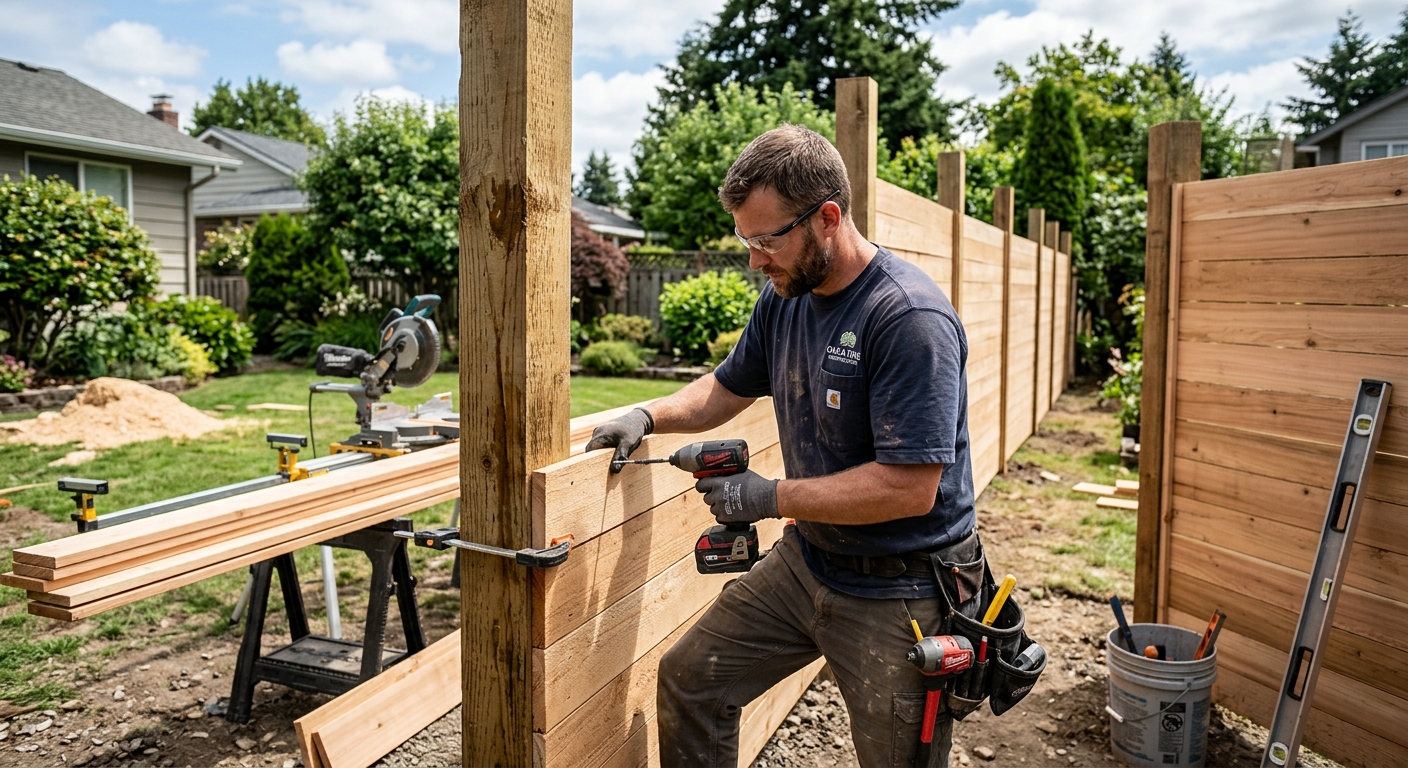
Fencing options and costs in Beaumont
Fencing options in Beaumont, Alberta range from simple boundary runs to full privacy enclosures, and the local pricing reflects real differences in installation conditions—not just the picket or panel you choose. Beaumont’s housing stock is heavily oriented to single-detached homes (80.0% of dwellings), and that matters because each detached property is a frequent fencing customer; in 2021, homeowner households made up 87.2% of all households (Statistics Canada, 2021 Census). In practice, that’s why you’ll often see higher contractor availability in established neighbourhoods where lots are larger and fences get replaced rather than added. Areas like Charron and Evergreen tend to be busy for backyard upgrades and privacy builds, especially when homeowners are replacing older, weathered wood.
Cost in the Edmonton economic region is driven less by material alone and more by site and climate realities. Alberta frost and wind exposure mean contractors typically plan for deeper post setting to reduce heaving, plus sturdier framing where panel stress is higher. If you’re adding gates, handling sloped grade, or removing an old fence, labour time rises quickly and can swing a quote by tens of percent.
To help you compare apples to apples, the table below shows typical installed ranges you can expect in Beaumont. Use it as a budgeting baseline, then we’ll break down what actually pushes a project toward the higher or lower end.
| Material |
Lifespan |
Maintenance |
Privacy Rating |
Price per Linear Foot |
| Pressure-treated pine (standard wood) |
10–15 years |
Stain/seal every 2–3 years |
8/10 (solid boards) |
$20–$32 |
| Cedar (natural rot resistance) |
15–20 years |
Light staining/finishing every 2–4 years |
9/10 (solid boards) |
$25–$40 |
| Vinyl / PVC (no-maintenance) |
20–30 years |
Rinse as needed |
8/10 (solid privacy styles) |
$27–$52 |
| Chain-link (galvanized steel) |
25+ years |
Minimal (wash and inspect) |
3/10 (visibility) |
$15–$25 |
| Aluminum ornamental |
25+ years |
Occasional rinse; touch-up if needed |
4/10 (open pickets) |
$22–$45 |
| Composite / recycled material |
20–30 years |
Low; rinse and inspect fasteners |
8/10 (board-style privacy) |
$30–$55 |
Prices are estimates only and vary by project scope, site access and material selection.
What affects the price of fencing in Beaumont
Even when two neighbours in Beaumont choose the same fence style, quotes can legitimately differ by 30–50% across the Edmonton region because builders are reacting to frost depth, wind loading, and how difficult your site is to work on. Labour rates and crew efficiency also affect pricing: a “straight line” backyard run is quicker than one with gates, removal, or a step-and-rake layout on a sloped yard.
In the Edmonton area, frost is a big driver because posts must be set below the design frost depth to reduce heaving. In practical terms, contractors often plan post holes 4–6 inches below the frost depth requirement, which commonly works out to about 1.5–2.0 m of embedment in colder Canadian winters. Deeper holes mean longer auger time, longer posts, and more concrete when you’re using concrete-set posts—so your material and labour both move upward. Wind exposure on the Prairies is another factor: open sites increase stress on panels and fasteners, so you’ll see tighter post spacing and stronger rails on privacy fences. That’s why a privacy build frequently lands closer to the upper end of the wood installation range ($3,000–$6,500) than a basic boundary run.
Two concrete examples from Beaumont conditions that raise cost include: (1) a fence on a long, flat run exposed to prevailing winds where contractors increase post spacing and bracing; and (2) replacing an older fence where you need careful removal of set posts and debris disposal before new footing work begins. Examples that can lower cost are: shorter lengths with limited gates, and backyard access where a skid steer or trailer can get close to the work zone, reducing carrying distance and rework.
On the budgeting side, it’s also common to see vinyl land toward the higher end of $3,500–$8,000 when wind-rated framing, more rigid components, or multiple gates are included. Finally, older homes built before 1981 make up a meaningful portion of the area (11.9% of homes were built before 1981, Statistics Canada, 2021 Census), and those properties often have older fence remnants, uneven grading, or buried obstructions that add time to locate and prep the site.
| Price Factor |
Why It Matters |
Cost Impact |
| Fence length in linear feet |
Most labour/materials scale directly with length |
High (largest driver) |
| Post depth required |
Frost depth controls embedment and hole depth |
Medium–High |
| Post setting method |
Concrete-set posts increase material time vs. gravel pack |
Medium–High |
| Material choice |
Vinyl/cedar and privacy systems often cost more than chain-link |
Medium |
| Gate count and type |
Drive-through/double gates require heavier hardware and alignment |
High |
| Grade and terrain |
Slopes need racked frames/stepped panels and extra layout time |
Medium |
| Old fence removal and disposal |
Demolition, hauling, and possible repair to damaged soil |
Medium |
| Permit fees and survey / property line locate |
Locates prevent encroachment and reduce rework |
Low–Medium |
Permits & regulations in Alberta
In Alberta, fences above a height threshold—typically about 2.0 m (6.5 ft) at the rear and around 1.0–1.2 m (3–4 ft) at the front or corner—often require a building permit, especially when the proposed height could affect visibility and safety. Regardless of height, all fences must respect property lines and municipal setback requirements. Because enforcement and specifics can vary by location and placement, treat height and setback rules as something you confirm before digging.
Before any post holes get dug, arrange utility locates through Alberta One-Call. That step is essential even in established Beaumont neighbourhoods where lines “should be” clear—lawn irrigation, hydro, and telecom routes can cross where contractors plan to auger. Next, confirm your boundary using a survey or by locating your property pins; this reduces the risk of building on a neighbour’s land. Shared fence ownership is addressed under Alberta line-fences legislation, so if your fence is on/near a shared boundary, you may need to coordinate responsibilities before proceeding.
What usually does NOT require a permit: routine repairs like replacing a damaged board on an existing, compliant fence without increasing height, and like-for-like maintenance where dimensions stay the same. What DOES require a permit: building or replacing a fence with heights that exceed the typical thresholds, and major changes that increase height or shift placement closer to setbacks.
To verify a contractor in Beaumont, ask for three things and check them before work starts: (1) Alberta licence details via the contractor’s business registration/registry information they provide; (2) a current certificate of insurance (liability) showing coverage is active and that they name you where appropriate; and (3) proof of WSIB/WCB coverage (workers’ compensation). If they won’t provide documents or direct you to where to check them, that’s a major warning sign.
Choosing the right fence material for Beaumont
Choosing the right fence material in Beaumont is mostly about matching performance to your priorities: privacy, low maintenance, budget, and lifespan—while accounting for Edmonton-region winter. Pressure-treated pine is the budget-friendly option, but you’ll typically need staining or sealing every 2–3 years to prevent grey weathering and early surface cracking. Cedar offers better natural rot resistance and an attractive look, but it still benefits from finishing to hold colour and protect the surface. Vinyl/PVC is the low-maintenance favourite; the trade-off is higher upfront cost and the need for quality installation in extreme cold, with proper rail/expansion allowances so panels don’t warp or become brittle over time.
For privacy, you’ll usually want solid-board designs or dense panel systems (wood, cedar, vinyl privacy styles, or composite). Chain-link is usually the lowest cost and can last a long time, but it doesn’t provide privacy by itself. Aluminum is durable and won’t rust like steel, but it’s also visually open, so it’s better for perimeter definition than privacy.
Post depth is the same story regardless of material in Alberta winters: in the Edmonton area, embedment often needs to be about 1.5–2.0 m to manage frost heaving, and concrete-set posts may be recommended depending on your soil and wind conditions. Wind and snow load also matter. A privacy fence catches more wind pressure than chain-link, so contractors commonly use heavier rails and correct post spacing to reduce panel flutter.
A practical way to justify the price: if a pressure-treated wood privacy fence is coming in around the lower end of the $3,000–$6,500 range, moving to cedar or vinyl is most worth it when you want longer life and less frequent re-finishing. For example, if vinyl is quoted near the mid-to-upper portion of the $3,500–$8,000 band, the extra cost can be justified if you’d rather avoid repeated staining in a snowy, freeze-thaw climate.
| Material |
Cold Tolerance |
Lifespan |
Annual Maintenance |
Best For |
Price Band |
| Pressure-treated pine |
Good with proper finishing |
10–15 years |
1–2 light coats/checks every 2–3 years |
Budget privacy and quick upgrades |
$3,000–$6,500 |
| Cedar |
Good; benefits from finishing |
15–20 years |
Inspect/spot-stain every 2–4 years |
Appearance + rot resistance |
$3,500–$7,500 |
| Vinyl / PVC |
Very good; quality install matters |
20–30 years |
Minimal rinse/inspection |
Low-maintenance privacy |
$3,500–$8,000 |
| Chain-link |
Excellent |
25+ years |
Occasional wash and tension check |
Perimeter security on a budget |
$2,000–$4,500 |
| Aluminum ornamental |
Excellent; no rust |
25+ years |
Low (rinse; touch-up if needed) |
Looks without maintenance |
$4,000–$9,000 |
| Composite / recycled |
Good; choose proper fasteners |
20–30 years |
Low; inspect fasteners and joints |
Durable privacy with low upkeep |
$4,000–$9,000 |
How to choose a fencing contractor in Beaumont
Choosing the right fencing contractor in Beaumont starts with verification and documentation. First, request their Alberta business credentials and confirm they can work in your area. Next, ask for a certificate of insurance (liability) and verify it’s current and covers your property during installation. For workers’ protection, confirm WSIB/WCB coverage so you’re not left responsible if a worker is injured on-site. If they can’t provide these documents on request—or provide outdated papers—you should treat it as a risk.
Then, get 2–3 itemised written quotes. A good quote separates labour and materials (posts, rails, panels/boards, hardware, gates, fasteners, concrete), lists any equipment time, and shows haul/disposal costs separately. Carefully read what’s excluded: is permit handling included or not? Is old fence removal disposal included, or is it “as available”? Are property-line locates/survey responsibilities included, especially if boundary accuracy is uncertain?
Warranty matters too. Ask for both: (1) a workmanship warranty (how long they stand behind the install—posts set, alignment, and hardware fastening), and (2) the manufacturer’s product warranty. If you sell your home, ask whether the warranty is transferable. For payment, avoid large deposits: never pay more than about 10–15% upfront, and use a holdback until completion and cleanup are done. Finally, get a written start date and completion estimate, and confirm weather delays are handled in a specific way.
- Ask for proof of liability insurance and confirm coverage limits are appropriate for residential projects.
- Confirm WSIB/WCB clearance before work begins.
- Require an itemised quote (labour vs. materials vs. concrete vs. disposal).
- Get gate hardware details in writing (hinges, latches, self-closing if requested).
- Ensure the quote includes post embedment plan for Alberta frost conditions.
- Ask who pulls permits (if required) and whether permit fees are included.
- Confirm whether property line locate/survey costs are included or your responsibility.
- Require removal and disposal to be explicitly included if there’s an existing fence.
- Review how they handle sloped yards (stepped vs. raked sections) and who sets the grade.
- Ask about cleanup standards (hauling, nail/screw pick-up, and site restoration).
- Clarify warranty length for workmanship and product, and whether warranties transfer.
- Use a payment schedule with a completion holdback (generally 10–20%).
In Beaumont, common red flags include: contractors who won’t show insurance/coverage documents, quotes that don’t include post-depth or concrete settings, lump-sum pricing with no scope notes, vague warranty statements, and unwillingness to provide a written timeline with start/completion targets.
Frequently asked questions — fencing in Beaumont
How do I find my property line before fencing?
In Beaumont and across Alberta, you should confirm the property boundary before any post holes are dug. The safest route is to use a survey or have your property pins located so you can mark the fence line accurately. If you’re not sure where pins are, ask a land surveyor or locate service to verify the boundary rather than relying on assumptions from old fence placement. Also remember utility locates: call Alberta One-Call before digging so you don’t hit hydro, telecom, or irrigation lines. If you’re replacing an older fence, some existing fencing may be slightly off; fixing the line later can add labour and material time and increase your total cost.
What's the most low-maintenance fence?
For most Beaumont homeowners, vinyl/PVC is typically the most low-maintenance option because it doesn’t require annual staining like wood. In the Edmonton-area winter, vinyl panels still need quality installation details (correct bracing and allowing for temperature changes), but you usually only need rinsing and occasional fastener checks. Aluminum ornamental is also low maintenance because it won’t rust, though it won’t give as much privacy due to open pickets. In budgeting terms, expect vinyl/PVC projects often to fall in the $3,500–$8,000 installed band, while pressure-treated wood usually starts lower within the $3,000–$6,500 range but needs re-finishing every few years to keep it looking good.
How tall can my fence be in Beaumont?
In Alberta, height limits for permits are commonly triggered around 2.0 m (about 6.5 ft) in the rear and around 1.0–1.2 m (about 3–4 ft) toward the front or corners. That doesn’t mean every taller fence is automatically forbidden, but it often means you may need a permit and you must still meet setback and property-line rules. Since fences are also influenced by safety and sightline considerations, the exact outcome depends on where the fence sits on your lot. If you’re planning a privacy fence, confirm the intended height and location with your contractor and check whether a permit is required before ordering materials.
Should fence posts be set in concrete here?
In Beaumont, concrete-set posts are often recommended because Alberta frost can cause heaving when posts aren’t embedded deep enough. Contractors commonly set posts below the design frost depth—often about 1.5–2.0 m into the ground depending on conditions—so using concrete can be part of achieving a stable base. That said, the best method depends on soil type, slope, and how the fence is engineered for wind. A good contractor will explain their post-setting approach in the quote and tie it to frost depth and your specific site. If you’re getting a bargain-priced quote, ask what embedment method they’re using and whether it matches Alberta winter realities.
What's the best fence for privacy?
For privacy in Beaumont, a solid-board wood/cedar privacy fence or a vinyl/PVC privacy system is usually the best match because you get high panel coverage and block visibility. Chain-link can be enhanced with privacy slats, but it isn’t as effective as a true privacy panel when wind kicks up. Because Prairies wind can stress panels, privacy fences often need sturdier rails and appropriate post spacing so the fence doesn’t loosen over time. Price-wise, privacy builds often trend toward the middle or upper end of the wood band—within $3,000–$6,500—or higher with vinyl/PVC, which commonly lands in $3,500–$8,000 depending on height, length, and gate hardware.
How do I compare fencing quotes?
When comparing quotes in Beaumont, focus on like-for-like scope, not just the total number. Ask each contractor for itemised breakdowns covering labour, materials, post method (embedment and whether concrete is used), gate type and hardware, and disposal/removal of the old fence. Confirm whether permits are included, and whether the quote includes a property-line locate/survey requirement (or states it as your responsibility). Look for workmanship warranty length, plus the manufacturer warranty on materials. Finally, compare payment schedules—legitimate contractors usually request only a small deposit (around 10–15%) and hold back until completion. This approach prevents “hidden” differences from turning a mid-range wood estimate into a significantly more expensive install.