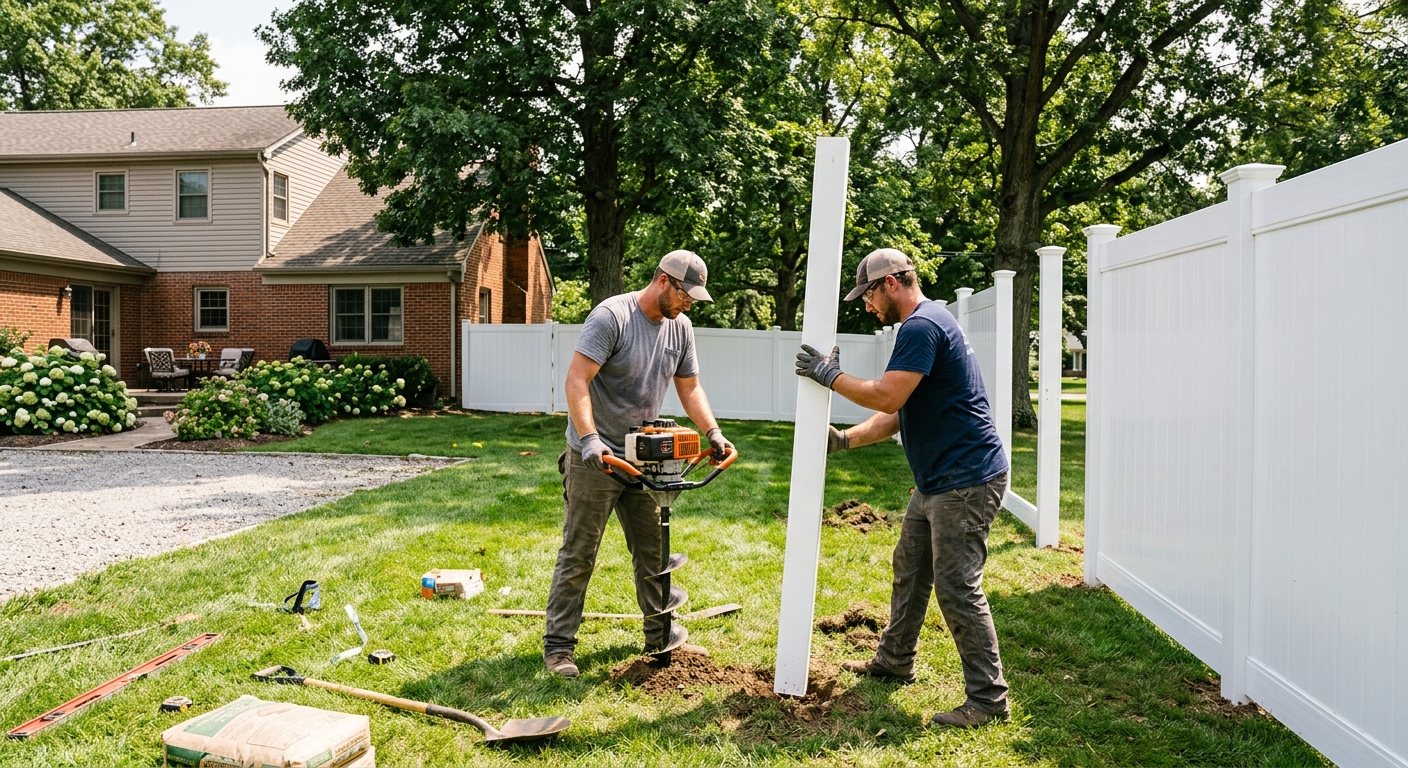
Fencing options and costs in Sandstone Valley
Sandstone Valley, Alberta is a neighbourhood where homeowners take their property boundaries seriously, and fencing demand tends to follow homeownership patterns. With a 2021 population of 5,795 (Statistics Canada, 2021 Census), most fence work is driven by long-term, single-home lots—each new privacy or boundary upgrade is essentially one more linear-foot project for local crews. The Calgary economic region also means contractors are busy across nearby communities, so availability and lead times can swing during peak spring installs.
Pricing is strongly shaped by the Prairie continental climate: long freeze–thaw cycles and open wind exposure make wind loading and frost protection the two biggest cost drivers. In this area, the City of Calgary-style guidance commonly used by fencing contractors is to set posts about 4 ft (≈120 cm) deep to get below the regional frost line, especially for 6 ft privacy fences and gate posts. That extra excavation, concrete volume, and labour pushes solid panel fencing higher than lighter, more airflow-friendly systems like chain-link. Terrain access also matters—snowbanks, soft edges near ditches, and sloped yards can add time for careful layout, stepping, and disposal.
In Sandstone Valley, fence installs are especially in demand around newer developments and perimeter streets where wind is more exposed, as many homeowners prioritize privacy from road-side views and winter wind. Next, use the comparison table to see typical lifespan and budget ranges by material before you request quotes for your specific run length and gate needs.
| Material |
Lifespan |
Maintenance |
Privacy Rating |
Price per Linear Foot |
| Pressure-treated pine (standard wood) |
10–15 years |
Stain/pressure wash every 2–3 years; replace boards as needed |
High (solid panels) |
$40–$80 |
| Cedar (natural rot resistance) |
15–25 years |
Seal/stain every 2–4 years; periodic board checks |
High (solid panels) |
$55–$95 |
| Vinyl / PVC (no-maintenance) |
20–30 years |
Rinse as needed; inspect posts and fasteners |
High (solid panels) |
$45–$90 |
| Chain-link (galvanized steel) |
25–40 years |
Occasional tension checks; rinse corrosion-prone areas |
Low to medium (open mesh) |
$25–$55 |
| Aluminum ornamental |
30–45 years |
Minimal; wash and spot-clean as needed |
Low to medium (decorative pickets) |
$70–$120 |
| Composite / recycled material |
20–30 years |
Light washing; hardware inspection |
High (solid options available) |
$60–$110 |
Prices are estimates only and vary by project scope, site access and material selection.
What affects the price of fencing in Sandstone Valley
Two quotes for the “same” fence in Sandstone Valley can differ by 30–50% because the expensive parts are rarely the fence material alone—they’re the ground prep, the structural allowances for wind and frost, and the complexity of layout. In the Calgary economic region, crews often price for deeper excavation, concrete setting for privacy fencing, and more rigid bracing to resist racking. That’s why wood and vinyl typically land mid-range to upper-range (often around $40–$80 and $45–$90 per linear foot respectively), while chain-link stays lower at about $25–$55 per linear foot.
Frost protection is the big lever. Posts generally need to be set 4–6 inches below the design frost depth to prevent heaving, and contractors commonly plan for roughly 1.5–2.0 m into the ground in colder Alberta winters. That means longer posts, deeper holes, more concrete for footing-style builds, and additional time for careful alignment. Wind exposure on the Prairies also drives tighter post spacing and heavier rails for solid wood/vinyl panels; open mesh systems like chain-link cost less because airflow reduces wind load.
In Sandstone Valley specifically, a few local conditions commonly raise cost: (1) a run near an open field or street where gusts are higher can require extra bracing, (2) rocky or clay-heavy soil can slow augers and increase labour for excavation, and (3) longer gate spans or double-drive gates add framing and hardware. Conversely, costs can be lower when the run is straight, soil is easy to dig, and chain-link is acceptable for visibility.
To keep your budget realistic, ask your estimator to show a line-item plan for post depth, post setting method, and bracing—those details usually explain the gap between an “average” quote and your final price.
| Price Factor |
Why It Matters |
Cost Impact |
| Fence length in linear feet |
Labour and materials scale directly with linear footage |
Largest variable; often the main driver of the total |
| Post depth required |
Frost line determines how far below ground posts must sit |
Deeper frost planning can add significant excavation time and post length |
| Post setting method |
Concrete footings resist heaving better than gravel-only setups |
Concrete can increase both material and labour compared with gravel packs |
| Material choice |
Wind and privacy needs change spacing and reinforcement |
Chain-link is usually lowest; wood/vinyl higher; aluminium highest |
| Gate count and type |
Gates require heavier posts, framing, and often self-closing hardware |
Walk-through gates are moderate; double-drive gates can meaningfully raise costs |
| Grade and terrain |
Slopes require stepped or raked systems to keep panel heights consistent |
More layout time and sometimes more materials for rails/fasteners |
| Old fence removal and disposal |
Hauling and demolition time vary widely |
Can add hours and dump fees; can also expose unexpected ground conditions |
| Permit fees and survey / property line locate |
Verification reduces encroachment risk and rework |
May add administrative costs and schedule time, especially for property line clarity |
Permits & regulations in Alberta
In Alberta, fences above certain heights often need a building permit, and rules can vary by whether the fence is in the rear or front/corner areas. As a practical homeowner baseline, fences taller than about 2.0 m (6.5 ft) at the rear and around 1.0–1.2 m (3–4 ft) at the front or corner are commonly the threshold where permits are triggered. Even when a permit isn’t required, you still must comply with property lines and municipal setback bylaws.
Before any post holes are dug in Sandstone Valley, call for utility locates through Alberta One-Call so you don’t hit buried services during excavation. For boundary accuracy, plan to obtain a survey or property line locate (your pins) and share that with the contractor—fencing on the wrong line can become a costly dispute. Shared fence ownership on boundary lines is guided by provincial line-fences legislation, so it’s worth clarifying which side is responsible before demolition or replacement.
What typically DOES require a permit: tall solid privacy fences near the height thresholds (especially rear privacy runs and any solid fence that meets/exceeds the local trigger), and projects that include substantial structural changes or unusual elements. What typically does NOT: replacing a fence on the same footprint and height within the usual limits, provided you’re not changing the design to exceed thresholds.
To verify a fencing contractor in Sandstone Valley, check (1) their Alberta business licence/registration status, (2) liability insurance certificate of insurance showing coverage for the trade and your address/job, and (3) their WCB/clearance coverage evidence (clearance letter or account status). Ask for the documents before work starts so you can avoid delays if they can’t produce them.
Choosing the right fence material for Sandstone Valley
Your “best” fence material in Sandstone Valley depends on what you value most—privacy, low maintenance, budget, or longevity—then you choose the material that survives Prairie freeze–thaw and wind. Pressure-treated pine is usually the lowest upfront option, but it needs staining every 2–3 years to prevent grey weathering and to keep water from degrading the surface. Cedar costs more but offers better natural rot resistance and a warmer look; it still benefits from periodic sealing. Vinyl/PVC is popular for low-maintenance ownership—however, in Alberta cold snaps it can become brittle if the system is poorly installed, so post depth and proper fastening matter. Chain-link is the longest-life budget option and doesn’t rot, but it provides limited privacy. Aluminum ornamental is rust-resistant and long-lasting, but it’s more expensive and doesn’t block views like a solid wood or vinyl privacy panel.
Post depth matters for all materials because frost heave is the enemy. Contractors typically plan for deep-set posts (often around 4 ft/≈120 cm or deeper depending on frost planning) with concrete for privacy styles, especially for 6 ft fences and heavier gate hardware. Wind and snow loads also affect spacing: solid panels need stronger bracing and closer spacing to prevent racking; chain-link generally tolerates wind better because it lets air through.
Concrete example: if you compare a 6 ft wood privacy fence at about $40–$80 per linear foot versus chain-link at $25–$55, the difference is often justified when you need actual visual blocking and you’re willing to maintain wood. If you want minimal yearly effort and long life, vinyl can be a middle-to-upper spend (commonly $45–$90) but the ongoing maintenance savings can make sense over time.
| Material |
Cold Tolerance |
Lifespan |
Annual Maintenance |
Best For |
Price Band |
| Pressure-treated pine |
Good if installed with deep-set posts and proper drainage |
10–15 years |
0–1 hour check plus stain plan every 2–3 years |
Budget-friendly privacy where you’ll maintain the finish |
$40–$80 |
| Cedar |
Good; handles Alberta dryness and wet cycles better than many softwoods |
15–25 years |
1–3 hours check; seal/stain every 2–4 years |
Natural look with better rot resistance for privacy runs |
$55–$95 |
| Vinyl / PVC |
Good with correct fastening and robust post bracing |
20–30 years |
Rinse and inspect fasteners; typically low |
Low-maintenance privacy and long-term appearance |
$45–$90 |
| Chain-link |
Very good (won’t rot; tolerates cold) |
25–40 years |
0–1 hour tension/visual checks |
Perimeter security on a budget with minimal visual blocking |
$25–$55 |
| Aluminum ornamental |
Excellent for cold; coated metal resists winter corrosion |
30–45 years |
Wash 1–2 times per year |
Front-yard curb appeal with durable, open look |
$70–$120 |
| Composite / recycled |
Good; performance depends on correct installation system |
20–30 years |
Rinse as needed; hardware checks |
Solid privacy with low upkeep and improved uniformity |
$60–$110 |
How to choose a fencing contractor in Sandstone Valley
Start by confirming the contractor’s Alberta credentials. Ask for their business registration/licence information, then verify their liability insurance certificate of insurance (COI) lists the correct legal entity and covers work at your Sandstone Valley address. For workers’ coverage, request proof of WSIB/WCB coverage—many reputable companies can provide a clearance letter or show active account status before the job begins. If they won’t share documents or only send photos later, that’s a risk you don’t need on a deep-excavation project.
Next, get 2–3 itemised written quotes, not lump sums. A good fence quote breaks out labour, materials, post setting (concrete vs gravel pack vs driven methods), gate framing and hardware, and removal/disposal if applicable. Read the scope carefully: confirm whether permits are included (or who pulls them), whether traffic control or locates are handled by them, and what happens if they find irrigation lines or buried obstacles after excavation. Make sure the quote includes a disposal line for old fence material if removal is part of the scope.
Warranty also matters. Look for a workmanship warranty length, whether it’s transferable if you sell the home, and how manufacturer warranty works for rails, panels, and posts. For payment schedules, never agree to more than 10–15% upfront—hold back the balance until the finish meets the agreed scope and gate operation is tested. Finally, insist on a start date and completion estimate in writing so weather delays are documented, not disputed.
- Ask for COI showing liability insurance and the correct insured contractor name
- Request WSIB/WCB clearance or active coverage proof before work starts
- Verify Alberta business registration/licence details match the quote
- Confirm post depth plan aligns with Alberta frost expectations and soil conditions
- Ensure quotes specify concrete setting for privacy fences and gate posts
- Require an itemised breakdown: posts, rails, panels, caps, gates, and hardware
- Check whether utility locates are included or you’re responsible for calling
- Clarify disposal/haul-away costs for old fence removal
- Confirm permit pull responsibility if the fence meets the height threshold
- Get warranty terms in writing: workmanship and product/manufacturer warranty
- Agree on a payment schedule with a final holdback after inspection
- Request an installation schedule with start date and estimated completion
Red flags in Sandstone Valley include contractors who won’t provide insurance/WCB proof, quotes that don’t specify post depth or setting method, vague scopes that omit gate hardware details, payment requests for large upfront deposits, and promises to “skip the locates” or handle boundaries informally.
Frequently asked questions — fencing in Sandstone Valley
How long does fence installation take in Sandstone Valley?
In Sandstone Valley, installation time mainly depends on linear footage, gate count, and how complex the ground is (slope, rock, soft edges). A straightforward straight run with limited gates can go quickly once posts are set and braced; however, Calgary-area frost planning typically means deeper post holes and, for many privacy fences, concrete setting. That adds curing and layout time, not just “hammer time.” As a rough homeowner expectation, smaller projects (short runs with one walk gate) may be completed in a couple of days, while longer privacy replacements with multiple gates can stretch longer, especially if old fence removal and disposal are included. If you’re planning around spring weather, book estimates early so crews can schedule excavation and concrete work in a proper window. (Statistics Canada, 2021 Census)
Can I install a fence on a slope in Sandstone Valley?
Yes, slopes are common around Sandstone Valley, and reputable installers handle them with stepped or raked panel layouts. The key is to keep structural stability and a consistent top line without over-stressing rails. Stepped fences keep each section level while adjusting the height between posts; raked fences follow the slope continuously but require careful rail/panel adjustments. For cold Alberta conditions, it’s especially important not to “cheat” post depth to make a quick fit—heaving risk increases if posts end up above planned frost depth. In quotes, ask how they’ll measure the grade line, whether they’ll use stepped or raked designs, and whether extra rails or fittings are included.
What is the most weather-resistant fence for Sandstone Valley's climate?
For Alberta winters with freeze–thaw cycles and Prairie wind loading, the most weather-resistant options are typically chain-link and properly installed vinyl/PVC systems—provided post depth and bracing are done for the local frost and wind environment. Chain-link generally has excellent longevity because it won’t rot, with many installations landing in the lower band of about $25–$55 per linear foot. Vinyl/PVC can be very durable as well (often $45–$90 per linear foot), but the system must be installed correctly with robust posts and proper fastening so panels don’t flex excessively in cold snaps. Pressure-treated wood can also perform well when maintained, but it’s more weather-sensitive and usually needs staining/finish maintenance every 2–3 years to prevent accelerated wear.
How do I prevent wood fence rot in Sandstone Valley?
Wood rot prevention is mostly about installation details and maintenance timing. In Sandstone Valley, ensure posts are set below the frost-depth planning so they don’t heave and trap moisture around the base; that’s one reason concrete setting is commonly used for privacy fences and gate posts. Use proper hardware and ensure boards have good airflow and aren’t sealed in a way that traps water. Choose pressure-treated lumber rated for exterior exposure and avoid cutting/handling that removes protective treatment. Then, maintain the finish: stain or protective sealant every 2–3 years (and re-check after heavy wet seasons). If your fence already has soft boards or recurring failures near the bottom rails, budget for board replacement early rather than waiting for widespread panel rot—repairs are usually cheaper than full section replacement.
What is the cost per linear foot for fencing in Sandstone Valley?
Homeowners in the Calgary economic region typically see installed pricing that sits roughly within these per-linear-foot bands: wood around $40–$80, vinyl/PVC about $45–$90, chain-link about $25–$55, and aluminum/metal about $70–$120, depending on height, terrain, and gate complexity. Your total can move up from the low end if you need deep post holes, concrete setting for privacy panels, or additional bracing to handle strong wind loads. It can also move down if the run is straight, access is easy, and you’re choosing a lighter mesh system. For the most accurate number in Sandstone Valley, ask for a quote that itemises post setting method, gate hardware, and removal/disposal so you can compare like-for-like scopes.
Should I repair or replace my old fence in Sandstone Valley?
Repairing makes sense when only a few boards/rails are failing and posts are still solid, properly set, and not leaning. In Alberta, frost heaving often shows up as gaps at the bottom or posts that shift—if that’s happening, repairs may just be temporary and replacement is usually the better long-term fix. If your fence is sagging because rails are twisted, replacing rails might work if posts are in good shape, but for 6 ft privacy fences with multiple compromised sections, replacement often costs less than a patchwork approach. Also consider maintenance fatigue: if you’re already staining every couple of years for a pressure-treated pine fence, upgrading to cedar (more rot resistance) or vinyl (lower upkeep) can justify the higher material spend. A contractor should inspect the post depth/footings and point out which sections are structurally failing before recommending a full replacement.