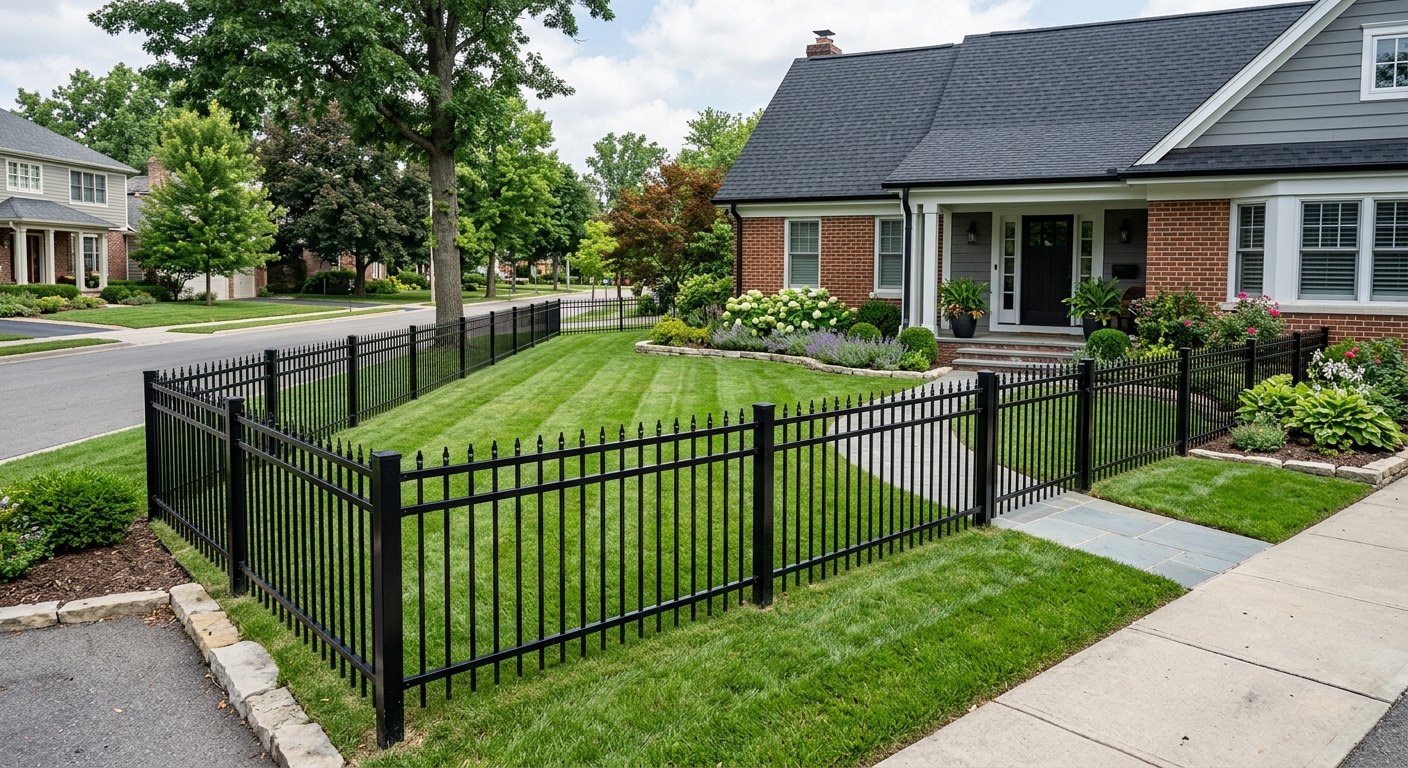
Fencing options and costs in Marlborough
Marlborough, Alberta is a growing community—there are 8,910 people in the area (Statistics Canada, 2021 Census)—and that steady demand shows up in how quickly fence crews book out once spring site work begins. Even more, the housing base matters: in many Calgary-region communities, detached homes are a common setup for yard fencing, and each detached property owner is a potential fencing customer, which makes fence installation work fairly consistent year-to-year.
In the Calgary economic region, the biggest cost drivers are not just the fence material, but the climate engineering behind it. Prairie continental winters bring long freeze–thaw cycles, which means contractors typically set posts about 4 ft (≈120 cm) deep (often using concrete footings for privacy fences and gate posts). That deeper excavation increases labour time, concrete volume, and material handling compared with milder parts of Canada. Open Prairie exposure also raises wind loads—solid privacy panels (wood/vinyl) need closer post spacing and stronger bracing to prevent racking, which further pushes installed pricing up.
In Marlborough, trade demand is especially common around established residential pockets where backyards face wind exposure and where owners upgrade older, weathered fencing. If you’re planning work near the edges of neighbourhood streets (where wind exposure can be higher), you can expect a more robust build—often with full post concrete setting for 6 ft privacy runs and gates.
Below is a practical comparison to help you map priorities (privacy, lifespan, and upkeep) to realistic installed ranges, which then transitions into what drives the final quote.
| Material |
Lifespan |
Maintenance |
Privacy Rating |
Price per Linear Foot |
| Pressure-treated pine (standard wood) |
10–15 years |
Stain/seal every 2–3 years to reduce grey weathering |
High (solid pickets) |
$40–$70 |
| Cedar (natural rot resistance) |
15–25 years |
Light seal or stain about every 2–4 years |
High (solid board) |
$55–$80 |
| Vinyl / PVC (no-maintenance) |
20–30 years |
Rinse as needed; occasional panel alignment checks |
High (solid privacy styles) |
$55–$90 |
| Chain-link (galvanized steel) |
20–30 years |
Minimal—wash down and replace any damaged sections |
Low (open mesh) |
$25–$55 |
| Aluminum ornamental |
25–40 years |
Occasional cleaning; no rust in typical conditions |
Low to medium (open rail) |
$70–$120 |
| Composite / recycled material |
20–30 years |
Low—rare cleaning; minor repairs if panels crack |
High (solid boards) |
$60–$100 |
Prices are estimates only and vary by project scope, site access and material selection.
What affects the price of fencing in Marlborough
If you’ve received two different fencing quotes for what sounds like the same job in the Calgary area, it’s common to see 30–50% variation. The spread usually comes from differences in post depth and setting method, wind-load design, gate hardware, and whether the contractor includes excavation, concrete, disposal, and site locating in the base price. Two contractors may both say “6 ft privacy fence,” but one may build for the region’s freeze–thaw and wind exposure with fully concreted posts and tighter bracing, while the other may price with lighter assumptions.
Here’s the key: frost line depth drives post installation. In Alberta, contractors typically set posts about 4–6 inches below the design frost depth to prevent heaving—meaning deeper hole excavation and longer posts that increase both material and labour. In many cold-climate builds, concrete setting becomes standard for privacy fence posts and gates, not because it’s a luxury, but because it reduces future movement. In contrast, milder regions may use shorter post depths and lighter anchoring; that’s where prices can drop.
Wind exposure is another Prairie factor. With open exposure across the Calgary region, solid panels (wood or vinyl) need sturdier posts and sometimes closer spacing, which also affects how much labour it takes to align pickets, rails, and bracing. As for why coastal BC changes the equation—wet, mild conditions can accelerate wood rot if the material and installation aren’t tuned for moisture management, while Calgary’s problem is more about freeze–thaw movement and racking.
In Marlborough, cost often rises when yards are sloped (stepped/raked panels), when gate count increases, or when older fencing removal is required. Costs can also lower when you have straightforward, level runs with easy access and minimal obstructions. For budgeting, wood or vinyl privacy commonly sit mid-range against the local bands (for example, wood installation often reflects the $40–$80 per linear foot range, while vinyl/pvc privacy typically tracks $45–$90 depending on post setting and gate complexity).
| Price Factor |
Why It Matters |
Cost Impact |
| Fence length in linear feet |
Most material and labour scale directly with total run length |
High (primary driver) |
| Post depth required |
Frost protection determines hole depth and post length |
Medium to high |
| Post setting method |
Concrete vs gravel pack vs driven posts changes excavation and materials |
Medium to high |
| Material choice |
Vinyl vs cedar vs chain-link affects panel weight, hardware, and labour |
Medium |
| Gate count and type |
Drive-through and double gates need heavier frames and hardware |
Medium to high |
| Grade and terrain |
Slope requires stepping/raking and more labour for alignment |
Medium |
| Old fence removal and disposal |
Hauling and time to demo can be significant |
Medium |
| Permit fees and survey / property line locate |
Administrative steps and locate work can add cost and scheduling time |
Low to medium |
Permits & regulations in Alberta
In Alberta, fencing height can trigger permitting requirements. A common rule of thumb is that fences above a height threshold—often about 2.0 m (6.5 ft) at the rear and around 1.0–1.2 m (3–4 ft) at the front or corner—may require a building permit, depending on the location within your lot and municipal interpretation. Regardless of permit requirements, all fencing must respect property lines and the applicable municipal setback bylaws.
Before you dig any post hole, call for utility locates (Alberta One-Call) so you don’t hit buried services. For accuracy and to avoid encroachment disputes, many homeowners in Marlborough also benefit from a survey or at least a documented property-pin locate before installation—especially if your existing fence isn’t aligned with the current pins. Shared fence ownership responsibilities are typically handled under provincial line-fences legislation, so it’s wise to clarify expectations with neighbours where fences are boundary-adjacent.
What typically DOES require a permit: solid privacy fences above common front/rear thresholds, and substantial structures that fall within permitting rules. What typically does NOT: standard low fence repairs or replacement in-kind at compliant heights, and shorter perimeter fences that stay under the height limits (confirm with your contractor and the municipality).
To verify your contractor’s Alberta compliance, ask for their Alberta licence reference (if applicable), a current certificate of insurance showing liability coverage, and proof coverage for worker protection (WSIB/WCB). You should be able to find licensing/registration details online, and you should receive an up-to-date clearance letter or coverage certificate on request.
Choosing the right fence material for Marlborough
Choosing the right material in Marlborough comes down to matching your goals—privacy, upkeep level, and budget—to the reality of Calgary’s freeze–thaw cycles and wind exposure. Pressure-treated pine is usually the most budget-friendly way to get a privacy look, but it typically needs staining or sealing every 2–3 years to reduce grey weathering and surface breakdown. Cedar often performs better aesthetically and resists rot longer, though it still benefits from regular maintenance to preserve colour and reduce warping at the rail lines.
Vinyl/PVC delivers true low maintenance—no staining—yet it’s not “zero work.” In extreme cold snaps, some styles can flex, so proper post setting and bracing matter. That’s why, in the Calgary region, concrete-set posts are commonly used for 6 ft privacy runs and gate posts to reduce movement when freeze–thaw pushes and pulls the ground. Chain-link is the longest-life, lowest-cost option and tends to handle wind very well because it’s open, but it does not provide true privacy unless you add privacy slats or an additional screen layer. Aluminum ornamental is rust-resistant and mid-range in price, but because it’s open, it’s usually a visual boundary rather than a privacy solution.
Here’s a concrete budget example: if you compare cedar privacy at roughly $55–$80 per linear foot versus chain-link at about $25–$55, you might pay an extra $30 per foot. That difference is justified when you need solid privacy for backyard living and you want panels that resist wind-driven racking. If you only need boundary definition and security, chain-link is often the smarter value.
| Material |
Cold Tolerance |
Lifespan |
Annual Maintenance |
Best For |
Price Band |
| Pressure-treated pine |
Good (when properly sealed and installed) |
10–15 years |
1–2 minor touch-ups; stain every 2–3 years |
Budget privacy with manageable upkeep |
$40–$70 |
| Cedar |
Good (naturally rot-resistant) |
15–25 years |
Light seal/stain about every 2–4 years |
Premium look privacy |
$55–$80 |
| Vinyl / PVC |
Very good (requires solid post support) |
20–30 years |
Rinse as needed; check hardware |
Low-maintenance privacy |
$55–$90 |
| Chain-link |
Excellent (open airflow) |
20–30 years |
Minimal |
Security and boundary definition |
$25–$55 |
| Aluminum ornamental |
Very good (no rust) |
25–40 years |
Occasional wash |
Clean curb appeal, durable perimeter |
$70–$120 |
| Composite / recycled |
Good (depends on board system and supports) |
20–30 years |
Low—periodic cleaning and repair checks |
Privacy with low upkeep |
$60–$100 |
How to choose a fencing contractor in Marlborough
When you’re hiring a fencing contractor in Marlborough, verify compliance and capability before you compare price. Start with Alberta coverage documentation: ask for proof of liability insurance (certificate of insurance), and confirm worker coverage under WSIB/WCB for the crews doing the work. You should also be able to provide any applicable contractor licensing/registration details and a current clearance letter or coverage certificate, not just a verbal assurance. If you’re unsure where to check, ask for the registry reference or paperwork details so you can verify them yourself.
Next, get 2–3 itemised written quotes. You want labour and materials broken out—posts, rails, panel quantity, concrete volume, hardware, gate components, and any reinforcement—rather than one lump sum. Review what’s excluded: is fence removal included? Is disposal/haul-away included? Are utility locates booked by the contractor or by you? Is the fence layout tied to property pins? Clarify whether a permit is pulled by the contractor (and included) or if you’re responsible.
For warranty, ask for two parts: workmanship warranty length (how long they’ll fix alignment, sagging, or post movement), and product/manufacturer warranty on materials. Also ask whether the product warranty is transferable if you sell your home.
For payment schedule, never pay more than about 10–15% upfront. Hold back a portion until the job is complete and you’ve reviewed the gate operation, alignment, and final grade transitions. Request a written start date and a realistic completion window based on excavation, post curing time, and weather delays.
- Request proof of liability insurance (certificate of insurance) and confirm coverage is current.
- Confirm WSIB/WCB/worker coverage for installation crews (clearance letter or certificate).
- Ask what Alberta-specific permits (if any) apply to your fence height/location and who pulls them.
- Get itemised pricing: labour, materials, hardware, and concrete/post quantities.
- Confirm post depth and setting method (concrete vs gravel pack) aligns with frost protection.
- Verify gate hardware specifications (hinges, latches, stop clearance, and swing direction).
- Ask whether disposal/haul-away of old fence is included.
- Confirm how they handle slopes: stepped vs raked panels and where the breaks are located.
- Check if they include utility locates (Alberta One-Call) before digging.
- Clarify who verifies property line/pins and how layout is documented.
- Review workmanship and material warranties in writing, including warranty transferability.
- Use a payment schedule with a small deposit and a holdback until completion and final walk-through.
Red flags I commonly see with fencing contractors in the Marlborough area include: refusing to provide a current certificate of insurance or WSIB/WCB proof; quoting with no post depth or concrete setting details; offering only lump-sum pricing without an itemised materials breakdown; starting excavation without confirming utility locates; and pushing for large upfront deposits beyond 10–15%.
Frequently asked questions — fencing in Marlborough
What's the most low-maintenance fence?
In Marlborough and across the Calgary economic region, the lowest-maintenance option for most homeowners is typically a vinyl/PVC privacy fence, because it doesn’t require staining or sealing like wood. With correct installation—solid posts for freeze–thaw stability and proper bracing for wind loads—you’ll usually only need occasional rinsing and quick hardware checks. As a budget guide, vinyl privacy commonly lands around $55–$90 per linear foot depending on height, gate count, and whether posts are fully concreted. Chain-link is also low maintenance and very durable, but it won’t give privacy unless you add slats/screens. If you want low effort and real backyard privacy, vinyl or a composite system is usually the best match.
How tall can my fence be in Marlborough?
Fence height rules in Alberta are often tied to where the fence sits on the lot (front/corner versus rear) and whether the height crosses commonly used permit thresholds. A practical guideline contractors use is about 2.0 m (6.5 ft) at the rear and roughly 1.0–1.2 m (3–4 ft) near the front/corner, where permits may become more likely once you go above those limits. Even when a permit isn’t required, you still must follow setback and property line requirements set by the municipality. Because Marlborough fence lines can be impacted by local lot layout, it’s worth confirming your exact measurements with your contractor before ordering materials—especially for solid privacy styles that increase wind resistance requirements.
Should fence posts be set in concrete here?
For most privacy fences in the Calgary region—including Marlborough—concrete setting is strongly recommended for stability because of long freeze–thaw cycles. Local practice commonly sets posts about 4 ft (≈120 cm) deep and uses concrete footings for fence posts and especially gate posts to reduce movement that can happen during ground heaving. The depth and concrete volume affect labour and total cost, which is why two quotes can differ significantly. That said, the exact method should match your fence type and soil conditions: lighter chain-link can sometimes use alternative methods, but solid wood or vinyl privacy generally performs better with concrete-set posts, particularly in open wind-exposed areas.
What's the best fence for privacy?
For true privacy in Marlborough, the best-performing options are solid-panel systems: cedar, pressure-treated pine (properly built and maintained), vinyl/PVC, or composite boards. Privacy fences typically need sturdier framing and correct post support to handle wind loading; on the Prairies, this is where concrete-set posts and good bracing matter. In local pricing terms, wood privacy often comes in around $40–$80 per linear foot, while vinyl privacy is commonly $55–$90 depending on build and gate complexity. Chain-link is better for boundary and security, but it won’t meet privacy goals on its own unless you add slats or a separate screen layer.
How do I compare fencing quotes?
Compare quotes like-for-like. Ask each contractor for an itemised breakdown: post depth, post setting method (concrete vs gravel pack), panel type, rails and bracing, gate hardware, concrete quantity, and whether disposal/haul-away is included. Ensure the quote mentions utility locates and how layout will be tied to property pins. A quote that looks cheaper often skips deeper frost protection, uses lighter framing, or excludes gate installation details—changes that can lead to early leaning or gaps in freeze–thaw cycles. Also confirm warranty terms: workmanship coverage and what’s included if a gate sags or a panel shifts. If the contractor can’t explain these line items clearly, keep looking.
How long does fence installation take in Marlborough?
For typical residential runs in Marlborough, installation time depends mainly on fence length, gate count, and how complex the terrain is. A straightforward run often progresses quickly once excavation starts, but cold-weather conditions and curing time for concrete can add days. In spring and early summer, crews usually plan around efficient post setting, rail assembly, and final alignment. If you have a lot of old fence removal, slopes requiring stepped panels, or multiple gates (especially drive-through), expect a longer schedule. When concrete is used for post setting, contractors will time out rail installation and finishing to ensure stability. Your best estimate comes from the itemised scope, but timeline transparency in writing is a good sign of a contractor who knows how Prairie builds work.