Fencing options and costs in Nolan Hill
Nolan Hill is a fast-growing community in the Calgary area, and it’s one of those places where homeowners tend to value both curb appeal and year-round usability of their backyards. With a total population of 8,755 (Statistics Canada, 2021 Census), the demand for new privacy fencing and backyard upgrades is steady—especially because detached homes are common locally, and each fenced lot creates a clear need for gates, post repairs, or full panel replacements. In practice, every additional linear foot you add becomes exposed to the same Prairie freeze–thaw cycle and wind loading that drives Calgary-area pricing.
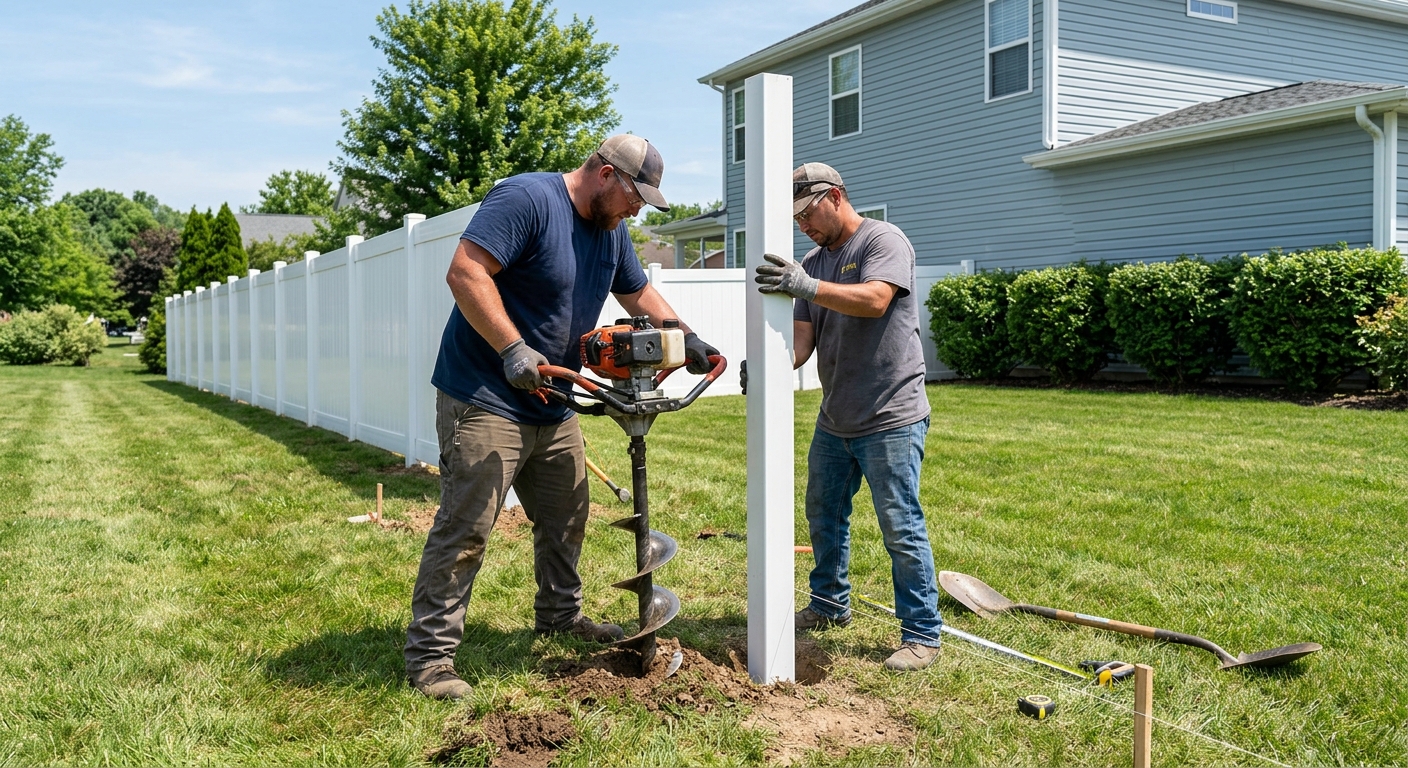
In Nolan Hill, fencing costs are shaped more by ground conditions and structural requirements than by material alone. Calgary’s Prairie continental climate means long freeze–thaw swings: contractors typically set posts about 4 ft (≈120 cm) deep to get below the regional frost line and reduce heaving risk, particularly for 6 ft privacy fences and heavier gate posts. That deeper excavation increases labour and concrete volume. At the same time, open exposure means privacy panels need tighter post spacing and stronger bracing to resist racking.
From what we see on recent builds and renewals, fence work can be especially in demand along newer infill pockets and active development around Nolan Hill Boulevard, where backyards are frequently enclosed for privacy, pets, and wind control. Use the table below to compare typical material options and what they mean for your long-term maintenance and budget.
| Material |
Lifespan |
Maintenance |
Privacy Rating |
Price per Linear Foot |
| Pressure-treated pine (standard wood) |
10–15 years |
Stain/seal every 2–3 years |
High (solid boards) |
$40–$80 |
| Cedar (natural rot resistance) |
15–25 years |
Light staining as needed (often every 3–5 years) |
High (solid boards) |
$55–$95 |
| Vinyl / PVC (no-maintenance) |
20–30 years |
Occasional wash; no staining |
High (privacy styles) |
$45–$90 |
| Chain-link (galvanized steel) |
20–35 years |
Minimal (rinse; occasional tensioning) |
Low (open mesh) |
$25–$55 |
| Aluminum ornamental |
25–40 years |
Minimal (cleaning only) |
Medium (aesthetic spacing) |
$70–$120 |
| Composite / recycled material |
20–30 years |
Low; periodic cleaning |
High (solid panels) |
$60–$110 |
Prices are estimates only and vary by project scope, site access and material selection.
What affects the price of fencing in Nolan Hill
Two homeowners in the Calgary economic region can receive quotes that look wildly different for the “same fence” because fence pricing has a few high-impact variables that contractors price conservatively in a Prairie climate. In Alberta, it’s common to see 30–50% variation between quotes once you include post depth requirements, wind-bracing, gate hardware, and how much work is needed for excavation and disposal. Even small differences—like a backyard that’s hard to access with a trailer, or a fence line crossing a slope—can move the labour and materials dial quickly.
The biggest driver is frost protection. In Nolan Hill and the broader Calgary area, posts are typically set about 4–6 inches below the design frost depth to prevent heaving; that often works out to roughly 1.5–2.0 m of embedment, depending on local soil and design. Deeper holes mean longer posts, more concrete, and more excavation time, which pushes wood and vinyl privacy fences toward the upper portion of their price ranges (for example, wood commonly lands around the mid-to-high end of the $40–$80 band). Wind exposure is the second major factor: open Prairie exposure encourages tighter post spacing and stronger rails, especially for solid wood, cedar, or vinyl privacy panels. By contrast, chain-link is more forgiving in wind because it allows airflow, which is why it tends to price lower—often aligning closer to the $25–$55 band.
Local conditions that commonly raise cost in Nolan Hill include stony or compacted soil that slows excavation, gate locations that require heavier posts and proper bracing, and winterized schedules that affect crew planning. Costs can be lower when you’re reusing existing sound posts, keeping a straight run with minimal corners, or when there’s easy truck access to the fence line. For context, a 6 ft privacy run can be a “buy once” improvement: the extra upfront spend is usually justified because the frost-safe post installation helps the fence stay aligned through freeze–thaw seasons.
| Price Factor |
Why It Matters |
Cost Impact |
| Fence length in linear feet |
Everything scales with length: posts, rails, labour and materials |
Highest direct impact; sets your baseline |
| Post depth required |
Frost line determines embedment, post length, and hole depth |
Can move pricing materially for privacy fences |
| Post setting method |
Concrete vs. gravel pack vs. driven posts changes labour and embedment reliability |
Concrete-setting typically increases cost |
| Material choice |
Vinyl, cedar, and wood require different bracing and hardware; chain-link is lighter |
Shifts you across the $25–$120 bands |
| Gate count and type |
Walk-through vs. drive-through affects post size, hinges, latches and reinforcement |
One gate can add a noticeable premium |
| Grade and terrain |
Slopes require stepping/raking and can increase cutting and rail complexity |
Often adds time and waste |
| Old fence removal and disposal |
Haul-away and demo labour vary by material and condition |
Can add hours and dump fees |
| Permit fees and survey / property line locate |
Ensures compliance and avoids expensive rework |
Varies; can be a one-time add-on |
Permits & regulations in Alberta
In Alberta, permits can be required for fences over certain height thresholds—commonly, fences at the rear around 2.0 m (about 6.5 ft) and higher fences at the front/corner area around 1.0–1.2 m (3–4 ft) may trigger permitting depending on location and specific circumstances. Even when a permit is not required, your fence still must respect property lines and municipal setback requirements. If you’re uncertain, verify with the City of Calgary planning bylaw resources for your Nolan Hill address before you dig.
Before any post holes are dug, arrange utility locates through the appropriate one-call service (in Alberta, use Alberta One-Call). This is essential even for small projects—hitting a buried service can stop your build and create large repair costs.
Also, get a survey or at least a formal locate for your property pins before installing. That step protects you from encroachment disputes with neighbours, especially on corner lots or where landscaping has shifted lines over time.
To check a contractor in Alberta, verify licensing/credentials and documentation in writing. Ask for: (1) proof of Alberta business registration/valid standing for the trade they perform, (2) a current certificate of insurance showing general liability coverage, (3) proof of WSIB/WCB coverage—if they’re required to carry it—and (4) your clearance letter if applicable. You should be able to review these documents before signing a contract; we also recommend confirming coverage dates align with your project start.
Choosing the right fence material for Nolan Hill
Choosing a fence in Nolan Hill is mostly about matching material to your priorities—privacy, low maintenance, and lifespan—while respecting Calgary’s freeze–thaw cycle and wind exposure. Pressure-treated pine is usually the budget-friendly entry point, but it’s not “set and forget.” Expect staining or sealing roughly every 2–3 years to minimize grey weathering and surface checking. Cedar costs more upfront, yet its natural rot resistance and attractive colour help it weather Alberta conditions with less stress on appearance, with maintenance often needed every 3–5 years depending on sun and moisture exposure.
Vinyl/PVC provides true low maintenance, but Alberta’s cold snaps can make installation quality more important: posts and rails must be properly aligned and braced so panels don’t rack. For cost planning, vinyl often sits in the $45–$90 band, while pressure-treated wood commonly lands around the $40–$80 band. Chain-link is the lowest-cost way to define boundaries and keep airflow moving, which helps with wind, but it doesn’t provide real privacy—unless you pair it with slats or privacy mesh. Ornamental aluminum is durable and rust-resistant for years, though you’re buying aesthetics and boundary definition more than privacy.
Because Calgary’s frost line drives post embedment (often around 4 ft deep or similar embedment targets), concrete-set posts are typically the safest choice for privacy fences and gate posts. That structural base usually matters more than material when it comes to long-term alignment through freeze–thaw. For example, spending closer to the mid-upper end of the wood range (around $70/linear foot) can be worth it if your quote includes proper frost-depth post setting and stronger bracing, rather than a cheaper install that skips the heavier hardware.
| Material |
Cold Tolerance |
Lifespan |
Annual Maintenance |
Best For |
Price Band |
| Pressure-treated pine |
Good (with proper staining and quality boards) |
10–15 years |
0–15 minutes check; seal/stain every 2–3 years |
Budget-friendly privacy with colour control |
$40–$80 |
| Cedar |
Very good (natural resistance to rot) |
15–25 years |
Low; stain as needed every 3–5 years |
Attractive privacy fence with less wear |
$55–$95 |
| Vinyl / PVC |
Good (cold-tolerant with correct installation) |
20–30 years |
Wash/inspect as needed (typically seasonal) |
Low maintenance privacy in windy yards |
$45–$90 |
| Chain-link |
Excellent (steel construction; durable) |
20–35 years |
Minimal; periodic rinse |
Security and boundary definition |
$25–$55 |
| Aluminum ornamental |
Excellent (no rust; stable in winter) |
25–40 years |
Minimal cleaning |
Front-yard style and long-term durability |
$70–$120 |
| Composite / recycled |
Good (stable panels; benefits from quality framing) |
20–30 years |
Low; periodic wash |
Privacy with reduced upkeep |
$60–$110 |
How to choose a fencing contractor in Nolan Hill
Picking the right fencing contractor in Nolan Hill is about documentation and clarity, not just the lowest number. First, verify Alberta coverage and compliance: ask for a certificate of insurance (general liability) with dates that cover your installation window, and request proof of WSIB/WCB coverage if they employ workers or subcontractors that are covered under Alberta requirements. If they can’t provide current paperwork immediately, that’s a strong warning sign. For licensing/standing, confirm the contractor’s business registration status and that their trade activity aligns with what they claim to do.
Next, request 2–3 itemised written quotes—separated into labour and materials. You want line items like post material, rails, hardware, concrete/setting method, gate hardware, removal/disposal, and any traffic or access considerations. Avoid “lump sum” quotes that don’t explain what’s included. Carefully read exclusions: is permit pull included (when required), is debris hauling included, and are utility locates arranged?
Warranty matters twice: check workmanship warranty length (for example, how long they stand behind post alignment, panel settling, or hardware adjustments) and confirm the product/manufacturer warranty for materials. Ask if warranties are transferable if you sell your home.
Finally, payment schedule should protect you: never pay more than 10–15% upfront. Hold back a portion until the job is complete and you’ve reviewed final grading and fence alignment. Get a written start date and a completion estimate—fencing schedules can shift with weather in Alberta, so timelines should state what happens if frost conditions delay excavation.
- Ask for proof of insurance and check the coverage dates match your start/end.
- Request WSIB/WCB clearance or proof of coverage where applicable.
- Verify business registration and the contractor’s contact details match the quote.
- Get 2–3 itemised quotes with labour/material/concrete/hardware separated.
- Confirm post embedment depth targets for freeze–thaw protection.
- Ask whether posts are set in concrete and how they’ll manage drainage around footings.
- Clarify gate type, hardware grade, and how double-drive gates are braced.
- Check how they handle slopes: stepped vs. raked panels and who decides the final layout.
- Confirm who orders and pays for utility locates and whether it’s scheduled before digging.
- Ask what’s included for old fence removal and disposal (dumping vs. haul-away limits).
- Confirm if permits and property line locating are included when required.
- Use a payment plan with no more than 10–15% upfront and a holdback until completion.
Red flags we see around Nolan Hill include: quoting a privacy fence with “driven posts” or shallow holes despite Alberta frost conditions, refusing to itemise labour and materials, promising “full warranty” but only covering product parts (not workmanship), requesting full payment upfront, and not providing insurance/coverage documents in advance.
Frequently asked questions — fencing in Nolan Hill
How long does fence installation take in Nolan Hill?
In Nolan Hill, most fence installations take anywhere from 1 to 3 days of on-site work for straightforward runs, assuming access is good and the ground is workable. Longer projects—multiple gates, complex corners, or slope raking—can push into 4 to 7 days, mainly due to excavation and the time required for proper post setting. Calgary’s freeze–thaw season can also affect scheduling: if soil is frozen or saturated, crews may need to adjust the start date to maintain frost-protection embedment quality. If you’re replacing an existing fence, demo and disposal can add time. For planning, share your fence line length and whether you need removal; many homeowners budgeting around mid-range wood pricing (for example, the $40–$80 band) also expect a few extra hours when concrete-setting and gate hardware upgrades are included.
Can I install a fence on a slope in Nolan Hill?
Yes, you can install a fence on a slope in Nolan Hill, and it’s common in the broader Calgary area where yards aren’t perfectly level. The key is how the fence is graded: most solid fences should use stepped panels or a raked layout that keeps the top rail visually straight while respecting the grade. A proper contractor will plan the system so posts are set consistently for frost protection, not “short-cut” by uneven embedment. That matters because even if the fence looks level from the street, uneven footing depth can lead to heaving during freeze–thaw cycles. If you have a steep grade, expect some added labour for measuring, cutting, and fitting; this is one reason quotes can vary within Alberta’s pricing range. A chain-link fence can be easier on slopes, but privacy styles still need a careful layout for a clean finish.
What is the most weather-resistant fence for Nolan Hill's climate?
In Alberta’s Prairie continental climate, the most weather-resistant “all-around” choices tend to be chain-link (galvanized steel) and properly installed aluminum—both resist rot and do well through winter cycles. For privacy, vinyl/PVC and cedar are strong performers when the installation quality includes correct post embedment and bracing for wind. The biggest weather risk in Nolan Hill isn’t only rain or snow—it’s freeze–thaw movement and wind-driven racking. That’s why we recommend concrete-set posts at frost-safe depths for 6 ft privacy fences and gate posts, regardless of whether you choose wood, vinyl, or composite. If you’re comparing budgets, chain-link often falls closer to the $25–$55 per linear foot band, while vinyl commonly sits around the $45–$90 band—so the “most resistant” option also depends on whether you need privacy or just a secure boundary.
How do I prevent wood fence rot in Nolan Hill?
Wood rot prevention in Nolan Hill comes down to three things: good material, good installation, and consistent maintenance. First, use pressure-treated lumber rated for ground contact where required and avoid cutting away treatment at the ends. Second, set posts correctly: frost-safe depth and solid concrete setting for privacy fence posts reduce movement that can trap moisture at joints. Third, manage surface exposure—keep sprinkler spray off the fence line and avoid letting landscaping touch the bottom rails. For your maintenance schedule, staining or sealing every 2–3 years helps slow grey weathering and reduces moisture penetration in the boards. Cedar generally resists rot longer than standard pine, but it still benefits from periodic maintenance. If you see dark streaking, soft boards near the bottom, or leaning posts, address it early—repairing hardware or replacing a few boards is usually far cheaper than full panel replacement.
What is the cost per linear foot for fencing in Nolan Hill?
For Nolan Hill homeowners, installed fencing prices typically follow the broader Calgary market patterns driven by frost-depth post setting and wind loading. Common ranges you’ll see: pressure-treated wood roughly $40–$80 per linear foot, vinyl/PVC around $45–$90, chain-link about $25–$55, and aluminum/metal fences about $70–$120. Final cost depends on height, number of gates, terrain (slopes increase labour for stepping or raking), and whether you need old fence removal and disposal. Because posts usually need to be set deep enough to prevent heaving in Alberta’s freeze–thaw conditions, privacy fences with solid panels often land mid-to-upper range of their material band. If you want a tighter estimate, ask for a quote that breaks out posts, concrete setting method, rails, and gate hardware rather than a single lump sum.
Should I repair or replace my old fence in Nolan Hill?
Repairing is usually best when the posts are sound, the fence line is mostly straight, and damage is limited to a few boards, rails, or minor hardware. Replacement is typically the smarter choice if you have leaning posts from frost heave, multiple sections with rot, significant panel sagging, or widespread separation between rails and posts. In Alberta, a fence can look “fine” from a distance but still be moving at the post level; once post movement is happening, repairs often just buy time. A good contractor will assess post condition, check whether the old embedment was frost-safe, and evaluate hardware wear at gate openings. If your quote shows the incremental cost of replacement is close to the repair cost—especially if gate hardware is due—many homeowners find replacement gives better longevity and a cleaner finish. For budgeting, it’s helpful to compare your repair option against the relevant material band (for example, wood often sits around the $40–$80 per linear foot range).