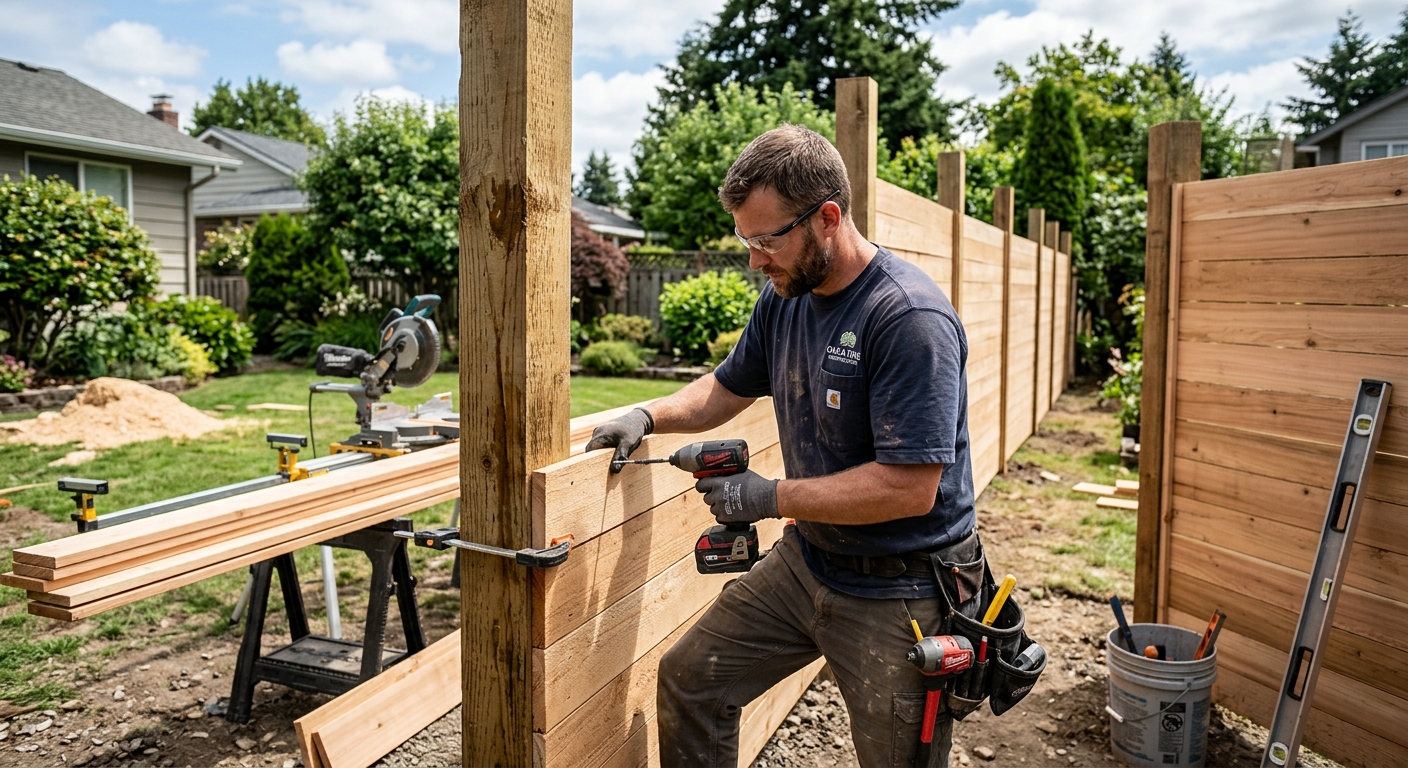
Fencing options and costs in Didsbury
Didsbury is a small community in Alberta where fencing is usually about practical yard boundaries—especially with a lot of single-detached homes (71.7% of dwellings). With 79.0% of households owning their homes (Statistics Canada, 2021 Census), there’s steady demand for privacy upgrades, gate work, and replacement of older runs as homeowners modernize backyards. You’ll notice contractors are busiest in the busier spring-to-early-fall window, and pricing reflects that scheduling pressure.
On the Calgary prairie side of things, costs are driven by climate physics. Freeze–thaw cycles mean post holes need frost protection and deeper embedment; wind loading also matters because open exposure across the region can rack lighter panels. That’s why 6 ft privacy fences often cost more than you’d expect compared with fence types that let wind pass through, like chain-link. In Didsbury areas near established residential pockets such as the downtown-adjacent neighbourhoods and the more mature housing sections (many homes were built before 1981), you’ll also see more “patch-and-match” jobs—removing an old section, then rebuilding to suit existing grades and alignment. Those scenarios typically take more labour than building straight line, new yard work.
Below are realistic Didsbury price ranges and performance expectations, followed by a quick note on what changes the final number.
| Material |
Lifespan |
Maintenance |
Privacy Rating |
Price per Linear Foot |
Price per Linear Foot (Range) |
| Pressure-treated pine (standard wood) |
10–15 years |
Stain/seal every 2–3 years; replace rotted rails/stiles as needed |
High (solid panels) |
$40–$70 |
$40–$70 |
| Cedar (natural rot resistance) |
15–25 years |
Light re-staining as required; inspect fasteners and bottom rails |
High (solid panels) |
$55–$80 |
$55–$80 |
| Vinyl / PVC (no-maintenance) |
20–30 years |
Rinse/clean as needed; occasional hardware checks |
High (solid privacy styles) |
$50–$90 |
$50–$90 |
| Chain-link (galvanized steel) |
25–40 years |
Minimal; rinse salt/dust and tighten hardware occasionally |
Low to medium (airflow; visibility varies) |
$25–$55 |
$25–$55 |
| Aluminum ornamental |
25–40 years |
Wash and inspect annually; repaint only if damaged |
Low to medium (decorative pickets) |
$70–$120 |
$70–$120 |
| Composite / recycled material |
20–30 years |
Low; clean and check posts/hardware |
High (solid styles) |
$60–$95 |
$60–$95 |
Prices are estimates only and vary by project scope, site access and material selection.
What affects the price of fencing in Didsbury
In Didsbury and across the Calgary economic region, quotes for what seems like the “same” fence can swing by roughly 30–50% because the real drivers are hidden in the site conditions: how long the fence is, how deep the posts must be set, how many gates you’re adding, and whether the contractor needs extra labour for removal, disposal, and grade changes. A straight run in a flat backyard is very different from a stepped privacy fence following a slope, or a job that requires careful line-matching to an older property boundary.
Most of the price variance comes from frost protection and wind loading. Calgary’s prairie freeze–thaw cycles typically require posts to be set about 4 ft (≈120 cm) deep so the base sits below the regional frost line; contractors also follow the “embedment into undisturbed soil” practice, meaning holes are often deeper than you’d see in milder parts of Canada. That depth increases excavation time, concrete volume, and labour—especially for 6 ft privacy fences where the panels catch more wind and must resist racking. In colder Alberta conditions, the extra post length and concrete setting can push total labour costs up compared to lighter systems; that’s one reason vinyl and wood privacy fences often land in the mid–upper ranges (for example, wood commonly sits around $40–$70 per linear foot, while vinyl privacy is often closer to $50–$90).
Two local examples you’ll see in Didsbury: (1) a backyard with clay-heavy soil often needs more excavation time and careful concrete placement, raising costs; (2) tight access near older homes—like narrow side yards—can require additional labour and equipment time, even if the linear footage is the same. Meanwhile, simple chain-link runs on a gently graded lot can come in near the lower band because airflow reduces wind forces and post spacing can be more forgiving (often around $25–$55 per linear foot). Housing age matters too: with many homes built before 1981 (43.8% in the area, Statistics Canada, 2021 Census), you may encounter older foundations, buried remnants, or mismatched fence lines that add time.
| Price Factor |
Why It Matters |
Cost Impact |
| Fence length in linear feet |
The longer the run, the more posts, rails, and labour time are required. |
Very high (primary driver) |
| Post depth required |
Frost line conditions determine how deep posts must be set to prevent heaving. |
High (deep holes + extra materials) |
| Post setting method |
Concrete setting typically stabilizes posts in wind and freeze–thaw cycles. |
Medium to high (concrete time/volume) |
| Material choice |
Vinyl/wood privacy panels catch wind; chain-link allows airflow. |
Medium (shifts you across price bands) |
| Gate count and type |
Drive-through double gates require stronger hardware and more bracing. |
High (adds framing + labour) |
| Grade and terrain |
Slope may require stepping/raking panels or extra hardware adjustments. |
Medium to high |
| Old fence removal and disposal |
Demolition, haul-away, and handling old fasteners/remnants takes time. |
Medium (often overlooked) |
| Permit fees and survey / property line locate |
Locates and any required approvals help avoid line disputes and rework. |
Low to medium (project dependent) |
Permits & regulations in Alberta
In Alberta, fences above typical height thresholds often trigger a permit requirement—commonly around 2.0 m (6.5 ft) for rear fencing and about 1.0–1.2 m (3–4 ft) for front or corner areas. Exact local thresholds can vary by municipality and location, but the key homeowner takeaway for Didsbury is: if you’re planning a tall privacy fence along a front/corner line, assume you may need a permit and confirm before digging. All fences must be built within your property line and respect municipal setback bylaws.
Before any post holes are dug, utility locates are non-negotiable. In Alberta, homeowners and contractors should call for utility marking through Alberta One-Call so that underground services are clearly identified. If you don’t have accurate reference points, obtain a survey or at minimum a locate of your property pins—especially if you’re replacing an older fence that may not be perfectly aligned. This helps prevent encroachment disputes with neighbours.
Shared fences are also governed by provincial line-fences legislation, so clarify who maintains which portion (and whether replacement costs are shared) before ordering materials. Typically, standard backyard low fences that don’t exceed height thresholds and don’t affect setbacks may not need a permit, but anything tall (or on a front/corner line) commonly does.
To verify a contractor is properly set up in Alberta, ask for: (1) your contractor’s Alberta business licence/registration details, (2) proof of general liability insurance and the policy showing fencing-related work, (3) WSIB/WCB coverage confirmation (where applicable). Check these by reviewing their certificate of insurance directly (and its coverage dates), then cross-referencing licensing/registration in the appropriate online registry, and requesting a clearance letter or account confirmation if they operate through an organization.
Choosing the right fence material for Didsbury
Choosing a fence in Didsbury comes down to matching the material to your priorities: privacy, low maintenance, upfront budget, and expected lifespan in Alberta’s freeze–thaw and wind conditions. With Calgary-area prairie exposure, the biggest performance issue is not just rot—it’s structural stability during freeze cycles and wind racking. That’s why post depth and anchoring matter as much as the board or panel material.
Pressure-treated pine is the budget-friendly choice, but it typically requires staining or sealing every 2–3 years to slow grey weathering and protect rail surfaces. Cedar resists rot better and usually looks more natural, but it still benefits from periodic maintenance, particularly along the bottom rails where moisture sits longer. Vinyl/PVC offers low maintenance and strong privacy options, but extremely cold snaps can make it more brittle if hardware and installation details aren’t done correctly. Chain-link is typically the lowest-cost and longest-lasting option because airflow reduces wind load; it’s ideal if you want security more than privacy. Aluminum ornamental provides a rust-free look and longevity, but it won’t give high privacy without adding privacy infill or choosing a more solid design. Composite/recycled boards can deliver solid privacy with good colour stability, but they’re not always the cheapest.
For Calgary-region frost protection, posts generally need deep embedment (often about 4 ft/≈120 cm) and commonly concrete-set footings for privacy fences and gate posts. If you’re comparing options, the “extra” cost is usually justified when you’re preventing future leaning and repairs. For example, if a pressure-treated wood privacy fence may land around $40–$70 per linear foot, while vinyl privacy may land around $50–$90, the added cost often makes sense when you want fewer maintenance visits across the long Alberta winters and you plan to stay put.
| Material |
Cold Tolerance |
Lifespan |
Annual Maintenance |
Best For |
Price Band |
| Pressure-treated pine |
Good with proper staining and hardware |
10–15 years |
Inspect and spot-seal; plan a stain cycle every 2–3 years |
Lowest upfront cost for a privacy fence |
$40–$70 |
| Cedar |
Good; performs well in wet/dry cycles when installed correctly |
15–25 years |
Light re-staining as needed; check bottom rails |
Natural look with better rot resistance |
$55–$80 |
| Vinyl / PVC |
Very good if installed with correct expansion/hardware |
20–30 years |
Minimal cleaning; periodic hardware checks |
Low-maintenance privacy |
$50–$90 |
| Chain-link |
Excellent; resilient against cold and wind |
25–40 years |
Very low (tighten/tidy as needed) |
Security, pet containment, longer service life |
$25–$55 |
| Aluminum ornamental |
Excellent (non-rusting) |
25–40 years |
Occasional wash and inspection |
Front-yard appearance with durable construction |
$70–$120 |
| Composite / recycled |
Good with correct post anchoring and spacing |
20–30 years |
Low (cleaning and hardware inspection) |
Solid look with reduced maintenance |
$60–$95 |
How to choose a fencing contractor in Didsbury
In Didsbury, it’s not enough to pick the lowest bid—you want a fencing contractor who builds for frost depth, wind bracing, and clean line work. Start by verifying Alberta coverage and credentials. Ask for their Alberta business licence/registration details and confirm they carry general liability insurance; request a certificate of insurance showing active coverage and that fencing construction is included. Next, confirm WSIB/WCB coverage where applicable—ask for the account status/clearance details rather than a verbal promise. If anything is unclear, pause and ask for updated documents before you commit. A contractor who can’t provide paperwork quickly is a risk when you’re paying for deep-set posts and gate hardware.
Then get 2–3 itemised written quotes. A solid fence quote should separate labour and materials (posts, rails, pickets/panels, hardware, concrete, and gate components). Watch for exclusions: is permit pull included where required, is old fence removal/disposal included, and are utility locate costs accounted for? Ask for the post depth and setting method in writing—especially for privacy panels in the Calgary prairie freeze–thaw cycle.
Warranty also matters. Confirm the workmanship warranty length, whether the product/manufacturer warranty applies to the exact materials used, and whether it’s transferable if you sell your home. For payment schedule, never pay more than 10–15% upfront; hold back until the job is complete and gates operate properly. Finally, insist on a start date and completion estimate in writing so you can plan around weather windows.
- Provide proof of Alberta registration/licence and date-stamped documentation.
- Share a current certificate of general liability insurance.
- Confirm WSIB/WCB coverage (account status or clearance letter) for workers.
- Use an itemised quote (materials vs labour), not a single lump-sum.
- State post depth (and whether posts are concreted) for privacy and gate posts.
- Include gate hardware brand/model and hinge/latch type in the quote.
- Confirm how slopes are handled (stepped vs raked) and how panels will be measured.
- Explain line-setting: who locates pins and how they confirm property boundary.
- Clarify utility locate responsibility and timing (Alberta One-Call marks).
- State whether old fence removal and dump fees are included.
- List warranty terms for both labour workmanship and materials separately.
- Keep payment staged: small deposit only, then progress payments with a final holdback.
Red flags I often see in Didsbury include: contractors who won’t put post depth in writing, vague quotes that don’t separate labour/materials, only accepting large upfront deposits, refusing to show insurance/coverage documents, and starting excavation without confirming utility locates or property line references.
Frequently asked questions — fencing in Didsbury
How long does fence installation take in Didsbury?
For most typical Didsbury residential jobs, installation is often measured in days rather than weeks. A straight, mid-size run with standard gates can commonly be completed within 2–4 working days once materials are staged and utility marking is done. The schedule depends heavily on post setting (deep frost-protected embedment, often about 4 ft/≈120 cm) and whether concrete is used for privacy panels and gate posts. If your yard is sloped, or if the job includes old fence removal and careful line alignment near property pins, expect additional time for layout and patch-and-match work. If you’re comparing quotes, ask each contractor how they plan the excavation, setting, and panel mounting steps—and what changes the timeline most.
Can I install a fence on a slope in Didsbury?
Yes—most fences can be installed on a slope in Didsbury, but the details matter for both appearance and strength. Contractors typically handle slopes by stepping panels (stair-stepping at set intervals) or raking panels to follow the grade while keeping the top line straight. Stepped installation is often more consistent with privacy fences because wind loading can stress uneven rails if panels are stretched between posts. The quote should specify which method will be used and how much variation is allowed before braces are needed. Also, deep-set posts are still required for frost protection on prairie soils—so the hole depth may change to match the grade while still keeping bases below the frost line. For accurate pricing, confirm whether your slope needs extra material or extra bracing.
What is the most weather-resistant fence for Didsbury's climate?
In Alberta’s freeze–thaw prairie climate, “most weather-resistant” depends on whether you mean rot resistance, wind stability, or low maintenance. Chain-link is often extremely durable because airflow reduces wind racking, and galvanized steel performs well through cold seasons; many Calgary-region projects land in the lower-to-mid cost band around $25–$55 per linear foot. For homeowners prioritizing privacy with long service life, vinyl/PVC can be very resilient and low maintenance if installed with correct hardware and expansion details—often around $50–$90 per linear foot. Wood can be weather-resistant too, especially with cedar, but it’s more sensitive to maintenance intervals and how well bottom rails are protected. Whatever you choose, ensure posts are set with frost protection and that gate posts get upgraded bracing.
How do I prevent wood fence rot in Didsbury?
Wood rot prevention is mostly about keeping water away from high-risk areas and making sure your fence is installed for Alberta winters. First, use proper pressure-treated or cedar rated for exterior use, and make sure boards are fastened with corrosion-resistant hardware. Second, protect the bottom of the fence: rot often starts at rails and pickets near the ground where snowmelt and water linger. Good contractors also ensure posts are deeply embedded below the frost line (often around 4 ft/≈120 cm) and set securely so the fence doesn’t heave and create gaps that trap moisture. Third, plan maintenance: staining or sealing every 2–3 years for pressure-treated pine is typical. Finally, ask about ventilation gaps and how panels are spaced—solid, well-built sections last longer because they move structurally as one system in wind.
What is the cost per linear foot for fencing in Didsbury?
In Didsbury, fencing costs commonly align with the Calgary region’s installed price bands, but the final number depends on height, material, terrain, and how deep posts must be set for frost protection. As a practical reference, chain-link often comes in around $25–$55 per linear foot, while pressure-treated wood privacy fences are frequently closer to $40–$70 per linear foot. Vinyl/PVC privacy projects are commonly in the mid-to-upper range around $50–$90 per linear foot, and aluminum ornamental can be higher, often around $70–$120 per linear foot. If you’re comparing quotes, check whether they include concrete footings, gate framing, removal/disposal, and utility locate timing—those details can swing the per-foot result a lot.
Should I repair or replace my old fence in Didsbury?
Often you can repair if the posts are still solid, the fence line hasn’t lifted or heaved, and the damage is limited to rails or a few panels. In Didsbury, though, older fences—especially those installed before many homeowners upgraded maintenance practices—can fail at the base first. If the fence has leaning sections from wind racking, widespread rot at bottom rails, or multiple posts that have shifted after freeze–thaw, replacement is usually the safer long-term choice. A repair might be best for a small localized area or when only one section is compromised and the rest is structurally sound. To decide, ask the contractor to assess: post plumb/strength, concrete condition where used, gate alignment, and the extent of rotted wood. If you’re close to the “replacement stage,” compare overall cost: repairs can add up quickly, especially when deep-set post replacement is required.