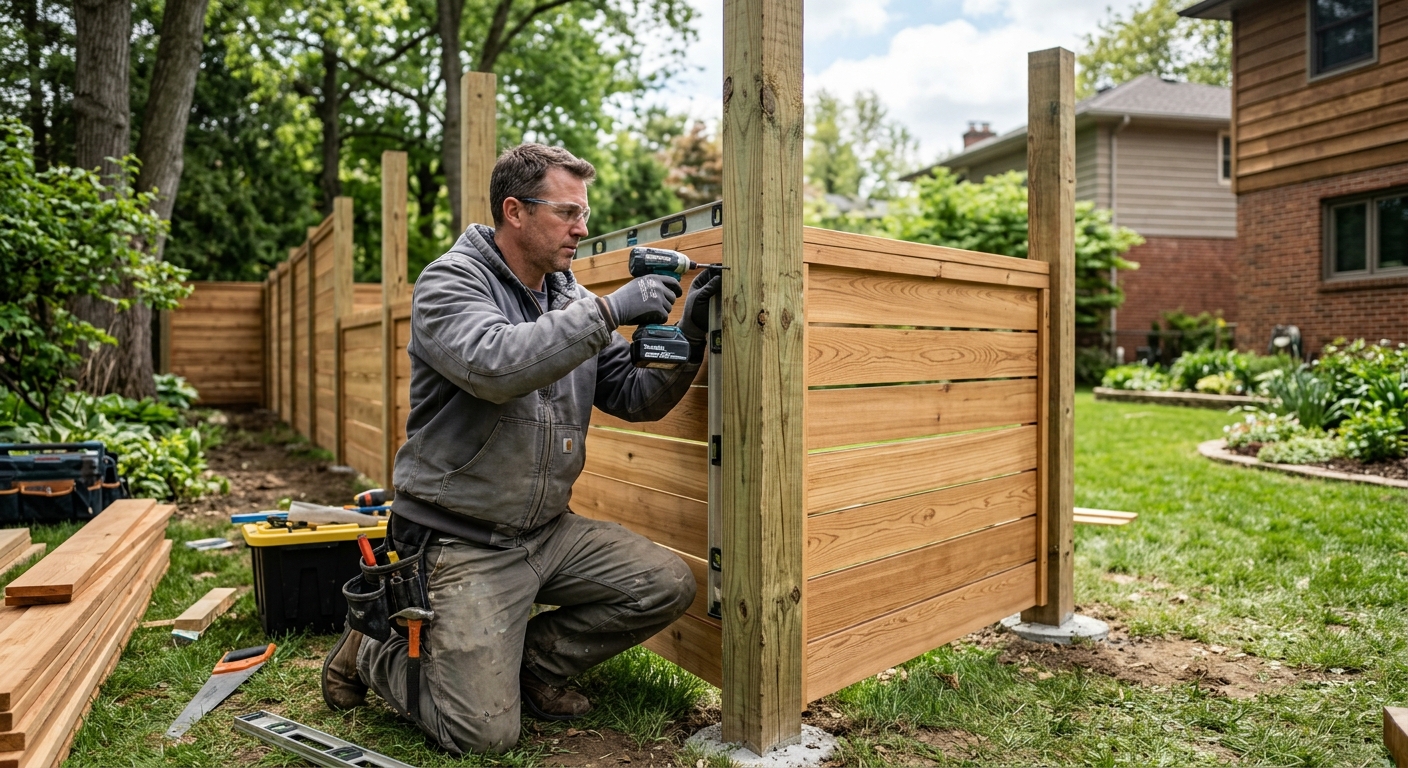
Fencing options and costs in Pump Hill
Pump Hill homeowners typically start their fencing search with privacy, curb appeal, and keeping maintenance reasonable—then quickly land on the reality that Calgary-area freeze–thaw cycles and wind exposure change both materials and installation details. With a local population of 1,455 (Statistics Canada, 2021 Census), demand is concentrated around the many single-family households that need side and back boundaries protected, especially as new yards get landscaped. In the Calgary economic region, long winters and repeated heaving/frost movement mean contractors plan deeper, more engineered post footings than you’d see in milder parts of Canada. That’s one reason a “simple” fence can price higher than expected.
In Pump Hill—particularly near established residential clusters and along the busiest access routes—fencing is in especially high demand where backyards face open prairie exposure. Solid wood and vinyl privacy fences (6 ft/1.8 m class) are built to resist racking, so they usually involve closer post spacing and fully concreted posts. Chain-link is often the budget-friendly alternative where airflow matters, while ornamental aluminum typically lands at the premium end due to hardware and finishing.
Below are realistic cost ranges per linear foot for common options in Pump Hill, using the Calgary market band as our baseline. From there, you can narrow choices by maintenance tolerance and how much privacy you want.
| Material |
Lifespan |
Maintenance |
Privacy Rating |
Price per Linear Foot |
| Pressure-treated pine (standard wood) |
15–25 years |
Stain/seal every 2–3 years; inspect posts after spring thaws |
Good (solid panels) |
$40 – $80 |
| Cedar (natural rot resistance) |
20–30 years |
Light staining/finishing every 2–4 years; check for wind-driven wear |
Very good (solid panels) |
$55 – $95 |
| Vinyl / PVC (no-maintenance) |
25–35 years |
Rinse annually; avoid impacts from snow/ice buildup |
Very good (solid styles) |
$45 – $90 |
| Chain-link (galvanized steel) |
20–40 years |
Occasional rinse; replace damaged ties/sections |
Low–moderate (airflow, not privacy) |
$25 – $55 |
| Aluminum ornamental |
25–40 years |
Wash as needed; check gate hardware |
Low–moderate (decorative pickets) |
$70 – $120 |
| Composite / recycled material |
25–35 years |
Minimal (wash down); avoid sharp-point impacts |
Good (solid looks) |
$65 – $110 |
Prices are estimates only and vary by project scope, site access and material selection.
What affects the price of fencing in Pump Hill
In Pump Hill and across the wider Calgary economic region, two identical-looking fence jobs can land 30–50% apart. The difference usually isn’t the “face material”—it’s what’s required underneath: frost protection, wind-load engineering, and how much labour it takes to set posts correctly. Here, post holes are planned deep because the regional freeze–thaw cycle is intense; that often means excavating and concreting below the frost line rather than relying on shallow gravel packs. Contractors also build for prairie wind: solid wood or vinyl needs sturdier framing and closer spacing so panels don’t rack, while chain-link is lighter and more forgiving.
To put the frost-line impact into real numbers, a privacy fence with 6 ft panels often pushes you from “standard” wood pricing into the mid-upper band (for example, wood/baseline can sit around $40 – $80 per linear foot depending on layout, but a more engineered section with concrete footings and heavier rails can climb within that range). Conversely, chain-link can stay nearer the lower end (around $25 – $55 per linear foot) because it’s more airflow-friendly and typically easier to align and tension.
Three Pump Hill examples that commonly raise cost: (1) longer runs that require more deep-set posts—each extra foot of excavation and concrete volume adds up; (2) gate-heavy designs (two large drive gates) that require reinforced hardware and bigger gate posts; and (3) yards with curbside access limitations or muddy spring ground, which can increase labour and equipment time. A lower-cost scenario usually occurs when the site is flat, gate counts are minimal, and the homeowner chooses chain-link or a lighter ornamental style where wind load is handled with less mass.
| Price Factor |
Why It Matters |
Cost Impact |
| Fence length in linear feet |
Every foot needs posts, rails, and materials |
Highest driver; longer runs can increase total project by hundreds quickly |
| Post depth required |
Frost line determines hole depth and post length to prevent heaving |
Deep-set posts add excavation time and concrete; can materially increase labour and material cost |
| Post setting method |
Concrete vs. gravel pack vs. driven posts changes stability in freeze–thaw |
Concrete setting typically raises cost vs. lighter methods but improves longevity in Alberta winters |
| Material choice |
Heavier privacy materials resist wind differently than lighter systems |
Vinyl/cedar often mid–upper; chain-link lower–mid; aluminum ornamental top end |
| Gate count and type |
Drive-through gates and wider walk gates need reinforced framing |
Each additional gate can add significant cost, often more than many homeowners expect |
| Grade and terrain |
Slopes require stepping/racking panels and more precise layout |
Stepped builds add labour and sometimes extra hardware/fittings |
| Old fence removal and disposal |
Dismantling, haul-away, and disposal drive additional time and equipment |
Can add a noticeable line item depending on condition and access |
| Permit fees and survey / property line locate |
Required documentation prevents encroachment disputes |
Often minor relative to fence cost, but can still shift the total and scheduling |
Permits & regulations in Alberta
In Alberta, fence rules are primarily about height limits, placement on or near property lines, and municipal setback requirements. As a practical homeowner guideline in many areas around Calgary (including Pump Hill), fences above a typical threshold—often around 2.0 m (6.5 ft) at the rear and about 1.0–1.2 m (3–4 ft) at the front/corner—may require a building permit. Even when a permit isn’t triggered, you still need to respect property lines and any municipal fencing setbacks.
Before digging any post hole, call for utility locates through Alberta One-Call to mark buried services. Next, get a survey or a property-pin locate so you know where your boundary actually is; this is the safest way to avoid encroachment disputes with neighbours, especially on older lots or where iron/wood posts may have shifted over time.
Shared fence ownership and maintenance responsibilities are governed by Alberta line-fences principles, so confirm who maintains what if you’re replacing an existing fence that borders a neighbour.
Contractor verification you can do quickly: ask for the company’s Alberta business/contractor registration details (if applicable), then check liability insurance by requesting a certificate of insurance showing you as an additional insured where possible. For workers on site, confirm they carry current WCB/WSIB-equivalent coverage documentation and won’t subcontract labour without coverage. If a clearance letter or proof of coverage is available, request it before work starts. Finally, ensure the scope clearly states whether permit pulls (if required) are included in the quote.
Choosing the right fence material for Pump Hill
Choosing the “right” fence in Pump Hill usually comes down to matching material performance to Alberta winters: freeze–thaw cycles, wind, and snow/ice impacts. Pressure-treated pine is the budget option and installs easily, but it needs staining or sealing about every 2–3 years to avoid grey weathering and to protect the wood in wet-spring conditions. Cedar looks better longer because of its natural rot resistance, but it still benefits from periodic finishing and careful inspection of posts after spring thaws.
Vinyl/PVC is popular for low maintenance—no staining—but the tradeoff is higher upfront cost and the need to handle cold-weather installation correctly. Chain-link remains the lowest-cost option and tends to last well (no privacy, though), which makes it a good perimeter solution where you want security and airflow. Ornamental aluminum is a mid-to-premium choice: it doesn’t rust and provides a clean, modern look, but it’s not truly private unless you combine it with landscaping or privacy inserts.
Because Calgary-region frost protection is a major cost driver, post depth matters more than people expect. For privacy fences, posts are typically set around the 4 ft (≈120 cm) depth range to sit below the regional frost line, with concrete footings especially common for 6 ft privacy styles and gate posts. In practice, that means even a vinyl fence won’t be “cheap” if it needs deep-set concrete posts and strong rails to resist racking. If you’re comparing options: moving from chain-link (~$25 – $55/linear foot) to a solid wood privacy fence (~$40 – $80/linear foot) is usually justified when privacy matters and you’re already paying for deep post installs—airflow-friendly chain-link may simply not solve the privacy problem.
| Material |
Cold Tolerance |
Lifespan |
Annual Maintenance |
Best For |
Price Band |
| Pressure-treated pine |
Good (with proper sealing and post-depth) |
15–25 years |
Inspect; minor touch-ups; stain/seal every 2–3 years |
Budget privacy with natural look |
$40 – $80 |
| Cedar |
Good (stable framing reduces warping) |
20–30 years |
Light finish every 2–4 years; check wind wear |
Appearance-focused privacy |
$55 – $95 |
| Vinyl / PVC |
Good (avoid impacts; correct expansion planning) |
25–35 years |
Rinse as needed; check joints after extreme cold |
Low maintenance privacy |
$45 – $90 |
| Chain-link |
Excellent (corrosion resistance when galvanized) |
20–40 years |
Occasional rinse; replace damaged ties/sections |
Security and long-term value |
$25 – $55 |
| Aluminum ornamental |
Excellent (painted powder coat) |
25–40 years |
Wash; inspect gate hardware |
Curbs appeal without rust |
$70 – $120 |
| Composite / recycled |
Good (designed for freeze–thaw) |
25–35 years |
Minimal washing; check for impacts |
Low maintenance with modern style |
$65 – $110 |
How to choose a fencing contractor in Pump Hill
When you’re hiring a fencing contractor in Pump Hill, verify three things before signing anything: licensing/registration where applicable, liability insurance, and workplace coverage (WCB/WCB-equivalent). Ask the contractor for their certificate of insurance and check that it’s current, covers fencing work (including excavation and gate installs), and lists your address or property as an additional insured where possible. For workplace coverage, request proof of WCB/WCB-equivalent coverage and ensure subcontractors are covered as well.
Then request 2–3 itemised written quotes—not lump sums. A strong quote separates labour, concrete/post setting, gates, hardware, removal/disposal, and material specs (including rail/board thickness where relevant). Read what’s excluded: is permit assistance included, is rock removal included, and does disposal of the old fence fall under the scope? Because Calgary-area frost protection is a major driver, insist the quote clearly states post depth and setting method (concrete vs. other).
Warranty matters too. Ask for the workmanship warranty length and whether it’s transferable if you sell your home. Confirm product/manufacturer warranty covers rails/panels as applicable, and ask how they handle damage from wind events or impacts (snow/ice can strike lower rails in Alberta). Payment schedule should protect you: never pay more than 10–15% upfront, and hold back the remainder until the job is complete and cleaned up.
Finally, lock in the schedule: get a written start date and a realistic completion estimate, including weather contingencies for excavation and concrete curing.
- Request a written, itemised quote (labour, materials, concrete, gates, hardware).
- Confirm the planned post depth and setting method in writing (frost-focused).
- Ask whether rock/solid soil removal is included if excavation is harder than expected.
- Verify liability insurance is current and appropriate for fencing work.
- Provide proof of WCB/WCB-equivalent coverage for workers on site.
- Get the warranty terms for workmanship and the manufacturer/product (and whether transferable).
- Confirm gate reinforcement details (especially for drive gates and wider openings).
- Check scope includes property line locate/survey coordination or states it as an add-on.
- Ask if permit pulls are included where required and who’s responsible for the paperwork.
- Require disposal/removal of the old fence if you’re replacing an existing run.
- Ensure the quote lists height, total linear footage, and any stepped/racked sections on slopes.
- Agree on a payment schedule (10–15% upfront max; holdback until final walk-through).
Concrete red flags I’ve seen in Pump Hill: quoting a “one-size-fits-all” post depth without discussing frost protection; refusing to provide insurance/WCB proof; offering only a lump-sum without a breakdown of gates, concrete, or disposal; starting work without confirming property line responsibility; and asking for large upfront payments well beyond 10–15%.
Frequently asked questions — fencing in Pump Hill
How tall can my fence be in Pump Hill?
In Pump Hill, fence height rules are tied to where the fence sits (rear vs. front/corner) and local municipal setback requirements. A common Alberta guideline homeowners run into is that taller fences—often around 2.0 m (6.5 ft) at the rear—may require a building permit, while front/corner fences are often limited closer to roughly 1.0–1.2 m (3–4 ft), depending on the specific location and bylaw wording. The safe approach is to confirm your property’s zoning and the fence position relative to setbacks before you order materials. If your contractor is experienced in Calgary-area permitting, they should tell you whether the proposed height and placement are likely to trigger a permit and include that step (or clearly state it’s your responsibility) in the written scope.
Should fence posts be set in concrete here?
For many Pump Hill privacy fences, yes—concrete-set posts are strongly common because Calgary’s freeze–thaw cycles can cause heaving if posts aren’t placed below the regional frost influence. In the Calgary area, guidance is often to set posts about 4 ft (≈120 cm) deep and use concrete footings for 6 ft privacy panels and especially for gate posts. Concrete adds cost and labour, but it’s one of the biggest reasons fences stay straight after spring thaws and winter expansion. If you’re comparing options, remember that the “per linear foot” range changes with post method: chain-link can stay closer to the lower end (about $25–$55/linear foot), while wood/vinyl privacy fences often sit in the mid-to-upper range (about $40–$80/linear foot for wood, and roughly $45–$90/linear foot for vinyl/PVC) partly because post setting is more intensive.
What's the best fence for privacy?
For privacy in Pump Hill, you’ll usually get the best results with solid-panel styles: wood (pressure-treated pine or cedar), vinyl/PVC privacy boards, or composite privacy panels. These systems limit sightlines and also cope well with prairie wind when they’re built with proper rails, closer post spacing, and deep-set footings. Cedar often looks premium, while pressure-treated pine is the budget-friendly route—though it needs staining every 2–3 years to prevent weathering. Vinyl/PVC is a good fit if you want minimal upkeep, but it can be more expensive upfront. If your goal is privacy plus long-term stability in Alberta’s freeze–thaw, you’re typically paying for the engineered base as much as the finish: a well-installed 6 ft wood privacy fence commonly lands around $40–$80 per linear foot, while vinyl privacy commonly sits around $45–$90 per linear foot, depending on access, gate count, and terrain.
How do I compare fencing quotes?
To compare quotes fairly in Pump Hill, make sure each bid includes the same scope and the same installation details. Look for: exact linear footage, fence height, material grade, post depth, and whether posts are concreted or set via another method. Confirm how gates are priced (walk-through vs. drive-through double gates) and whether hardware/hinges/latches are included. Also compare what’s excluded—permit assistance, old fence removal and disposal, and any rock/solid-ground excavation. Ask for an itemised labour + materials breakdown rather than a lump sum. Finally, check warranty terms: workmanship warranty length and whether the manufacturer warranty covers the specific components you’re buying. Two contractors can both quote within a similar band (for example, wood privacy around $40–$80 per linear foot), yet one may be skipping concrete setting or using different post depth, which is exactly where problems start after Alberta winters.
How long does fence installation take in Pump Hill?
Typical timelines in Pump Hill depend on linear footage, gate count, and how hard the excavation is after winter freeze. For many residential jobs, crews can install a standard run within a day or two once materials arrive, but deeper post holes, concrete curing time, and any slope-stepped layout can stretch the schedule. If your project includes 6 ft privacy panels with concrete-set posts and one or more gates, plan for at least a couple of working days for fabrication and set-up, plus concrete curing time before final tightening/alignment. If you’re removing an old fence, that adds time for dismantling and haul-away. Ask the contractor for a written start date and completion estimate, including how they’ll handle weather interruptions during excavation and concrete work.
Can I install a fence on a slope in Pump Hill?
Yes—you can install a fence on a slope in Pump Hill, but the details matter. Contractors typically use stepped panels (where each section changes height in increments) or raked layouts that follow the grade more smoothly. Stepping is usually more consistent for privacy fences, while raking can be workable for certain materials if the top rail and pickets/boards align properly. Expect more labour in layout and more fittings/hardware than a flat yard, because every post height and rail level needs careful measurement. On sloped ground, deep-set posts are still important for frost protection; the depth to the correct footing level doesn’t change just because the grade changes. That’s why quotes can vary even when “total linear feet” looks the same—slope work changes the labour and sometimes the material cutting/waste.