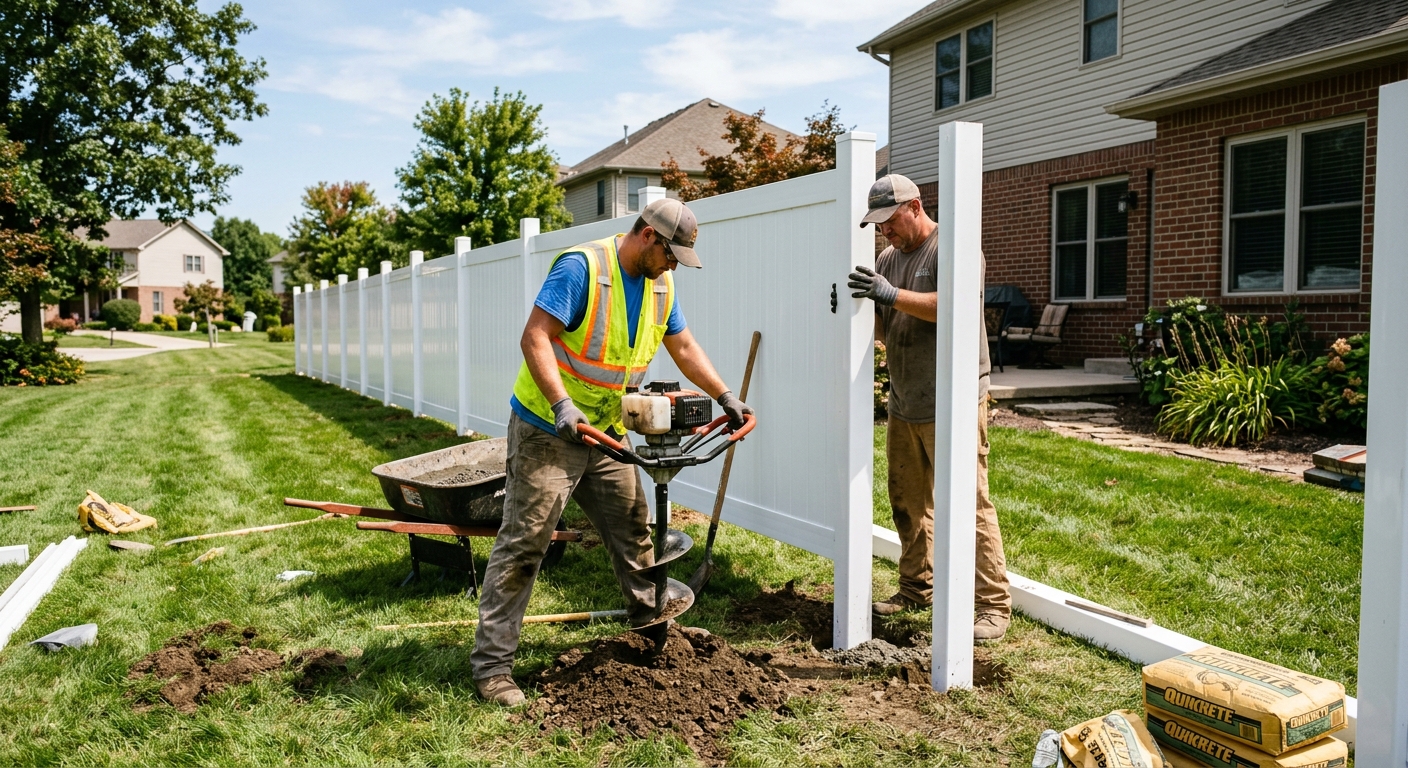
Fencing options and costs in Wembley
In Wembley, Alberta, fencing choices usually start with one practical question: do you want privacy, or do you mainly want boundary definition? With an owner-homeward profile where 84.5% of households own their homes (Statistics Canada, 2021 Census), demand tends to cluster around single-detached properties—80.0% of local dwellings—because homeowners are more likely to invest in longer-term upgrades like new panels, upgraded gates, and post reinforcement. That matters because most yards in areas such as the residential core around Railway Avenue see recurring fence work as owners replace older runs and address leaning sections.
Pricing in the Athabasca–Grande Prairie–Peace River economic region is strongly shaped by cold and exposure. In this part of Alberta, frost routinely forces posts deeper—typically setting roughly 4–6 feet below grade depending on conditions—so excavating is slower and contractors often add concrete setting to reduce heave and sag over freeze–thaw cycles. Prairie winds also influence material choice: heavier privacy systems (wood or vinyl) perform best with tighter post spacing and more robust hardware, while open styles (like chain-link) span more easily between posts with fewer structural supports. Local labour availability can shift pricing too, especially when crews are coordinating installs across rural road access, rock/hardpan pockets, and winter schedule constraints. As a result, a fence that’s “the same length” on paper can land at the low or high end of the region’s typical bands.
Use the comparison below as a starting point for budgeting before you request an itemised quote for your exact layout.
| Material |
Lifespan |
Maintenance |
Privacy Rating |
Price per Linear Foot |
| Pressure-treated pine (standard wood) |
10–15 years |
Stain/seal every 2–3 years; tighten hardware as needed |
High (good solid coverage) |
$35 – $70 |
| Cedar (natural rot resistance) |
15–25 years |
Light sealing/cleaning every 2–4 years (grey weathering control) |
High (solid boards) |
$45 – $85 |
| Vinyl / PVC (no-maintenance) |
20–30 years |
Occasional wash; check for panel/rail alignment in extreme cold |
High (board-style privacy) |
$40 – $80 |
| Chain-link (galvanized steel) |
20–35 years |
Minimal; occasional tension/repairs after impacts |
Low to Medium (open mesh) |
$25 – $50 |
| Aluminum ornamental |
25–40 years |
Wash; inspect hinges/spacers annually |
Low to Medium (decorative pickets) |
$45 – $90 |
| Composite / recycled material |
20–30 years |
Rinse seasonally; minor spot repairs if damaged |
High (board-style) |
$60 – $110 |
Prices are estimates only and vary by project scope, site access and material selection.
What affects the price of fencing in Wembley
In Wembley and the broader Athabasca–Grande Prairie–Peace River region, two identical-looking fence requests can easily diverge by 30–50% once you account for frost depth, wind exposure, ground conditions and how posts are set. Some bids come in closer to the lower region bands (for example, chain-link at roughly $25–$50 per linear foot), while privacy fences can land toward the upper ends (wood often runs $35–$70, and cedar/vinyl can push higher) depending on whether crews need extra concrete, longer posts, and more labour time. Where the market shifts most is not just material—it’s excavation and installation method in cold, sometimes rocky soil.
First, the frost line depth is the biggest driver. In this climate, contractors typically set posts about 1.5–2.0 m into the ground (often deeper in harder-to-stabilise soils) so the bottom of the post is below the freeze–thaw zone. That means longer posts, more trenching/auger time, and often concrete setting to prevent heaving and leaning. Second, Prairie wind exposure around the area can act like a sail: privacy panels behave like a larger wind load, so spacing and hardware specs tighten—raising material and labour. Third, local access matters: rural mobilization and equipment setup time can be noticeable on properties with limited machine entry.
Concrete examples from the Wembley build reality: (1) clay pockets or frost-heave-prone ground typically require more concrete per post than a gravelly soil, increasing installed cost; (2) if an old fence is failing and must be removed all the way to the property line, disposal and extra demo time can add substantially to the quote; and (3) sloped yards often require stepped or raked sections, increasing rail cutting, hardware, and install time.
Finally, housing age plays in—46.4% of homes were built before 1981 (Statistics Canada, 2021 Census). Older yards often have older post spacing, set posts that are difficult to extract, and non-straight fence lines that need more layout work. Budget accordingly when comparing a lower band option to a premium privacy install.
| Price Factor |
Why It Matters |
Cost Impact |
| Fence length in linear feet |
Every extra foot adds rails, posts, hardware, and labour days |
Direct: often the single biggest line item |
| Post depth required |
Frost line determines how deep posts must be set to prevent heaving |
Can swing a quote by tens of dollars per foot |
| Post setting method |
Concrete versus gravel pack versus driven posts changes stability and labour time |
Concrete setting typically increases cost |
| Material choice |
Vinyl/cedar/wood require different rails, spacers, and fastening hardware |
Wood may sit around $35–$70/ft; chain-link around $25–$50/ft |
| Gate count and type |
Drive-through gates need stronger framing and more hinges/latches |
Often adds the equivalent of several extra fence sections |
| Grade and terrain |
Sloped yards require stepped panels or raked rails and careful alignment |
Increases cut labour and sometimes material waste |
| Old fence removal and disposal |
Demo, hauling, and disposal time add labour and equipment costs |
Can add a noticeable bump versus “new install” sites |
| Permit fees and survey / property line locate |
Locates and any required paperwork prevent costly boundary corrections |
Variable, but can add a few hundred dollars on some projects |
Permits & regulations in Alberta
In Alberta, fences can fall under municipal permit requirements based on location and height. A common threshold homeowners run into is when fencing is higher than about 2.0 m (6.5 ft) in the rear yard, or roughly 1.0–1.2 m (3–4 ft) near the front or corners; once you’re above those typical caps, a building permit is often required. Your municipality may have additional setback rules for accessory structures, so it’s important to confirm the applicable bylaw for Wembley before installation.
What you should do before digging: call for utility locates through Alberta One-Call to mark buried lines. Next, obtain a survey or at least locate your property pins so your post holes won’t encroach on a neighbour’s land. Fencing on boundary lines can also involve shared fence ownership rules under provincial line-fences legislation, which is especially relevant when a shared fence needs replacement or cost sharing.
Permit typically required: building a fence that exceeds the height thresholds (and in some cases, adding new fencing on corner lots where height affects visibility). Typically not a permit: like-for-like repairs (replacing a few boards/posts) that do not increase height or change the location beyond the permitted footprint—though you should still verify with the municipality if you’re unsure.
To verify your contractor in Wembley, ask for: (1) proof of Alberta business registration/licence (where applicable for the trade), (2) a current certificate of insurance showing general liability, and (3) WCB/WSIB coverage confirmation for workers (WCB in Alberta). Look for a clear, current COI date and matching business name on the certificate. If a contractor claims coverage but won’t provide documentation on request, treat that as a red flag.
Choosing the right fence material for Wembley
Choosing the right fence material in Wembley is mostly about matching your priorities—privacy, low maintenance, and budget—to the local freeze–thaw reality and Prairie wind behaviour in the Athabasca–Grande Prairie–Peace River region. Pressure-treated pine is usually the lowest upfront privacy option, but it’s not “set and forget”: plan on staining/sealing every 2–3 years to limit grey weathering and keep boards protected. Cedar tends to look better longer because of natural rot resistance; it still benefits from periodic sealing, but it often holds up visually and structurally better than standard pine in Alberta’s wet-cold cycles. Vinyl/PVC is popular for homeowners who want minimal chores, yet very cold snaps can make panels more brittle than wood—so quality systems, correct rail spacing, and good post support matter.
Cold tolerance and wind load are tightly linked here. With frost routinely pushing the effective freeze zone down, post depth is critical regardless of material. Contractors typically set posts below the freeze–thaw zone (often about 1.5–2.0 m into the ground, depending on local soil and design frost requirements), and concrete setting is commonly used when the soil is prone to heaving. In open windy conditions, chain-link and aluminum ornamental work well structurally because they present less wind surface area; privacy fences need tighter post spacing and stronger hardware to resist sail-like loads and snow movement.
For a practical dollar example: if you’re comparing a pressure-treated privacy fence at roughly $35–$70 per linear foot versus chain-link at about $25–$50 per linear foot, the difference may be justified if you’re actively screening wind, eyes, or yard activity. But if your main goal is boundary security and visibility, paying for a premium privacy system may not be the best value.
| Material |
Cold Tolerance |
Lifespan |
Annual Maintenance |
Best For |
Price Band |
| Pressure-treated pine |
Good (needs proper sealing; better with quality posts set deep) |
10–15 years |
Light inspection; plan stain/seal every 2–3 years |
Budget privacy with periodic upkeep |
$35 – $70 |
| Cedar |
Good (stands up well to rot when installed with good drainage) |
15–25 years |
Seal/clean every 2–4 years |
Natural look + better long-term appearance |
$45 – $85 |
| Vinyl / PVC |
Very good when installed to spec (quality rails/spacers matter) |
20–30 years |
Wash as needed; check alignment after freeze–thaw |
Low maintenance privacy |
$40 – $80 |
| Chain-link |
Excellent (metal resists cold cracking better than rigid plastics) |
20–35 years |
Minimal; tension/repairs only when needed |
Security and long life with low cost |
$25 – $50 |
| Aluminum ornamental |
Excellent (coated metal resists freeze and rust) |
25–40 years |
Wash; yearly inspection of hardware |
Attractive boundary definition with mid-level privacy |
$45 – $90 |
| Composite / recycled |
Good (depends on product quality and installation) |
20–30 years |
Rinse seasonally; spot repairs if damaged |
Privacy with reduced upkeep |
$60 – $110 |
How to choose a fencing contractor in Wembley
When you’re hiring a fence contractor in Wembley, you want proof—not promises. Start with Alberta coverage documentation. Ask for their Alberta business registration/licence details (as applicable), their certificate of insurance (general liability) with your project address where possible, and confirmation of WCB coverage for workers in Alberta. To check that coverage, request a current certificate of insurance showing active dates and the insured party name matching the contractor you’re hiring; then verify WCB status using the coverage confirmation details they provide (and don’t proceed if they can’t furnish documents).
Next, get 2–3 itemised written quotes. “Itemised” means a labour line and a materials line with key specs: post size, post depth approach, concrete setting vs. gravel pack, rail type, panel spacing, gate framing, hardware, and whether removal/disposal is included. A good quote clearly states what’s excluded—like replacing damaged underground utilities, extra site excavation for rock, or restoring disturbed landscaping.
Warranty matters in Alberta’s freeze–thaw climate. Look for (1) a workmanship warranty length for posts, alignment and installation, and (2) the manufacturer’s warranty for panels/rails. Ask if the product warranty is transferable to a new owner, especially if you sell.
Finally, payment schedule: never pay more than 10–15% upfront. Hold back remaining payments until the fence is complete, aligned, and gates operate correctly. Request a start date and a completion estimate in writing so weather delays are clearly managed.
- Ask for an itemised quote with separate labour and materials.
- Confirm post depth and whether posts are concrete-set or gravel-packed.
- Verify insurance and WCB/WCB coverage documents before signing.
- Check that the quote includes gate hardware and installation, not just the frame.
- Request fence height and top style details (board orientation, cap rails).
- Confirm whether old fence removal and disposal are included.
- Ask how they handle rocky ground or unexpected hardpan pockets.
- Ensure they include utility locate responsibility (you call Alberta One-Call; they should schedule around it).
- Confirm layout and property line locate approach (pins/survey verification).
- Get warranty details in writing for workmanship and product.
- Use a payment schedule with a holdback until final walkthrough.
- Require a written start date and completion timeline.
Red flags: contractors who won’t show insurance or WCB/WCB proof; quotes that only provide a lump sum without post depth or setting method; promises of “no concrete needed” in frost-prone soil without a written plan; vague scope language that excludes removal/disposal without explanation; and requests for large upfront deposits (beyond about 10–15%).
Frequently asked questions — fencing in Wembley
Should I repair or replace my old fence in Wembley?
In Wembley, the decision usually comes down to post stability and the real condition of the bottom rails. If posts are leaning, lifted by frost heave, or the fence line moves after wind gusts, repairs often become “patchwork” and cost more long-term. For wood, if you’re seeing widespread rot near the ground line, replacing sections may still work, but full replacement is more cost-effective when multiple posts have shifted. With many homes built before 1981 (Statistics Canada, 2021 Census), older fences can have inconsistent post depth and fastener corrosion that isn’t obvious until panels are removed. As a rough budgeting guide, new pressure-treated wood privacy installs often land around the $35–$70 per linear foot band, while a chain-link boundary might be closer to $25–$50 per linear foot. If your main problem is cosmetic, selective repairs may be best; if the fence is structurally compromised, replace.
How do I handle a fence dispute with a neighbour in Alberta?
Fence disputes in Alberta generally turn on property lines and shared responsibility. First, don’t assume; verify. Get a survey or locate your property pins so you understand whether the fence is on your boundary, encroaching, or entirely on one property. If you share a boundary, provincial line-fences legislation may guide responsibilities and cost sharing, but local municipal rules can affect height and placement. Next, document everything: photos, measurements, and when the problem started (leaning, damage from wind, or removal needs). Then discuss a solution in writing with your neighbour—especially if replacement is required. If you’re dealing with a contractor, ask them to keep the work scoped to the verified boundary and to include the utility-locate safety steps before digging. Most importantly, avoid removing the fence impulsively; that can escalate disputes if the line is unclear.
What fence style offers the best wind resistance in Wembley?
For wind resistance in Wembley’s Prairie conditions, the style that performs best is usually the one with lower “sail area” and robust bracing at posts. Chain-link is often the most wind-tolerant for its open mesh design, and aluminum ornamental can also handle gusts well because it doesn’t create a solid barrier. Privacy styles (wood or vinyl) can still perform well, but they need tighter post spacing, sturdier rails, and proper post setting below the freeze–thaw zone. In this region, frost routinely pushes the effective freeze line down, so post depth and stability are as important as the fence material. If you want privacy and wind strength, consider upgraded hardware and a layout that reduces panel surface area (for example, keeping post spacing tighter than the minimum) rather than just choosing a thicker material. That said, if your priority is maximum wind durability, open styles generally beat solid panel designs.
How much does a fence cost in Wembley?
Fence costs in Wembley vary most by material, total linear feet, and how posts are installed for frost stability. As a quick budgeting reference based on typical regional bands: chain-link commonly falls around $25–$50 per linear foot, while pressure-treated wood fencing is often roughly $35–$70 per linear foot. Vinyl/PVC privacy commonly lands around $40–$80 per linear foot depending on panel style and post support. Your quote may rise toward the higher end if you need deeper concrete-set footings, if the yard is sloped and needs stepped panels, or if old fence removal and disposal are included. Also note that post installation is not “one-size-fits-all” here; colder soils and freeze–thaw cycles push contractors to set posts deep to prevent heaving and leaning. If you share your approximate fence length and gate count, it’s easier to estimate whether you’re closer to the low or high end of the bands.
How deep should fence posts be for Wembley's frost?
In Wembley, post depth is designed around the local freeze–thaw zone, and contractors typically set fence posts below the frost line to reduce heaving and leaning. Practically, many fence installs in this part of Alberta require posts set roughly 1.5–2.0 m into the ground, with the deeper end often needed depending on soil conditions and the design frost depth for the site. That’s why you’ll often see concrete setting used: it helps stabilize posts in frost-prone ground and supports long-term alignment through winter cycles. The exact depth depends on soil type (clay vs. gravel pockets), yard grading, and whether the contractor is following a local engineering/design assumption for frost depth. A reputable contractor should tell you how deep they plan to dig for your specific fence run and whether they’ll concrete-set, not just what material you’re buying. If they avoid discussing depth and setting method, ask for it in writing.
Wood vs vinyl vs aluminum fence — which is best?
“Best” depends on your priority in Wembley: privacy, maintenance, or appearance with durability. Wood (pressure-treated pine) is usually the best starting budget for privacy, commonly around $35–$70 per linear foot, but it needs periodic staining/sealing every 2–3 years to reduce weathering and keep boards looking uniform. Cedar costs more but holds appearance better over time and still needs upkeep, typically sealing every few years. Vinyl/PVC offers no-fuss cleaning and can last decades, generally around $40–$80 per linear foot, but it needs correct installation and solid post support in extreme cold. Aluminum ornamental is mid-to-higher cost, often $45–$90 per linear foot, and it’s excellent for rust resistance and curb appeal, but it won’t give you full privacy the way board privacy styles do. If you want privacy, compare wood/cedar vs. vinyl; if you want low maintenance and decorative definition, aluminum is hard to beat.