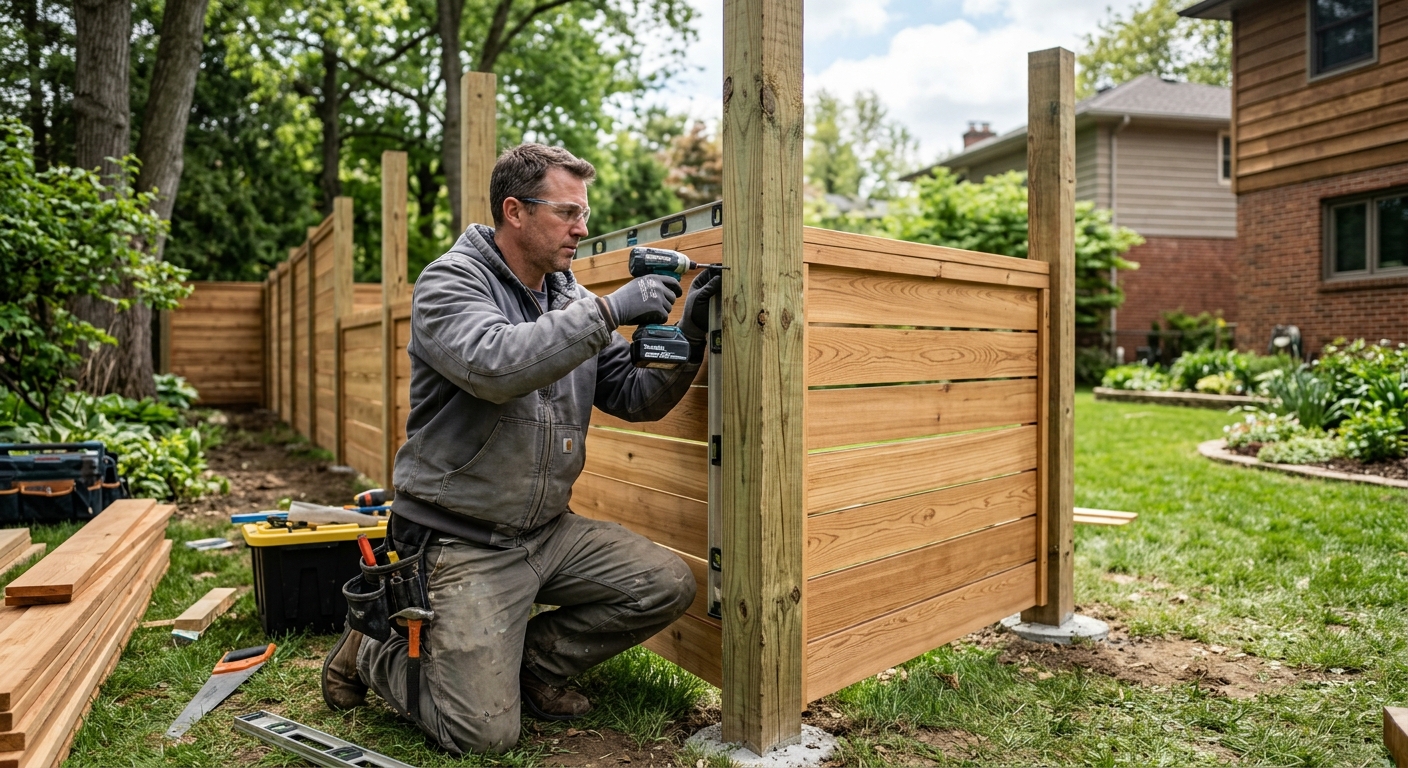
Fencing options and costs in Delta
Delta, British Columbia is a busy waterfront community where homeowners commonly upgrade boundary fencing as properties change hands and as older yards get reshaped for pets, privacy, and safer access. With about 75.6% of households owning homes (Statistics Canada, 2021 Census), there’s steady local demand for new installs and fence replacements—especially on single-detached properties, where roughly 55.5% of dwellings are detached, creating more “exclusive use” fence lines to maintain and renew (Statistics Canada, 2021 Census). This matters because each detached lot typically has multiple fence segments, posts, and gates that need careful layout and consistent results.
In the Lower Mainland–Southwest, pricing is shaped by mild but not trivial frost and frequent wet conditions. Even though coastal BC frost is often shallower than colder provinces, contractors still set posts below the practical heaving zone, and Fraser Valley-style wet soils often mean deeper holes, more concrete for key posts, and more labour per metre than a dry-site install. Wind exposure around open stretches (and the way solid panels catch gusts) also drives stronger post sizing and sometimes tighter spacing.
In Delta, fence work tends to be especially active in the Tsawwassen area, where many yards back onto greenbelt/open areas and homeowners want privacy upgrades that can withstand coastal moisture. Next, here’s a practical comparison of common materials and what you can typically budget for installed pricing in Delta.
| Material |
Lifespan |
Maintenance |
Privacy Rating |
Price per Linear Foot |
Price Range |
| Pressure-treated pine (standard wood) |
10–15 years |
Stain/seal every 2–3 years; hardware checks |
Good (solid/close boards) |
$55–$95 |
$55 – $95 |
| Cedar (natural rot resistance) |
15–25 years |
Wash and stain as needed (often every 3–4 years) |
Good to very good (solid/close boards) |
$70–$120 |
$70 – $120 |
| Vinyl / PVC (no-maintenance) |
20–30 years |
Rinse only; occasional inspection of brackets |
Very good (solid privacy styles) |
$75–$130 |
$75 – $130 |
| Chain-link (galvanized steel) |
25–35 years |
Minimal; check tension and coatings |
Low (privacy requires slats/mesh) |
$30–$55 |
$30 – $55 |
| Aluminum ornamental |
25–40 years |
Wash annually or as needed |
Low to medium (decorative spacing) |
$90–$170 |
$90 – $170 |
| Composite / recycled material |
20–30 years |
Rinse; no staining |
Good (solid panel systems) |
$95–$145 |
$95 – $145 |
Prices are estimates only and vary by project scope, site access and material selection.
What affects the price of fencing in Delta
In Delta and across the Lower Mainland–Southwest, two quotes for the “same-looking” fence can land 30–50% apart because the biggest line-items—post depth, set method, gate hardware, and how crews manage wet or sloped ground—can change significantly from one property to the next. That’s why a chain-link line can be relatively consistent while wood privacy panels, vinyl privacy systems, and any job with multiple gates or removal can swing quickly. This volatility is common across British Columbia: even when crews share similar labour rates regionally, materials plus ground conditions drive the total.
Frost and post depth are a core driver. In practical Canadian frost-design terms, contractors typically position posts several inches below the design frost depth (often translating to roughly 4–6 inches deeper than the “minimum” comfort point) to limit heaving. In colder Ontario and Alberta regions, posts are commonly set 1.5–2.0 m into the ground, which usually requires concrete setting and longer posts—raising both material and labour costs. While coastal BC often needs shallower embedment than the Prairies, wet Delta soils still frequently mean deeper holes than people expect, plus more concrete at corner posts, gate posts, and privacy-panel sections for stability.
Concrete examples from Delta: (1) a yard with saturated soil after rain may require larger post holes and more concrete to achieve proper bearing; (2) a property with clay-heavy spots near the walkway often slows excavation, increasing labour; (3) sloped backyards frequently need stepped or raked panel layouts that add framing and time. On the same street, a long, straight chain-link run might stay closer to the $30–$55 band, while a 6-ft to 8-ft privacy fence that needs reinforced posts and disposal can quickly fall into the $75–$130 vinyl or $55–$95 wood-installed bands—depending on material choice and gate count.
| Price Factor |
Why It Matters |
Cost Impact |
| Fence length in linear feet |
Labour and materials scale directly with run length |
Usually the largest single driver (often 50%+ of total) |
| Post depth required |
Frost heave control and stable bearing depend on embedment |
Deeper posts increase hole size, labour, and materials |
| Post setting method |
Concrete vs. gravel pack vs. driven posts affects strength and time |
Concrete setting typically adds cost but improves long-term stability |
| Material choice |
Vinyl/PVC and cedar require different structural members and components |
Shifts the job between the $55–$95 (wood) / $75–$130 (vinyl) bands |
| Gate count and type |
Gates require extra framing, hinges, and often stronger posts |
Each gate can add noticeable cost (especially drive-through doubles) |
| Grade and terrain |
Slopes need stepped/raked boards or custom panel adjustments |
More cuts and labour; sometimes increased material waste |
| Old fence removal and disposal |
Hauling, disposal fees, and demolition time add to the scope |
Can add a meaningful surcharge depending on length and condition |
| Permit fees and survey / property line locate |
Locates reduce dispute risk; permits may be required for taller fences |
Varies by project; often a few hundred to over $1,000+ |
Permits & regulations in British Columbia
In British Columbia, fence permit requirements commonly depend on height and location. As a practical rule of thumb for many residential situations, fences above a height threshold—typically around 2.0 m (6.5 ft) at the rear and about 1.0–1.2 m (3–4 ft) at the front or corner—can require a building permit. Beyond permits, every fence must respect property lines and local setback rules set out in municipal bylaws.
Before any post hole is dug, you should call for utility locates (BC 1 Call). It’s also wise to confirm your property pins or get a survey/locate before installation so you avoid encroachment disputes—something that can become expensive quickly when neighbours disagree on where the fence should sit. For shared fence ownership, the rules are governed by provincial line-fences legislation, and what each party is responsible for can depend on how the fence is shared, maintained, and located.
For homeowners in Delta, the step-by-step contractor check is straightforward: ask for the contractor’s BC licence details (and verify them online where applicable), request a Certificate of Insurance for liability coverage, and confirm their workers’ compensation coverage (WSIB/WCB equivalent coverage in BC). A reputable company will provide a clearance/coverage confirmation letter and will name the insured parties on the policy.
Choosing the right fence material for Delta
Choosing a fence material in Delta comes down to balancing privacy, low maintenance, and your budget against the realities of Lower Mainland–Southwest weather: wet winters, mild temperatures, and periodic wind. Pressure-treated pine is usually the most budget-friendly approach in the $55–$95 wood-installed band, but it typically needs staining or sealing every 2–3 years to prevent grey weathering and to protect the boards from moisture cycling. Cedar costs more upfront, yet it naturally resists rot and often keeps a better appearance with fewer “heavy” maintenance cycles—often every 3–4 years depending on sun exposure and airflow.
Vinyl/PVC can be a strong choice for homeowners prioritizing low maintenance. In this region it commonly fits the $75–$130 vinyl-installed band and usually just needs rinsing, but extreme cold snaps can make some plastics more brittle than wood (so quality installation and appropriate post/bracket systems matter). Chain-link generally wins for cost, sitting in the $30–$55 band, and it can last decades, but it offers limited privacy unless you add slats or privacy mesh. Aluminum ornamental looks sharp and won’t rust, landing in the higher $90–$170 band, but it’s typically not the best match if your goal is full backyard privacy.
Post depth and setting still matter regardless of material. Even with coastal BC’s typically shallower frost influence than colder provinces, crews often set key posts deeper than the bare minimum, and concrete-setting is commonly used for corner posts, gate posts, and privacy fence sections for stability. If you’re comparing options, a realistic example is choosing vinyl privacy panels over basic wood: the jump from the low end of wood pricing (near $55 per linear foot) to vinyl at the higher end (near $130 per linear foot) can be justified if you want to avoid repeated staining and reduced maintenance trips over the next decade.
| Material |
Cold Tolerance |
Lifespan |
Annual Maintenance |
Best For |
Price Band |
| Pressure-treated pine |
Good (boards handle wet-cold cycles with proper sealing) |
10–15 years |
Light inspection; stain/seal every 2–3 years |
Budget privacy with straightforward upkeep |
$55–$95 |
| Cedar |
Good (naturally resistant, especially in wet climates) |
15–25 years |
Wash/rinse; stain as needed (often 3–4 years) |
Longer-lasting wood appearance in coastal BC |
$70–$120 |
| Vinyl / PVC |
Very good (can be brittle in extreme cold—quality install helps) |
20–30 years |
Rinse and check hardware/brackets |
Low-maintenance privacy and consistent look |
$75–$130 |
| Chain-link |
Excellent (galvanized steel resists weather) |
25–35 years |
Minimal; visual checks for tension/coating |
Security and pet containment with openness |
$30–$55 |
| Aluminum ornamental |
Excellent (coated metal; no rot) |
25–40 years |
Wash periodically |
Attractive curb definition with durability |
$90–$170 |
| Composite / recycled |
Good (stable but product-specific) |
20–30 years |
Rinse; inspect fasteners occasionally |
Wood-like look without staining |
$95–$145 |
How to choose a fencing contractor in Delta
When you hire a fence contractor in Delta, start by verifying licensing and coverage. In British Columbia, ask for proof of the contractor’s BC licence details (and verify it using the public registry information available online), then request a Certificate of Insurance showing current general liability coverage—make sure your address is correctly referenced or that you’re listed as an interested party if the policy format supports it. Finally, confirm they carry workers’ compensation coverage (WCB/WSIB coverage equivalents in BC). A legitimate fencing business will provide a clearance/coverage letter on request, not just “verbal confirmation.”
Next, get 2–3 itemised written quotes rather than one lump-sum number. You want line items for excavation, post setting method (concrete vs. gravel pack), materials (boards/pickets, rails, hardware), gate components, and any hauling/disposal. A good contractor will clearly list what’s excluded—like removal of mature shrubs, restoration of lawns, or replacement of damaged sprinkler lines—so you’re comparing like-for-like.
Warranty matters: ask for the length of workmanship coverage and whether it covers post setting and alignment issues, plus the product/manufacturer warranty on materials. Also ask if warranties are transferable to future owners. For payment, never pay more than about 10–15% upfront; hold back a portion until the job is complete and you’ve confirmed measurements, height consistency, and gate operation. Get a start date and an estimated completion timeline in writing so weather-related delays don’t become disputes.
- Verify BC licence information using the contractor’s business details (not just a brochure name).
- Request a current liability Certificate of Insurance.
- Confirm workers’ compensation coverage with a clearance/coverage letter.
- Ask for 2–3 itemised quotes (labour, materials, gates, and disposal separated).
- Confirm post setting method (concrete at corners/gates; depth assumptions) in writing.
- Make sure permits (if applicable due to fence height) are explicitly stated as included or excluded.
- Check whether utility locates and any re-locating costs are included.
- Confirm removal of old fence and disposal is priced (and whether recycling is included).
- Ask how slopes will be handled (stepped vs. raked) and who decides the final grade plan.
- Get gate hardware specifics (hinge type, latch quality, and whether posts are reinforced).
- Clarify warranty terms: workmanship duration, what failures qualify, and claim process.
- Use a payment schedule with a small deposit only; hold back until final cleanup and adjustments.
Red flags I commonly see in Delta include: quotes that omit post depth and setting method, “no-disposal” terms after assuming removal, refusing to provide insurance/coverage proof, vague scopes that don’t specify gate counts or hardware, and starting work without a clear written start/end schedule.
Frequently asked questions — fencing in Delta
How much does a fence cost in Delta?
In Delta, your total cost usually follows the installed material bands for the Lower Mainland–Southwest. As a realistic benchmark, chain-link tends to be the lowest, commonly landing around $30 – $55 per linear foot installed, while typical wood installs often fall in the $55 – $95 band depending on height, gate count, and whether concrete is used at key posts. Vinyl/PVC is usually higher because of material and structural requirements, commonly in the $75 – $130 range. Exact pricing still depends heavily on fence length, access for excavation, soil conditions, and slope. If your property has wet spots or saturated ground, deeper holes and extra concrete at corners/gates can push a project toward the top of the range.
How deep should fence posts be for Delta's frost?
Even though Delta has a milder coastal climate than colder Canadian regions, frost heaving control still matters, and wet soils often make the install more involved. Contractors typically set posts below the practical heave zone—often translating to embedment that’s effectively “a bit deeper than the minimum”—so the post remains stable through seasonal temperature swings. In general Canadian practice, post embedment is commonly about 4–6 inches below the design frost depth, with deeper concrete-set holes in heavier soils. In Delta specifically, many residential privacy fences are set with concrete at corner posts, gate posts, and line sections where panel strength is critical. Your quote should state the intended post depth and setting method; if it doesn’t, ask for it before signing.
Wood vs vinyl vs aluminum fence — which is best?
The “best” choice depends on whether you value privacy, maintenance, or curb style most. Wood (pressure-treated pine) is often the most budget-friendly and typically fits around $55 – $95 installed, but it needs periodic sealing/staining to protect against weathering in Delta’s wet coastal conditions. Cedar can last longer and look better, but it still usually requires maintenance over time. Vinyl/PVC is popular for low maintenance and is commonly priced around $75 – $130; it’s durable and doesn’t require staining, but it still needs correct installation hardware for stability. Aluminum ornamental tends to be the highest for materials and fabrication, commonly in the $90 – $170 band, and it usually isn’t the best fit if you need maximum privacy (it’s more decorative/open). Many Delta homeowners choose vinyl for privacy and low upkeep, while aluminum suits front-yard definitions.
Do I need a permit to build a fence in British Columbia?
In British Columbia, a permit may be required for fences above certain height thresholds—commonly around 2.0 m (6.5 ft) at the rear and about 1.0–1.2 m (3–4 ft) at the front or corner—though the exact requirement can vary by local rules and fence placement. Even when a permit isn’t required, the fence still must respect property lines and municipal setback bylaws. Before digging, you should call for utility locates through BC 1 Call, and ideally confirm your property pins or obtain a locate/survey to reduce the risk of placing the fence on the neighbour’s land. Shared boundary responsibilities are also shaped by provincial line-fences legislation. Your contractor’s written scope should clearly state whether permits are included or excluded.
How long does a wood fence last in Delta?
A wood fence lifespan in Delta commonly ranges from about 10–15 years for pressure-treated pine and 15–25 years for cedar, assuming the fence is installed correctly with proper post setting, good hardware selection, and appropriate top/bottom detailing to reduce water trapping. Delta’s wet winters and coastal moisture mean staining and sealing are key—pressure-treated wood typically needs attention every 2–3 years to avoid rapid weathering and board deterioration. Cedar can hold up better because of natural rot resistance, but it’s not maintenance-free; sun exposure and drainage patterns still affect longevity. The biggest practical factor is often not just the species but whether posts were set deep enough and whether concrete was used where needed (corners/gates/privacy sections) for long-term stability.
Who owns and maintains a shared fence?
Shared fence ownership and maintenance in British Columbia generally follow provincial line-fences legislation, and the responsibilities can depend on how the fence is established, located, and whether it’s considered a boundary fence shared by both adjoining owners. In practice, it’s common to see neighbours agree informally on upkeep, but disagreements often start when a party assumes the fence is “shared” without confirming the boundary location or maintenance responsibility. Before replacing a shared fence in Delta, confirm the property line using pins/locates, then discuss scope: whether one side is replacing the full fence, whether costs are shared, and who handles staining/sealing going forward. A transparent written agreement (even a simple one) and a clear, itemised contractor quote help prevent misunderstandings.