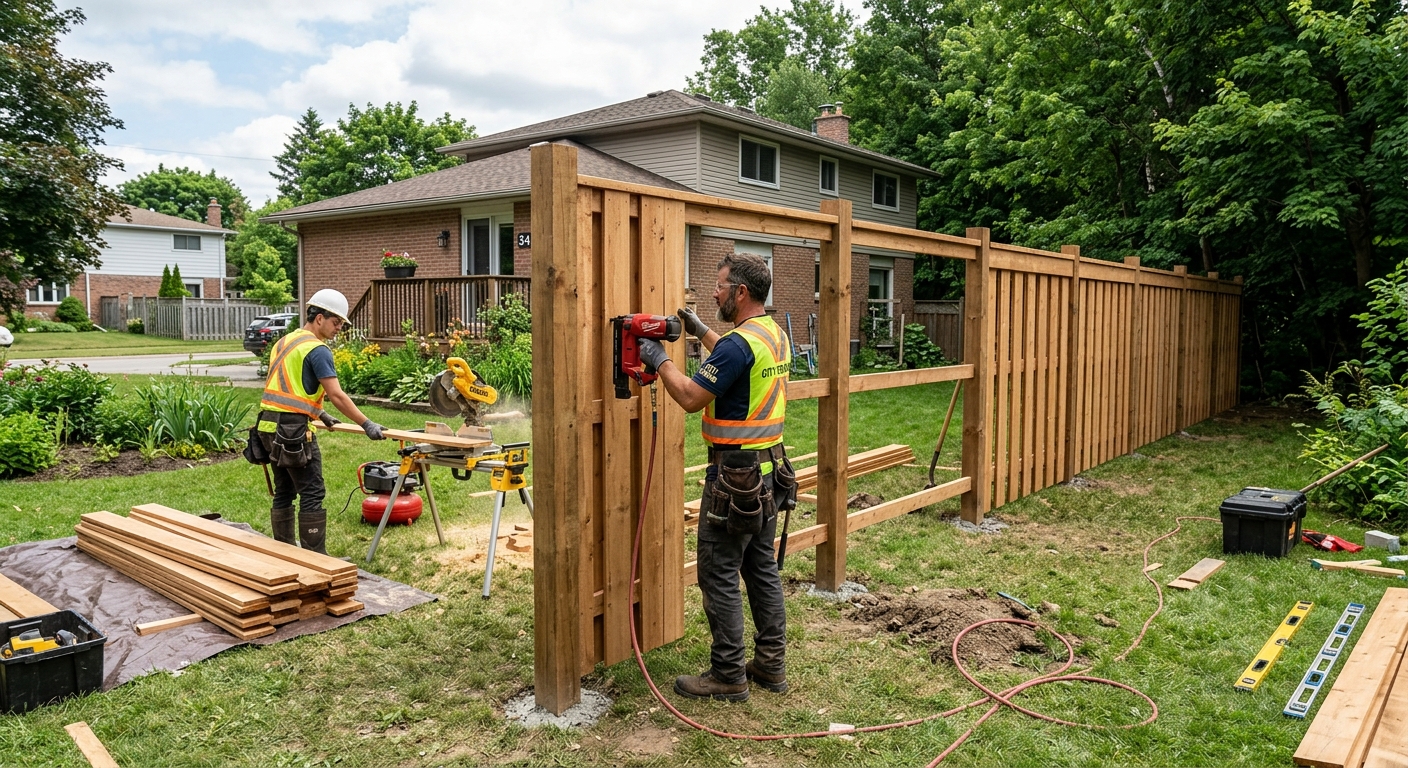
Fencing options and costs in Middlegate
Middlegate is a small community in the Lower Mainland–Southwest, and that matters because steady, local demand shows up when homeowners look to tidy property edges—especially around detached houses. With a 2021 population of 4,000 (Statistics Canada, 2021 Census), most fencing work is concentrated on residential lots, driveways, and backyard lines where privacy and wind protection are top priorities. At the same time, Lower Mainland–Southwest fencing pricing is shaped by mild but persistent frost-and-wind conditions: even where the frost line is shallower than inland Canada, posts still need to be set below the frost influence to limit heaving, and wetter Fraser Valley soils often mean deeper holes, more concrete, and more labour.
In neighbourhoods where homes have larger backyards and older perimeter fencing—often around the busier residential corridors near central amenities—contractors tend to be especially busy with replacement projects and gate work. Expect quote differences based on access (driveway width and whether a crew can bring materials to the back), yard slope, and whether your fence needs privacy panels in high-wind areas. If you want a realistic comparison, use the regional installed price bands as your anchor: chain-link typically comes in lowest, wood is mid-range, and vinyl/PVC or aluminum usually cost more due to material and structural requirements.
Below is a straightforward comparison of common fence types for Middlegate, using installed ranges you can expect from Lower Mainland–Southwest contractors.
| Material |
Lifespan |
Maintenance |
Privacy Rating |
Price per Linear Foot |
| Pressure-treated pine (standard wood) |
12–18 years |
Stain/seal every 2–3 years |
Medium–High (solid panels) |
$55 – $95 |
| Cedar (natural rot resistance) |
18–25 years |
Light stain/finish every 3–4 years |
High (boards close-spaced) |
$65 – $110 |
| Vinyl / PVC (no-maintenance) |
20–30 years |
Wash occasionally (no staining) |
High (privacy styles) |
$75 – $130 |
| Chain-link (galvanized steel) |
20–35 years |
Occasional cleaning; tension checks |
Low (non-privacy) |
$30 – $55 |
| Aluminum ornamental |
25–35 years |
Wash annually or as needed |
Low–Medium (decorative) |
$90 – $170 |
| Composite / recycled material |
20–30 years |
Wash; minimal repairs |
Medium–High (solid infill) |
$95 – $155 |
Prices are estimates only and vary by project scope, site access and material selection.
What affects the price of fencing in Middlegate
In the Lower Mainland–Southwest, two homeowners can get quotes that differ by 30–50% for what looks like the “same” fence because the job is rarely identical: soil moisture, post embedment depth, access for crews and material delivery, and how much wind reinforcement is needed all change labour and hardware costs. Compared with other parts of British Columbia, a Middlegate install can feel more labour-intensive because wet Fraser Valley conditions often mean longer digging time and more concrete setting to stabilize posts.
The biggest driver is frost influence on post depth. Even in BC’s milder climate, posts still need to be set below the design frost influence to prevent heaving; a practical rule used by many contractors is to set posts about 4–6 inches below the local design frost depth. That typically means deeper holes than many homeowners expect, especially in wetter ground. In colder Ontario and Alberta regions, contractors often need deeper embedment (often 1.5–2.0 m) and more concrete setting—so material and labour costs rise sharply. Here in Middlegate, you may not go that deep, but you can still see added cost from deeper-than-minimum holes, concrete-setting for corner and gate posts, and longer posts for privacy sections.
Concrete examples: (1) a flat backyard with dry, workable soil usually lands closer to the lower end of the wood range (for example, the $55–$95 band), while (2) a fence line in consistently wet soil may increase concrete use and labour so the same wood project drifts upward. (3) If you need multiple privacy panels with heavier reinforcement due to wind exposure, you’ll often pay toward the upper end of the vinyl/PVC range ($75–$130) because the structure must hold the panels steady.
Housing age also plays a role: older lots frequently have uneven grades and remnants of the previous fence to remove, which can add hours for demolition, hauling, and post-hole corrections—directly affecting final cost.
| Price Factor |
Why It Matters |
Cost Impact |
| Fence length in linear feet |
The main measurement that drives materials, posts, rails, and labour. |
High (can account for most of the total) |
| Post depth required |
Frost influence determines hole depth and post length to reduce heaving. |
Medium–High |
| Post setting method |
Concrete-set posts resist movement; gravel packs can be quicker where soils allow. |
Medium |
| Material choice |
Vinyl/PVC has different structural requirements; cedar costs more than pressure-treated pine. |
High (varies widely) |
| Gate count and type |
Drive-through double gates require heavier frames, hinges, and alignment. |
Medium–High |
| Grade and terrain |
Slopes require stepped or raked panels to keep sightlines consistent. |
Medium |
| Old fence removal and disposal |
Demolition, hauling, and disposal add labour and equipment time. |
Medium |
| Permit fees and survey / property line locate |
Some projects require documentation; locating pins prevents encroachment rework. |
Low–Medium (project-dependent) |
Permits & regulations in British Columbia
In British Columbia, fences over certain heights often require a building permit. As a practical rule of thumb, fences above about 2.0 m (6.5 ft) along the rear yard, and above roughly 1.0–1.2 m (3–4 ft) in the front or corner areas, commonly trigger permit requirements (height thresholds can vary by local bylaws). Even when a permit is not required, all fences must respect property lines and municipal setback requirements.
Before any post holes are dug, you should have utility locates completed (BC 1 Call) so crews don’t hit buried services. Also, many disputes come from incorrect line assumptions—so plan to obtain a survey or at least a property line locate using your property pins before the first post is set. Shared fence ownership rules are handled under provincial line-fences legislation, which affects how costs and responsibilities may be split when neighbours share a boundary fence.
What typically DOES require a permit: higher fences above the commonly used rear/front height thresholds, and any project that changes the fence footprint, height significantly, or impacts required sightlines.
What typically does NOT: like-for-like replacements in the same height range and within property lines, where local bylaw height thresholds are not exceeded (still confirm with your municipality).
To verify a contractor in Middlegate, ask for: (1) British Columbia licensing details (check online through the appropriate provincial registry), (2) certificate of insurance for general liability with an active policy term, and (3) proof of coverage for workplace injuries via clearance documentation (or WCB account clearance letter where applicable). Use these documents before signing, and keep copies for your records.
Choosing the right fence material for Middlegate
Choosing the right fence material in Middlegate is mostly about matching your priorities—privacy, low maintenance, budget, and lifespan—to Lower Mainland–Southwest climate realities. Pressure-treated pine is usually the lowest-cost “wood” path, but it needs regular staining or sealing every 2–3 years to prevent grey weathering and to slow down moisture-driven wear. Cedar looks better for many homeowners and naturally resists rot, so it generally holds up longer, but it still benefits from periodic finishing. Vinyl/PVC is popular for low maintenance: it doesn’t require staining, but in extreme cold snaps it can become brittle if the product is not rated appropriately, and proper spacing/structural bracing matters. Chain-link is the lowest price option and can last a long time, but it offers no privacy without add-ons. Aluminum ornamental is rust-resistant and maintenance-light, though it won’t provide the privacy many Middlegate households want.
Post depth and setting matter regardless of material. In Lower Mainland–Southwest installations, contractors typically set posts below frost influence (often roughly 4–6 inches below the design frost influence) to reduce the risk of heaving. Concrete-set posts are commonly used for corner posts, gate posts, and privacy-panel sections where structural stability is critical—especially in wetter soils.
Wind and snow load are part of the decision too. Heavier solid panels (wood privacy or vinyl privacy) need sturdier rails and tighter post spacing so the fence doesn’t rack under gusts. If your goal is privacy in a windy yard, paying the mid-to-upper end of wood pricing (for example, staying closer to the $55–$95 band rather than the absolute cheapest chain-link) is often more justified than buying a cheaper material that won’t meet your privacy goals.
| Material |
Cold Tolerance |
Lifespan |
Annual Maintenance |
Best For |
Price Band |
| Pressure-treated pine |
Good (with proper sealant) |
12–18 years |
Stain/inspect every 2–3 years |
Budget privacy with periodic upkeep |
$55 – $95 |
| Cedar |
Very good |
18–25 years |
Finish every 3–4 years |
Natural look and stronger rot resistance |
$65 – $110 |
| Vinyl / PVC |
Good (quality-rated products) |
20–30 years |
Wash as needed |
Low maintenance privacy |
$75 – $130 |
| Chain-link |
Excellent |
20–35 years |
Minimal (tension/cleaning) |
Security on a budget |
$30 – $55 |
| Aluminum ornamental |
Excellent |
25–35 years |
Wash annually or as needed |
Attractive boundaries with visibility |
$90 – $170 |
| Composite / recycled |
Good (depends on brand spec) |
20–30 years |
Wash; minor repairs |
Clean look with low upkeep |
$95 – $155 |
How to choose a fencing contractor in Middlegate
Start by verifying British Columbia coverage and compliance. Ask for a current certificate of insurance for general liability (so you’re protected if a crew damages property during digging or hauling). For workplace injury coverage, request proof of coverage/clearance documentation through the provincial workplace coverage system, and ensure the contractor is properly covered before work begins. For licensing, confirm the correct provincial registry entry for the contractor/business and match the name on the quote to the registry listing.
Next, get 2–3 itemised written quotes instead of lump sums. You want a breakdown separating materials (posts/rails/panels), labour (digging, setting, assembling, installing), hardware (hinges, latch sets, gate frames), and any additional scope such as removal and disposal. Ask if permit pull is included or if you’ll need to handle it. Confirm what’s excluded: landscape restoration, concrete removal, hauling limits, and any unknown underground conditions found during post-hole excavation.
Warranty matters in fencing because posts and rails carry the long-term stress. Ask for (1) a workmanship warranty (how long the installer stands behind alignment and fastening), (2) the manufacturer warranty on materials, and (3) whether any warranty is transferable to future homeowners. For payment, don’t put more than about 10–15% upfront—then hold back the remainder until the work is complete and cleaned. Finally, insist on a start date and a completion estimate in writing, so delays don’t become budget surprises.
- Verify the contractor’s BC registration details match the business name on your quote.
- Request and review the liability insurance certificate before any materials arrive.
- Ask for workplace coverage proof/clearance documentation for the crew.
- Get itemised pricing for posts, rails, panels, and all gate hardware.
- Confirm whether concrete setting is included for corner and gate posts.
- Clarify post-hole depth assumptions (frost influence) and how holes are corrected on uneven terrain.
- Ask who handles permit applications, if required by height thresholds.
- Confirm utility locate responsibility (BC 1 Call scheduling and documentation).
- Check whether old fence removal and disposal are included or priced separately.
- Make sure the quote specifies fence height, style, and the exact privacy/rack options.
- Review warranty length for workmanship and product, including transferability.
- Use a payment schedule with 10–15% max upfront and a holdback until completion.
Common Middlegate red flags include: quotes that don’t state post depth/setting method, missing insurance or outdated coverage documents, lump-sum pricing with no allowance for gates or removal, refusal to put a start/completion timeframe in writing, and warranty language that only covers materials—not workmanship.
Frequently asked questions — fencing in Middlegate
How do I prevent wood fence rot in Middlegate?
To prevent wood rot in Middlegate, the best protection starts below grade: posts must be set below frost influence so they don’t heave and crack the surrounding material. In Lower Mainland–Southwest conditions, wetter soils keep wood damp, so contractors often concrete-set corner posts, gate posts, and privacy-panel anchor points for stability. Above grade, choose proper pressure-treated pine or cedar, and keep up finishes—pressure-treated typically needs staining or sealing about every 2–3 years to reduce moisture-driven greying and surface breakdown. Also ensure good drainage and install with spacing that allows air circulation; “fully sealed” designs trap moisture. If you’re comparing costs, remember that wood ranges commonly land around $55 – $95 installed depending on height and build. Spending a bit more on cedar can be justified if you want longer appearance life with fewer re-staining cycles.
What is the cost per linear foot for fencing in Middlegate?
In Middlegate, pricing per linear foot depends heavily on material and the site conditions along the fence line. As a planning anchor for Lower Mainland–Southwest installs, chain-link often falls around $30 – $55, while wood is commonly mid-range at about $55 – $95. Vinyl/PVC typically costs more because of material and structural requirements and often lands around $75 – $130. Aluminum ornamental can be the highest in this typical mix, with many jobs falling around $90 – $170. Your quote will shift with post embedment depth, soil moisture, gate count (especially double drive-through gates), slope, and whether disposal and old fence removal are included.
Should I repair or replace my old fence in Middlegate?
Repair is usually worth considering when the fence is still straight, only has a few boards that have rotted, and the posts are solid (no wobble at the base). Replace is typically the better option when multiple posts are failing, rails are loose, or the fence line is out of alignment—because those issues usually mean you’ll spend labour reworking the same sections repeatedly in wet Lower Mainland conditions. If your existing fence is well past its lifespan (common with older pressure-treated installations), replacement can be more cost-effective than repeated patches that don’t stop ongoing moisture exposure. When pricing, compare like-for-like: a wood replacement may be closer to $55 – $95 installed, while vinyl privacy could run $75 – $130. If you want to improve wind stability and privacy, replacement often gives you better rail spacing and stronger gate hardware than patching.
How do I handle a fence dispute with a neighbour in British Columbia?
In British Columbia, fence boundary disagreements are commonly about property lines, shared responsibility, and how the fence was installed relative to the boundary. Start by getting clarity on the exact location of your property line: use a survey or a property line locate based on your pins rather than relying on old marks. Then review whether your situation involves a shared fence under provincial line-fences rules, because that can affect cost sharing and responsibilities. Keep communication in writing, and focus on solutions (for example, correcting alignment, adjusting height where required, or replacing damaged sections). If the dispute involves height thresholds or setbacks, check the local bylaw and whether a building permit should have been obtained for the fence height. For practical progress, ask your contractor to document post-hole setting depth and measurements, and provide photos/measurements before work covers the ground.
What fence style offers the best wind resistance in Middlegate?
For Middlegate, the “best” wind-resistant style depends on your goal (privacy vs. visibility), but solid privacy panels can perform well when the structure is designed for gust loads. Wind resistance improves with heavier posts, appropriate rail spacing, and closer post spacing—especially on fence runs that face open exposure. Many homeowners find that wood privacy or vinyl privacy works better than lightweight decorative panels because the fence body resists racking when properly braced. However, chain-link is also wind-active; it allows wind through, which reduces pressure but also eliminates privacy. That’s why many installs use either well-built privacy panels (with reinforced anchoring at corners and gates) or a security chain-link line paired with landscaping/screens if privacy is secondary. Your builder should also consider snow load and wet-season soil conditions, because unstable posts can shift and amplify wind effects over time.
How much does a fence cost in Middlegate?
The total cost in Middlegate depends mainly on total length, material, height, gate count, and how difficult the ground is for post holes. As rough budgeting ranges commonly used in the Lower Mainland–Southwest, chain-link jobs may land around $30 – $55 per linear foot installed, while a typical wood privacy or board fence is often around $55 – $95. Vinyl/PVC is commonly higher at $75 – $130, and aluminum ornamental often ranges from $90 – $170 depending on style and build complexity. If your yard is sloped, requires stepped panels, or needs old removal and disposal, your “effective” per-foot cost can climb even within the same material band. For a more accurate number, request a quote that itemises labour, materials, gate hardware, and post setting method so you can compare apples-to-apples.