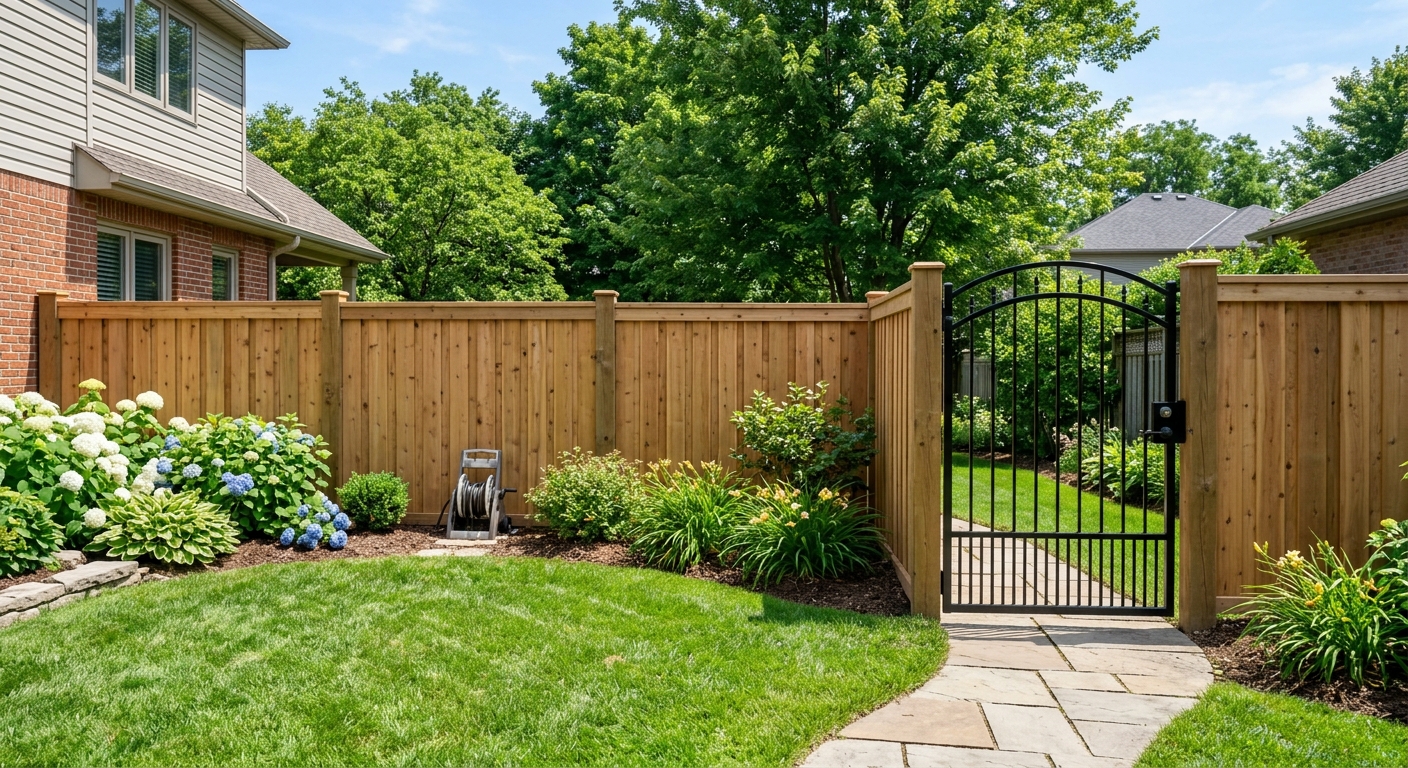
Fencing options and costs in Houston
In Houston, British Columbia, fencing choices usually come down to privacy versus maintenance, and the local frost-and-wind reality of the Nechako economic region. With about 60.2% of local homes being single-detached (Statistics Canada, 2021 Census), many properties have yard perimeters that need upgrading, replacement, or proper post installation. Demand is also steady in older neighbourhoods—62.2% of homes were built before 1981 (Statistics Canada, 2021 Census)—because older lots commonly have earlier generations of fence posts that no longer sit straight after freeze–thaw cycles.
Pricing is shaped by deeper frost concerns around Houston and the broader Bulkley-Nechako area. Contractors typically set posts 3–5 feet deep, often with concrete footings, to stabilize in mixed clay and rocky ground and reduce frost heave. On exposed sites near valley edges, wind can act like a sail against solid panels, so stronger bracing and closer spacing may be required. On the schedule side, winter working windows can be tighter than in milder southern BC markets, and local equipment time for augering through tougher soil can push labour up.
For homeowners in the Houston town area (especially larger corner lots and properties backing onto more open corridors), privacy fences and wind-stable layouts are particularly in demand. Below is a quick, practical comparison of common materials and what they typically cost per installed project in Houston, to help you read quotes before you meet a contractor.
| Material |
Lifespan |
Maintenance |
Privacy Rating |
Price per Linear Foot |
| Pressure-treated pine (standard wood) |
10–15 years |
Stain/seal every 2–3 years; periodic board replacement |
Good (solid board styles) |
$55–$85 |
| Cedar (natural rot resistance) |
15–25 years |
Light staining/sealing as needed; inspect for fastener corrosion |
Good–Excellent |
$65–$105 |
| Vinyl / PVC (no-maintenance) |
20–30 years |
Wash occasionally; no painting |
Good (solid/tall panel options) |
$70–$110 |
| Chain-link (galvanized steel) |
25–35 years |
Rinse/replace damaged sections; keep gates aligned |
Low–Fair (privacy screen optional) |
$35–$60 |
| Aluminum ornamental |
25–40 years |
Occasional wash; touch-up if damaged coating |
Low–Fair |
$80–$140 |
| Composite / recycled material |
20–30 years |
Wash; minimal repairs depending on product system |
Good (solid board systems) |
$85–$135 |
Prices are estimates only and vary by project scope, site access and material selection.
What affects the price of fencing in Houston
In Houston, British Columbia, it’s common to see very different quotes for what sounds like the “same fence,” because the scope can change quickly once you factor in Nechako’s freeze conditions and how exposed the yard is. Across the region and across BC, homeowners often experience 30–50% variation in total cost when comparing jobs that differ only slightly in post depth, wind bracing, gates, or whether old fence removal and disposal are included. Material pricing also moves the cost needle—chain-link tends to sit near the $35–$60 band, while aluminum and premium composite are more often in the $80–$140 band—yet labour can still swing the final number if ground conditions are tough.
Frost depth is the biggest driver. In cold North BC, frost penetration can reach around 60 inches in nearby areas like Smithers, so installers plan for posts set about 4–6 inches below the design frost line to reduce heaving risk. That translates into deeper holes, longer posts, and more concrete or more labour-intensive augering. In colder regions, contractors may effectively target depths around 1.5–2.0 m (based on local frost planning), which raises both materials and labour time. On wind-exposed sites (valley edges and open lots), tighter post spacing and stronger rails increase labour and sometimes require heavier components.
Here are a few real examples of what can raise or lower cost in Houston: (1) Rocky or clay-heavy soil requiring slower auger work can add several hours; (2) A fully fenced yard with 2–3 gates can out-cost a similar-length straight run because of hardware and alignment time; (3) A sheltered back lot can allow standard bracing while an exposed run may require upgraded wind reinforcement. With many homes built before 1981, older, settled fence lines also mean more re-leveling and sometimes more post replacement than homeowners expect. If your estimate is near the wood band (mid $55–$85), but your ground needs deep concrete-set posts and two gate builds, you can easily trend upward toward the cedar/vinyl territory.
| Price Factor |
Why It Matters |
Cost Impact |
| Fence length in linear feet |
More posts, rails, panels, and fasteners; labour scales directly |
Largest swing in total price; can change by hundreds to thousands |
| Post depth required |
Frost line determines hole depth and post length |
Deeper installs increase auger time, concrete, and material |
| Post setting method |
Concrete vs. gravel pack vs. driven posts impacts stability in freeze–thaw |
Concrete setting generally costs more but reduces heave risk |
| Material choice |
Vinyl/cedar cost more than chain-link; hardware differs by system |
Can move you between roughly the $35–$60 and $80–$140 bands |
| Gate count and type |
Drive-through gates require heavier frames and better bracing |
Adds labour, specialty hardware, and alignment time |
| Grade and terrain |
Slopes need stepped or raked panels and may require extra material |
Often adds labour and reduces “standard” panel efficiency |
| Old fence removal and disposal |
Demolition, hauling, and disposal add a separate task stream |
Can noticeably raise cost if posts are concrete-set |
| Permit fees and survey / property line locate |
Some heights and locations trigger permit requirements; pin confirmation prevents disputes |
Variable, but typically adds a measurable baseline cost |
Permits & regulations in British Columbia
In British Columbia, fence rules depend on height, location (front yard versus rear yard), and municipal bylaws. As a general guideline, fences above the common thresholds—often around 2.0 m (6.5 ft) in the rear and 1.0–1.2 m (3–4 ft) in the front or corner—may require a building permit. Regardless of permits, all fences must be built within your property boundaries and comply with local setback requirements.
Before any post hole is dug, verify utilities. Use the appropriate one-call service (e.g., BC 1 Call) so your auger work doesn’t damage buried lines. For peace of mind, obtain a survey or confirm property pins/locates before you install—this matters because disputes are expensive, especially on older lots where boundary markers may have shifted or fences were previously moved.
Shared fence responsibilities generally align with provincial line-fences legislation. If the fence is intended to be a shared boundary fence, clarify ownership and cost-sharing in writing with your neighbour before construction.
Licence and insurance verification should be part of your hiring checklist: ask for proof of the contractor’s business licence (if applicable in their structure), liability insurance, and coverage for workers under the applicable workers’ compensation system (commonly WCB). Look for these documents directly on their certificate of insurance and/or clearance letter, and make sure the policy is active for the project dates.
Choosing the right fence material for Houston
Choosing the right fence material in Houston is mostly about balancing privacy, maintenance time, and how well the system survives Nechako’s freeze–thaw cycles and wind. Pressure-treated pine is usually the most budget-friendly route, but to keep it looking good you’ll typically need staining or sealing every 2–3 years. Cedar offers better natural rot resistance and often looks warmer and more uniform; it still benefits from periodic maintenance, but it tends to weather more gracefully. Vinyl/PVC gives you a no-paint workflow, yet in extreme cold you need to choose quality systems that handle contraction and use proper installation methods. Chain-link is typically the longest-lasting low-cost option; however, it provides minimal privacy unless you add slats or a privacy screen. Aluminum ornamental fencing looks sharp and won’t rust, but it’s usually better for delineation than full privacy.
For cold tolerance, the material matters less than the post foundation. Because Nechako frost can be significant, year-round fences perform best with posts set deeply—commonly 3–5 feet—and, on many sites, with concrete footings to reduce heave risk. Wind exposure can also push you toward stronger bracing and closer post spacing, especially if you choose solid privacy panels that catch wind and snow load.
Example: if you compare a wood privacy run in the approximate $55–$85 band to vinyl privacy closer to $70–$110, the extra upfront cost can be justified when you want to avoid recurring staining and you’ll be busy with other home priorities. On older properties (many built before 1981), the “hidden” cost is often additional post replacement—so choosing a more stable system and foundation details can pay off even if material cost is higher.
| Material |
Cold Tolerance |
Lifespan |
Annual Maintenance |
Best For |
Price Band |
| Pressure-treated pine |
Good (with proper post depth and sealing) |
10–15 years |
0.5–1 day/year for inspection; stain every 2–3 years |
Budget privacy with regular homeowner upkeep |
$55–$85 |
| Cedar |
Good (natural rot resistance) |
15–25 years |
0.25–0.5 day/year; stain/seal as needed |
Natural look with better rot resistance |
$65–$105 |
| Vinyl / PVC |
Very good (if installed to allow expansion) |
20–30 years |
Wash/inspect (often no stain) |
Low-maintenance privacy |
$70–$110 |
| Chain-link |
Excellent (galvanized steel) |
25–35 years |
Occasional rinse; replace damaged sections |
Security and longevity on a budget |
$35–$60 |
| Aluminum ornamental |
Very good (coated finish) |
25–40 years |
Occasional wash |
Attractive boundary marking |
$80–$140 |
| Composite / recycled |
Good (quality varies by brand) |
20–30 years |
Wash/inspect; limited repairs |
Privacy with reduced maintenance |
$85–$135 |
How to choose a fencing contractor in Houston
When hiring a fencing contractor in Houston, British Columbia, verify credentials the same way you would for any major exterior build: licensing/business registration, liability insurance, and workers’ compensation coverage. Start by requesting a certificate of insurance and confirming the policy covers fencing work at your address and includes active dates. Next, ask for proof of workers’ compensation clearance (commonly issued as a clearance letter). If the contractor uses subcontractors, request the same documentation for them—don’t assume it’s covered under the main company.
Get 2–3 itemised written quotes instead of lump sums. You want a breakdown that separates labour, materials, and any extras like concrete setting, gate hardware, and old fence removal. Read the scope for what’s excluded: excavation limits, disposal fees, permits, survey/property line locating, and whether post depth adjustments are included if soil conditions differ. A good quote will state how they’ll handle slopes (stepped versus raked panels) and how they’ll brace for wind.
Warranty matters too. Ask for the workmanship warranty (how long they stand behind installation), the product/manufacturer warranty, and whether it’s transferable if you sell your home. For payments, don’t provide more than about 10–15% upfront—then pay the remainder in milestones, with a holdback until final inspection and walkthrough are complete. Finally, insist on a start date window and completion estimate in writing, so winter access and curing time for concrete aren’t surprises.
- Ask for proof of active liability insurance and verify dates match your project window.
- Request workers’ compensation clearance (and confirm subcontractors are covered).
- Get quotes with a material list (posts, rails, fasteners, concrete quantities or pack method).
- Confirm post depth approach (3–5 feet typical for local frost-stable installs).
- Check whether concrete setting is included or treated as an option.
- Verify gate hardware type, latch style, and whether the quote includes alignment adjustments.
- Confirm whether removal/disposal of the old fence is included.
- Ask how they locate property lines (pins/survey locate responsibility).
- Clarify slope handling (stepped/raked panels) and how the design maintains privacy.
- Ask about wind bracing assumptions (especially for solid privacy panels).
- Review warranty details: workmanship term, product term, and transferability.
- Confirm payment schedule—keep a holdback until completion and tidy-up are verified.
Concrete red flags to watch in Houston: (1) a quote that ignores frost-depth/post depth and only talks “surface” installs; (2) refusal to provide an itemised scope for gates or concrete setting; (3) no proof of insurance/clearance or willingness to “handle it later”; (4) promises of extremely fast turnaround without acknowledging auger time or cure time for concrete; and (5) vague wording like “disposal included” without stating what’s removed and hauled.
Frequently asked questions — fencing in Houston
What's the best fence for privacy?
For privacy in Houston, British Columbia, most homeowners choose a solid privacy style—wood (cedar or pressure-treated) or vinyl/PVC when they want a cleaner, lower-maintenance finish. In the Nechako region, privacy fences are also more exposed to wind because solid panels catch air; that means you should expect stronger bracing and proper post depth planning. If you’re comparing costs, pressure-treated privacy fences often land in the $55–$85 band, while vinyl privacy is frequently closer to the $70–$110 band depending on height and gate count. Chain-link can work only if you add slats/screens, but true privacy usually requires solid panels and good alignment. A careful foundation (deep posts set below frost planning) is what keeps the fence straight so you actually get privacy year after year.
How do I compare fencing quotes?
In Houston and across Nechako, comparing quotes gets easier when you force them into the same categories. Ask for itemised totals that separate labour and materials, and verify whether post depth, concrete setting, and auger time are included. Make sure each quote lists the same fence height, panel/rail layout, and gate types (walk-through versus drive-through double). Confirm what happens to old fence sections: removal and disposal should be stated clearly—especially if posts are concrete-set. Also compare the “extras” often buried in the fine print: property line locate/survey support, permit pull responsibilities (where needed), and how they handle sloped yards. Finally, look at the warranty: workmanship term, product warranty term, and whether the warranty is transferable. Two quotes in different price bands can still be fair if the cheaper one omits frost-stable post depth or gate reinforcement.
How long does fence installation take in Houston?
Typical fence installations in Houston can range from a couple of days to about a week, depending on length, gate count, soil conditions, and whether old fence removal is included. The Nechako frost environment affects scheduling mainly through ground conditions and the excavation workload: if the soil is rocky or requires slower augering, day-to-day progress can be slower. If concrete footings are used, crews plan the workflow to allow for proper setting time and alignment before panels go on, which can add time versus gravel-pack or driven-post methods. Weather also matters—winter access windows can limit hauling and concrete work. If you’re replacing a short run with one walk-through gate, expect less disruption than a full yard privacy rebuild with multiple gates. Your contractor should provide a start date and a written completion estimate after they review site conditions.
Can I install a fence on a slope in Houston?
Yes—fencing on slopes is common in Houston, and contractors can handle it well when the design is planned correctly. The two main approaches are stepped panels (each section changes height discretely) or raked panels (a continuous slope). For privacy, stepped designs can keep coverage more consistent because the boards remain at a controlled angle, while raked styles may create small gaps if the slope is pronounced or if the ground isn’t graded evenly. Frost-stable post depth is still essential on sloped yards; a fence can look level but still heave if posts aren’t set properly below local frost planning. Expect potentially higher cost for sloped sites due to extra layout time and more cut panels/posts. Make sure your quote specifies the method they’ll use and whether the fence height stays consistent at the highest and lowest points.
What is the most weather-resistant fence for Houston's climate?
For Houston’s winter freeze–thaw and snow load conditions, the most weather-resistant choices are the ones built for longevity with frost-stable foundations. Chain-link with galvanized steel can be extremely durable in cold weather and is often the longest-life option when installed correctly—especially for homeowners who need security more than privacy, with prices commonly in the $35–$60 band. Vinyl can also perform very well if it’s installed with correct tensioning and post spacing, while cedar and pressure-treated wood can last for many years when posts are set deep enough and the wood is properly maintained. The biggest determinant is actually foundation and post installation—deep posts set below frost planning reduce heaving, which protects every fence type. If you’re dealing with high wind exposure, consider upgrading bracing regardless of material, because wind stress can loosen rails and lead to early misalignment.
How do I prevent wood fence rot in Houston?
Wood rot prevention in Houston comes down to how the wood is detailed and how the posts are installed. First, ensure posts are set below frost planning—if the post base heaves, water collects and breaks down fasteners and lower boards. Use proper concrete footings or the appropriate stabilized method your contractor recommends for local soil, and confirm the quote includes correct drainage/setting practices. Second, choose quality materials: cedar naturally resists rot better than standard pine, and pressure-treated lumber has preservatives designed for outdoor use, but it still needs protection. Third, maintain the finish: for pressure-treated pine, staining or sealing every 2–3 years is a common best practice to slow weathering and moisture penetration. Finally, keep vegetation trimmed so airflow reaches the fence face and so wet leaves don’t stay trapped at the base. If you’re replacing an older fence built before 1981, inspect for post settling—rot often follows movement.