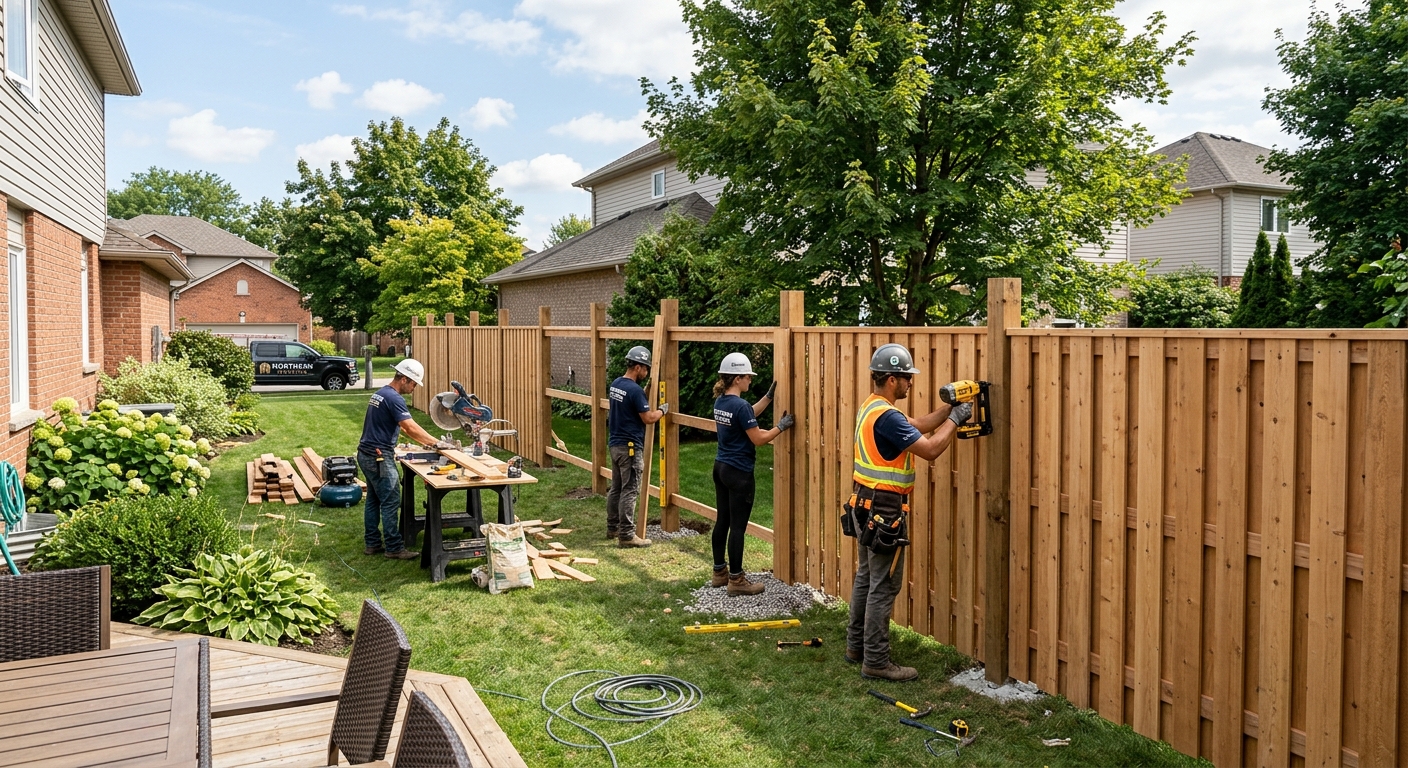
Fencing options and costs in Parksville
Parksville homeowners choose fencing for privacy, pet safety, and keeping kids and crews away from gardens, and the local demand is strong because the community has 4,935 homeowner households, with 73.1% of households owning their homes (Statistics Canada, 2021 Census). Parksville also has a large share of detached housing stock—single-detached houses make up 60.2% of dwellings—so many yards are enclosed with long runs where fences become a regular maintenance and upgrade project.
On Vancouver Island and the Coast, contractors price fencing around moderate coastal frost (about 45–60 cm) and frequent wind exposure off the Strait of Georgia and Juan de Fuca Strait. Even though the frost line is relatively shallow, posts still need to be buried deep enough—typically around 75–90 cm for most residential fence runs—to reduce heaving and long-term leaning. Where soils are wet or clay-rich, concrete footings are often recommended, which increases labour and disposal time. Access constraints (tight side yards, slopes, or rock pockets) also affect excavation and alignment, especially in neighbourhoods like Morningstar/Qualicum area-adjacent lanes where driveways and garden beds can limit machinery staging.
Material choice follows the climate. Coastal salinity can accelerate corrosion on cheaper hardware, so galvanized or powder-coated components cost a bit more but last longer. With that in mind, here’s a practical comparison of the most common fence options and typical local cost bands, so you can align the quote you receive with the scope you actually want before we move to what drives pricing.
| Material |
Lifespan |
Maintenance |
Privacy Rating |
Price per Linear Foot |
| Pressure-treated pine (standard wood) |
10–15 years |
Stain or seal every 2–3 years; check posts and top rails yearly |
High (solid pickets/boards) |
$55–$85 |
| Cedar (natural rot resistance) |
15–25 years |
Oil/stain every 2–4 years depending on sun and exposure |
High (solid panels) |
$70–$110 |
| Vinyl / PVC (no-maintenance) |
20–30 years |
Rinse as needed; inspect fasteners and replace warped sections after extremes |
High (privacy styles) |
$70–$110 |
| Chain-link (galvanized steel) |
25–40 years |
Occasional tightening; touch up minor coating damage if needed |
Low to Medium (works best with screen/planting) |
$35–$60 |
| Aluminum ornamental |
30–45 years |
Wash annually; inspect for loosened brackets after storms |
Low to Medium (open pickets) |
$80–$140 |
| Composite / recycled material |
20–30 years |
Minimal—clean periodically; avoid impact damage and check posts after big storms |
Medium to High (board/composite privacy panels) |
$90–$150 |
Prices are estimates only and vary by project scope, site access and material selection.
What affects the price of fencing in Parksville
In Parksville, two contractors can quote the “same” fence and still be 30–50% apart, mainly because the real scope isn’t identical: excavation difficulty, post layout, gate hardware, and disposal practices can change the labour hours as much as the material choice. On Vancouver Island and the Coast, mild coastal winters don’t eliminate frost; they change the ground conditions. Frost is typically around 45–60 cm, so we still plan for frost-safe installation by placing posts deeper than the design frost line (often 4–6 inches below design frost depth) and using concrete set when soils are wet, disturbed, or clay-heavy—common factors that add cost.
Coastal wind also affects the structure. Solid privacy fences catch more wind load, so contractors may recommend heavier posts, closer spacing, and stronger rails compared with more open styles like chain-link or ornamental aluminum. If you compare price bands, a chain-link run might land in the $35–$60 range, while a vinyl privacy fence often comes closer to $70–$110 once you include bracing, wind-rated posts, and stronger gate framing.
In Parksville specifically, a few local conditions frequently raise cost. First, older neighbourhood yards (and homes built before 1981 are 29.5% of the local housing profile, Statistics Canada, 2021 Census) often hide old footings, broken buried blocks, or decades of settled soil that complicate post-hole excavation. Second, slopes near the back of lots can require stepped or raked panels, increasing layout time. Third, coastal soil saturation means more time digging, more concrete aggregate use for stable set, and more haul-away for unsuitable soil.
| Price Factor |
Why It Matters |
Cost Impact |
| Fence length in linear feet |
Most line items scale directly with total run length |
High (often the largest portion of the invoice) |
| Post depth required |
Frost safety drives hole depth and post length |
Medium to High (more excavation and longer materials) |
| Post setting method |
Concrete set stabilizes posts in wet/clay soils |
Medium (adds materials and labour) |
| Material choice |
Vinyl, cedar, and chain-link have different durability and framing demands |
Medium to High (material price difference plus hardware) |
| Gate count and type |
Drive-through double gates require heavier frames and stronger hinges |
High (gates can add significant cost beyond fence panels) |
| Grade and terrain |
Slopes require stepped/raked installation and more layout time |
Medium (more labour, more cut components) |
| Old fence removal and disposal |
Debris hauling and time to detach posts impacts labour |
Medium (can be low or major depending on condition) |
| Permit fees and survey / property line locate |
Some height configurations and corner work may require documentation |
Low to Medium (often a small line item, but affects schedule) |
Permits & regulations in British Columbia
In British Columbia, fence rules are typically tied to height and placement, and many municipalities expect a building permit when fences go above height thresholds—commonly around 2.0 m at the rear and about 1.0–1.2 m at the front or corner (exact thresholds can vary by municipality and street classification). Even when a permit isn’t required, fences must respect property lines and local setback bylaws. If you’re planning a tall privacy fence along a front or corner side, it’s wise to confirm requirements before you order materials.
Before digging any post holes, have utilities located. While one-call rules differ by province, the practical step is the same: call for utility locates (BC 1 Call) before excavation. Also consider obtaining a survey or locate your property pins so you can avoid encroachment disputes—especially important in areas where older lots and long-standing boundary markers are less clear. Shared fence ownership rules are handled under provincial line-fences legislation, but the safest approach is to document agreements in writing when fences are shared.
To verify a contractor in Parksville, start with: (1) their licensing information (where applicable for the work scope) and (2) their liability insurance certificate (ask for it directly and confirm it matches the legal business name). For worker coverage, request proof of WCB coverage (or the contractor’s clearance letter if they’re not required to carry coverage in the usual way). Look for the certificate’s effective dates and contact details, and don’t proceed until you have current documentation in hand.
Choosing the right fence material for Parksville
Choosing a fence in Parksville is mostly about matching material to how you live and how Vancouver Island and the Coast treats your yard. Pressure-treated pine is usually the most budget-friendly option, but it needs staining/sealing every 2–3 years to slow grey weathering and keep boards looking uniform. Cedar offers better natural rot resistance and a nicer appearance from day one, but it still benefits from periodic oil or stain to protect the surface. Vinyl/PVC is popular for low maintenance because it resists rot, and most homeowners only need to rinse it—however, the initial price is higher and extreme cold snaps can make some plastics brittle if the system isn’t installed correctly.
Chain-link is the lowest upfront cost and can last a long time, but it won’t provide privacy unless you add slats or grow-through screening. Aluminum ornamental gives a clean, rust-resistant look and handles coastal corrosion well, but it’s an open style and won’t block sight lines the way a solid privacy fence will. For all of these materials, frost-safe post depth still matters: on Vancouver Island we often aim for posts buried about 75–90 cm for typical residential runs, and concrete-set posts become important where soils are saturated, disturbed, or where gates and heavier panels increase stress at the base.
Wind also affects which style holds up best. Solid privacy fences catch more wind, so you may get better long-term performance with closer post spacing, sturdier rails, and wind-rated installation. If you’re deciding between chain-link at roughly $35–$60 per linear foot and a vinyl privacy fence around $70–$110, the price difference is justified when you want true privacy and plan for wind bracing and a fence layout that’s structurally sound—not just a cosmetic upgrade.
| Material |
Cold Tolerance |
Lifespan |
Annual Maintenance |
Best For |
Price Band |
| Pressure-treated pine |
Good (with proper post depth and sealant) |
10–15 years |
Light inspection; stain/seal every 2–3 years |
Budget privacy with willing maintenance |
$55–$85 |
| Cedar |
Good (requires surface protection) |
15–25 years |
Inspect annually; oil/stain every 2–4 years |
Premium look and better rot resistance |
$70–$110 |
| Vinyl / PVC |
Good (avoid improper fasteners/undersupport) |
20–30 years |
Rinse as needed; check fasteners after storms |
Low maintenance privacy |
$70–$110 |
| Chain-link |
Good (galvanized coating) |
25–40 years |
Tighten/inspect; occasional touch-ups |
Security and pet containment on a budget |
$35–$60 |
| Aluminum ornamental |
Good (powder-coating) |
30–45 years |
Wash annually; check brackets after high winds |
Appearance, corrosion resistance, curb appeal |
$80–$140 |
| Composite / recycled |
Good (impact-sensitive—correct supports matter) |
20–30 years |
Low; periodic cleaning and post/base inspections |
Long-life privacy with minimal upkeep |
$90–$150 |
How to choose a fencing contractor in Parksville
When you hire a fencing contractor in Parksville, you want proof—not promises. Start by verifying British Columbia coverage and risk management: ask for a current certificate of liability insurance (make sure the named insured matches their business name), and request proof of worker coverage through WCB or a clearance letter where applicable. If they can’t provide these documents promptly, that’s a strong sign to look elsewhere.
Next, get 2–3 itemised written quotes rather than lump-sum totals. You want a breakdown that shows labour and materials separately for posts, rails, panels, hardware, and gates, plus line items for excavation, concrete/gravel set, and disposal. Read the scope carefully for inclusions and exclusions: are permits handled by the contractor if required, is a property-line locate included, and is old fence removal and haul-away included or “optional”? On wind-exposed Vancouver Island sites, a proper quote should also describe post spacing and bracing strategy, not just the board/panel look.
Finally, protect yourself with contract terms. Confirm the workmanship warranty length and whether it’s transferable if you sell your home. Keep payment schedules sensible: don’t pay more than 10–15% upfront, and use a holdback until the fence is complete and tidy. Ask for a start date and an estimated completion timeline in writing so you can plan around weather and material lead times.
- Verify WCB coverage (or clearance letter) before work begins.
- Confirm liability insurance certificate is current and matches their legal name.
- Request an itemised quote showing labour vs materials vs gates vs disposal.
- Ask how they handle frost-safe post depth and whether concrete set is included.
- Confirm post spacing and bracing plan for wind exposure on the Strait side.
- Clarify what’s excluded: rock removal, extra returns, and slope raking/stepping.
- Check whether permit pull (if needed) is included or billed separately.
- Confirm property line locate/survey is included or explicitly excluded.
- Review the disposal line item for old fence and excess soil.
- Ask about warranty terms: workmanship duration and what’s covered.
- Set a payment schedule with a holdback until final inspection/cleanup.
- Get the schedule in writing: start date, material delivery expectations, completion estimate.
Specific Parksville red flags: (1) quotes that don’t specify post depth or setting method, (2) “bottom of fence” talk that skips concrete set when soils are wet/clay or when frost heave risk is likely, (3) no itemised gate hardware breakdown, (4) vague warranty language (“no issues ever” type statements), and (5) contractors who ask for large upfront payments before any measurements or utility locates are complete.
Frequently asked questions — fencing in Parksville
How do I prevent wood fence rot in Parksville?
Wood rot prevention in Parksville (British Columbia) starts below grade. Even with moderate coastal frost, you still need frost-safe post depth and proper post setting; posts that sit too shallow are more likely to heave and crack, letting moisture pool. A contractor should either use concrete set where soils are wet or clay-rich, or build a stable gravel pack method where appropriate—either way, water management is key. For the boards themselves, pressure-treated pine should be stained/sealed every 2–3 years to slow grey weathering, while cedar still benefits from periodic oil or stain. Also ask for corrosion-resistant fasteners and well-detailed caps/top rails so water can’t stay trapped at board ends. (Statistics Canada, 2021 Census)
What is the cost per linear foot for fencing in Parksville?
Cost per linear foot in Parksville depends on material, fence height, and whether you’re building privacy (solid panels) or an open style. Based on local Parksville pricing bands for this region, chain-link is commonly around $35–$60 per linear foot installed. Wood and cedar privacy fences often land closer to $55–$85 for pressure-treated pine and $70–$110 for cedar, while vinyl privacy and many cedar-like scopes tend to overlap in that $70–$110 range once rails, bracing, and wind-rated posts are included. Heavier gate builds and slope racking can push the effective per-foot cost higher because labour and framing increase even if the fence run length stays the same.
Should I repair or replace my old fence in Parksville?
In Parksville, the decision usually comes down to the posts first. If the fence posts are leaning, loose, or show signs of rot at the base, repairs may just delay replacement because moisture has likely already affected the framing. If the panels are sagging but the posts are solid and well-set, repairing might be worthwhile—especially for boards/rails only. Homes built before 1981 make up 29.5% of the local housing profile (Statistics Canada, 2021 Census), and older installations can have hidden issues like deteriorated hardware, non-corrosion-resistant fasteners, or earlier post depths that weren’t frost-safe for today’s expectations. A good contractor can assess post condition, fasteners, and top-rail stability, then recommend a phased approach if only one section needs replacement.
How do I handle a fence dispute with a neighbour in British Columbia?
Fence disputes in British Columbia are best handled calmly and with documentation. Start by confirming the property line—if you don’t have clear survey pins or a locate, get a survey or have your property pins checked so you’re not debating location “by eye.” Next, review shared boundary rules under BC line-fences legislation and determine who owns which portion (and what “shared” means in your situation). If the fence is on the boundary, communicate in writing about repairs or replacement scope and proposed timelines, and document photos of damage and weather impacts (like post heaving from wet winters or wind damage). If you share costs, agree on a clear scope and quote before work starts. When a boundary line is unclear, avoid fencing work that moves the fence into the neighbour’s lot.
What fence style offers the best wind resistance in Parksville?
In Parksville and on Vancouver Island’s coastal exposure, wind resistance depends more on structure than the brand name. Solid privacy fences can catch a lot of wind load, so the “best” style is usually the one built with the right engineering for your gust exposure: heavier posts, closer post spacing, and sturdy rails with proper bracing. If you want strong wind performance with less structural stress, open styles like chain-link or aluminum ornamental generally act like wind vents and transfer less force to the posts—often making them more forgiving in gusty conditions. That said, gates are typically the weak point, so choose well-built gate frames and correct hinge hardware. A contractor should explain their post depth and bracing plan based on your lot exposure, not just the material.
How much does a fence cost in Parksville?
Fence cost in Parksville varies mainly by fence type (privacy vs open), linear feet, gate count, and site conditions like access, slope, and soil saturation. For a quick budgeting range, many projects fall within the local per-linear-foot bands: chain-link commonly runs about $35–$60, while pressure-treated pine privacy projects often sit around $55–$85. Vinyl privacy and cedar typically overlap around $70–$110, and aluminum ornamental tends to be higher, often around $80–$140, especially with more decorative framing. Taller fences, multiple gates, steep grades that require stepped panels, or removal and disposal of an old fence can add to the total because they increase labour and materials, even if the fence length is unchanged.