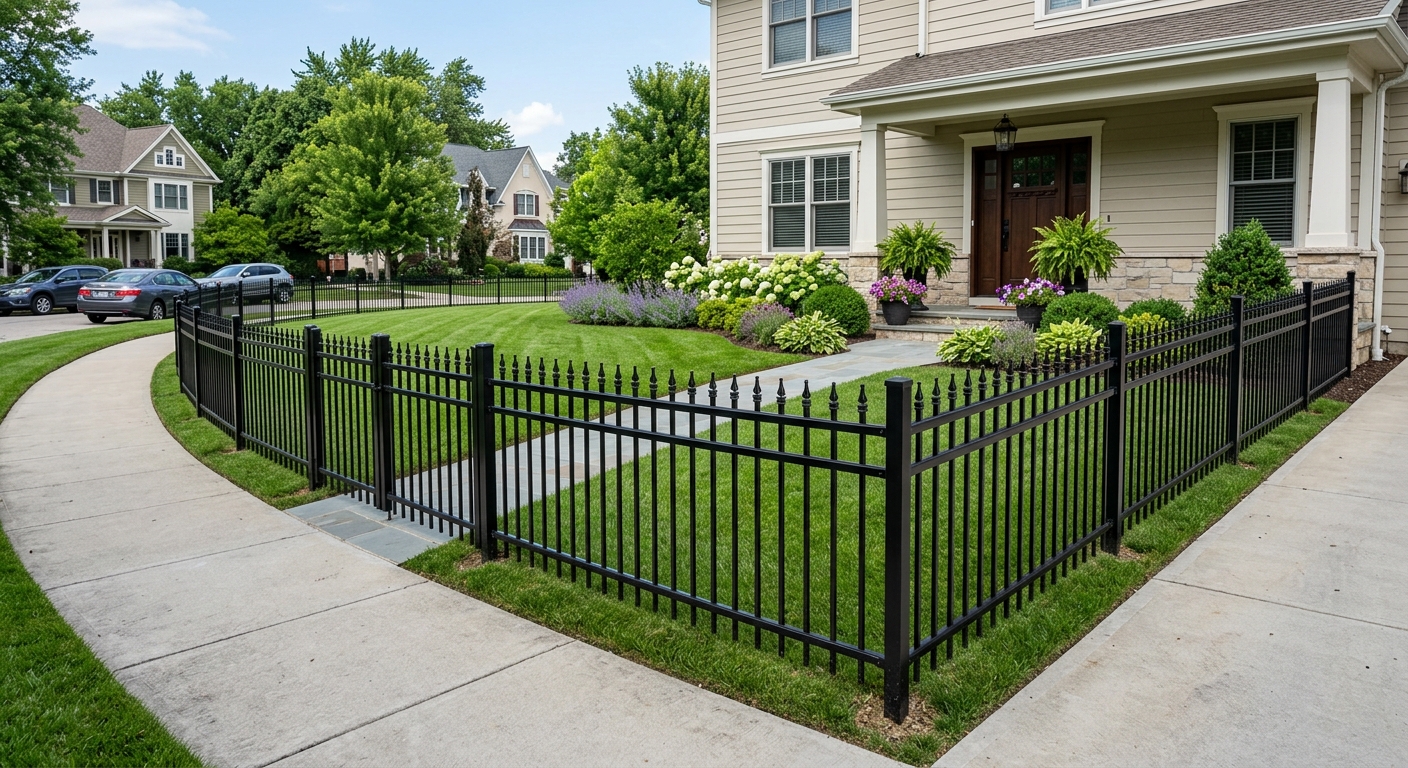
Fencing options and costs in Strathroy
Strathroy homeowners usually start their fencing plan with privacy and long-term stability in mind, and for good reason—there’s more than 23,871 people in the town (Statistics Canada, 2021 Census). In practice, that steady housing demand means local crews are familiar with backyard layouts, mature lots, and the soil conditions that affect post holes. Strathroy also sits within the broader Toronto economic region, so scheduling and material availability tend to track GTA contractor capacity and seasonal installation windows.
Fencing costs here are shaped by Southern Ontario’s freeze–thaw cycles. While your fence may look “above grade,” the real work is in the footing: most privacy fences need concrete-set posts set well below the frost influence to reduce the chance of heaving over time. For taller solid fences (wood or vinyl), contractors typically use heavier posts and closer spacing (often 6–8 ft centres) to resist racking from wind and spring snow loads. If you’re in an area like North Street, where lots are older and fences often need replacement and realignment, it’s especially common to see more labour for removals, setting posts to the right depth, and re-leveling along irregular grades. That’s what drives the range you’ll see between quotes.
Below is a practical comparison to help you translate what you want—appearance, maintenance, and privacy—into a realistic per-foot budget.
| Material |
Lifespan |
Maintenance |
Privacy Rating |
Price per Linear Foot |
| Pressure-treated pine (standard wood) |
10–15 years |
Stain/seal every 2–3 years |
High (solid panels) |
$10 – $25 |
| Cedar (natural rot resistance) |
15–20 years |
Light stain every 3–4 years |
High (solid or close-board) |
$12 – $30 |
| Vinyl / PVC (no-maintenance) |
20–30 years |
Rinse only; avoid harsh impacts |
High (solid privacy styles) |
$14 – $32 |
| Chain-link (galvanized steel) |
25+ years |
Occasional rinse; tighten hardware as needed |
Low to Medium (with slats only) |
$8 – $18 |
| Aluminum ornamental |
25+ years |
No rust; occasional wash |
Low (open pickets) |
$12 – $28 |
| Composite / recycled material |
20+ years |
Minimal; occasional cleaning |
Medium to High (style dependent) |
$16 – $35 |
Prices are estimates only and vary by project scope, site access and material selection.
What affects the price of fencing in Strathroy
In Strathroy, two quotes for what looks like the same fence can still land 30–50% apart. The most common reason is that contractors price the groundwork and the system—post depth, setting method, hardware, and grading—rather than just the material on paper. In the Toronto economic region, crews also compete for installs in spring and early fall, so access, crew availability, and the time required to prep lots can change the final number.
Post depth is a major swing factor. Southern Ontario frost depth is often treated as roughly 42"–48", which means posts typically need to be set about 4–6 inches below that design influence to limit heaving. That commonly works out to about 1.5–2.0 m in the ground, and it generally requires longer posts and concrete-set holes (ready-mix costs and labour time increase accordingly). Wind is another consideration: while the GTA doesn’t get the same open-field wind loads you’d see on the Prairies, taller solid privacy fences still need appropriate post size and tighter spacing to reduce racking and uplift. By contrast, some coastal areas have different failure modes (like faster wood rot), but here the freeze–thaw cycle is the bigger driver.
Concrete examples: (1) A 6–8 ft privacy fence with concrete-set posts usually costs more than a fence where posts are only gravel-packed; the stability is better, but the labour and concrete add cost. (2) If you’re replacing an older fence along a slightly sloped backyard, stepped panels and more layout time can raise the installed price even when the linear footage stays the same. In budget terms, chain-link often lands closer to the $45–$85 range for similar installs, while vinyl/PVC typically tracks the $75–$130 band—especially once you factor in post spacing and gate hardware.
Finally, older housing stock in the Strathroy area frequently means hidden surprises: buried debris near old post holes, uneven lot lines, or additional layout corrections that add dollars quickly.
| Price Factor |
Why It Matters |
Cost Impact |
| Fence length in linear feet |
More sections means more posts, rails, and hardware. |
Highest impact; drives most of the total. |
| Post depth required |
Frost influence sets hole depth and post length. |
Moderate to high; affects material and labour time. |
| Post setting method |
Concrete-set posts resist heaving better than gravel or driven methods. |
High; concrete-ready mix and more labour time. |
| Material choice |
Vinyl/cedar cost per board and hardware requirements differ. |
Moderate to high; can shift the whole project band. |
| Gate count and type |
Gates require heavier frames, hinges, and often additional bracing. |
Moderate; one drive-through gate can add significant labour. |
| Grade and terrain |
Slope requires stepping or raked panel systems and careful layout. |
Moderate; extra time and parts. |
| Old fence removal and disposal |
Demolition time, hauling, and stump/post remnants increase scope. |
Moderate; can add several hundred to over a thousand dollars. |
| Permit fees and survey / property line locate |
Paperwork and accurate locating prevent rework and disputes. |
Low to moderate; varies by scenario. |
Permits & regulations in Ontario
In Ontario, fence requirements are tied to height and location, and Strathroy homeowners should expect rules that apply both at the front and rear. As a practical guideline, fences above a height threshold—commonly around 2.0 m (6.5 ft) at the rear and about 1.0–1.2 m (3–4 ft) at the front or corner—often trigger a building permit requirement. Municipal bylaws also govern setbacks, and that’s why “same fence, different street” can produce different approval outcomes.
Before any digging, call to locate buried utilities. In Ontario, that means Ontario One Call (1-800-400-2255) or their online request system, so your excavator doesn’t hit gas, hydro, telecom, or water lines. Also consider getting a survey (or at least a property pin locate) before you install: even when you’re sure of your boundary, old fences can be off by inches or feet, and encroachment disputes are costly to fix.
For shared fence lines, Ontario’s line-fence legislation governs how shared fencing is maintained and paid for—your contractor can build what you agree to, but the underlying ownership and contribution rules are provincial.
How to verify a contractor properly: check that they’re licensed/registered where applicable in Ontario, review their certificate of liability insurance (and ensure it’s current for the work), and confirm workers’ coverage (WSIB clearance/coverage information or equivalent proof, as applicable to the contractor’s setup). Ask for those documents before signing, and keep copies with your contract.
Choosing the right fence material for Strathroy
Choosing the right fencing material in Strathroy is mostly about matching your priorities—privacy, maintenance level, and lifespan—to how our winters behave. With Toronto-region freeze–thaw cycles, the fence you regret least is usually the one designed for stable posts: concrete-set footings and appropriate spacing matter as much as the board or panel material.
Pressure-treated pine is the lowest upfront option, but it typically needs staining or sealing every 2–3 years to slow down grey weathering and keep surface integrity. Cedar looks great and resists rot naturally, but it still performs best with periodic staining. Vinyl/PVC is popular for low maintenance, because it doesn’t need painting or staining; however, it can crack if impacted and it can look “different” in extreme cold if the system is installed without proper expansion considerations. Chain-link is long-lasting and budget-friendlier, but it offers low privacy unless you add slats or privacy screening. Aluminum ornamental is neat and rust-resistant, but it’s open; it won’t block sightlines like solid privacy boards.
For post depth, Southern Ontario’s design frost influence generally pushes you toward deeper holes (often about 1.5–2.0 m) and concrete-set posts for taller privacy fences. That added footing work is why many contractors steer homeowners toward stable systems rather than “driven posts,” especially for 6–8 ft fences.
Here’s where the price difference can make sense: a chain-link install may align with the $45–$85 band, but if you want real backyard privacy, vinyl privacy in the $75–$130 band (plus the right post system) is often justified because it delivers both enclosure and longer-term “set-and-forget” maintenance savings.
| Material |
Cold Tolerance |
Lifespan |
Annual Maintenance |
Best For |
Price Band |
| Pressure-treated pine |
Good with proper sealing and post stability |
10–15 years |
Seasonal inspection; stain as needed (typically every 2–3 years) |
Lowest cost privacy with willingness to maintain |
$65 – $120 |
| Cedar |
Good; tends to handle moisture better |
15–20 years |
Light stain/maintain every 3–4 years |
Appearance + rot resistance |
$75 – $130 |
| Vinyl / PVC |
Good; avoid impact and ensure correct install |
20–30 years |
Minimal (rinse/clean; hardware checks) |
Low maintenance privacy |
$75 – $130 |
| Chain-link |
Very good; steel holds up well |
25+ years |
Low (periodic rinse and tension checks) |
Security/perimeter with budget control |
$45 – $85 |
| Aluminum ornamental |
Excellent; does not rust |
25+ years |
Low (wash and check fasteners) |
Front yard aesthetics and defined boundaries |
$90 – $160 |
| Composite / recycled |
Good; performance depends on system and spacing |
20+ years |
Very low (cleaning; occasional inspection) |
Maintenance-free look with upgraded materials |
$90 – $160 |
How to choose a fencing contractor in Strathroy
For fencing work in Ontario (including Strathroy), start by verifying licensing, insurance, and workers’ coverage. Ask the contractor for their certificate of liability insurance and confirm the coverage is active and matches the project’s scope. If they have employees or subcontract labour, request proof related to WSIB coverage (or a clearance letter where provided) and ensure it aligns with their operational setup. In practice, you should be able to find their registration/clearance information through Ontario’s online channels, and a legitimate company should respond quickly with documents rather than “next week” assurances. Always request the clearance evidence before work begins.
Next, get 2–3 itemised written quotes. You want a breakdown that shows materials (posts, rails, panels, hardware) and labour separately, plus line items for concrete/footings, excavation, and any demolition/disposal. Avoid vague lump sums that don’t state whether removal is included, whether permits are covered, and whether a property line locate/survey is part of the price.
Warranty is also a big differentiator: ask for the workmanship warranty term (for example, post-footing stability, panel alignment, and install defects), the manufacturer product warranty, and whether warranties transfer to a new owner if you sell the home. For payment, don’t pay more than about 10–15% upfront; hold back a portion until the job is complete and cleaned up. Finally, require a start date and a completion estimate in writing—fencing is weather-dependent, but a contractor should still commit to an expected schedule.
- Request proof of current liability insurance (certificate with project dates/description if available).
- Confirm workers’ coverage: WSIB clearance letter or proof as applicable.
- Get 2–3 itemised quotes with separate labour, materials, and footing costs.
- Ask whether concrete-set posts are included and specify post depth/hole depth.
- Confirm panel spacing (especially for privacy fences) and post sizes/hardware.
- Verify what’s included for gates: frames, bracing, hinges, latches, and alignment.
- Ensure old fence removal and disposal are listed as an add-on or included scope.
- Ask how the contractor handles sloped yards (stepped vs. raked) and who designs it.
- Confirm utility locate responsibility and whether the contractor runs Ontario One Call scheduling.
- Ask if permits/property line locate are included or require separate payment.
- Review warranty details in writing: workmanship and product warranty terms.
- Set payment terms in the contract with a holdback until completion and walkthrough.
Red flags I commonly see around Strathroy: contractors who won’t provide insurance/coverage documents on request; quotes that are “too good to be true” because post depth and concrete-set footings are missing; vague scope language that excludes removal/disposal and then invoices later; no clear timeline or no written start/completion dates; and pressure to collect a large deposit before any materials are ordered or layout is confirmed.
Frequently asked questions — fencing in Strathroy
How deep should fence posts be for Strathroy's frost?
For Strathroy and the surrounding Southern Ontario climate, post depth is normally set to resist frost heave. While contractors use slightly different methods, a common best practice is to set footings roughly 4–6 inches below the design frost influence. In practice, that often means posts end up about 1.5–2.0 m into the ground for taller privacy fences, especially 6–8 ft styles. Because of clay and mixed soils in this region, most contractors recommend concrete-set posts (not just gravel or driven posts) to improve long-term stability. If a quote doesn’t clearly state post depth and whether concrete is used, ask directly—this is one of the biggest “hidden” differences between low and mid-range pricing.
Wood vs vinyl vs aluminum fence — which is best?
“Best” depends on what you’re optimizing. Wood (pressure-treated pine or cedar) offers a classic look and usually fits a broader range, but it requires maintenance—often staining or sealing every 2–3 years for pressure-treated pine. Vinyl/PVC is typically a stronger choice for low maintenance privacy, with long service life and minimal yearly upkeep, though the upfront cost is higher and installation details matter in winter. Aluminum ornamental is excellent for appearance and corrosion resistance without rust, but it won’t block sightlines like a solid privacy fence. If you want privacy, you’ll usually be comparing options in the mid bands; for example, vinyl privacy frequently lands around the $75–$130 range, while chain-link security can be closer to $45–$85 when privacy isn’t the goal.
Do I need a permit to build a fence in Ontario?
In Ontario, permits are commonly tied to fence height and location (front vs. rear/corner). A practical rule of thumb many homeowners run into is that fences around 2.0 m (6.5 ft) at the rear and roughly 1.0–1.2 m (3–4 ft) at the front or corner may require a permit, depending on municipal rules. In Strathroy, it’s smart to confirm requirements before you buy materials, especially for taller privacy fences, because the permit decision affects scheduling and paperwork. Regardless of permits, you must follow property line setbacks and respect utility locations. A solid contractor should tell you whether their scope includes permit handling or if you’ll need to apply separately.
How long does a wood fence last in Strathroy?
With proper installation for Strathroy’s freeze–thaw conditions, wood fences often last around 10–15 years for pressure-treated pine and about 15–20 years for cedar, assuming the posts are set correctly and the wood is maintained. The biggest life-shortener isn’t only rot—it’s also movement from frost heave when post depth and concrete setting aren’t done right. Wood also needs ongoing surface protection: pressure-treated pine typically needs staining/sealing every 2–3 years to reduce grey weathering and maintain water resistance. If you’re seeing fast deterioration near the bases, that’s often a sign of footing and drainage issues rather than a “bad board” problem.
Who owns and maintains a shared fence?
On shared boundary lines in Ontario, the responsibility for ownership, maintenance, and cost sharing is governed by provincial line-fence legislation. In plain terms, if the fence truly runs on a shared line, both adjoining owners may share in maintenance or replacement according to the legal framework and what’s agreed between parties. Practically, you’ll want to confirm the exact boundary (survey or locate) before building—old fences can be misaligned. When you talk to your neighbour, base the conversation on the fence location, expected lifespan, and who pays for which parts (materials, labour, and disposal). Your contractor can build what you jointly approve, but the underlying rules and contributions come from Ontario’s line-fence guidance.
How do I find my property line before fencing?
Start with your property pins and existing survey documentation if you have it. If you don’t, the safest approach in Strathroy is to get a survey or at least have a property pin locate completed before posts go in. Many disputes happen because an older fence was installed slightly off the true line, so “where the fence is” isn’t always “where the boundary is.” Also, before digging, arrange utility locates through Ontario One Call so you can excavate safely. When a contractor prepares the layout, insist on a clear marked line and confirm the measured distances match your pins and locate information. This reduces rework and helps avoid neighbour disagreements.