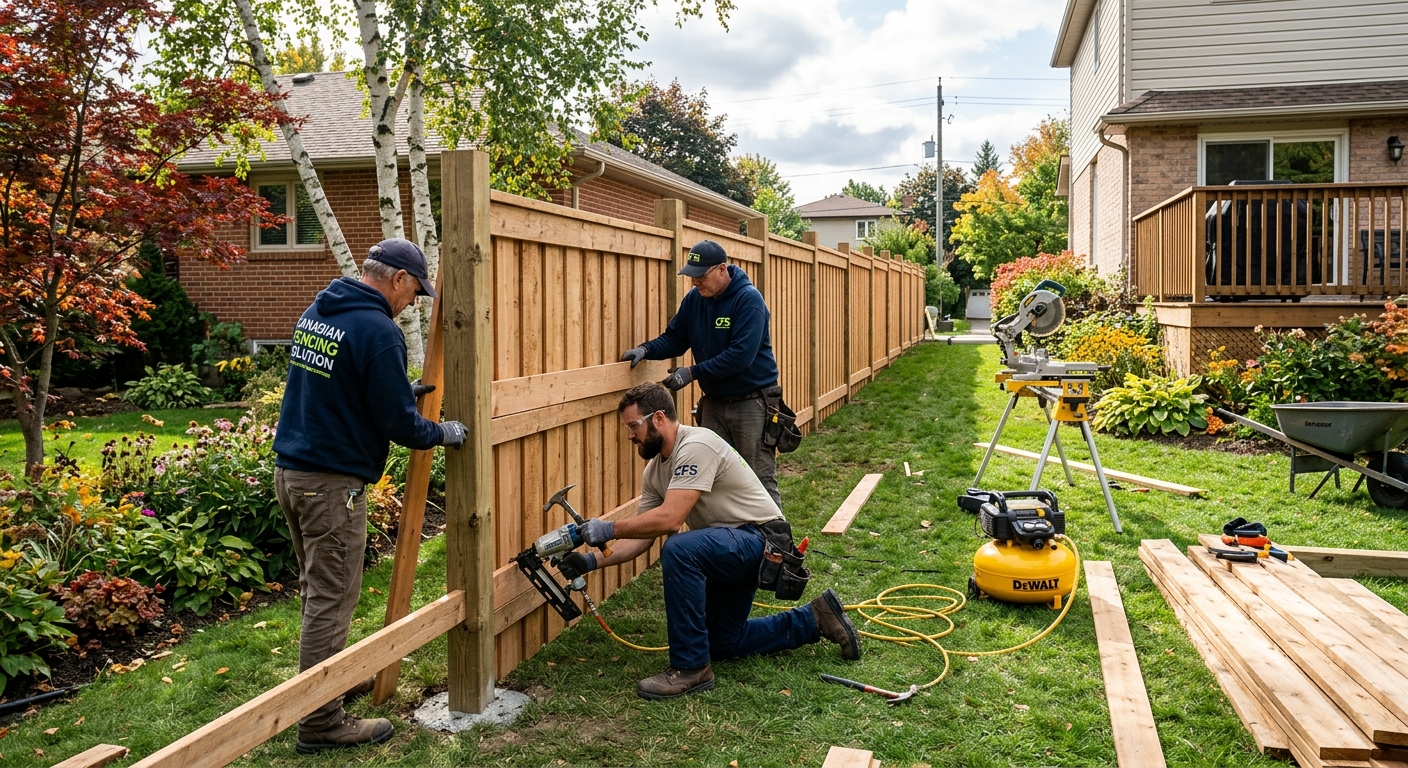
Fencing options and costs in Bolton
Bolton homeowners typically choose their fencing based on privacy, yard shape, and the day-to-day effort they’re willing to manage. Bolton’s population was 26,795 in the 2021 Census (Statistics Canada, 2021 Census), and the Toronto economic region’s steady housing demand helps keep local fencing crews busy—especially in mature neighbourhoods where side yards are already established. That matters because many customers are adding infill panels, replacing worn sections, or upgrading from chain-link to a solid privacy fence. In practice, fence replacements are common anywhere there are older lots and frequent home renovations, and each project’s scope (new posts, line repair, demolition, and gates) can change the final installed price.
In Southern Ontario, costs are shaped heavily by freeze conditions. Frost is commonly planned around 42"–48", so contractor quotes usually assume concrete-set posts with deeper holes to reduce frost heave—particularly for 6–8 ft privacy fences. This is one reason Toronto-area projects often land closer to the upper end of typical price bands. You’ll also see pricing vary based on neighbourhood access and wind exposure; open corners and wider backyards can require more robust post sizing and hardware to prevent racking.
In Bolton, trade demand is especially noticeable in areas around the Bolton core and nearby established subdivisions, where backyard privacy upgrades are common. Below is a side-by-side cost and performance comparison to help you estimate which material fits your priorities—then you can refine it with an itemised quote.
| Material |
Lifespan |
Maintenance |
Privacy Rating |
Price per Linear Foot |
Price Range |
| Pressure-treated pine (standard wood) |
10–15 years |
Stain/seal every 2–3 years |
High (solid panels) |
$18–$32 |
$65–$120 |
| Cedar (natural rot resistance) |
15–20 years |
Reseal/stain every 2–3 years (lighter effort) |
High (solid pickets/boards) |
$22–$38 |
$70–$130 |
| Vinyl / PVC (no-maintenance) |
20–30 years |
Rinse as needed (no staining) |
High (solid privacy styles) |
$24–$42 |
$75–$130 |
| Chain-link (galvanized steel) |
20–30 years |
Occasional tension and coating touch-ups |
Low–Medium (privacy screen optional) |
$14–$24 |
$45–$85 |
| Aluminum ornamental |
25–40 years |
Wash annually; inspect gates/hardware |
Medium (semi-open style) |
$22–$40 |
$90–$160 |
| Composite / recycled |
20–30 years |
Low (periodic cleaning) |
High (board/solid styles) |
$25–$45 |
$90–$160 |
Prices are estimates only and vary by project scope, site access and material selection.
What affects the price of fencing in Bolton
In Bolton and across the Toronto economic region, two quotes that look similar on paper can still differ by 30–50% once you account for how posts are installed, how many gates you’re adding, and what the ground conditions require. In the GTA, contractors typically set posts deeper and more securely because clay and mixed soils can heave as freeze–thaw cycles repeat. That means even when the material is “mid-range,” the labour and concrete can push the project toward the higher part of the wood or vinyl bands.
The biggest variable is frost-line planning. Southern Ontario commonly uses a design frost range of roughly 42"–48", so contractors often set posts at least 4–6 inches below the design frost depth, which typically works out to about 1.5–2.0 m of embedment. Practically, deeper holes mean longer posts, more excavation time, and more ready-mix. A second factor is wind loading: while the GTA isn’t as severe as exposed Prairie sites, taller solid privacy fences can rack during storms and can shift under repeated freeze–thaw if post spacing and panel fastening aren’t tuned.
Concrete examples that routinely move costs in Bolton: (1) a 6 ft replacement with concrete-set posts often lands closer to the upper wood band—versus a lower-cost chain-link run where post depth can be simpler; (2) a vinyl privacy fence in a narrow side yard can cost more even at a similar material price because of access and panel handling; (3) sloped lots near creeks or established backyard grades can require stepped rails, extra labour, and sometimes additional lumber waste—pushing the total closer to the vinyl/composite band rather than the low end of the pricing chart.
To forecast your budget, treat every fence quote as “length + ground + hardware.” A 50 linear foot fence with one gate can land near the mid $60s–$100s per linear foot range for many Toronto-area wood jobs, while adding a second gate, demolition, and heavier privacy panels frequently moves totals into the $90–$160 per linear foot band for vinyl/aluminium/composite projects.
| Price Factor |
Why It Matters |
Cost Impact |
| Fence length in linear feet |
Labour and materials scale directly with total run |
Large (often 50–70% of total) |
| Post depth required |
Frost line determines hole depth and post length |
Medium–Large (can add 10–25%) |
| Post setting method |
Concrete-set posts are more stable but labour-intensive |
Medium (adds setup and material) |
| Material choice |
Vinyl/aluminium/composite cost more than wood or chain-link |
Medium–Large (shifts to different band) |
| Gate count and type |
Drive-through gates require heavier frames and hardware |
Large (often $600–$2,000+ per gate) |
| Grade and terrain |
Slopes require stepped or raked layouts and extra fittings |
Medium (adds time and waste) |
| Old fence removal and disposal |
Demo adds labour, hauling, and sometimes salvage decisions |
Medium (can be 5–15%+ of total) |
| Permit fees and survey / property line locate |
Administrative and locating work prevents boundary mistakes |
Small–Medium (but can be essential) |
Permits & regulations in Ontario
In Ontario, fences above a height threshold typically require a building permit—commonly 2.0 m (6.5 ft) at the rear and 1.0–1.2 m (3–4 ft) at the front or corner, depending on the yard and local rules. Regardless of permit requirements, all fences must respect property lines and municipal setback requirements. In Bolton, it’s also common to find older lots with established lines; if your fence plan doesn’t match your pins, you can end up in a neighbour dispute even when the fence “looks right.”
Before digging any post hole, call for utility locates using Ontario One Call. That step protects buried hydro, communications, and gas lines. Next, obtain a survey or have your property pins located before installing so your rails and gate posts land where they’re supposed to. Shared fence boundaries are governed by Ontario line-fences principles, so if the fence is truly on or beside a shared boundary, document agreement terms in writing before construction starts.
What typically DOES require a permit: new fences above the noted height thresholds, major upgrades that change height materially, and sometimes gates that significantly alter the structure near front/corner areas. What typically does NOT: replacing like-for-like sections that don’t increase height beyond thresholds, routine repairs, and swap-outs in the same footprint (confirm with your permit office before work begins).
To verify a contractor in Bolton, ask for: (1) proof of licence/registration if applicable for the work category (check the online registry listed on their site or ask them directly), (2) a current certificate of insurance naming you as an additional insured where appropriate, and (3) WSIB coverage evidence (or the applicable exemption letter if they claim one). Clearance letters and the policy dates should be current for your start date.
Choosing the right fence material for Bolton
Picking the right fence material in Bolton is mostly about matching your budget to how much maintenance you’ll realistically do—and how the material behaves through Southern Ontario winters. Pressure-treated pine is the lowest upfront choice, but it typically requires staining or sealing about every 2–3 years to limit greying and surface breakdown. Cedar looks better and has better natural rot resistance, yet it still benefits from regular maintenance to keep it looking uniform.
Vinyl/PVC is a popular option for homeowners who want low day-to-day effort. The trade-off is higher upfront material and the need for correct installation: properly set, plumb posts and good expansion/fastening practice matter to avoid issues in extreme cold snaps. Chain-link is the most budget-friendly and durable choice, but it offers low privacy unless you add slats or a screen—so it’s usually chosen for security rather than concealment. Aluminum ornamental fencing offers a clean, rust-resistant look, but it’s not a full privacy fence and tends to cost more than most wood or chain-link runs.
For Toronto-area frost conditions, many contractors recommend concrete-set posts for privacy fences because deeper embedment helps reduce frost heave in clay and mixed soils. Whether you choose wood, vinyl, or composite, expect similar post-depth requirements in order to keep the fence line stable. Wind and snow loads also favour correct post sizing and closer spacing for taller solid panels (often 6–8 ft centres) so the fence resists racking.
A concrete budget example: if you’re comparing a pressure-treated pine privacy fence versus vinyl, a typical project might fall near the wood band (around $65–$120) but could move toward the vinyl band (around $75–$130) once you include heavier posts and access work. That extra cost can be justified if you want to avoid recurring staining and repainting for many years.
| Material |
Cold Tolerance |
Lifespan |
Annual Maintenance |
Best For |
Price Band |
| Pressure-treated pine |
Good (with proper sealing) |
10–15 years |
1 minor inspection; stain/refresh every 2–3 years |
Budget privacy with willingness to maintain |
$65–$120 |
| Cedar |
Good (natural resistance) |
15–20 years |
1 inspection; reseal/stain every 2–3 years |
Better look and slower rot without premium metal costs |
$70–$130 |
| Vinyl / PVC |
Very good (proper installation required) |
20–30 years |
Rinse/spot clean as needed |
Low-maintenance privacy through Ontario winters |
$75–$130 |
| Chain-link |
Excellent |
20–30 years |
Occasional hardware checks |
Security, pets, and long service life |
$45–$85 |
| Aluminum ornamental |
Excellent (non-rusting) |
25–40 years |
Wash annually; check hinges/latches |
Curb appeal with boundary definition |
$90–$160 |
| Composite / recycled |
Very good (stable boards) |
20–30 years |
Low; periodic cleaning |
Durable privacy with reduced wood upkeep |
$90–$160 |
How to choose a fencing contractor in Bolton
Choosing a fencing contractor in Bolton comes down to proof, process, and clarity. Start by verifying Ontario coverage and credentials: request a current certificate of insurance (liability) and ensure the policy dates cover your construction window. Ask for WSIB coverage documentation for workers; if they’re claiming an exemption, they should provide the appropriate clearance letter. For licensing, ask what category they operate under for the work they’re doing and confirm using the applicable online registry the contractor provides. A legitimate fence company should answer quickly and provide documents without pressure.
Next, request 2–3 written itemised quotes, not just lump sums. Good quotes break out labour and materials (posts, rails, panels, fasteners, concrete, gates, and any removal). Watch the scope: what’s included for permit pull (if required), disposal of old fencing, and protection of grass, paving stones, or landscaping? If they say “we’ll handle it,” ask where that’s stated in the contract.
Warranty matters too. Ask for a workmanship warranty period and the product/manufacturer warranty specifics. Confirm whether the warranty is transferable if you sell the home—this can matter in Ontario where fences are often included in sale condition discussions. Payment schedules should be cautious: never pay more than 10–15% upfront; hold back part of the final amount until cleanup and punch-list items are complete. Finally, timeline: get a start date and completion estimate in writing so you can plan around the busy building season.
- Provide insurance certificate with your address listed (where applicable)
- Show WSIB clearance or coverage proof with dates
- Use a detailed site plan showing fence line, gate locations, and lengths
- Include concrete quantities if posts are concrete-set
- State post spacing and post size explicitly for tall privacy fences
- Confirm permit responsibility (who applies and what’s included)
- List whether old fence demolition and disposal are included
- Specify materials grade (wood treatment type, vinyl grade, chain-link gauge)
- Quote includes utility locate confirmation and marking responsibilities
- Provide warranty terms in writing (labour vs product)
- Use a payment schedule with 10–15% maximum deposit
- Document an estimated start date and completion window
Red flags I often see with fencing contractors in the Bolton area: skipping itemised breakdowns and quoting only a single “total,” refusing to provide insurance/WSIB documentation, vague language like “frost-proof posts” without depth or method, bundling permit responsibility without stating whether they’ll pull it, and requesting a large upfront payment beyond 10–15%.
Frequently asked questions — fencing in Bolton
Can I install a fence on a slope in Bolton?
Yes, you can install a fence on a slope in Bolton, but it should be designed correctly so it stays level on the fence line rather than “grading” the panels in a way that leaves gaps. Contractors typically use stepped panels for privacy fences or a raked design where rails follow the slope smoothly. Because Southern Ontario uses a frost depth approach of roughly 42"–48", the post holes still need to be excavated to the required embedment—so the fence height change comes from the layout, not from shallow posts. If you’re comparing materials, note that a stepped wood privacy fence might land around the wood band (for example, $65–$120), while a more complex vinyl privacy install with careful layout and heavier hardware can push you closer to the $75–$130 range.
What is the most weather-resistant fence for Bolton's climate?
For Bolton homeowners, the most weather-resistant options are typically vinyl/PVC, aluminum, and properly installed composite—provided posts are set deep enough for Southern Ontario frost conditions. Vinyl and composite boards handle freeze–thaw well when installed with correct fastening and solid post support, and aluminum won’t rust. Chain-link is also extremely durable and long-lived, but it doesn’t provide privacy unless you add a privacy screen. For most privacy-focused yards, vinyl often becomes the “set it and forget it” choice in the Toronto market, frequently falling within the $75–$130 band. A well-installed cedar fence can also perform very well, but it’s still best paired with maintenance to keep it looking consistent through Ontario winters.
How do I prevent wood fence rot in Bolton?
Wood rot prevention in Bolton is about installation details, not just the board type. Use rot-resistant material such as cedar or pressure-treated pine, but still follow good practices: keep the fence off bare soil where possible, avoid trapping standing water at post bases, and ensure panels aren’t pressed into mulch or damp ground. Concrete-set posts help stabilize the fence and can reduce moisture movement around the embedment zone. For pressure-treated pine, plan for staining or sealing about every 2–3 years; this is what slows down surface breakdown and greying in Ontario’s wet-to-freeze cycles. Also, use exterior-rated fasteners and keep sprinklers from hitting fence boards directly. If you’re doing a repair/replacement, ask your contractor whether they’re reusing hardware or replacing with treated/exterior-rated components.
What is the cost per linear foot for fencing in Bolton?
In Bolton, your cost per linear foot depends on material, height, and how the posts are installed. For budgeting, the common installed price bands for the Toronto economic region generally fall around: wood at $65–$120 per linear foot, vinyl/PVC at $75–$130, chain-link at $45–$85, and aluminum/metal at $90–$160. The “per linear foot” figure assumes typical privacy/security installations where contractors account for frost-depth embedment and proper post setting. If your property has narrow access, sloped grade, multiple gates, or requires old fence removal, the total can land toward the upper end of the band. For exact pricing, request an itemised quote with post depth, setting method, and gate hardware called out.
Should I repair or replace my old fence in Bolton?
In Bolton, repair can be the right move when the posts are solid and only panels or rails are failing. If you see post wobble, heaving after winter, or repeated rot at the base, replacement is usually more cost-effective long-term because new posts are the key to stability in Ontario’s freeze–thaw cycle. Also consider whether you’re upgrading privacy or changing gate sizes—those upgrades often require new framing and hardware, which pushes you toward a full replacement rather than piecemeal patches. As a rule of thumb: if multiple sections are failing within the same run, a single replacement may land closer to the wood band (for example, $65–$120) instead of repeated service visits that add labour each time. A contractor should assess the condition of post embedment, not just the visible boards.
How do I handle a fence dispute with a neighbour in Ontario?
Fence disputes in Ontario usually come down to property line location, shared boundary understanding, and agreed responsibilities for repairs or replacement. Start by locating your property pins or getting a survey so you can confirm where the fence should sit. Keep everything documented: photos, measurements, and copies of any prior agreements. If utilities or boundary markers are involved, don’t assume—verify before digging. Since shared fence ownership rules are governed by Ontario line-fences principles, you should aim for a written agreement on who pays for what, especially if you’re upgrading materials or changing the fence height. If the dispute is blocking the work, pause construction and consult a professional who can help interpret the boundary evidence. A good contractor can help by marking the proposed line clearly before any post holes are dug.