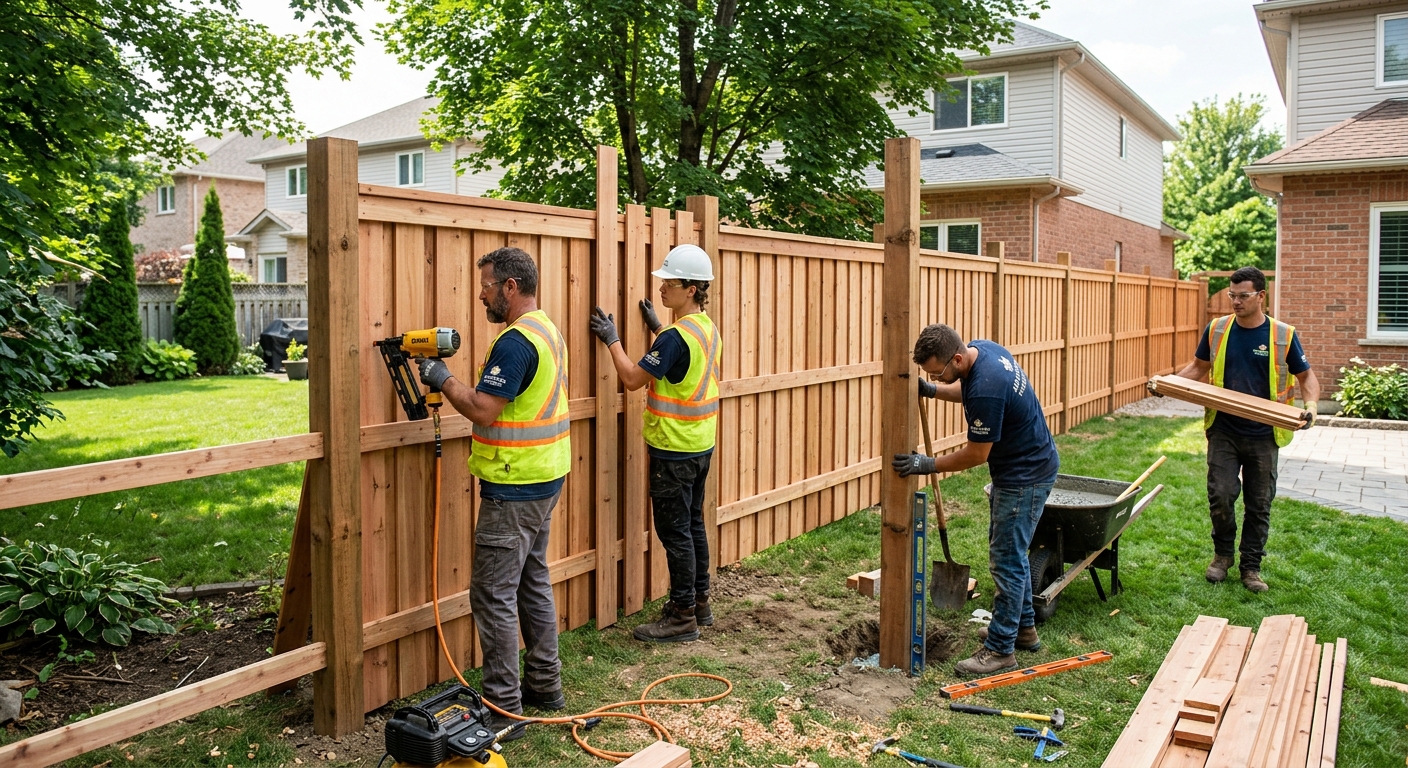
Fencing options and costs in Whitchurch-Stouffville
Whitchurch-Stouffville homeowners usually start fence planning with one big question: which material gives the look they want without turning into a maintenance project. With 49,864 residents and 14,695 homeowner households (87.9% of households own), there’s steady demand for back-yard privacy, pool enclosures, and side-yard boundary fencing tied to single-detached homes—74.3% of local dwellings are detached, so many properties need full perimeter runs rather than short sections.
In the Toronto economic region, fencing costs are shaped by freeze–thaw cycles and how most contractors build around them. The commonly used Southern Ontario frost-line rule of thumb is about 42"–48", so for 6–8 ft privacy fences, posts are typically set with concrete and placed roughly 3.5–4 ft deep to reduce frost heave and long-term leaning. Local clay and mixed soils also push builders toward concrete-set posts instead of simple driven posts, which increases labour time and ready-mix costs but improves stability.
Trade activity is especially strong in growth pockets like the East/central Stouffville corridor where new builds and landscaping updates are frequent, and where backyard fences are often installed soon after grading is complete. If you’re budgeting, it helps to compare common material options side-by-side before you request itemized quotes for your exact linear footage, gate count, and site access. Use the table below to anchor expectations, then we’ll break down what changes the price most in the next section.
| Material |
Lifespan |
Maintenance |
Privacy Rating |
Price per Linear Foot |
| Pressure-treated pine (standard wood) |
10–15 years |
Stain/seal every 2–3 years; inspect annually |
High (solid boards/panels) |
$15 – $26 |
| Cedar (natural rot resistance) |
15–20 years |
Light staining or oiling every 2–4 years |
High (solid boards/panels) |
$18 – $32 |
| Vinyl / PVC (no-maintenance) |
20–30 years |
Rinse as needed; no staining |
High (solid privacy styles) |
$20 – $38 |
| Chain-link (galvanized steel) |
25–35 years |
Occasional wash; tighten hardware as needed |
Low–Medium (privacy slats optional) |
$10 – $18 |
| Aluminum ornamental |
25–40 years |
Minimal wash; inspect gate latches |
Low (open pickets) |
$18 – $40 |
| Composite / recycled material |
20–30 years |
Low; clean and check fasteners |
High (solid styles) |
$22 – $42 |
Prices are estimates only and vary by project scope, site access and material selection.
What affects the price of fencing in Whitchurch-Stouffville
In Whitchurch-Stouffville, it’s common to see quotes for the “same” fence range by 30–50% across the Toronto area and Ontario. The biggest driver is that fencing is built on-site: linear footage, post depth, soil conditions, and access all change the labour hours, concrete volume, and material waste. Contractor availability matters too—when crew schedules are tight around peak season, lead times can push scheduling costs and influence pricing.
Toronto’s frost line is a major reason posts cost more here. Best practice in Southern Ontario is often treated as needing post holes set roughly 4–6 inches below the design frost depth; in cold regions, that means posts frequently land about 1.5–2.0 m into the ground. For 6–8 ft privacy fences, that typically requires longer posts and concrete-set footing (not gravel-only or driven posts), which raises both material cost and labour time. Meanwhile, while the GTA doesn’t experience the extreme open-field wind loads seen on the Prairies, wind still affects how contractors size panels, choose spacing, and select hardware; solid privacy styles often need heavier posts (and tighter spacing) to resist racking.
Two practical examples: if your yard has clay-heavy soil or soft spots common in the Toronto region, drilling and concrete bearing can increase labour and concrete quantities; if you have good access for a skid steer or trailer, costs can drop because excavation and deliveries are faster. Also, older fences (pre-1981 homes make up 22.4% of local stock, so upgrades are frequent) often require removal and disposal, adding hauling fees and additional labour before the new layout is set. For budgeting, a wood privacy run may start near the lower end of Ontario bands (wood installations often land around $65–$120), while vinyl privacy commonly runs higher (often $75–$130) because materials and post hardware add up.
Next, we’ll cover permits and the checks homeowners should complete before anyone digs a single post hole.
| Price Factor |
Why It Matters |
Cost Impact |
| Fence length in linear feet |
Every additional foot adds materials, posts, and labour time. |
$200 – $1,200+ per incremental section depending on style |
| Post depth required — frost line determines post length and hole depth |
Deeper holes mean more excavation and more concrete volume; also requires longer posts. |
$350 – $1,000 per typical run of privacy posts |
| Post setting method — concrete vs. gravel pack vs. driven posts |
Concrete-set posts are more stable in freeze–thaw soils but cost more. |
$500 – $2,000 depending on soil and number of posts |
| Material choice — vinyl vs. cedar vs. chain-link |
Materials and hardware differ in cost; vinyl and cedar typically cost more than chain-link. |
$750 – $3,500 for a full backyard-sized project |
| Gate count and type — walk-through vs. drive-through (double) |
Gates require heavier framing, hinges, latches, and often thicker posts. |
$400 – $2,800 per gate depending on size and type |
| Grade and terrain — sloped yards require stepped or raked panels |
Slopes increase labour and may require extra posts or customized panel adjustments. |
$300 – $1,500 for a sloped perimeter |
| Old fence removal and disposal |
Demolition, hauling, and any buried post removal add time and equipment costs. |
$500 – $2,500 depending on length and condition |
| Permit fees and survey / property line locate |
Some builds trigger permitting; accurate layout prevents encroachment issues. |
$150 – $1,200 in typical scenarios |
Permits & regulations in Ontario
In Ontario, fence rules are primarily about height, location, and respecting property lines and setbacks. In many municipalities, fences above a height threshold—often around 2.0 m (6.5 ft) at the rear and closer to 1.0–1.2 m (3–4 ft) at the front or corner—commonly require a building permit. Even when a permit isn’t triggered, setbacks and property-line alignment still matter, especially on corner lots.
Before digging any post hole in Whitchurch-Stouffville, homeowners should arrange utility locates through Ontario One Call so crews avoid hitting buried services. Next, confirm your boundary lines: if you don’t already have a recent survey, get a property pin locate or verify your survey documents. This step reduces the risk of building on a neighbour’s land, which can quickly turn into costly rework.
Shared fencing ownership and responsibilities are also governed by Ontario’s line-fences framework, but the most important practical point is clarity: if the fence is truly on a shared line, confirm who owns the materials and who pays for repairs before work starts.
How to verify a contractor (step-by-step): (1) Request your contractor’s Ontario licence details or business registration proof; (2) ask for an up-to-date certificate of insurance showing general liability; (3) confirm WSIB coverage (or the appropriate exemption documentation where applicable); (4) verify clearance letter details if they provide them; and (5) keep copies for your records.
In the next section, we’ll match materials to Whitchurch-Stouffville’s weather realities and your priorities—privacy, maintenance, and lifespan.
Choosing the right fence material for Whitchurch-Stouffville
Choosing the right fence material in Whitchurch-Stouffville is about matching your priorities—privacy, low maintenance, budget, and lifespan—to what the local climate does over time. Pressure-treated pine is the most budget-friendly option, but it typically needs staining every 2–3 years to prevent grey weathering and to keep boards looking even. Cedar offers better natural rot resistance and a warmer appearance, yet it still requires periodic sealing or staining to keep colour and reduce surface cracking.
Vinyl/PVC is popular for “set it and forget it” maintenance. It resists rot and never needs staining, but it can become brittle if installed with poor hardware or in extremely cold snaps without correct expansion spacing. Chain-link is the lowest upfront cost and the longest-life framing choice, but it won’t deliver real privacy unless you add privacy slats or switch to a solid panel style. Aluminum ornamental looks clean and never rusts like steel can, but it’s primarily decorative—privacy is limited due to the open picket design. Composite/recycled materials sit in the low-maintenance middle-to-upper range and can be a good option when you want solid privacy without the staining cycle.
For Toronto-area frost conditions, the big structural decision is post depth and setting method rather than the “brand” of fence. With frost-line guidance around 42"–48", most solid fences benefit from concrete-set posts (or equivalent engineered footing) to resist heaving in clay/mixed soils. Higher solid fences also need wind-stiff construction: heavier posts and tighter spacing help prevent racking and uplift.
A simple budget justification: if a wood privacy fence is priced closer to the lower wood installation band and a vinyl privacy fence is closer to the higher end of the vinyl band, vinyl can be worth the increase when you want to avoid staining for decades. If you only plan to stay 5–7 years, wood may be the smarter value; if you’re staying long-term, vinyl or composite often pencils out.
| Material |
Cold Tolerance |
Lifespan |
Annual Maintenance |
Best For |
Price Band |
| Pressure-treated pine |
Good with correct staining and post setting |
10–15 years |
2–3-year stain cycle; annual visual checks |
Budget-first privacy and straightforward installs |
$65 – $120 |
| Cedar |
Good; performs well in freeze–thaw when sealed |
15–20 years |
2–4-year seal/stain cycle |
Natural look with better rot resistance |
$75 – $130 |
| Vinyl / PVC |
Very good when installed with expansion and correct hardware |
20–30 years |
Low: rinse/inspect hardware as needed |
Low maintenance solid privacy |
$75 – $130 |
| Chain-link |
Good; galvanized coatings handle winters well |
25–35 years |
Occasional wash and hardware check |
Security boundaries and pets |
$45 – $85 |
| Aluminum ornamental |
Excellent (no rust); hardware quality matters |
25–40 years |
Low: wash; check gate latches |
Curb appeal with moderate visual openness |
$90 – $160 |
| Composite / recycled |
Good; board fastening and airflow reduce issues |
20–30 years |
Low: occasional cleaning and fastener checks |
Solid privacy with reduced staining |
$85 – $150 |
How to choose a fencing contractor in Whitchurch-Stouffville
Hiring the right fencing contractor in Whitchurch-Stouffville starts with verifying coverage and checking how they build. Ask for proof of Ontario business registration/licensing, then request a certificate of insurance that clearly lists general liability and adequate coverage limits for your project. Next, confirm WSIB coverage: the contractor should either be registered with WSIB or provide documentation explaining how they comply if they’re exempt. This protects you if a worker is injured on your property.
Get 2–3 itemized written quotes, ideally with a labour-and-materials breakdown rather than a single lump sum. The best quotes list: fence type, post size and spacing, post depth expectations (including frost-safety details), concrete quantity or footing method, hardware brand/grade, gate type and hardware, and disposal/cleanup. Also check what’s excluded: removal of buried posts, damaged landscaping, trimming trees, replacing compromised subgrade, and any permit-related work (if required).
Warranty matters. Confirm the workmanship warranty length (not just product warranty), whether it applies to gate alignment and post setting, and whether the manufacturer’s warranty transfers if you sell the home. For payment, never let a contractor ask for more than 10–15% upfront; hold back the remainder until the job is complete and you’ve confirmed material match, straightness/level alignment, and gate operation.
Timeline should be in writing. Ask for a realistic start date, an estimated completion window, and how weather delays are handled during Toronto-area freeze–thaw and rainy stretches.
- Request their WSIB proof and general liability certificate before signing.
- Confirm who pulls any permits (if your fence height triggers one).
- Insist on an itemized quote: posts, concrete, panels, gates, and hardware.
- Ask for post spacing and post dimensions (4x4 vs 6x6 vs larger) for privacy styles.
- Confirm concrete-set post policy and hole depth approach for frost resistance.
- Verify disposal/hauling is included for old fence removal.
- Check how they handle sloped yards (stepped vs raked panels) and near boundary lines.
- Ask about utility locate scheduling and who provides the locates reference.
- Review start/completion schedule and how rain/frost delays are communicated.
- Get warranty terms in writing: workmanship and product coverage.
- Confirm payment schedule and include it in the contract.
- Ensure they reference how they protect existing landscaping and driveways.
Red flags we commonly see in the Whitchurch-Stouffville market: quotes that don’t specify post depth or setting method; only a lump-sum price with no scope details for removal/disposal; missing or outdated insurance/WSIB paperwork; pushy payment terms asking for large deposits early; and vague timelines with no written completion date.
Frequently asked questions — fencing in Whitchurch-Stouffville
Should fence posts be set in concrete here?
In Whitchurch-Stouffville and across Southern Ontario, concrete-set posts are typically recommended for solid wood, vinyl, and privacy fences because freeze–thaw cycles can cause heaving if posts aren’t stable. The common frost-line rule of thumb (about 42"–48") means deeper post holes are usually needed—often around 1.5–2.0 m total depth for taller runs—so using concrete helps lock the post in place within suitable bearing and reduces movement over time.
That said, the “right” method depends on soil conditions and how the contractor designs the footing. Ask for the post depth and the setting method in your quote, not just the material type. A well-built solid fence may cost more initially, but it usually avoids the rework and leaning that can quickly wipe out savings.
As a reference point, privacy installs often fall within the mid-range of local bands (for example, wood installations commonly sit around $65–$120, while vinyl/PVC is often $75–$130), and concrete setting is one of the reasons.
What's the best fence for privacy?
For real privacy in Whitchurch-Stouffville, a solid-panel style is the best choice—typically wood (pressure-treated pine or cedar), vinyl/PVC privacy, composite privacy, or any fence designed with no meaningful gaps. Chain-link alone won’t give much privacy unless you add slats, and aluminum ornamental is usually too open for privacy goals.
Because taller solid fences catch wind and must resist racking, you’ll want heavier posts, closer spacing, and correct hardware. In Toronto’s climate, don’t shortcut post depth: frost heave is a common cause of misalignment on older fences where posts were only gravel-set or driven.
If you want the lowest maintenance while keeping privacy, vinyl/PVC and composite are often the most straightforward. If you want the best value for the first budget pass, pressure-treated pine privacy is usually the most affordable (often aligned with the wood band of $65–$120), while cedar offers a nicer look with better rot resistance at a higher price.
How do I compare fencing quotes?
Comparing fencing quotes in Ontario is easiest when each quote includes the same scope items. Start by lining up linear feet, fence height, gate count, and gate size (walk-through vs double drive gate). Then compare the building details: post size/dimensions, post spacing, post depth, and whether posts are concrete-set (especially important for frost resistance in this region).
Also check what’s included: old fence removal and disposal, utility locate responsibility, permit pulling (if your fence height triggers one), cleanup, and any restoration of disturbed ground. A cheaper quote often looks low because it excludes concrete setting, disposal, or uses lighter posts/panels.
Request itemized labour and materials. If one quote only provides a lump sum, ask for a breakdown. For budget anchoring, you can compare against local price bands—for example, chain-link is often around $45–$85, while aluminum ornamental is commonly $90–$160, and vinyl privacy tends to be nearer $75–$130.
How long does fence installation take in Whitchurch-Stouffville?
Most typical residential fences in Whitchurch-Stouffville are installed in about 1–3 days once the crew is on site, but the full timeline can be longer because scheduling and material ordering affect start dates. The biggest day-to-day variable is post excavation speed: frost-safe footing requires proper hole depth, and soil can be harder in some yards.
For longer runs, multiple gates, slopes that require stepped or raked sections, or properties with old fence removal, expect the timeline to stretch. If concrete is used for posts, crews still usually work in a standard day cycle, but the job should be completed with bracing/hardware installed properly rather than rushing.
Ask your contractor for a written start date and completion estimate, and clarify weather delay handling. In Southern Ontario, rain or ground freeze can temporarily slow excavation, so a realistic schedule helps you avoid gaps in the plan.
Can I install a fence on a slope in Whitchurch-Stouffville?
Yes, you can install a fence on a slope in Whitchurch-Stouffville, but the installation method matters. You generally have two options: stepped panels (each section is “tiered” to follow the slope) or a raked/angled adjustment where the top rail follows the grade. Which one is best depends on the fence style and how strict your visual alignment needs to be.
On sloped yards, expect extra labour because you may need to adjust post lengths, add precision layout work, and sometimes use more posts or customized panel cutting to keep spacing consistent. A good contractor will explain how they keep the fence level from a visual perspective without compromising structural integrity.
Because frost heave is still a concern, the contractor should also keep consistent post depth or engineered footing approach, even when the top surface changes with grade.
What is the most weather-resistant fence for Whitchurch-Stouffville's climate?
For Whitchurch-Stouffville’s freeze–thaw winters and wet springs, the most weather-resistant choices are typically vinyl/PVC or properly built cedar/pressure-treated wood with correct staining and post setting. Vinyl/PVC performs well because it doesn’t rot, and it handles moisture cycles better than untreated wood. Cedar is naturally resistant to rot and looks great, but it still needs maintenance to protect the surface over time.
Chain-link is also extremely durable in winter (galvanized steel with good coating), but it doesn’t provide privacy unless you add slats or choose a different design. Aluminum ornamental resists rust and remains stable visually, yet it’s open picket style, so privacy is limited.
Regardless of material, “weather resistance” depends heavily on installation quality—especially frost-depth and concrete-set posts for tall solid fences. If you’re comparing budgets, wood often aligns with $65–$120, while vinyl/PVC is commonly $75–$130, and that difference often reflects longer-life materials plus the stability built into the post system.