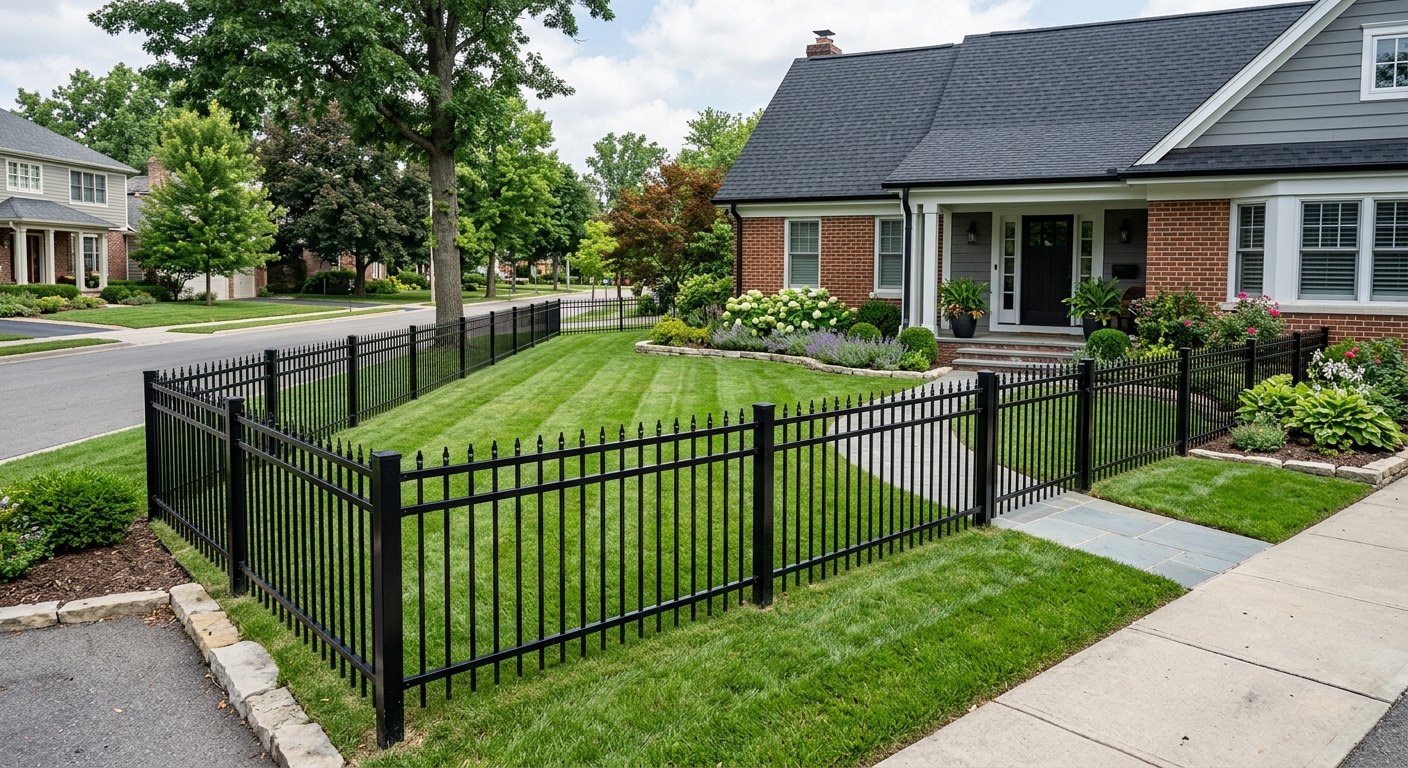
Fencing options and costs in University Downs
University Downs, Ontario is a small but well-established community within the Toronto economic region, and that matters because fences here are mostly driven by private backyards and growing in-fill property work. With a population of 4,036 (Statistics Canada, 2021 Census), demand isn’t “mass market,” but fencing still stays consistent because detached homes and family lots create steady turnover for privacy upgrades, pet containment, and backyard renovations. In practice, each new deck, pool, or landscaping refresh often triggers a boundary fence replacement or extension.
Toronto-area winters also shape what you pay. In Southern Ontario, the commonly used design frost line is about 42"–48", and most contractors plan for post holes set roughly 4–6 inches below that frost depth to reduce frost heave. For 6–8 ft privacy fences, this usually means concrete-set posts and deeper holes, which increases labour time and material costs versus simple driven posts. At the same time, wind loading isn’t as brutal as Prairie open fields, but solid panels still need proper post sizing and closer spacing to prevent racking and uplift.
Trade demand tends to be especially noticeable around family-heavy pockets like the residential corridors near the University Downs/Conestoga area (locals often call these “the backyard-renovation lanes”), where homeowners frequently upgrade from aging cedar and older chain-link to wood or vinyl privacy panels. Use the options below as your baseline, then compare the price bands by material and maintenance level in the table.
| Material |
Lifespan |
Maintenance |
Privacy Rating |
Price per Linear Foot |
| Pressure-treated pine (standard wood) |
10–15 years |
Stain/seal every 2–3 years |
High (solid picket/routed boards) |
$15 – $25 |
| Cedar (natural rot resistance) |
15–25 years |
Seal/stain every 2–4 years |
High (solid boards) |
$18 – $30 |
| Vinyl / PVC (no-maintenance) |
25–30 years |
Rinse only; occasional spot cleaning |
High (solid/walled systems) |
$20 – $32 |
| Chain-link (galvanized steel) |
20–30 years |
Minimal; occasional tension/repairs |
Low–Medium (privacy slats optional) |
$10 – $18 |
| Aluminum ornamental |
25–40 years |
Wash as needed; inspect hardware yearly |
Low–Medium (good visibility) |
$22 – $40 |
| Composite / recycled material |
20–35 years |
Minimal; occasional rinse |
High (solid systems) |
$24 – $38 |
Prices are estimates only and vary by project scope, site access and material selection.
What affects the price of fencing in University Downs
In University Downs and across the Toronto economic region, two homeowners can receive quotes for “the same fence” that differ by 30–50% because fencing is cost-sensitive to the details: how many linear feet you need, how deep posts must be set, how many gates are included, and whether your site requires extra labour for access and terrain. Even if materials look similar at first glance, installation choices (concrete-set vs driven posts, post spacing, bracing type) can shift the total quickly. That’s why price bands like wood at roughly $65–$120 and vinyl/PVC at $75–$130 (per linear foot installation tier) are useful, but the job-site variables still decide where you land.
Toronto frost protection is a major driver. In cold Ontario winters, post holes are typically planned with depth about 1.5–2.0 m into the ground (or at minimum set below frost), and the concrete-set method adds ready-mix and labour for hole prep and setting. For a taller 6–8 ft privacy fence, deeper, heavier installations plus closer spacing can raise costs even before you factor in demolition.
Local condition examples that commonly raise costs in University Downs include: (1) clay-heavy or mixed soils that don’t drain well, increasing the time to excavate clean post holes and set plumb; (2) sloped backyards that require stepped panels, which increases rail cuts and labour; (3) gates and corners that need stronger framing, meaning more hardware and reinforced posts. Conversely, costs can drop when your fence line is straight, access is easy for a mini-excavator, and you’re adding extensions to an existing sound fence rather than replacing everything.
| Price Factor |
Why It Matters |
Cost Impact |
| Fence length in linear feet — the primary cost driver |
Most material and labour scale directly with length |
Large: more footage can add thousands fast |
| Post depth required — frost line determines post length and hole depth |
Deeper holes prevent heaving and movement |
Moderate–high: deeper holes + more concrete |
| Post setting method — concrete vs. gravel pack vs. driven posts |
Concrete-set improves long-term stability in local soils |
Moderate–high: concrete and extra labour time |
| Material choice — vinyl vs. cedar vs. chain-link |
Materials differ in unit price, installation time, and durability |
High: can swing overall total significantly |
| Gate count and type — walk-through vs. drive-through (double) |
Gates require heavier framing and stronger hinges/latches |
Moderate–high: hardware and labour increase |
| Grade and terrain — sloped yards require stepped or raked panels |
More cuts and layout time for proper alignment |
Moderate: higher labour and trim waste |
| Old fence removal and disposal |
Demolition time + hauling fees |
Moderate: replacement jobs typically add cost |
| Permit fees and survey / property line locate |
Some heights/setbacks trigger permits and accurate boundary work |
Low–moderate: varies by scope and municipality |
Permits & regulations in Ontario
In Ontario, many backyard fences require a building permit when the fence exceeds common height thresholds, often around 2.0 m (6.5 ft) at the rear and about 1.0–1.2 m (3–4 ft) along the front or corner areas, depending on location and bylaw interpretation. Regardless of permit needs, your fence must be built within property lines and comply with local setback requirements. Before anyone digs, you should call for utility locates—using Ontario One Call—to avoid hitting buried services when excavating post holes.
Step one: confirm where your property boundary is. If you don’t have clear pins/markers, obtain a survey or a property line locate so you’re not encroaching on a neighbour’s land. Step two: confirm the contractor will handle permit pulls if your design triggers one, or that the scope explicitly states who is responsible. Step three: understand shared fence ownership. Line-fences responsibilities are governed by Ontario’s provincial line-fences legislation, which affects how costs and maintenance disputes are handled when fences sit on or near boundary lines.
To verify a contractor’s legitimacy in University Downs before work starts: (1) licence/business credentials—check the applicable Ontario contractor registry/credentials page (or ask for their business number and trade registration details); (2) liability insurance—request a current certificate of insurance showing fence-related work and limits; (3) WSIB coverage—ask for proof of WSIB registration or clearance letter where applicable, and confirm it covers the individuals working on your site. If they can’t provide paperwork up front, that’s usually a sign to slow down.
Choosing the right fence material for University Downs
Choosing the right fence material in University Downs is mainly about balancing privacy, maintenance, lifespan, and winter toughness. Pressure-treated pine is the budget-friendly route, but Ontario weathering is real: you’ll typically need staining/sealing every 2–3 years to keep it from greying and to reduce moisture penetration. Cedar costs more upfront, but it naturally resists rot better and generally holds up with less intensive surface management—still, it benefits from periodic sealing. Vinyl/PVC offers the lowest day-to-day effort (clean and go), though extreme cold can make some cheaper grades more brittle; quality systems hold up better but still cost more to install.
Chain-link is the long-life “security and pets” option with the lowest initial price, but it doesn’t deliver privacy unless you add slats or switch to a solid system. Aluminum is durable and no-rust, but it’s ornamental—privacy is limited. For Toronto winters, panel stability and post setting matter as much as the material: given the Southern Ontario frost line (commonly 42"–48"), deeper concrete-set posts are usually recommended for 6–8 ft fences. Solid fences also need enough support to handle wind loads and the seasonal freeze-thaw cycle; poorly spaced posts can rack and shift even when the material itself is strong.
Here’s a practical dollar example: if a basic pressure-treated pine privacy fence is priced near the wood tier (roughly $65–$120 per linear foot installed) but a cedar upgrade lands closer to the upper wood range, the extra spend often pays back in appearance and longevity—fewer early replacements and fewer “patch-and-reseal” seasons. If your main priority is avoiding maintenance altogether, vinyl/PVC in the $75–$130 band is the most predictable choice, especially when paired with concrete-set posts for long-term stability.
| Material |
Cold Tolerance |
Lifespan |
Annual Maintenance |
Best For |
Price Band |
| Pressure-treated pine |
Good (proper sealing needed) |
10–15 years |
Light: inspect and spot-seal; full stain every 2–3 years |
Budget-focused privacy with acceptable maintenance |
$65 – $120 |
| Cedar |
Good (moisture-resilient) |
15–25 years |
Light: seal/stain every 2–4 years |
Better look and improved rot resistance |
$75 – $130 |
| Vinyl / PVC |
Very good in quality grades |
25–30 years |
Very low: rinse/clean as needed |
Low-maintenance privacy |
$75 – $130 |
| Chain-link |
Excellent (metal holds up well) |
20–30 years |
Minimal: check tension and hardware |
Security and pet containment |
$45 – $85 |
| Aluminum ornamental |
Excellent |
25–40 years |
Low: occasional wash; yearly hardware check |
Durable curb-side appearance (limited privacy) |
$90 – $160 |
| Composite / recycled |
Good (solid panels tolerate freeze-thaw well) |
20–35 years |
Low: rinse and inspect |
Privacy with minimal upkeep |
$90 – $160 |
How to choose a fencing contractor in University Downs
Start by verifying licensing and coverage the right way—don’t just accept “trust me.” In Ontario, you want proof of liability insurance and WSIB/WCB coverage (or the applicable clearance documentation). Ask the contractor to provide: (1) a certificate of insurance with fence-installation activities listed and limits that make sense for property work; and (2) WSIB clearance letter or proof of registration showing the workers are covered. If they’re hesitant or can’t provide certificates quickly, that’s a major risk for you as the homeowner.
Next, get 2–3 itemised written quotes. The best quotes separate labour and materials (posts, rails, panels, hardware, concrete-ready mix, gate frames, and any demolition). Make sure the quote addresses: whether permits are included, whether old fence removal and disposal are included, and whether you’re paying extra for utility locating or site prep. Avoid “lump-sum” only numbers—your goal is to compare apples-to-apples for post depth, concrete-set method, and panel spacing.
Warranty matters too. Confirm the workmanship warranty length in writing, the manufacturer’s product warranty for the specific material, and whether the warranty is transferable if you sell the home. Payment schedule should be conservative: never pay more than 10–15% upfront, and hold back the final amount until the job is complete and cleaned up. Finally, request a start date and completion estimate in writing, including what weather delays mean in Toronto-area winters.
- Confirm they specify concrete-set posts for 6–8 ft fences in frost-prone soil.
- Request proof of liability insurance (certificate) before signing.
- Ask for WSIB clearance letter/proof for covered workers.
- Get an itemised quote: posts, rails, panels, concrete, hardware, gates.
- Ensure post depth and footing method are stated (not “standard”).
- Clarify demolition: removal, hauling, and dump fees.
- Ask who pulls the permit if your height triggers one.
- Confirm property line locate/survey responsibility for boundary disputes.
- Check gate hardware brand/type and whether hinges are rated for outdoor use.
- Review warranty: workmanship and product warranty terms and transferability.
- Confirm payment schedule: 10–15% max upfront; holdback at completion.
- Ask how they handle slopes: stepped vs raked panels and how they’ll keep alignment.
Red flags I commonly see in University Downs include: vague “allowance” line-items for concrete or post depth, refusal to provide insurance/WSIB documents, quoting a straight-line total without stating linear footage or gate counts, promising permits “if needed” with no written responsibility, and starting work with no signed scope/specs for material grade and warranty paperwork.
Frequently asked questions — fencing in University Downs
What's the best fence for privacy?
For privacy in University Downs, solid wood (pressure-treated pine or cedar) and vinyl/PVC are the most effective choices because they block sightlines with no gaps. In the Toronto area, privacy fences commonly run in the 6–8 ft range, and the installation should use proper post depth for winter frost protection (commonly planned below the design frost depth). That’s why costs often align with the wood band (about $65–$120 installed) or vinyl/PVC (about $75–$130 installed), depending on material and whether you need reinforced corners and gates. If you want privacy but minimal maintenance, vinyl/PVC is usually the easiest day-to-day option. If your priority is “best look over time,” cedar tends to age more gracefully than standard pine, but it still benefits from periodic sealing.
How do I compare fencing quotes?
To compare fencing quotes in Ontario (including University Downs), first ensure the quotes describe the same fence design: height, length, material grade, and how corners and gates are handled. Ask whether posts are concrete-set and what post depth is planned—this is where Toronto-area frost considerations change the real labour and material time. Compare totals after confirming they include demolition/removal of the old fence, site access assumptions, and any disposal fees. Look for itemised labour and materials rather than lump sums; otherwise you can’t tell if one contractor is cheaper because they’re driving posts or using lighter hardware. As a pricing anchor, a pressure-treated pine privacy fence often sits around the wood tier (roughly $65–$120), while vinyl/PVC usually lands closer to the vinyl tier (roughly $75–$130).
How long does fence installation take in University Downs?
Typical fence installation timelines in University Downs depend on total linear feet, gate count, and whether you’re replacing an existing fence. For straightforward runs with good access, many crews can complete a small to mid-size section in a few working days, but replacement projects with demolition and concrete-set posts usually require more time due to layout, excavation, setting, and final alignment. Weather also affects production in Southern Ontario; frozen ground can slow digging and concrete setting during the coldest periods. If your fence line includes multiple gates and corners, expect longer because bracing and hardware installation take careful measuring. Your best estimate will come from an itemised plan with post numbers, gate types, and the expected lead time for materials delivery.
Can I install a fence on a slope in University Downs?
Yes—you can install a fence on a slope in University Downs, but the details matter. The two common approaches are stepped panels (good for privacy fences where you want consistent top lines) or raked panels (more common on longer runs where flexibility is acceptable). Stepped installation usually requires more layout work and rail cutting, so it can increase labour costs compared with a flat backyard. A quality contractor will explain how they’ll keep visibility consistent and how they’ll address drainage so posts remain plumb after freeze-thaw cycles. Also confirm that your design respects property boundaries and any permit height thresholds. If you’re dealing with significant grade changes, request a sketch or measurements plan so your contractor’s method matches what you’re expecting.
What is the most weather-resistant fence for University Downs's climate?
For University Downs’ freeze-thaw winters and wet spring/fall conditions, the most weather-resistant options tend to be vinyl/PVC and well-installed metal systems—provided posts are set correctly below frost depth. Vinyl/PVC is popular because it doesn’t rot or require staining; it typically pairs well with concrete-set posts for long-term stability. Cedar is also very durable in Ontario weather due to its natural rot resistance, though you’ll still want maintenance to keep the surface protected. Chain-link can be extremely long-lasting for structure and corrosion resistance, but it won’t provide privacy without additions. The key takeaway: “weather-resistant” isn’t just the material—it’s also the footing method, panel bracing, and proper spacing for wind and racking. In pricing terms, vinyl/PVC is often closer to the $75–$130 installed band, while chain-link is commonly lower, roughly $45–$85 installed.
How do I prevent wood fence rot in University Downs?
Wood rot prevention in Ontario starts at the base. Use a proper footing approach (commonly concrete-set posts for frost stability), and keep the bottom of the fence system away from standing water by ensuring good drainage along the fence line. Pressure-treated pine should be stained/sealed every 2–3 years to reduce moisture penetration and grey weathering. Cedar resists rot better, but it still needs periodic sealing to slow surface breakdown and protect against repeated wet/dry cycles. Ask your contractor whether they’re using appropriate hardware (corrosion-resistant fasteners) and whether they’re installing with correct panel clearance. Finally, avoid sprinklers directed at fence surfaces; trimming nearby vegetation helps airflow. These steps significantly reduce early failures compared with “install and forget.”