Fencing options and costs in Old East York
In Old East York, choosing a fence is as much about seasonal performance as it is about curb appeal. With a population of 9,233 in the area (Statistics Canada, 2021 Census), the demand is steady among homeowners—especially along older residential pockets where yards and side paths have been fenced for decades and often need upgrading. Toronto’s housing stock is also a key driver: fenced properties tend to be single-family lots where privacy, pets, and seasonal security matter, and fence replacements happen in waves as boards weather out.
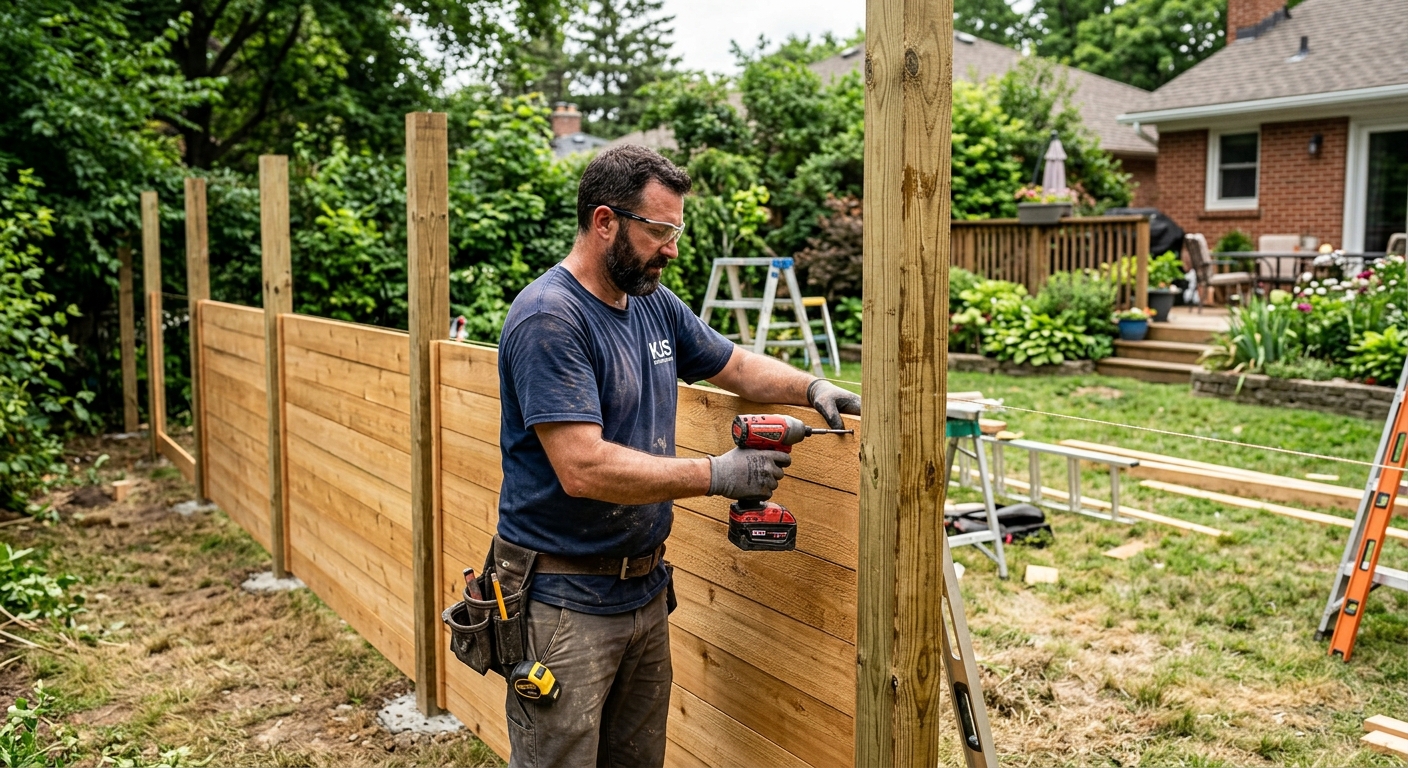
Cost in the Toronto market is shaped by Southern Ontario’s freeze-thaw cycle. The frost line is commonly estimated around 42"–48", so contractor best practice is to set posts about 3.5–4 feet deep for many 6–8 ft privacy runs. That usually means concrete-set posts rather than simple driven posts, which increases labour time and ready-mix costs but reduces the risk of heaving and leaning. In neighbourhoods like East York’s Coxwell/Greenwood area and along busier corridors toward Danforth, access can also affect pricing—wider gates, parking restrictions, and longer staging walks add hours.
Below is a practical comparison of material options you’ll see quoted in Old East York, including typical lifespan, maintenance expectations, and price per linear foot. Use it as a baseline before you ask for itemised proposals.
| Material |
Lifespan |
Maintenance |
Privacy Rating |
Price per Linear Foot |
Price Range |
| Pressure-treated pine (standard wood) |
10–15 years |
Stain/seal every 2–3 years |
High (solid board) |
$15 – $25 |
$65 – $120 |
| Cedar (natural rot resistance) |
15–20 years |
Light stain/seal every 2–4 years |
High (solid board) |
$20 – $32 |
$75 – $130 |
| Vinyl / PVC (no-maintenance) |
20–30 years |
Rinse as needed; inspect for impact |
High (solid or lattice) |
$22 – $38 |
$75 – $130 |
| Chain-link (galvanized steel) |
20–30 years |
Occasional tensioning; rinse coating |
Low–Medium (privacy slats optional) |
$14 – $20 |
$45 – $85 |
| Aluminum ornamental |
30–40 years |
Wash yearly; check hardware |
Low–Medium (decorative pickets) |
$25 – $45 |
$90 – $160 |
| Composite / recycled material |
20–30 years |
Minimal cleaning; replace damaged boards |
High (board-style systems) |
$28 – $44 |
$90 – $160 |
Prices are estimates only and vary by project scope, site access and material selection.
What affects the price of fencing in Old East York
In Old East York, it’s common to see quotes for what looks like the “same” fence swing by 30–50% across Toronto and Ontario once you account for the real work: post holes, concrete, gate hardware, and any removal/disposal. Contractors also price based on neighbourhood logistics—if you need to stage materials on-street, work around driveway widths, or protect landscaping, labour hours rise quickly. Even the choice between chain-link (budget) and a taller solid privacy fence (premium) can shift the quote because wind and panel load change how posts must be sized and spaced.
Post depth is a major reason Toronto costs aren’t “one price fits all.” Frost line depth typically guides how deep posts must be set—often about 4–6 inches below the design frost depth to prevent heaving. In practice for Southern Ontario, that generally means posts need to go roughly 1.5–2.0 m into the ground, and concrete-set posts are the norm for 6–8 ft privacy fences. That increases both material (ready-mix and form/anchor hardware) and labour (digging, checking plumb, and curing time). Wind also matters: while the GTA isn’t as open-exposure as the Prairies, taller solid panels still rack—so heavier posts and closer spacing may be required.
Two examples that show how local conditions change cost in Old East York: (1) a backyard run that needs 6–8 ft privacy panels usually pushes you into the wood/vinyl price bands (often $65 – $120 for standard wood installs and $75 – $130 for vinyl depending on system), because more concrete and heavier posts are standard; (2) a shorter front-yard run that can use chain-link often stays closer to $45 – $85, but only if you don’t need privacy slats and the yard is accessible for trench-free post setting.
Lastly, older homes and older fence lines can hide surprises—sunken sections, off-level ground, and buried remnants. On sloped yards, stepped rails or raked panel systems add framing and labour, which is why age and topography can translate into hundreds of dollars quickly.
| Price Factor |
Why It Matters |
Cost Impact |
| Fence length in linear feet |
Most costs scale directly with footage (posts, rails, fasteners) |
Highest single driver; can change the total by thousands |
| Post depth required |
Frost conditions determine post length and hole depth |
Deeper holes increase dig time and concrete |
| Post setting method |
Concrete-set posts resist frost heave better than gravel pack/driven posts |
Concrete method typically adds labour and ready-mix costs |
| Material choice |
Different hardware, rail systems, and panel weights affect framing |
Vinyl/cedar costs more than chain-link; aluminum is often premium |
| Gate count and type |
Gates need heavier posts, extra hinges/latches, and alignment |
Each gate can add a significant fixed cost |
| Grade and terrain |
Slopes require raked panels or stepped designs |
More cutting, layout time, and labour complexity |
| Old fence removal and disposal |
Demolition, hauling, and disposal vary by material and access |
Can add a day of labour and tipping/haul fees |
| Permit fees and survey / property line locate |
Ontario rules and accurate line locate prevent encroachment issues |
May add direct administrative costs and lead time |
Permits & regulations in Ontario
In Ontario (including Old East York), the permit requirement often kicks in based on fence height. As a practical rule of thumb, fences above about 2.0 m (6.5 ft) at the rear and above about 1.0–1.2 m (3–4 ft) at the front or corners commonly trigger a building permit requirement in many GTA situations. Height, location on the property, and how the fence relates to municipal setback requirements are what matter—so treat online advice as guidance, then confirm with the municipality before you schedule post digging.
Before any digging, call Ontario One Call for utility locates (even if you think the line is “far back”). Then verify property boundaries: a survey or locate your property pins before installation to avoid disputes—especially on older lots where fences may have been erected slightly off-line over the years.
Shared fence ownership rules are governed by provincial line-fences legislation, so if a fence straddles a boundary or is used jointly, you’ll want clear written agreement on ownership responsibilities and cost sharing. Also, municipal bylaws can dictate setbacks and the maximum height allowed in specific locations.
What usually requires a permit: taller privacy fences (rear around 2.0 m+ and front/corner higher than roughly 1.0–1.2 m) and fence projects that fall under height thresholds set by your municipality.
What typically does not require a permit: lower fences below those height thresholds, routine repairs (like replacing individual boards) when you are not increasing height or changing locations—though it still may require municipal sign-off depending on local interpretation.
When hiring, you can confirm contractor credibility by checking: (1) their Ontario business/licence status (via the appropriate provincial/municipal business listings), (2) their liability insurance certificate (request COI showing fencing as an insured activity and current limits), and (3) their WSIB coverage/letter of clearance (request a WSIB clearance letter or proof of registration status). If a contractor can’t provide documentation on request, that’s a red flag.
Choosing the right fence material for Old East York
For Old East York homeowners, material selection should balance privacy, maintenance comfort, and winter durability. Pressure-treated pine is usually the lowest upfront choice, but it needs staining or sealing every 2–3 years to reduce grey weathering and slow moisture-driven issues. Cedar looks better for longer and naturally resists rot, so it’s a common “upgrade” when neighbours want a classic, warm appearance—still, it benefits from maintenance to keep colour and performance consistent.
Vinyl/PVC is popular for low hassle: you typically don’t stain it, and it’s straightforward to wash. The catch in Toronto’s cold snaps is impact and brittleness—extreme cold and blunt hits can cause cracking, so vinyl works best with good post spacing and careful installation hardware. Chain-link has the longest service life for the lowest cost and is excellent for containment, but it won’t give you privacy unless you add slats or plant-support screens. Aluminum ornamental fencing is rust-resistant and durable, but it’s more for security with visibility than true privacy.
For privacy runs, Toronto’s frost conditions make concrete-set posts the practical standard for many 6–8 ft fences, because posts must be set well below frost line to reduce heaving. That means the foundation approach matters as much as the board material. Wind and snow loads in the GTA are moderate compared to the Prairies, but taller solid panels still need robust posts (often 4x4 or 6x6 equivalents in wood systems) and proper spacing to prevent racking.
A concrete example: if a 40 ft run is quoted at roughly $65 – $120 for a standard pressure-treated pine privacy fence, but vinyl comes in closer to $75 – $130, the price difference is often justified when you want to avoid recurring staining and you expect to keep the fence for decades. If your yard is mostly shaded and you’re willing to maintain, wood can be the smarter value; if you want “set it and forget it,” vinyl or composite tends to win.
| Material |
Cold Tolerance |
Lifespan |
Annual Maintenance |
Best For |
Price Band |
| Pressure-treated pine |
Good when posts are concrete-set and properly sealed |
10–15 years |
Inspect spring/fall; stain/seal every 2–3 years |
Budget privacy with periodic maintenance |
$65 – $120 |
| Cedar |
Good; responds well to Toronto moisture cycles with care |
15–20 years |
Clean/check yearly; stain/seal every 2–4 years |
Natural look and better rot resistance |
$75 – $130 |
| Vinyl / PVC |
Good in Ontario cold; can crack if struck in extreme cold |
20–30 years |
Rinse/brush as needed; inspect hardware |
Low maintenance privacy |
$75 – $130 |
| Chain-link |
Excellent; metal coatings handle freeze-thaw well |
20–30 years |
Check tension; rinse coatings periodically |
Security and containment |
$45 – $85 |
| Aluminum ornamental |
Excellent; doesn’t rust and tolerates cold contraction |
30–40 years |
Wash yearly; check fasteners |
Security with visibility |
$90 – $160 |
| Composite / recycled |
Good; stable boards when installed to spec |
20–30 years |
Minimal cleaning; replace damaged sections |
Durable privacy with low upkeep |
$90 – $160 |
How to choose a fencing contractor in Old East York
Choosing the right fencing contractor in Old East York starts with documentation and a transparent bid. In Ontario, you want proof of liability insurance and WSIB coverage (or a valid clearance letter). Ask for a WSIB clearance letter directly—contractors should be able to provide it on request. For liability insurance, request a certificate of insurance (COI) showing the current policy period, the insurer, and that they carry coverage suitable for construction work (general liability at minimum). Also confirm they’re operating legitimately as a business and can provide references from similar Toronto neighbourhoods where access constraints are common.
Next, get 2–3 itemised written quotes. You want a breakdown that separates labour, materials, post setting method (concrete set versus gravel/driven), rail/panel systems, gate hardware, and disposal. Avoid lump sums that don’t show how they’ll build the fence at frost-depth and what they assume for ground conditions. Read the scope carefully: is permit pulling included (when needed), is old fence removal included, and where does disposal/hauling go?
Warranty matters too: ask for a workmanship warranty (for example, against sagging panels, loose posts, or misalignment) and confirm the manufacturer’s product warranty terms (and whether it’s transferable to future owners). Payment scheduling is another marker of professionalism: never pay more than 10–15% upfront, and use a holdback until completion and final walk-through.
Finally, demand a timeline in writing—start date, estimated completion date, and what weather delays they plan for in Toronto’s freeze-thaw season.
- Ask for WSIB clearance letter or proof of coverage status before signing.
- Request COI for liability insurance and verify coverage details match fencing work.
- Confirm they will set posts to frost-depth best practice (concrete-set where appropriate).
- Get quotes that break out labour vs materials, not one blended number.
- Verify gate pricing is included and hardware is specified (hinges, latch, hinges count).
- Ask whether permits are included when fence height thresholds are exceeded.
- Confirm old fence removal, demolition, and disposal/hauling are included or excluded.
- Request a site visit or documented measurements and post spacing plan.
- Ask how they handle sloped yards (raked vs stepped system) and who decides.
- Check that the quote states the post setting method (concrete vs gravel/driven).
- Review warranty terms in writing for workmanship and materials.
- Use a staged payment schedule: ≤10–15% deposit; holdback until final acceptance.
Red flags I see in Old East York: “We’ll just drive posts” for a tall privacy fence without frost-depth discussion, quotes that omit gate hardware and only list “fence only,” refusal to provide insurance/WSIB documentation, missing disposal terms for the old fence, and schedules that avoid a completion date in writing.
Frequently asked questions — fencing in Old East York
What is the most weather-resistant fence for Old East York's climate?
For Old East York, the most weather-resistant choice is usually a solid, properly installed system with frost-depth posts—most often vinyl/PVC or cedar where the foundation work is done correctly. In Toronto, the freeze-thaw cycle around the commonly used 42"–48" frost line means posts need to be set roughly 3.5–4 feet deep for many 6–8 ft fences, typically with concrete-set posts to reduce heaving. Vinyl systems last a long time and don’t rot like wood, while cedar resists decay better than many standard lumber choices. If you’re comparing price bands, a vinyl/PVC privacy install is commonly in the $75 – $130 range, while pressure-treated wood often lands closer to $65 – $120. The best answer depends on whether you prioritise “low maintenance” or “natural look with periodic upkeep.” (Statistics Canada, 2021 Census)
How do I prevent wood fence rot in Old East York?
Wood rot prevention in Ontario starts before the boards go up: the post foundation is critical. Make sure contractors use a frost-aware layout and concrete-set posts for privacy height so water isn’t trapped at the post base and the fence doesn’t tilt over time. Use pressure-treated lumber for budget projects and choose cedar when appearance matters; then apply a quality stain/seal on a schedule (often every 2–3 years for pine in Toronto’s wet/dry swings). Avoid leaving soil piled against the wood and keep vegetation trimmed so airflow reduces moisture. Also, confirm hardware is corrosion-resistant (galvanized/stainless where appropriate). If your fence is already leaning from earlier frost heave, “quick board swaps” rarely last—re-aligning posts and correcting drainage typically costs more upfront but prevents repeated rot cycles.
What is the cost per linear foot for fencing in Old East York?
In Old East York, pricing is commonly discussed as a per-project installed range, but many estimates translate to a per linear foot outcome once materials and post requirements are included. For example, chain-link often prices within the $45 – $85 band, while standard wood privacy fencing commonly sits around $65 – $120 depending on height, post setting method, and gate count. Vinyl/PVC typically overlaps around $75 – $130. Aluminum ornamental is usually the higher end, commonly $90 – $160. The reason it varies per linear foot is simple: post depth (frost line best practice), concrete vs driven methods, and gates add “fixed” costs per fence section. For a precise per-foot number, ask your contractor to itemise labour, materials, and the post setting plan in the quote.
Should I repair or replace my old fence in Old East York?
Repair can make sense when the fence posts are solid (not leaning), rails are still straight, and the damage is limited to a few boards. Replacement is usually the better long-term decision when you see widespread rot at bases, posts that have shifted due to frost heaving, or repeated sagging after past repairs. In Old East York, many older fences were installed with simpler post methods that don’t perform as well through Southern Ontario freeze-thaw cycles, so “patching” can keep costs rising. A practical approach is to ask for a site assessment and a written comparison: (1) cost to replace only damaged sections, versus (2) cost to remove and rebuild with concrete-set posts and correct post spacing for your fence height. If you’re nearing the end of a fence’s lifespan, replacement often provides better value and fewer recurring issues.
How do I handle a fence dispute with a neighbour in Ontario?
In Ontario, fence disputes typically come down to property line location, responsibility for shared fence sections, and whether your fence increases height or changes how it sits on the boundary. In Old East York, the first step is evidence: confirm your property pins or get a survey/locate so you’re not relying on an old fence line that may have been placed slightly off. Next, communicate in writing: share the contractor’s estimate and how the fence will be built (materials, height, and where posts will be set). If the fence is shared, provincial line-fences rules may affect cost sharing and responsibilities. Also, check whether permits are involved—taller privacy fences can cross height thresholds. Keep records of photos, measurements, and any communications. If you can’t resolve it directly, consider advice from a qualified professional familiar with Ontario boundary disputes.
What fence style offers the best wind resistance in Old East York?
In Old East York, the most wind-resistant approach for taller fences is usually a solid privacy fence installed with adequate post sizing, correct post spacing, and strong bracing/hardware. While Toronto doesn’t have the extreme open-field wind loads of the Prairies, wind can still cause racking—especially with 6–8 ft solid panels. That means your contractor should use frost-depth concrete-set posts where appropriate, ensure panel-to-rail connections are tight, and consider heavier posts (often wood systems using larger posts) for stability. If you want a compromise with less wind load, semi-privacy or wind-permeable designs (like certain slat patterns) can reduce pressure on the structure. Discuss your yard exposure (corner lots, open driveways, or near laneway winds) so the contractor can recommend the right style and spacing rather than using a one-size template.