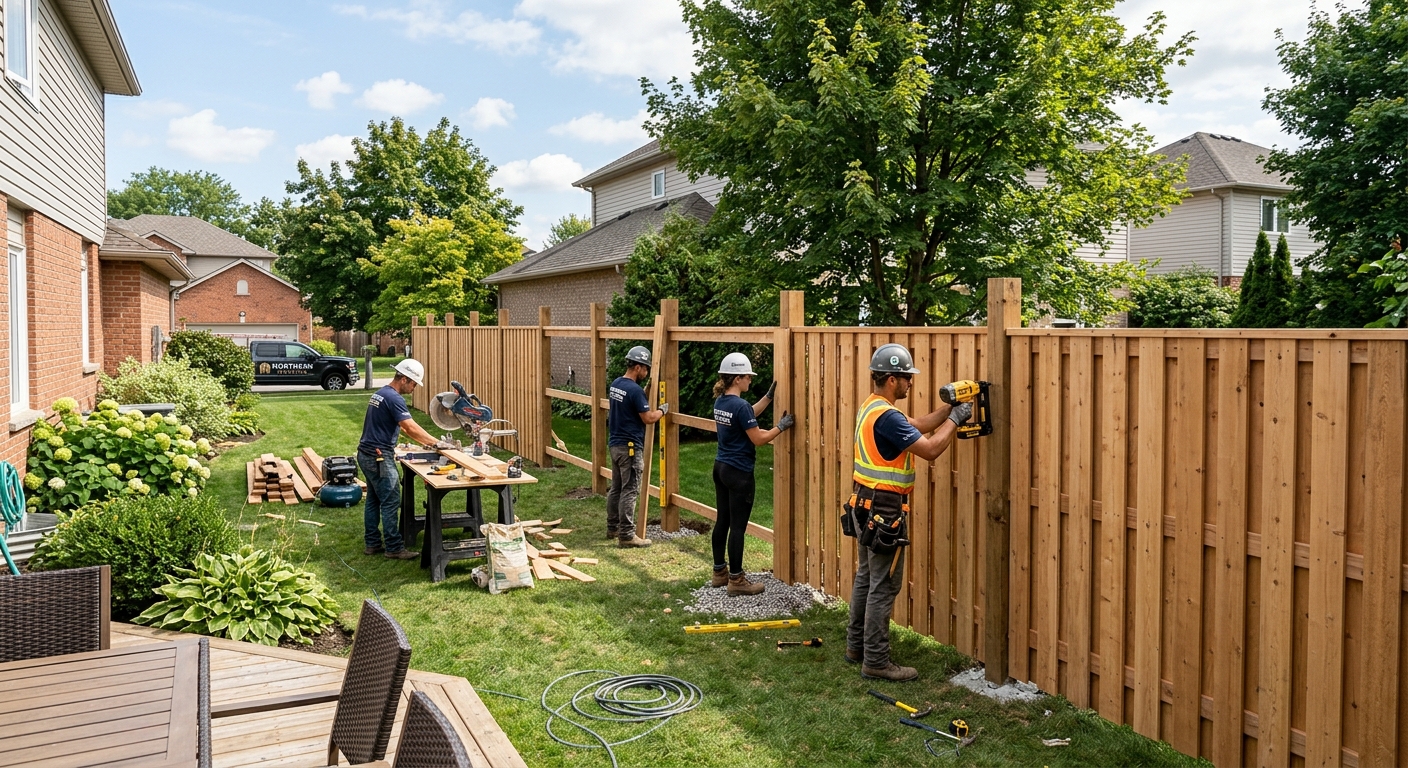
Fencing options and costs in South Parkdale
South Parkdale, Ontario is a tight, established neighbourhood where homeowners often upgrade fences when they modernize landscaping, rear patios, or side-yard access. With a local population of 21,849 (Statistics Canada, 2021 Census), there’s steady demand for new installs and replacements—especially around the busy streets and the older residential pockets where properties are closely spaced. In practice, Toronto’s mix of single-family housing stock and frequent curb/side-yard improvements makes fence work a consistent trade, and that availability helps keep pricing competitive when you’re comparing contractors in the area.
Toronto’s frost cycle is a major cost driver. In Southern Ontario, the frost line is commonly estimated around 42"–48", which usually means fence posts need to be set about 4–6 inches below that design frost depth to reduce the risk of frost heave. For common 6–8 ft privacy fences, this pushes typical post setting to roughly 3.5–4 ft deep, and most local crews favour concrete-set posts in clay and mixed soils for long-term stability. That extra labour and ready-mix can add cost, but it also reduces post shifting and leaning over time—an issue that shows up quickly in freeze/thaw years.
From a homeowner perspective, the decision usually comes down to privacy needs, maintenance tolerance, and your tolerance for upfront cost. If you’re in the South Parkdale area near Queen Street West or the residential blocks off Roncesvalles, expect similar climate impacts but different access constraints depending on lane space, driveway location, and whether older fence removal is required. Use the comparison table below to anchor your expectations, then we’ll break down why quotes can swing so much.
| Material |
Lifespan |
Maintenance |
Privacy Rating |
Price per Linear Foot |
Price Range |
| Pressure-treated pine (standard wood) |
8–12 years |
Stain/seal every 2–3 years |
High (solid boards/boards with minimal gaps) |
$10–$18 |
$65 – $120 |
| Cedar (natural rot resistance) |
12–18 years |
Seal/stain every 2–4 years (varies by finish) |
High (solid cedar boards) |
$13–$22 |
$85 – $130 |
| Vinyl / PVC (no-maintenance) |
20–30 years |
Wash only; no painting |
High (solid or privacy pickets) |
$18–$28 |
$75 – $130 |
| Chain-link (galvanized steel) |
25–40 years |
Occasional rinse; tighten hardware as needed |
Low–Medium (privacy slats optional) |
$10–$16 |
$45 – $85 |
| Aluminum ornamental |
25–35 years |
Wash; touch-up rare |
Low–Medium (open style) |
$14–$26 |
$90 – $160 |
| Composite / recycled material |
20–35 years |
Low; clean with mild soap |
High (solid boards designed for privacy) |
$18–$30 |
$100 – $170 |
Prices are estimates only and vary by project scope, site access and material selection.
What affects the price of fencing in South Parkdale
In South Parkdale and the broader Toronto area, the same fence can come in 30–50% apart simply because the “scope” changes—how long it is, how many gates you need, whether posts are concrete-set, and how hard the site is to access. Two crews can quote the same material and height, but one may be planning for heavier wind-rated panels, concrete setting for every corner/post, or full old-fence removal and disposal. That’s why it’s smart to compare quotes like-for-like instead of comparing only the total at the top.
Toronto’s freeze/thaw conditions are a big reason for variance. The design frost line is commonly taken at about 42"–48", and best practice usually means setting posts roughly 4–6 inches below that. For many 6–8 ft privacy fences, that translates into deeper holes (often about 1.5–2.0 m) and typically concrete-set posts rather than simple driven posts—especially in clay and mixed soils common to parts of the GTA. That added excavation, rebar/bracing (where needed), and ready-mix labour can push wood fence installation toward the upper end of the $65–$120 band, and it can make vinyl/PVC projects land closer to the $75–$130 band even when the material price looks similar.
Local examples that commonly raise costs in South Parkdale include: (1) corner posts on long privacy runs that require heavier bracing because panels can rack; (2) sloped yards in which panels must be stepped or raked to keep a consistent top line—this can increase labour and sometimes post height adjustments; and (3) projects with narrow side access or where a dumpster can’t be placed near the line, slowing down removal and haul-away. On the other hand, straightforward runs with easy vehicle access and no old fence removal can keep projects closer to the lower end of the bands.
| Price Factor |
Why It Matters |
Cost Impact |
| Fence length in linear feet |
Labour and materials scale directly with total run length |
Largest driver (often majority of total cost) |
| Post depth required |
Frost line determines post length and hole depth |
Deeper holes increase excavation and material |
| Post setting method |
Concrete vs. gravel pack vs. driven posts affects stability |
Concrete-set usually adds labour and ready-mix |
| Material choice |
Vinyl vs. cedar vs. chain-link changes material price and build complexity |
Can swing overall price by 20–40% |
| Gate count and type |
Hinges, latch hardware, and bracing differ for walk-through vs. double drive gates |
Each gate can add significant labour and hardware |
| Grade and terrain |
Sloped yards require stepped or raked panels and more layout time |
Increases fitting time and sometimes extra materials |
| Old fence removal and disposal |
Demolition time plus dump fees and hauling affects schedule and cost |
Common add-on that varies widely by access |
| Permit fees and survey / property line locate |
Locates reduce encroachment disputes; permits may be required for taller fences |
Can add a few hundred to more depending on requirements |
Permits & regulations in Ontario
In Ontario, fence rules are mainly about height limits, location relative to property lines, and permitting when fences are considered “high” for the lot context. While municipalities can vary, a common threshold is that fences above about 2.0 m (6.5 ft) at the rear and roughly 1.0–1.2 m (3–4 ft) at the front or corner often trigger a building permit requirement. Practically, if you’re planning a full-width privacy fence, it’s worth checking before you dig, because permit timing can affect your installation schedule in South Parkdale.
Before any post hole goes in, call for utility locates through Ontario One Call so underground services aren’t struck during excavation. Also, obtain a survey or property line locate (locating your pins) before installing—this is one of the most effective ways to prevent boundary disputes with neighbours when fence lines don’t match old stakes, survey drawings, or landscaping boundaries.
For shared fence ownership, Ontario’s line-fences legislation guides how costs and responsibilities are handled when fences benefit more than one property owner. For contractor verification, a homeowner should: (1) confirm the contractor’s Ontario licence status where applicable; (2) request a current certificate of insurance (general liability) naming you as certificate holder; and (3) verify workplace coverage—WSIB in Ontario—if they employ workers. Ask for clearance letters or equivalent proof and check the effective dates so you’re not left uncovered if something happens during excavation.
Choosing the right fence material for South Parkdale
Choosing a fence material in South Parkdale is mostly about balancing privacy and weather durability against what you’re willing to maintain. Pressure-treated pine is typically the budget route, but it needs staining or sealing every 2–3 years to prevent grey weathering and early surface breakdown. Cedar offers better natural rot resistance and often looks better as it ages, but it still benefits from periodic sealing/staining to keep it from drying out. Vinyl/PVC is the low-effort option—usually no painting required—however it can be more brittle in extreme cold and may require careful installation practices around post spacing and hardware. Chain-link is the lowest upfront and longest-lasting in many cases, but it provides limited privacy unless you add slats or privacy screening. Aluminum ornamental fencing gives a clean, rust-resistant look with mid-range cost and long lifespan, though it’s not a true privacy material.
Toronto’s frost line is commonly taken around 42"–48", and for privacy fences the post-depth requirement is what often determines your long-term results. For 6–8 ft fences, concrete-set posts are commonly recommended because the deeper hole (often about 3.5–4 ft) reduces frost heave in freeze/thaw cycles, particularly in clay and mixed soils. That deeper footing work applies across materials, but it’s especially important for wood and vinyl privacy runs where panel weight and wind loading can stress weak bases.
For a practical dollar example: a chain-link run may fit closer to the $45–$85 per-unit band, while a vinyl privacy fence tends to land around the $75–$130 range. If you truly need privacy for patios or backyards in South Parkdale, that extra investment is usually justified because privacy panels and heavier post setup reduce movement over winter—whereas chain-link will require add-ons (slats, screens, or lattice) that often reduce the value of the initial lower price.
| Material |
Cold Tolerance |
Lifespan |
Annual Maintenance |
Best For |
Price Band |
| Pressure-treated pine |
Good (if properly sealed and installed) |
8–12 years |
Quick inspection; stain/seal every 2–3 years |
Budget privacy with periodic upkeep |
$65 – $120 |
| Cedar |
Good (natural rot resistance) |
12–18 years |
Seal/stain every 2–4 years |
Appearance + rot resistance for privacy lines |
$85 – $130 |
| Vinyl / PVC |
Moderate to good (requires correct installation) |
20–30 years |
Wash once or twice per year |
Low maintenance privacy |
$75 – $130 |
| Chain-link |
Excellent (galvanized) |
25–40 years |
Occasional rinse and hardware checks |
Security/containment at lowest cost |
$45 – $85 |
| Aluminum ornamental |
Excellent |
25–35 years |
Wash; no rust paint needed |
Decorative boundaries with curb appeal |
$90 – $160 |
| Composite / recycled |
Good (engineered for outdoor freeze/thaw) |
20–35 years |
Low; clean mild soap as needed |
Long-life privacy with minimal effort |
$100 – $170 |
How to choose a fencing contractor in South Parkdale
When you hire a fence contractor in South Parkdale, start by verifying Ontario compliance and basic financial protection. Ask for: (1) proof of general liability insurance (a certificate of insurance with you as certificate holder, and coverage dates that match your project); (2) WSIB coverage if they have employees (request clearance or proof and confirm it’s active); and (3) workmanship warranty details. You don’t want to be guessing—request the documents before signing and keep copies of everything.
Next, get 2–3 itemised written quotes. I recommend you ask for a breakdown that separates labour from materials, including line items for post setting (concrete vs. gravel pack), hardware, gate construction, and any demolition/removal. A proper quote also lists what’s excluded: for example, whether permit pulls are included, whether debris haul-away and disposal fees are included, and whether repairs to adjacent landscaping are part of the scope.
On warranty, look for two layers: a workmanship warranty (how long the contractor stands behind their installation) and the product/manufacturer warranty for materials (posts, rails, boards, or vinyl components). Confirm whether the warranty is transferable if you sell your home—this can matter to buyers.
For payment scheduling, don’t pay more than about 10–15% upfront. Hold back a portion until the fence is complete and cleaned up, and confirm timing in writing. A reliable contractor should give you a start date and a completion estimate that account for excavation, post curing time when concrete is used, and gate hardware lead times.
- Ask for insurance certificate and verify dates; look for you named as certificate holder.
- Confirm WSIB coverage is active (clearance letter/proof if available).
- Require an itemised quote: labour, posts, concrete, rails, panels, gates, and hardware.
- Ensure quote specifies post depth and setting method (concrete-set vs driven).
- Check if permit fees and any property line locate are included or excluded.
- Confirm whether old fence removal, disposal, and hauling are included.
- Verify gate type and count in writing (walk-through vs double drive gates).
- Ask for panel layout on sloped grades (stepped vs raked) and how top alignment is handled.
- Request warranty terms in writing: workmanship duration and product warranty details.
- Confirm schedule details: start date, estimated duration, and curing time assumptions.
- Use a payment schedule with minimal upfront (10–15%) and a holdback on completion.
- Ensure there’s a clear scope map or measurements included to prevent “change order” surprises.
Red flags I commonly see with fencing quotes in South Parkdale: only lump-sum pricing with no breakdown, vague language like “posts set properly” (no depth or method stated), skipping insurance/WSIB proof until late in the process, offering a warranty that’s shorter than typical industry expectations or not written clearly, and refusing to put the timeline and permit responsibilities in the contract.
Frequently asked questions — fencing in South Parkdale
What's the most low-maintenance fence?
In South Parkdale and across Ontario, vinyl/PVC is usually the lowest-maintenance “set it and forget it” option. You typically wash it occasionally and avoid staining or painting—unlike pressure-treated pine, which often needs treatment every 2–3 years to prevent weathering. Cedar is also relatively manageable compared with standard pine because of its natural rot resistance, but it still benefits from periodic sealing. Chain-link is maintenance-light too, but it doesn’t give privacy unless you add slats or screening, which can introduce extra upkeep. Budget-wise, expect vinyl/PVC projects to generally track the $75–$130 price band, while pressure-treated pine tends to land in the $65–$120 band depending on height and post setting. The biggest “maintenance” difference comes from installation quality—especially concrete-set posts that reduce movement during freeze/thaw cycles (Statistics Canada, 2021 Census).
How tall can my fence be in South Parkdale?
Fence height rules in Ontario commonly depend on whether the fence is considered front/corner vs rear, and many homeowners in South Parkdale end up planning around typical thresholds of about 1.0–1.2 m (3–4 ft) near the front/corners and up to around 2.0 m (6.5 ft) at the rear before a permit may be required. The safest approach is to verify the applicable municipal requirements before ordering materials. If your plan is for a taller privacy fence across the rear yard, you may need a building permit and should factor that into timing. Also, even if height is allowed, your fence still must respect property lines and municipal setback bylaws. If you’re unsure, ask your contractor to confirm permit responsibility in the written quote and provide guidance on what needs to be filed.
Should fence posts be set in concrete here?
For many South Parkdale backyards—especially where you’re building a privacy fence 6–8 ft tall—concrete-set posts are commonly recommended. The reason is local frost and soil movement: with a design frost line often estimated around 42"–48" in Southern Ontario, best practice is usually to set posts roughly 4–6 inches below that depth to reduce frost heave. That often means posts around 3.5–4 ft deep, which in clay and mixed soils performs better with concrete than simple gravel or driven-only methods. Concrete adds labour and ready-mix cost, which can push wood and vinyl privacy fences toward the upper range of their bands. That said, the correct method is project-specific: ask the contractor to state post depth, setting method, and how they’ll brace panels to handle winter uplift and racking.
What's the best fence for privacy?
For privacy in South Parkdale, a solid privacy fence with minimal gaps is the priority. Vinyl/PVC and cedar are both strong choices because you can build true “look-through resistance” with solid boards or privacy pickets. Composite/recycled materials can also provide excellent privacy with low upkeep. Pressure-treated pine works well if you’re comfortable with periodic staining/sealing; it’s generally the budget-friendly privacy route and often sits around the $65–$120 band. Vinyl/PVC is usually higher upfront (often in the $75–$130 band) but is low-maintenance over time. Just as important as material is structure: deeper, concrete-set corner/line posts and properly spaced supports help prevent leaning and gaps forming after freeze/thaw cycles. If you need a privacy fence, avoid open ornamental styles—aluminum ornamental is decorative, not private by design.
How do I compare fencing quotes?
To compare fencing quotes fairly in Ontario (including South Parkdale), look beyond the total price and verify the scope. Ask for itemised labour and materials: post setting method (concrete vs gravel pack vs driven), post depth, panel style, rail sizes, gate count/type, and whether demolition/removal and disposal are included. Confirm permit responsibility—if a permit is required for your fence height and location, the quote should state whether the contractor will handle it or whether you must. Also check warranty details: workmanship duration, product/manufacturer warranty, and whether it transfers. Watch payment terms: a responsible contractor typically takes a small deposit (around 10–15%) and holds back until completion. When quotes differ, it’s often because one includes concrete-set posts and full disposal while another does not—two changes that can easily shift pricing by tens of percent.
How long does fence installation take in South Parkdale?
Typical fence installation timelines in South Parkdale depend on length, gate count, access, and whether old fencing must be removed. A straightforward, single-run project with minimal site prep can take a few days, while longer privacy fences (especially around corners and with multiple gates) commonly take longer due to layout, concrete-set post work, and finishing. If concrete is used, plan around curing time before final panel alignment, which can slow the last steps compared with driven-post builds. Sites with narrow side access or without a convenient staging/dump area for debris also require extra time for safe excavation and haul-away. Weather can affect excavation scheduling during heavy snow or frozen ground. Your best guide is an itemised quote with a written start date and completion estimate—so you can see whether curing and disposal are accounted for.