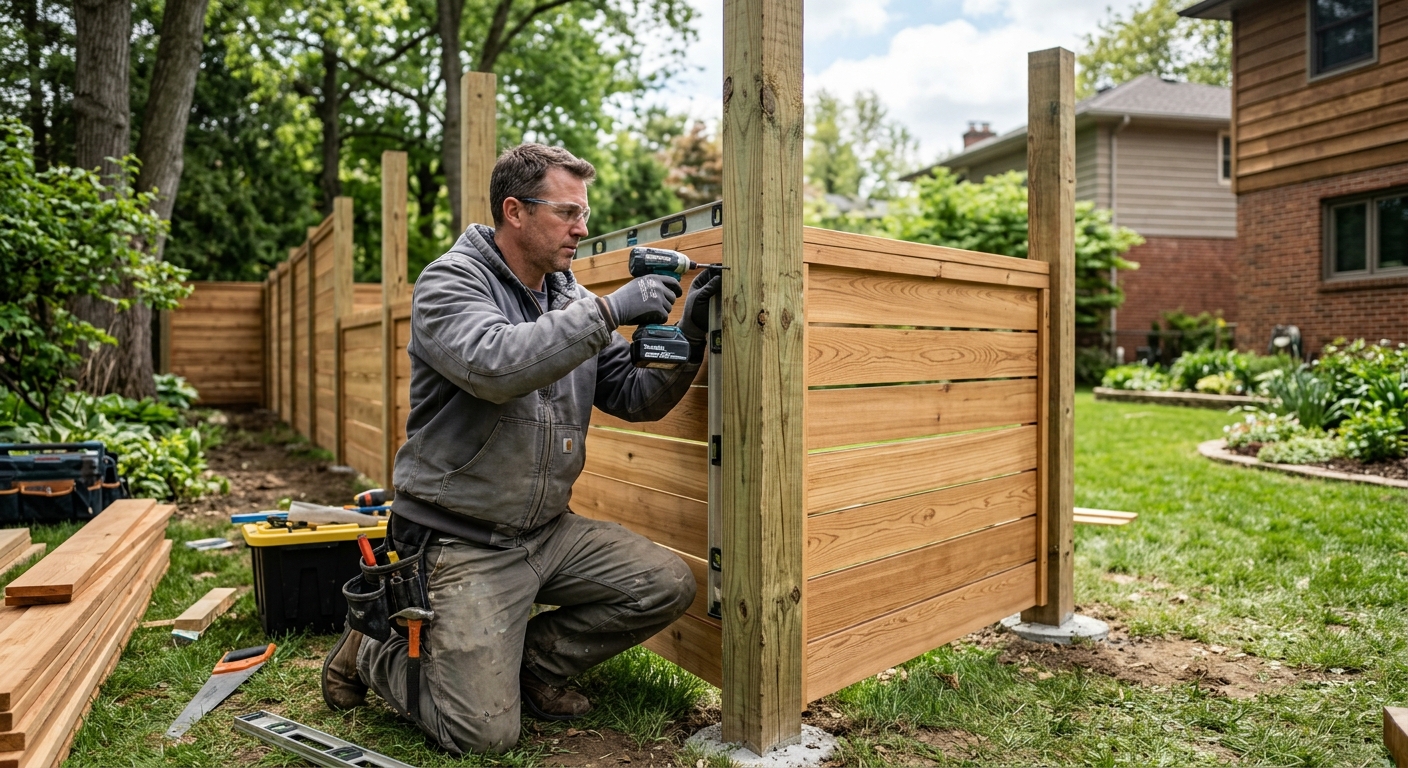
Fencing options and costs in Oakridge
Oakridge is a steady demand market for fencing because homes here are typically long-term, family-oriented properties—many owners plan upgrades rather than short-term fixes. With a population of 13,845 (Statistics Canada, 2021 Census), local streets may feel “neighbourhood scale,” but the Toronto area bidding environment still strongly affects pricing. Each additional detached or semi-detached property you fence tends to pull more crews toward the same timing windows, which influences availability and the labour line on your quote.
In the Toronto economic region, frost depth and local soil conditions are the biggest cost drivers. Contractors typically set posts deeper to resist frost heave; for taller privacy fences (6–8 ft), that often means concrete-set posts with deeper holes and heavier hardware. On top of that, Oakridge has plenty of mature trees, tighter access lanes, and occasional backyard gate constraints—small differences that can add hours to layout, excavation, and final alignment.
We see fencing especially in demand around the more built-up residential pockets near major corridors and busy commuting routes, including areas where backyards back onto park paths and multi-use lanes. Those locations often require higher privacy panels and more careful panel racking for even sight lines.
Below is a practical cost and performance comparison to help you compare materials apples-to-apples before you review itemised quotes.
| Material |
Lifespan |
Maintenance |
Privacy Rating |
Price per Linear Foot |
| Pressure-treated pine (standard wood) |
10–15 years (with regular sealing) |
Stain/seal every 2–3 years; check fasteners annually |
High (solid picket/board, 6–8 ft) |
$65–$120 |
| Cedar (natural rot resistance) |
15–25 years (properly installed with good post depth) |
Light stain/finish every 3–4 years; inspect annually |
High (solid board/privacy styles) |
$80–$140 |
| Vinyl / PVC (no-maintenance) |
25–30 years (warping risk lower with correct installation) |
Rinse as needed; no staining; tighten where required |
High (solid panels available) |
$75–$130 |
| Chain-link (galvanized steel) |
20–35 years |
Minimal: rinse/spot clean; check tension and posts |
Low to medium (privacy slats if desired) |
$45–$85 |
| Aluminum ornamental |
25–40 years |
Minimal: wash; inspect hinges and latches |
Low (semi-privacy only) |
$90–$160 |
| Composite / recycled material |
20–30 years (varies by brand and fastening method) |
Occasional cleaning; avoid abrasive surface damage |
High (solid privacy boards) |
$95–$165 |
Prices are estimates only and vary by project scope, site access and material selection.
What affects the price of fencing in Oakridge
Two fences that look identical on a brochure can land 30–50% apart in Toronto and across Ontario because fencing quotes are driven by site physics, not just material. Post installation is labour-heavy here due to frost and soil—so when a contractor prices “same height, same style” but proposes different footing depth, concrete volume, or hardware quality, the price difference shows up fast. Labour availability around the GTA also fluctuates seasonally, which can change installation rates and crew scheduling.
In Southern Ontario, the frost line is commonly taken around 42"–48", which translates into deeper holes for stable posts. In practice, many crews set posts about 4–6 inches below the design frost depth, meaning hole depth often pushes into roughly 1.5–2.0 m of ground for 6–8 ft privacy fences. That increased excavation and the use of concrete-set posts raise both material and labour cost. If your yard has clay/mixed soils (common across the region), the “digging effort” can increase again.
Wind matters too. The GTA doesn’t see Prairies-level exposure, but a solid tall fence still needs enough post size and spacing to reduce racking and uplift, especially at corner runs or open backyard edges. By contrast, coastal BC has a wetter climate that accelerates wood rot without proper treatment; Oakridge/ Toronto projects are more about frost stability and winter moisture cycling.
Concrete examples from Oakridge pricing: (1) a 40 ft run of vinyl privacy often lands closer to the mid-band for vinyl (around the $75–$130 range) when posts are correctly concrete-set; (2) switching from chain-link at roughly $45–$85 to solid wood at $65–$120 can add cost because of extra framing, more posts for rigidity, and more time aligning boards; (3) adding a second gate or an uneven grade can add labour comparable to upgrading materials. If your fence touches an older property line with uncertain pins, time for verification can also increase your quote.
| Price Factor |
Why It Matters |
Cost Impact |
| Fence length in linear feet |
More perimeter means more posts, rails, panels and fastening |
High: primary driver of total cost |
| Post depth required |
Frost line determines hole depth and post length to prevent heaving |
High: deeper holes increase labour and concrete |
| Post setting method |
Concrete vs. gravel pack vs. driven posts changes stability |
Medium to high: concrete-set typically costs more but lasts |
| Material choice |
Vinyl, cedar, and chain-link have different hardware and installation steps |
Medium: commonly shifts you between the $45–$85 and $75–$130 bands |
| Gate count and type |
Gates need stronger frames, hinges, and latch hardware |
Medium: each gate adds labour and often upgrades framing |
| Grade and terrain |
Sloped yards require stepped sections or raked panels |
Medium: more layout time and custom cuts |
| Old fence removal and disposal |
Demolition adds labour and hauling/disposal fees |
Low to medium: can still add a meaningful line item |
| Permit fees and survey / property line locate |
Locates prevent encroachment disputes and protect both sides |
Low to medium: varies by site and how pins are handled |
Permits & regulations in Ontario
In Ontario, fence requirements typically hinge on height, location (rear vs. front/corner), and local by-law rules. As a general guideline used across many Ontario municipalities, fences above about 2.0 m (6.5 ft) in the rear and 1.0–1.2 m (3–4 ft) at the front or corner often trigger a building permit review. Even when a permit isn’t required, your fence must respect property lines and municipal setback bylaws.
Before any post hole is dug, call for utility locates (Ontario One Call). Ontario homeowners should also confirm property pins—either through a survey or a locate that ties your fence layout to the pins. This step matters because a “straight line” on a sketch can still land over the property line if pins aren’t verified, creating dispute risk and costly rework.
Shared fence ownership rules are governed by provincial line-fences legislation, so it’s wise to document agreements with neighbours when the fence is truly shared (or when you’re building on the lot line).
Step-by-step contractor checks for Oakridge/greater Toronto homeowners:
- Verify the contractor’s Ontario licence (where applicable for fencing/building trades), and confirm their company name matches the quote.
- Request a current certificate of insurance for liability—ensure it covers fencing construction activities and includes adequate limits.
- Confirm WSIB/WCB coverage and ask for proof of clearance/coverage status before work starts.
- Ask whether they handle permit pulls if required, and whether those costs are included in the quote or billed separately.
- Get everything in writing: scope, measurements, post depth approach, and disposal responsibility.
Choosing the right fence material for Oakridge
Your best fence material in Oakridge is the one that matches your priorities while surviving Toronto’s freeze-thaw cycles, winter moisture, and occasional high-load snow/wind events. Pressure-treated pine is often the lowest upfront option, but it still needs ongoing sealing or staining (commonly every 2–3 years) to prevent grey weathering and to keep boards looking good. Cedar offers better natural rot resistance and looks warmer, but it still benefits from periodic finishing—especially at cut ends and around gates where moisture sits. Vinyl/PVC is attractive for low maintenance: you generally rinse it and move on. The trade-off is higher upfront cost and the need for correct installation to reduce cold-weather stress cracking. Chain-link provides the longest service life per dollar and excellent durability, but it won’t give you privacy unless you add slats or switch to a solid-panel system. Aluminum ornamental is rust-resistant and neat-looking, but it’s ornamental rather than privacy-focused.
For post depth, Toronto frost conditions typically mean concrete-set posts are recommended rather than simple driven posts—especially for 6–8 ft privacy fences where stability and reduced heaving matter. Wind and snow load considerations push you toward sturdier post sizing and closer spacing for solid fences, particularly on long runs and exposed side yards.
A practical dollar example: if chain-link at roughly $45–$85 per linear foot meets your security need, you’ll likely spend noticeably less than a privacy fence in the $65–$120 wood range. However, if your goal is backyard privacy and sound dampening, upgrading from a lower-privacy option to a solid wood or vinyl panel often makes sense because you’re paying for additional framing, more posts and heavier hardware—what you’re buying is longevity and reduced movement over winters.
| Material |
Cold Tolerance |
Lifespan |
Annual Maintenance |
Best For |
Price Band |
| Pressure-treated pine |
Good with deep, concrete-set posts and proper sealing |
10–15 years |
Small: inspect fasteners; plan stain/seal every 2–3 years |
Budget-friendly privacy where you’ll maintain the finish |
$65–$120 |
| Cedar |
Excellent rot resistance through wet-cold cycles |
15–25 years |
Moderate: finish/stain about every 3–4 years |
Appearance + natural durability for Toronto backyards |
$80–$140 |
| Vinyl / PVC |
Good if installed with correct allowances in cold |
25–30 years |
Minimal: rinse; periodic inspection of hardware |
Low maintenance privacy without annual staining |
$75–$130 |
| Chain-link |
Very good; galvanized steel holds up well |
20–35 years |
Minimal: tension checks and spot cleaning |
Security and boundary marking with long-term durability |
$45–$85 |
| Aluminum ornamental |
Very good; corrosion resistance in winter moisture |
25–40 years |
Low: occasional wash and hardware check |
Decorative curb look with durability |
$90–$160 |
| Composite / recycled |
Good if installed with manufacturer fastening guidance |
20–30 years |
Low: cleaning; inspect posts and connections |
Solid appearance with reduced maintenance |
$95–$165 |
How to choose a fencing contractor in Oakridge
Choosing the right fencing contractor in Oakridge starts with verification. First, confirm Ontario licensing status where it applies to the contractor’s trade category, and request proof of liability insurance—so you’re covered if there’s jobsite damage. Next, verify WSIB/WCB coverage by asking for proof of clearance or active coverage documentation before work begins. A reputable crew will provide these documents quickly and without pressure. If they hesitate, that’s a meaningful warning sign.
Then, get 2–3 itemised written quotes that separate labour and materials. Look for a breakdown of post depth approach (concrete-set vs. alternatives), panel/rail configuration, gate framing, and whether disposal is included. Avoid “lump sum” quotes that don’t clarify what’s excluded—especially excavation conditions, uneven grades, and any required footing adjustments.
Warranty matters in Ontario’s freeze-thaw environment. Ask for both a workmanship warranty (how long they stand behind installation) and the manufacturer warranty for materials. Confirm whether the warranty is transferable to future owners, which can be important if you sell.
Payment schedule should be conservative. Never pay more than 10–15% upfront for materials mobilization, and hold back the remainder until the job is complete and you’ve accepted the final measurements and gate operation. Ask for a written start date and a realistic completion estimate, since weather windows and cure times for concrete-set posts can affect timelines.
- Request and review proof of WSIB/WCB coverage before signing.
- Confirm liability insurance certificate is current and job-specific.
- Ask for licence/registration details and verify the company name matches the contract.
- Require itemised labour + materials, not one blended number.
- Confirm post depth and setting method in writing (concrete-set for privacy runs).
- Check how they handle slopes: stepped vs. raked panels, and who decides.
- Verify who locates utilities and whether Ontario One Call is documented.
- Ask if disposal/removal of old fencing is included (and hauling limits).
- Confirm gate hardware quality: hinges, latch type, and frame reinforcement.
- Ensure permits (if required by height/location) are clearly included or excluded.
- Look for a workmanship warranty duration and exact scope of coverage.
- Agree on payment milestones tied to inspection/acceptance points.
Red flags I see in Oakridge: contractors who won’t provide insurance or WSIB/WCB proof; vague quotes that don’t specify post depth/concrete setting; “lowest price” bids that omit old fence removal/disposal without explaining why; no written timeline or no itemised scope; and requests for large upfront payments beyond 10–15%.
Frequently asked questions — fencing in Oakridge
How do I compare fencing quotes?
In Oakridge, compare quotes by scope first, not by the final number. Ask for an itemised breakdown that shows material type, rail/panel configuration, post size, post depth, and whether posts are concrete-set versus gravel pack or driven. For privacy fences, confirm the contractor’s approach to Toronto frost conditions—most stable installs in our area set posts deeper (often about 4–6 inches below design frost depth) and use concrete for long-term movement control. Also compare gate framing, hardware, and whether removal/disposal of the old fence is included. If one quote uses pressure-treated wood in the $65–$120 band and another uses cedar or vinyl, the “difference” may be justified—what you want is like-for-like.
How long does fence installation take in Oakridge?
Timelines in Ontario depend mainly on length, site access, and how deep posts must be set for winter stability. A straightforward chain-link or aluminum run with minimal gates can move faster, while a tall solid privacy fence with concrete-set posts takes additional excavation and set-time planning. In practical terms, many residential projects complete within 1–3 days of on-site construction once layout is verified, but weather and cure timing for concrete can extend schedules. If your backyard has limited side access or requires stepped/raked panels for slope, expect extra time for layout accuracy. Your contractor should provide a start date and completion estimate in writing before work begins.
Can I install a fence on a slope in Oakridge?
Yes, you can install a fence on a slope in Oakridge, and it’s common. The key is choosing the right method: stepped panels follow the terrain in increments, while raked panels follow a continuous slope (the look can differ). A good contractor will measure the grade and propose a configuration that keeps the fence level visually where it matters and maintains consistent post stability where soil changes. Because Toronto winter freeze-thaw can amplify movement where footing conditions vary, stepped/raked layout plus correct post depth and setting method becomes more important than on flat sites. Make sure your quote specifies how they will handle grade changes rather than assuming “standard installation” will fit.
What is the most weather-resistant fence for Oakridge's climate?
For Oakridge and the Toronto region, weather resistance is mostly about frost stability, moisture cycling, and long-term fastening performance. Vinyl/PVC and properly installed composite materials are excellent for low maintenance and consistent appearance, while aluminum is very durable against corrosion. For solid privacy, cedar is also a strong performer due to natural rot resistance. The “most weather-resistant” option in your case depends on whether you want privacy, appearance, and how much maintenance you’re comfortable with. For example, vinyl often sits in the $75–$130 per linear foot range in local pricing, while chain-link can be as low as $45–$85 but won’t provide privacy without slats. Regardless of material, concrete-set posts for taller fences are typically the biggest longevity factor.
How do I prevent wood fence rot in Oakridge?
Preventing wood rot starts at installation: use proper post depth and post setting so water doesn’t trap around the base. In our Southern Ontario conditions, don’t rely on shallow or driven posts for privacy runs—frost heave and shifting can open gaps and accelerate rot. Ask your contractor what concrete-set method they use and whether they use good ventilation between boards and at the bottom edges. For pressure-treated pine, staining/sealing on a maintenance cycle (often every 2–3 years) helps keep the surface protected through freeze-thaw. Cedar resists rot better naturally, but it still needs periodic finishing, especially on cut ends and around hardware. Also keep sprinklers and downspouts from dumping water near the fence line.
What is the cost per linear foot for fencing in Oakridge?
Oakridge fencing costs generally align with Toronto-market price bands and vary by material, fence height, post method, and gate count. As a starting point, pressure-treated wood typically lands around $65–$120 per linear foot, vinyl/PVC around $75–$130, chain-link about $45–$85, and aluminum/metal about $90–$160. Your final per-foot rate can move up if you need concrete-set posts for a tall privacy fence, add gates, remove an old fence, or work on sloped terrain that requires stepped/raked sections. To compare properly, request a quote that lists the post depth plan and whether concrete setting is included—those details can shift the effective per-foot cost even when the material is the same.