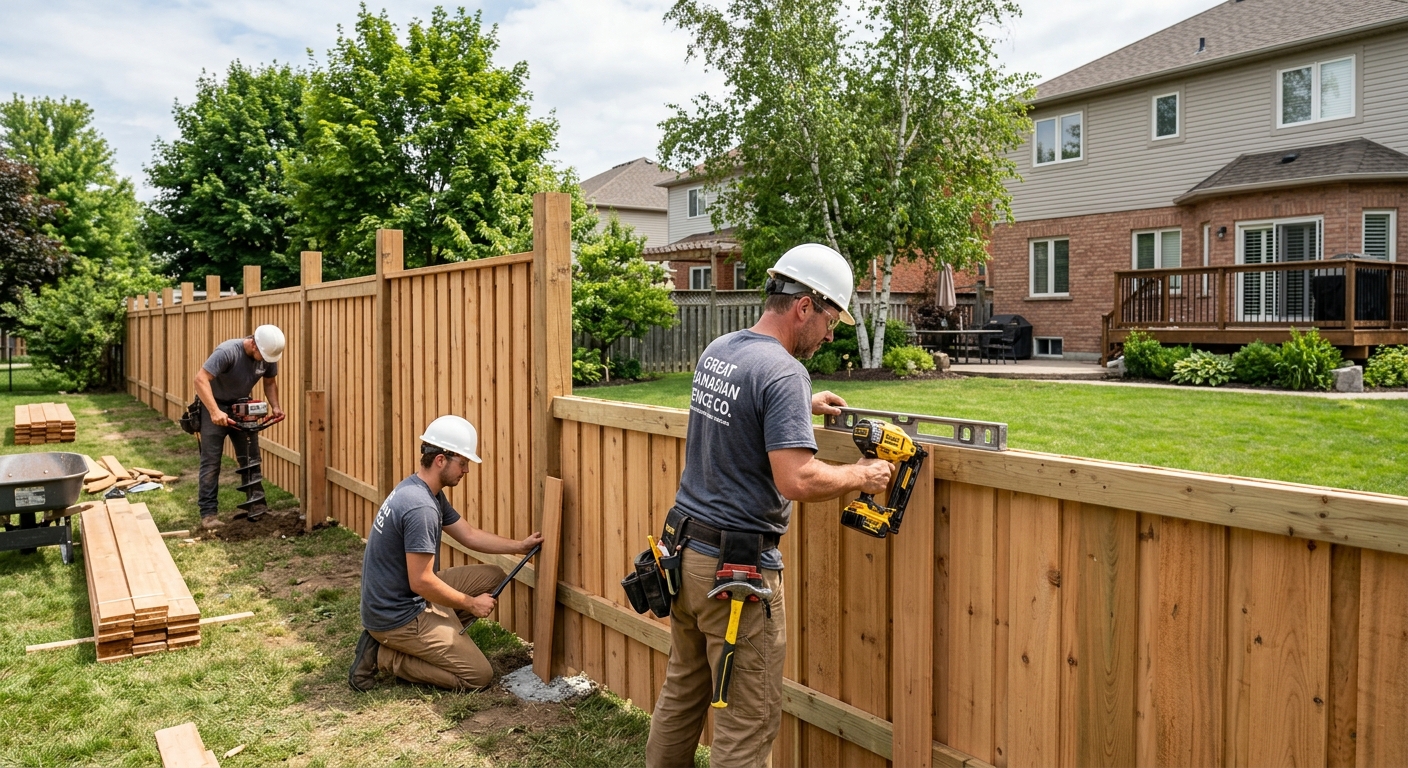
Fencing options and costs in Ballantrae
Fencing in Ballantrae is mostly about balancing privacy, winter durability, and long-term cost, and that’s why the right material choice matters as much as the quote. With a population of 3,223 (Statistics Canada, 2021 Census), the market is smaller than central Toronto, but the demand is steady—especially because detached properties are a common setup for backyard privacy and side-yard boundaries. In a neighbourhood scale community where neighbours tend to be close, most homeowners want a fence that looks good through the freeze-thaw cycle and still holds up after heavy snow seasons.
In the Toronto economic region, pricing is shaped by climate and typical installation practice. The frost line in Southern Ontario is commonly estimated at about 42"–48", so posts for taller privacy fences often need to be set a minimum of 3.5–4 feet deep to reduce frost heave risk. That concrete-set approach increases labour time and ready-mix costs, but it improves stability for 6–8 ft fences. Local building patterns also influence access—narrow side yards and mature landscaping in parts of the community can slow down post excavation and disposal, which pushes quotes up for the same “linear foot” footage.
Trade demand is particularly consistent in residential streets where properties back onto open lanes or larger lots—areas where homeowners commonly upgrade from older board fencing to solid privacy panels. If you’re planning a similar upgrade, the table below gives a practical, Ballantrae-focused cost comparison to help you talk shop with contractors and benchmark proposals.
| Material |
Lifespan |
Maintenance |
Privacy Rating |
Price per Linear Foot |
Price per Linear Foot |
| Pressure-treated pine (standard wood) |
10–15 years |
Stain/seal every 2–3 years |
High (solid board/panel) |
Mid-low |
$65 – $120 |
| Cedar (natural rot resistance) |
15–20 years |
Stain every 2–4 years (varies by exposure) |
High (solid boards) |
Mid |
$75 – $130 |
| Vinyl / PVC (no-maintenance) |
20–30 years |
Wash as needed; no staining |
High (solid styles) |
Mid-high |
$75 – $130 |
| Chain-link (galvanized steel) |
20–35 years |
Occasional rinse; straighten panels if needed |
Low (visibility depends on add-ons) |
Low |
$45 – $85 |
| Aluminum ornamental |
25–40 years |
No rust; light cleaning |
Medium (open pickets) |
Mid-high |
$90 – $160 |
| Composite / recycled material |
20–30 years |
Wash as needed; minimal sealing |
High (solid composite boards) |
Mid-high |
$75 – $130 |
Prices are estimates only and vary by project scope, site access and material selection.
What affects the price of fencing in Ballantrae
In Ballantrae and across the Toronto area, two quotes for what sounds like the same fence can differ by 30–50% because the “linear feet” number is only part of the job. The rest is in installation details: footing depth, post spacing for privacy panels, gate hardware, how much old fencing gets removed, and whether your yard has obstacles that slow crews down. In a smaller market like Ballantrae, scheduling also matters—if a crew is already set up nearby, you may see a sharper labour rate; if not, mobilization and downtime can raise the overall price.
Toronto-area winter conditions are a major driver. Frost line depth in Southern Ontario is commonly estimated around 42"–48", so contractors often set posts about 4–6 inches below the design frost depth to prevent frost heave. Practically, that usually means posts need to go roughly 1.5–2.0 m into the ground. When crews concrete-set posts for 6–8 ft privacy fences, they’re working with heavier digging, additional labour steps, and ready-mix costs—pushing many projects from “budget wood” territory toward the mid-range bands (for example, wood installs often land around $65 – $120 per linear foot depending on design).
Two local examples from the region: (1) a solid vinyl or wood privacy fence with close post spacing (to resist racking) requires more posts per run, increasing both material and footing labour; (2) yards with clay-mixed soils often require more careful excavation and backfill to keep posts straight through thaw cycles. Meanwhile, if you choose a chain-link run for the same perimeter, you may stay closer to $45 – $85 per linear foot, because fence panels and hardware are lighter and footings can be simpler.
| Price Factor |
Why It Matters |
Cost Impact |
| Fence length in linear feet |
The total perimeter controls how many posts, panels, rails, and fasteners you need. |
Largest driver; scales directly with materials and labour. |
| Post depth required |
Frost line depth determines hole depth and post length to reduce heaving risk. |
Higher depth can add labour + ready-mix and increase material waste. |
| Post setting method |
Concrete setting is more reliable than driven posts in cold-freeze conditions. |
Concrete-set typically increases cost vs gravel pack or driven-only. |
| Material choice |
Vinyl/PVC and cedar generally cost more than pressure-treated pine; chain-link is cheaper. |
Can shift the project across multiple price bands. |
| Gate count and type |
Gates require heavier hinges, latches, and alignment; double gates need stronger framing. |
One double gate can add significant labour and hardware cost. |
| Grade and terrain |
Sloped yards often need stepped panels or raked sections to maintain privacy height. |
More cutting, layout time, and possible extra rails. |
| Old fence removal and disposal |
Demolition, hauling, and disposal vary with debris condition and accessibility. |
Often adds a noticeable surcharge, especially with tight access. |
| Permit fees and survey / property line locate |
Some fences require permits; accurate property line location avoids rework. |
Can add direct fees and coordination time. |
Permits & regulations in Ontario
In Ontario, many fences must follow municipal bylaws and property-line rules, and fences above common height thresholds often require a building permit. A typical guideline homeowners run into is that fences higher than about 2.0 m (6.5 ft) at the rear and about 1.0–1.2 m (3–4 ft) at the front or corner may trigger permitting requirements. The exact threshold and permitting steps can vary by municipality, but the safe approach in Ballantrae is to ask your contractor to confirm what your address requires before any holes get dug.
Before digging any post hole, you should arrange utility locates through Ontario One Call (your local “Call before you dig” process). A survey or at least a property-pin locate is strongly recommended, especially if your yard borders a lane or has older boundary markers—these are the situations where encroachment disputes most often start. For shared fences, line-fences rules are governed by Ontario’s line-fences legislation, and shared maintenance expectations should be clarified with neighbours early.
To verify a contractor for Ontario work, start with their Ontario licence status (where applicable for business registration and trades they use), then confirm liability insurance and whether they carry WSIB/WCB coverage for their workers. Ask for a current clearance letter or proof of coverage and make sure the certificate includes fencing-related work. Only once you’ve reviewed insurance and the proposed scope in writing should you commit—especially for concrete-set posts where rework is costly.
Choosing the right fence material for Ballantrae
Choosing a fence material in Ballantrae is about matching your priorities—privacy, low maintenance, budget, and lifespan—to what Southern Ontario winter actually does to fence systems. Pressure-treated pine can be the budget-friendly route, but it needs staining or sealing roughly every 2–3 years to slow grey weathering and protect boards from moisture cycling. Cedar looks premium and naturally resists rot better, but it still benefits from periodic maintenance to keep an even finish. Vinyl/PVC is the low-maintenance favourite for many homeowners, and it avoids staining; however, in extreme cold snaps it can become more brittle if the system is underbuilt or posts weren’t set properly.
Chain-link is usually the lowest-cost and longest-life option, but it won’t give you privacy unless you add slats, planting, or a privacy screen. Aluminum ornamental is attractive and won’t rust, yet it’s also open by design—so it’s best for boundary definition, not full privacy. For most Ballantrae privacy-focused yards, concrete-set posts are typically recommended for 6–8 ft fences because the frost line in the region is commonly estimated around 42"–48". Heavier panels and closer spacing help reduce racking and wind-driven movement, which is especially important when snow loads and spring thaws cause freeze-thaw stress on footings.
Where the price difference makes sense: if you’re choosing between pressure-treated pine (often around $65 – $120 per linear foot installed) and vinyl/PVC (often around $75 – $130), the extra cost can be justified when you want fewer maintenance visits and a consistent look through wet springs and snowy winters. In many cases, the “value” is less about the first invoice and more about avoiding repeated staining and board replacement.
| Material |
Cold Tolerance |
Lifespan |
Annual Maintenance |
Best For |
Price Band |
| Pressure-treated pine |
Good with proper sealing and solid post support |
10–15 years |
Minor checks + stain/seal every 2–3 years |
Budget privacy fences where upkeep is acceptable |
$65 – $120 |
| Cedar |
Good; performs well through freeze-thaw when protected |
15–20 years |
Wash/inspect; stain every 2–4 years |
Premium look with better rot resistance |
$75 – $130 |
| Vinyl / PVC |
Very good when installed on correct post depth/spacing |
20–30 years |
Wash as needed; no staining |
Low-maintenance solid privacy |
$75 – $130 |
| Chain-link |
Good; galvanized resists rust in Ontario conditions |
20–35 years |
Occasional rinse and hardware checks |
Secure boundaries on a budget |
$45 – $85 |
| Aluminum ornamental |
Excellent; metal system handles cold without rot |
25–40 years |
Light cleaning; occasional fastener check |
Attractive boundaries with airflow |
$90 – $160 |
| Composite / recycled |
Good; stable boards when post system is correct |
20–30 years |
Wash/inspect; minimal upkeep |
Maintenance-light privacy with a modern look |
$75 – $130 |
How to choose a fencing contractor in Ballantrae
When you’re hiring a fencing contractor in Ballantrae, start by verifying the basics that protect you if something goes wrong. For Ontario work, ask for proof of liability insurance (so your property and landscaping are covered), and confirm workers’ coverage under WSIB/WCB. Don’t rely on verbal reassurance—request a current certificate of insurance and a clearance letter or proof of coverage showing the contractor has active protection for their staff. If a quote uses subcontractors for excavation or demolition, confirm they’re covered too.
Next, get 2–3 itemised written quotes. You want a breakdown that shows labour (layout, excavation, setting, assembly), concrete/aggregate quantities if applicable, material list (posts, rails, panels, hardware), gate components, and removal/disposal. Insist that the quote states what’s included and excluded—especially permit pull responsibility (if required), grading/stepping on slopes, and cleanup at completion. For winter-proofing in this region, ask specifically how posts are being set for your height (concrete-set vs alternatives) and what post depth they plan.
For warranty, separate workmanship from product warranty. Ask for the workmanship warranty length, what “failure” means (warping, leaning, fastening issues), whether the warranty is transferable if you sell the home, and how claims are handled. On payments, keep it sensible: never pay more than 10–15% upfront, and use a holdback until the job is fully complete and inspected.
- Request licence/business registration details and confirm the company is active and insured.
- Ask for liability insurance certificate and verify the address/coverage details match the job.
- Confirm WSIB/WCB clearance letter or proof of active coverage for all workers.
- Get 2–3 itemised quotes (labour + materials), not just a lump-sum “per foot”.
- Ensure the quote lists gate count, gate type, and hardware quality.
- Ask how they handle frost depth and post depth for your fence height.
- Confirm whether posts are concrete-set and what base (if any) is included.
- Check what’s included in disposal (old fence removal, hauling, landfill fees).
- Verify cleanup expectations: driveway protection, sawdust/debris removal, and final grade checks.
- Ask how they address sloped yards (stepped vs raked panels) and include it in the scope.
- Confirm start date, completion estimate, and a written timeline for staging materials.
- Put warranty details in writing and understand the claim process.
Red flags I see too often in Ballantrae: contractors who won’t show insurance/WSIB documentation, quotes that omit whether posts are concrete-set for 6–8 ft fences, “allowance” language that hides material grade or gate hardware, vague scopes that don’t mention old fence removal/disposal, and requests for large upfront payments without a signed contract and schedule.
Frequently asked questions — fencing in Ballantrae
What's the most low-maintenance fence?
In Ballantrae, the usual answer is vinyl/PVC or a properly installed aluminum system, because both avoid staining and rot-related repairs. Vinyl/PVC is typically quoted around $75 – $130 per linear foot installed, depending on height, panel style, and post support. For cold tolerance, the key isn’t just the material—it’s correct post depth for Ontario’s freeze-thaw cycle and the use of concrete-set posts for taller privacy fences (especially 6–8 ft styles). Chain-link is also low maintenance, but it won’t provide privacy unless you add slats or a screen. If you want “set it and forget it” privacy, vinyl/PVC or composite are often the easiest ongoing-care options in the Toronto region.
How tall can my fence be in Ballantrae?
Fence height rules depend on whether the location is front/corner versus rear, and whether a permit is required. In Ontario, a common guideline is that fences over about 2.0 m (6.5 ft) at the rear and about 1.0–1.2 m (3–4 ft) at the front or corner may require a building permit. Even when height is allowed, you still must respect property lines and municipal setbacks. Because Ballantrae homes vary in lot shape and boundary conditions, don’t assume: ask your contractor to confirm what applies to your specific address before ordering materials. A clear, written plan for placement and height is also important if you have neighbours close by or shared boundary sections.
Should fence posts be set in concrete here?
For most 6–8 ft privacy fences in the Toronto area, yes—concrete-set posts are the most reliable choice due to the local frost depth and freeze-thaw movement. Southern Ontario’s frost line is commonly estimated at about 42"–48", and many contractors set posts deeper to reduce frost heave risk. In practical terms, that often means posts go roughly 1.5–2.0 m into the ground and are typically concrete-set, which increases labour time and ready-mix costs but improves long-term stability. Gravel-pack or driven-post methods can work for shorter, lighter fences, but they’re less forgiving for tall solid panels when winter movement and spring settling occur. If your quote is close in price, the better long-term value is usually the one that clearly specifies concrete-set post depth and spacing.
What's the best fence for privacy?
For privacy in Ballantrae, you’ll usually be looking at solid-panel designs: wood (pressure-treated pine or cedar), vinyl/PVC, or composite. “Best” depends on how much maintenance you can tolerate. If you want strong privacy with a classic look, cedar boards provide a high privacy rating with better rot resistance than standard pine, but they still want periodic staining. Vinyl/PVC tends to win for homeowners who want consistent appearance and minimal upkeep; it’s commonly priced around $75 – $130 per linear foot. For tall privacy, installers should use heavier post systems and closer spacing to reduce racking, and ensure post depth is suitable for Ontario’s freeze-thaw conditions. Chain-link is generally not a privacy solution unless you add slats or screens.
How do I compare fencing quotes?
Start by comparing apples to apples. Ask each contractor for an itemised breakdown: labour, materials (post size, rails, panel type), gate count and hardware, and whether old fence removal/disposal is included. Confirm how posts will be installed—especially whether they’ll be concrete-set to appropriate depth for a 6–8 ft fence in Ontario’s frost conditions. Also check whether the quote includes permit pull responsibilities if needed, and whether they provide a property line locate plan to avoid encroachment. Price alone can be misleading: wood fences often land around $65 – $120 per linear foot, while vinyl/PVC is commonly $75 – $130. The best comparison is total installed scope, warranty terms, and how clearly the contractor explains frost-proofing and gate framing.
How long does fence installation take in Ballantrae?
Install time depends on linear feet, how many gates you have, terrain, and whether you’re removing an existing fence. In Ballantrae, typical project pacing is slowed when access is tight (mature landscaping, narrow side yards) or when there’s demolition and disposal to handle. A straightforward run with no removal may take a crew only a couple of days for layout through assembly, but taller privacy fences usually require additional time for post excavation and concrete curing strategy. Even when concrete is placed promptly, crews plan the day-by-day workflow for stability and alignment rather than rushing. If your project includes multiple gates or sloped grading requiring stepped sections, add time for measurement and trimming. Get a written start date and completion estimate so you understand staging, inspections, and final cleanup.