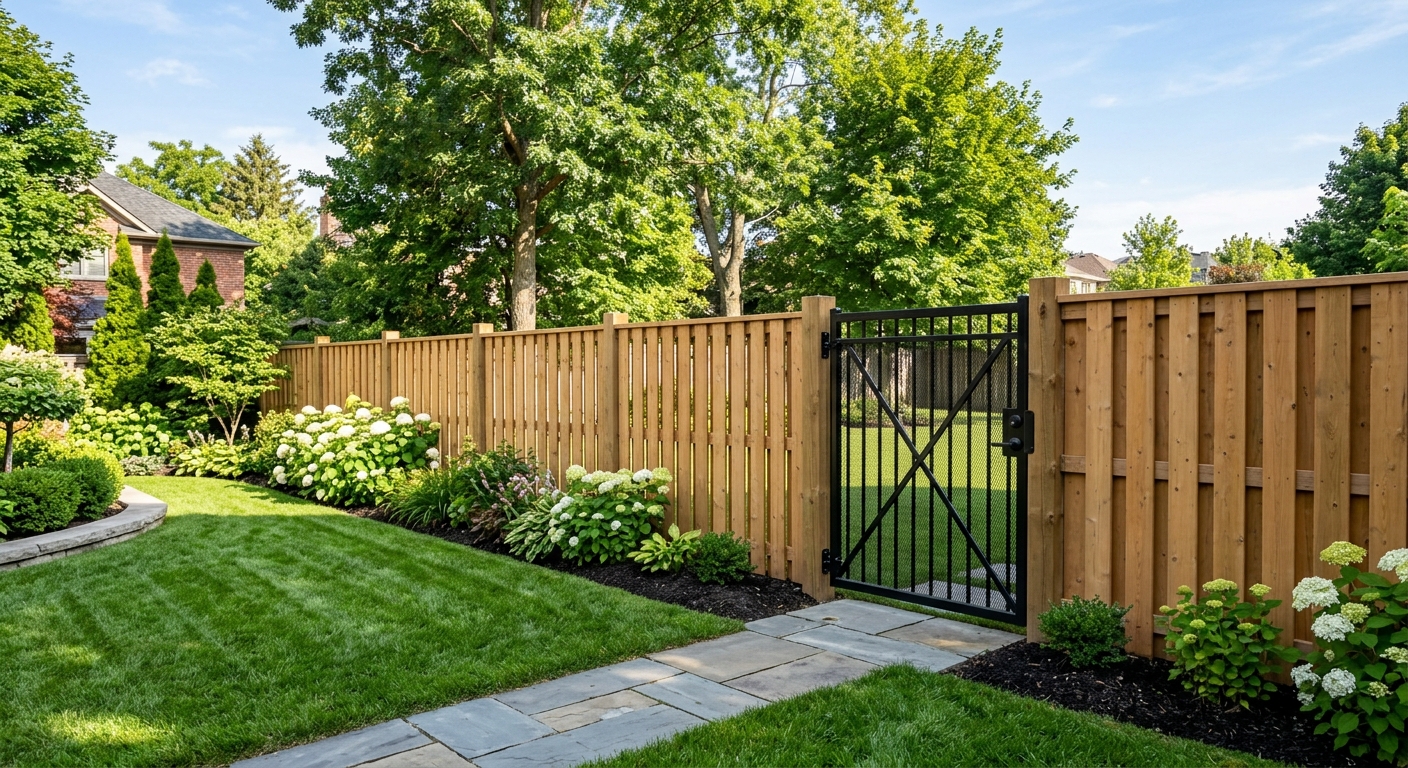
Fencing options and costs in Kingsway South
Kingsway South is a mature, family-focused part of Toronto’s GTA, and fencing demand tracks closely with how many homeowners are protecting yards and gardens. In the 2021 Census, the City’s surrounding Toronto area population sits at 2,736,690, and Kingsway South itself totals 9,271 residents (Statistics Canada, 2021 Census). While that doesn’t directly count fences, it does reflect a steady base of property owners who tend to refresh boundaries as landscaping and home maintenance cycles line up. That’s why you’ll often see more fence updates around established residential pockets like the Jane/Finch corridor-adjacent streets and other long-settled neighbourhood blocks where yards are being tightened for pets, privacy, and seasonal comfort.
Toronto pricing is also shaped by the way Southern Ontario freezes. The commonly used design frost line in this region is about 42"–48", so post holes typically need to go deeper than many people expect. For 6–8 ft privacy fences, it’s normal to set posts a minimum of 3.5–4 feet down to reduce the risk of frost heave—especially in clay and mixed soils common across the Toronto region. That leads to more labour time, concrete-set posts, and (often) longer posts. On top of that, wind and seasonal gusts influence heavier panel build-ups and tighter spacing for solid privacy styles, which can add cost even when fence length is the same.
Below is a practical comparison of common materials for Kingsway South, including lifespan expectations and typical pricing—so you can sanity-check quotes before you book an on-site measurement.
| Material |
Lifespan |
Maintenance |
Privacy Rating |
Price per Linear Foot |
| Pressure-treated pine (standard wood) |
10–15 years |
Stain/seal every 2–3 years; inspect posts annually |
High (solid panels) |
$10 – $18 |
| Cedar (natural rot resistance) |
15–25 years |
Light re-stain/seal every 2–4 years |
High (solid panels) |
$14 – $24 |
| Vinyl / PVC (no-maintenance) |
20–30 years |
Wash with hose; occasional panel hardware checks |
High (solid or privacy pickets) |
$12 – $26 |
| Chain-link (galvanized steel) |
20–35 years |
Minimal; rinse and check tension/hardware |
Low (visibility through mesh) |
$8 – $14 |
| Aluminum ornamental |
25–40 years |
Wash seasonally; tighten hardware as needed |
Medium (open design) |
$18 – $32 |
| Composite / recycled material |
20–30 years |
Minimal; periodic cleaning and fastener inspection |
High (solid boards) |
$16 – $30 |
Prices are estimates only and vary by project scope, site access and material selection.
What affects the price of fencing in Kingsway South
In Kingsway South, it’s not unusual to see the “same fence” priced 30–50% apart across the Toronto region. The differences usually aren’t the brochure material—it’s how contractors handle posts, wind loads, and site conditions. Two crews can both quote “6 ft privacy,” but one may price concrete-set posts to suit Ontario’s frost depth, while another uses a faster (and less stable) method. That change alone drives labour time, ready-mix cost, and how much excavation is required.
Southern Ontario frost is a major driver. With a design frost line commonly estimated at about 42"–48", post holes often need to be set with extra depth to prevent heaving. In practice, that typically means posts going roughly 1.5–2.0 m into the ground—so longer posts and deeper holes. For a 100 ft run, those “extra inches” add up quickly, and they directly affect the installed total, not just the materials.
Wind matters too, even if we’re not on the Prairies. Taller solid privacy fences (wood or vinyl) usually need heavier posts (like 4x4 or 6x6 wood) and closer centres (often 6–8 ft) to avoid racking. That means more posts and more hardware. On the other end, chain-link can stay in the lower bands because it uses lighter posts and simpler installation—usually landing around the $45 – $85 per typical installation tier—while vinyl privacy often tracks closer to the $75 – $130 band due to taller panel systems and more robust framing.
Concrete examples in Kingsway South: (1) clay-heavy or mixed soils often require extra excavation care and more concrete to stabilize posts; (2) yards with mature trees can slow digging and increase restoration time; and (3) gate-heavy builds (especially drive-through double gates) add hinges, latch hardware and alignment time, which can add noticeable labour even when fence length is the same. If your fence is replacing an older run, demolition and disposal can also swing the final bill—sometimes as much as the difference between basic wood and cedar.
| Price Factor |
Why It Matters |
Cost Impact |
| Fence length in linear feet |
More panels and rails means more materials, post holes, and labour hours |
Largest driver; longer runs can change your total by thousands |
| Post depth required |
Ontario frost heave risk dictates deeper holes and longer posts |
Higher excavation and concrete; commonly increases costs meaningfully on privacy builds |
| Post setting method |
Concrete-set posts resist movement better than gravel packs or driven posts |
Concrete and ready-mix delivery add cost; gravel/driven methods can reduce upfront but increase risk |
| Material choice |
Vinyl, cedar, and chain-link differ in rigidity, hardware, and expected lifespan |
Vinyl/wood privacy generally costs more than chain-link; cedar often costs more than treated pine |
| Gate count and type |
Double drive gates require stronger frames, hinges, and more alignment work |
Can add substantial labour and special hardware over “standard panel” work |
| Grade and terrain |
Sloped yards require stepped or raked panel layouts |
More cutting, layout time, and sometimes extra labour to keep spacing consistent |
| Old fence removal and disposal |
Hauling and demolition add time and tipping/disposal costs |
Often a meaningful line item—especially with heavy concrete footings |
| Permit fees and survey / property line locate |
Over-height or corner/line-adjacent fences may need permits; line locating avoids disputes |
Can add hundreds to your total depending on your municipality’s requirements |
Permits & regulations in Ontario
In Ontario, fences can trigger permitting and compliance requirements depending on height and location. As a practical guideline used across many GTA municipalities, fences above roughly 2.0 m (6.5 ft) at the rear and around 1.0–1.2 m (3–4 ft) at the front or in corner areas often require a building permit. Even when a permit isn’t required for your height, your installation must still respect property lines and any municipal setback bylaws that apply to your lot.
Before any digging, call for utility locates through Ontario One Call. This is non-negotiable—post-hole digging near services can be dangerous and can stop work if not verified. Also, if there’s any doubt about the boundary, obtain a survey or at minimum a locate of your property pins so you don’t end up with an encroachment dispute.
To support shared fence boundaries, line-fences matters are guided by provincial legislation on maintenance and responsibility between neighbours—so it’s smart to communicate in writing before you remove or replace a shared run.
For contractor verification in Kingsway South, I recommend three checks: (1) Ontario licence/registration—look up the contractor in the appropriate online registry for their business standing; (2) liability insurance—request a current certificate of insurance and confirm it covers fence installation; and (3) WSIB/WCB—ask for clearance information and confirm coverage for the crew doing the work. Never rely on “we’ll take care of it” stories—ask for documentation up front and keep copies with your contract.
Choosing the right fence material for Kingsway South
Choosing a fence material in Kingsway South is really about balancing privacy goals with winter performance and maintenance fatigue. Pressure-treated pine is the usual budget-friendly starting point, but it typically needs staining or sealing every 2–3 years to slow down grey weathering and protect the wood surface. Cedar looks better longer thanks to natural rot resistance, yet it still benefits from periodic sealing in Ontario’s freeze-thaw cycle. Vinyl/PVC is popular for low-maintenance living—wash-and-go—but it isn’t “infinite maintenance-free” in extreme cold; it still requires good install practices (straight posts, correct spacing, and proper rail/hardware fastening) to avoid cracking or brittleness over time.
Post depth is where Toronto climate becomes non-negotiable. With Southern Ontario frost lines often estimated around 42"–48", privacy fences generally need concrete-set posts set deeper (commonly 3.5–4 ft or more) to reduce frost heave risk. That’s why “cheap” fences sometimes get expensive later when a contractor uses driven posts or shallower holes.
Chain-link is the longest-life low-cost option, but it offers limited privacy unless you add slats/mesh or privacy screens. Aluminum ornamental gives a clean, durable look without rust, but it’s also open by design. For many Kingsway South homeowners who want privacy, the biggest value comes from choosing the right system: cedar or treated wood (with proper sealing) or vinyl privacy when you truly want less upkeep.
Here’s a realistic dollar example: if your quote for a 6 ft privacy fence is within the treated-wood tier (often around the $65 – $120 installation band), upgrading to cedar commonly adds material and labour for a higher-end look and better longevity. If the cedar option is only marginally more per linear foot, the extra cost is usually justified—especially because you’re paying once for the deeper, concrete-set posts anyway.
| Material |
Cold Tolerance |
Lifespan |
Annual Maintenance |
Best For |
Price Band |
| Pressure-treated pine |
Good with proper sealing; requires attention after freeze-thaw seasons |
10–15 years |
1–2 inspections; stain/seal every 2–3 years |
Budget privacy with manageable upkeep |
$65 – $120 |
| Cedar |
Excellent rot resistance; performs well in Ontario’s wet winters when sealed |
15–25 years |
Light re-stain/seal every 2–4 years |
Longer-lasting privacy with better appearance |
$75 – $130 |
| Vinyl / PVC |
Good; can be affected by poor installation or extreme cold hardware strain |
20–30 years |
Wash 1–2 times per year; hardware checks as needed |
Low-maintenance privacy |
$75 – $130 |
| Chain-link |
Very good; galvanized steel resists winter corrosion |
20–35 years |
Minimal; rinse and tighten tension periodically |
Security on a budget with durable boundaries |
$45 – $85 |
| Aluminum ornamental |
Excellent; powder coating holds up in Ontario freeze-thaw |
25–40 years |
Wash and occasional hardware tightening |
Attractive curb definition with moderate openness |
$90 – $160 |
| Composite / recycled |
Good; resists rot and weathering better than untreated wood |
20–30 years |
Minimal cleaning; periodic fastener inspection |
Privacy with reduced maintenance |
$90 – $160 |
How to choose a fencing contractor in Kingsway South
When you hire a fencing contractor in Kingsway South, verification matters because fence failures often come from poor post setting, weak bracing, or unclear scope—not just material brand. First, confirm they’re properly insured: ask for liability insurance documentation and confirm WSIB/WCB coverage for the crew. How to check: (1) request their certificate of insurance (look for policy number, coverage limits, effective dates) and ensure the address/job location is covered; (2) ask for WSIB/WCB clearance information or proof of coverage and keep it on file with your quote; and (3) verify their business status through Ontario’s public contractor/business listings when available for their trade category.
Second, get 2–3 itemised written quotes. You want labour + materials broken down (posts, rails, panels, gates, hardware, concrete, excavation, disposal) rather than a single “installed” number. Make sure each quote states post spacing and post depth methodology—because in Ontario, concrete-set posts to reduce frost heave is standard best practice for many privacy builds. Third, read exclusions carefully: is permit handling included, or is it your responsibility? Is old fence removal and debris disposal included? Are extra materials for sloped yards, tree root interference, or adjustments included or billed hourly?
For warranty, ask what’s covered: workmanship warranty length (often the bigger deal for longevity), the product/manufacturer warranty for materials, and whether the warranty is transferable if you sell your home. Payment schedule should be conservative—never pay more than 10–15% upfront. Use a holdback for completion and walk-through corrections.
Finally, timelines should be written with a realistic start date and estimated completion, including weather contingencies for digging and concrete curing.
- Ask for itemised breakdown: posts, rails, panels, concrete, hardware, and gate components
- Confirm post-depth method aligns with Southern Ontario frost risk (concrete-set for privacy fences)
- Require written panel style, post size, and spacing (6–8 ft centres where applicable)
- Verify liability insurance certificate is current before work starts
- Verify WSIB/WCB clearance for workers doing installation
- Confirm permit responsibility in the contract (who pulls permits if required)
- Ask whether fence line staking and property line locating is included or extra
- Confirm whether old fence removal and disposal are included
- Require disposal/tipping details if demolition is part of the scope
- Get gate hardware specs: hinges, latch type, post reinforcement and clearance
- Check warranty details: workmanship duration, material warranty, and transferability
- Use a conservative payment plan: small deposit, progress payments, final holdback
Red flags I see in Kingsway South: quotes that won’t state post depth or setting method; “no questions asked” boundary placement without locating pins; refusal to provide insurance/WSIB proof; vague warranties that only cover materials and not labour; and contracts that exclude site conditions (roots, buried utilities, slope) without a clear change-order process.
Frequently asked questions — fencing in Kingsway South
What's the best fence for privacy?
For privacy in Kingsway South, the most reliable options are solid privacy styles like wood picket/board or vinyl/PVC privacy systems. The key isn’t only the “solid look”—it’s proper post depth and spacing for Ontario’s freeze-thaw cycle. Most privacy fences should use concrete-set posts placed about 3.5–4 feet down to reduce frost heave risk, especially for 6–8 ft heights. If you’re comparing budgets, treated wood typically lands around the $65 – $120 installation tier, while vinyl privacy commonly trends higher in the $75 – $130 range due to stronger framing and longer-lasting panels. If you have wind exposure (corner lots, open edges), insist on heavier posts and closer spacing to prevent racking.
How do I compare fencing quotes?
When you compare quotes in Ontario, don’t look only at the bottom line—compare the install method and scope line-by-line. Ask each contractor to itemise posts (size and quantity), post depth/setting method (concrete vs. gravel pack vs. driven), panel or rail count, gate hardware, and excavation details. Confirm whether disposal of the old fence is included, and whether permits/property line locating are covered. It’s normal for Toronto-area pricing to vary 30–50% because deeper post setting and more posts for tall privacy fences can add labour and ready-mix costs. A good quote should read like a construction plan, not a generic supply-and-install number.
How long does fence installation take in Kingsway South?
Timeline depends on fence length, gate count, soil conditions, and whether old fence removal is part of the job. In Kingsway South, a straightforward backyard run (for example, a short section with one gate and easy access) can often be completed in a couple of days, but longer privacy jobs typically take longer because concrete-set posts require proper setting and alignment. Weather can affect digging and curing—especially during freeze/thaw periods. If you’re doing deeper post holes for frost protection, a crew needs more time per run. Ask for a written start date and completion estimate, and make sure the contract includes how delays due to ground conditions or weather are handled.
Can I install a fence on a slope in Kingsway South?
Yes, you can install a fence on a slope in Kingsway South, but it should be done using a method that keeps the fence stable and visually consistent. Typically, that means stepped panels (each section follows the contour with consistent top line “steps”) or raked panels (with adjustable angles). The right choice depends on your preferred look and the materials—vinyl and aluminum generally do best with proper panel configuration and measured spacing. On steep grades, the contractor may need additional layout time, extra rails, and careful post sizing. Your quote should explicitly mention whether it’s stepped vs. raked and how it will be priced—sloped yards can increase labour even when total linear feet stays the same.
What is the most weather-resistant fence for Kingsway South's climate?
In Ontario’s winters, the most weather-resistant choices are usually vinyl/PVC privacy, composite/recycled boards, and properly built chain-link or aluminum (for exposed hardware durability). For wood, cedar tends to outperform pressure-treated pine in appearance and rot resistance, but it still needs periodic maintenance to keep it looking sharp through snow and rain. Whatever you choose, the fence’s long-term resistance to weather is heavily tied to the foundation: correct post depth for frost heave, concrete-set where required, and proper hardware selection for wind. If your budget is tight and you need the most durable “boundary” with minimal maintenance, chain-link often fits well within the $45 – $85 band. If you want privacy plus durability, vinyl or cedar privacy often justifies moving into the $75 – $130 tier.
How do I prevent wood fence rot in Kingsway South?
Preventing rot in Kingsway South starts with installation decisions, not just paint or stain. Rot typically begins where moisture sits around the wood—especially at the bottom and around post connections. First, insist on properly deep post setting (often concrete-set for many Ontario privacy builds) so posts don’t heave and leave gaps that trap water. Second, choose good fasteners and keep rails/panels off contact with wet ground where possible. Third, maintain the finish: pressure-treated pine usually needs staining or sealing every 2–3 years, while cedar generally benefits from re-staining every 2–4 years. Finally, ask your contractor about ventilation and spacing for your fence design so water can drain and dry after rain and snowmelt.