Fencing options and costs in Thistletown-Beaumond Heights
Thistletown-Beaumond Heights is a classic northwest GTA neighbourhood where homeowners often upgrade perimeter fencing as they renovate, add dogs or kids’ play zones, or secure backyard privacy. With a 2021 population of 10,360 (Statistics Canada, 2021 Census), demand is steady, especially for lots along major internal corridors and near parks where yards feel more exposed. In Toronto’s housing stock, most fence projects are tied to single-family properties, so even a small access constraint—like a narrow driveway on a busy street—can swing contractor availability and labour time.
Pricing in the Toronto economic region is driven by climate and how crews build for long winters. The common Southern Ontario approach treats the design frost line at about 42"–48", and many contractors plan posts set roughly 3.5–4 ft deep for 6–8 ft privacy fences to reduce frost heave risk in clay/mixed soils. That means concrete-set posts, deeper augers, and longer lead-in material runs—raising installed costs versus “surface” installations. At the same time, winter conditions can increase schedule time (weather and curing), particularly if you’re rebuilding after an older fence has heaved or leaned.
In Thistletown-Beaumond Heights, fencing trade demand tends to be especially strong around the Roncesvalles/Thistletown edges where properties have longer lot lines and more frequent wind-driven panel movement complaints. Use the options below to compare typical lifespan, upkeep, and installed price per linear foot, then we can narrow it to the right match for your yard.
| Material |
Lifespan |
Maintenance |
Privacy Rating |
Price per Linear Foot |
| Pressure-treated pine (standard wood) |
10–15 years |
Stain/seal every 2–3 years |
High (solid picket/panel) |
$65 – $105 |
| Cedar (natural rot resistance) |
15–25 years |
Light stain/seal every 2–3 years |
High (solid picket/panel) |
$85 – $120 |
| Vinyl / PVC (no-maintenance) |
25–35 years |
Rinse as needed; no painting |
High (solid privacy styles) |
$75 – $130 |
| Chain-link (galvanized steel) |
20–30 years |
Occasional cleaning; check tension |
Low–Medium (not private by itself) |
$45 – $85 |
| Aluminum ornamental |
25–40 years |
Wash yearly; tighten hardware |
Low (open look) |
$90 – $160 |
| Composite / recycled material |
25–35 years |
Minimal; occasional rinse |
High (solid boards) |
$110 – $170 |
Prices are estimates only and vary by project scope, site access and material selection.
What affects the price of fencing in Thistletown-Beaumond Heights
In Thistletown-Beaumond Heights and across the Toronto economic region, two quotes for the “same fence” can differ by 30–50% because the drivers aren’t just material—it's how deep posts must go, how many concrete holes you’ll need, and how difficult access is for hauling boards, concrete, and hardware. A longer run with more corners and gates often costs disproportionately more than you’d expect, because each corner needs stronger bracing and each gate adds framing, hinges, and latching alignment time.
Post depth is the biggest Ontario-specific factor. Because Southern Ontario’s frost line is commonly planned around 42"–48", best practice is to set fence posts roughly 4–6 inches below the design frost depth and frequently plan 3.5–4 ft of embedment for 6–8 ft privacy fences. In practical terms, that’s often about 1.5–2.0 m of hole depth into clay/mixed soils, plus concrete setting and longer posts—so labour time and ready-mix costs rise. Wind still matters in the GTA (more than people expect in open corners), and taller solid panels require heavier posts and tighter spacing to prevent racking, which increases both labour and framing lumber.
Local conditions can raise or lower costs quickly. For example: a sloped backyard that needs stepped panels costs more than a flat run because you’re buying more labour hours and hardware. If your soil is very compact clay, augering and setting can be slower than on sandy loam, raising labour time. Conversely, if your yard has good driveway access and your fence line is clear, a crew can stage materials efficiently and keep project disruption minimal—often pushing you toward the lower end of $65 – $120 for wood or $75 – $130 for vinyl/PVC installed pricing.
| Price Factor |
Why It Matters |
Cost Impact |
| Fence length in linear feet |
Most costs scale directly with footage and hardware quantity |
High: typically the main driver |
| Post depth required |
Frost considerations determine embedment depth and post length |
High: deeper holes add labour + materials |
| Post setting method |
Concrete set vs gravel pack vs driven posts changes labour and stability |
Medium–High: concrete increases cost |
| Material choice |
Different materials require different framing, fasteners and handling |
Medium: can shift project budget materially |
| Gate count and type |
Gates need stronger framing and aligned hardware |
Medium–High: each gate adds cost and time |
| Grade and terrain |
Slopes require stepping/racking and more layout time |
Medium: usually adds labour hours |
| Old fence removal and disposal |
Demolition, hauling and tipping fees vary by site |
Medium: can materially change totals |
| Permit fees and survey / property line locate |
Paperwork and locating reduce risk of encroachment disputes |
Low–Medium: varies by project |
Permits & regulations in Ontario
In Ontario, fence requirements depend on height and location, and many homeowners in Thistletown-Beaumond Heights run into surprises when they plan a taller privacy run. As a practical threshold, fences over about 2.0 m (6.5 ft) at the rear and about 1.0–1.2 m (3–4 ft) at the front or corner often trigger a building permit requirement. Regardless of permit status, every fence must respect property lines and follow municipal setback bylaws—especially at corners where sightlines are a concern.
Before digging any post hole, you should call for utility locates through Ontario One Call. This is essential even for “simple” work, because power, communication, and service lines can run closer than homeowners expect in urban and suburban GTA lots. It’s also smart to obtain a survey or locate your property pins before installing: it’s the most reliable way to prevent encroachment disputes when neighbours dispute the line after years of fence drift.
Shared fence ownership rules are governed by Ontario’s line-fences legislation, so if you’re replacing or changing a shared boundary fence, clarify who owns which portion and how costs are handled.
Contractor verification steps: ask for the contractor’s Ontario licence (or proof of business registration where applicable), liability insurance certificate, and WSIB/WCB clearance letter or coverage proof. Look for the certificate holder named correctly, policy validity dates, and coverage that matches the work being performed.
What typically does NOT require a permit: lower-than-threshold fences, like standard backyard privacy heights below local permitting triggers, provided they remain within property line and setback rules. What DOES typically require a permit: fence heights above the threshold (commonly rear around 2.0 m; front/corner around 1.0–1.2 m), and any unusual installations that alter safety or drainage concerns—confirm details before work starts.
Choosing the right fence material for Thistletown-Beaumond Heights
Choosing fencing material in Thistletown-Beaumond Heights is about matching your priorities—privacy, low maintenance, budget, and lifespan—to Toronto’s freeze–thaw cycles, snow loading, and winter damp. Pressure-treated pine is usually the most budget-friendly starting point, but you must plan for staining or sealing every 2–3 years to slow down grey weathering and surface cracking. Cedar costs more up front and looks better, with natural rot resistance that can extend service life, but it still benefits from regular coating to keep it looking sharp. Vinyl/PVC is the low-maintenance favourite for many homeowners: it generally needs no painting, but in extreme cold it can become brittle if not installed correctly, so you want proper temperature-aware installation and durable post frames.
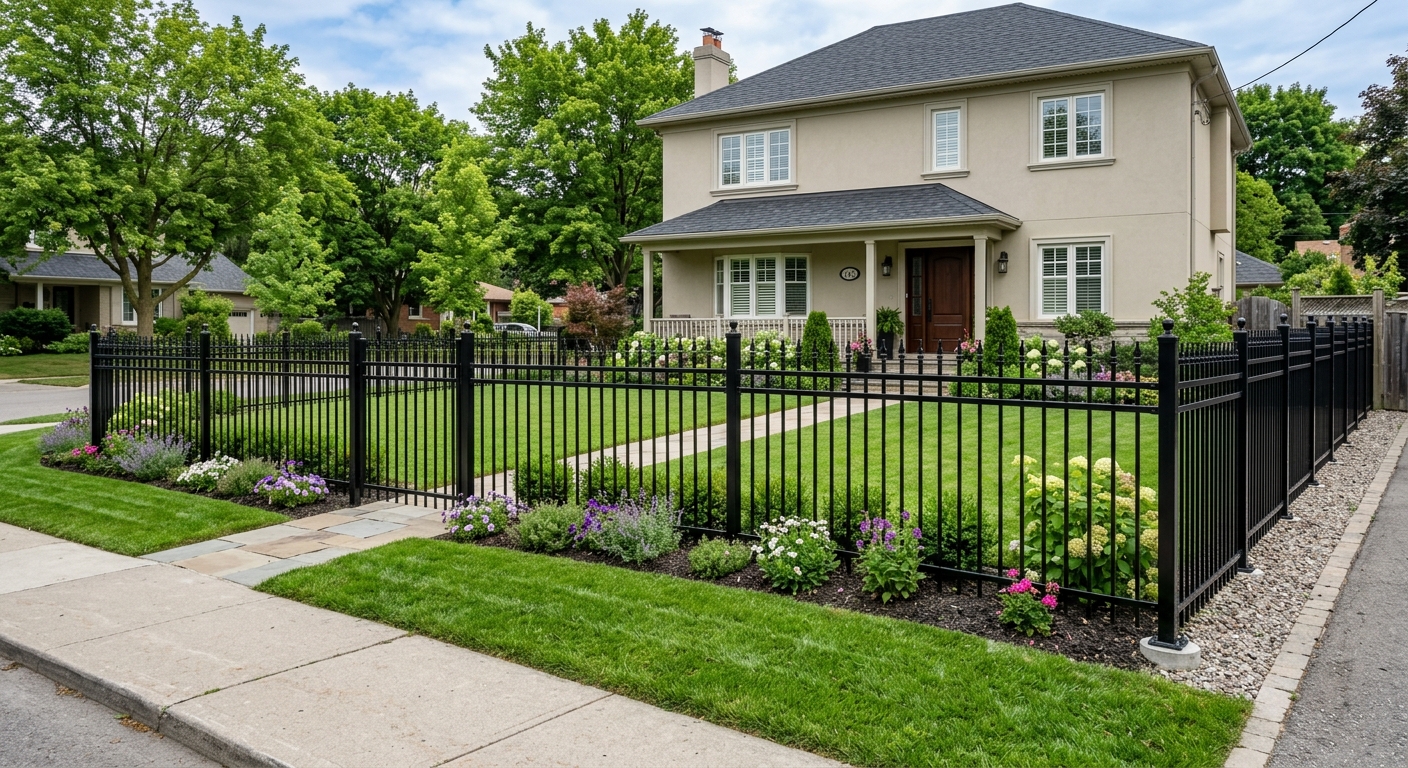
For chain-link, the cold tolerance and longevity are strong and it’s typically the lowest-cost way to secure a yard, but it doesn’t provide privacy unless you add slats or plant screening. Aluminum ornamental offers a clean look with no rust, but because it’s open, it’s not the best choice for blocking wind-driven visibility. Composite/recycled boards can provide solid privacy with minimal upkeep, though pricing can be higher.
All materials still need frost-aware posts in Toronto. For privacy fences, concrete-set posts are often recommended because embedment depth and stable base prevent heaving and panel tilt. As for wind and snow load, taller solid styles need heavier bracing and closer post spacing to reduce racking; that’s where the “cheaper” material sometimes costs more over time due to additional repairs.
A concrete example: if you’re comparing budget wood at roughly $65 – $105 per linear foot versus vinyl/PVC at $75 – $130, the vinyl difference is often justified when you want fewer maintenance visits and longer straight-line service through wet springs and freeze–thaw winters—especially if you don’t plan to re-stain.
| Material |
Cold Tolerance |
Lifespan |
Annual Maintenance |
Best For |
Price Band |
| Pressure-treated pine |
Good with proper seal/coating |
10–15 years |
1–2 light coats per cycle (every 2–3 years) |
Lower upfront cost privacy |
$65 – $120 |
| Cedar |
Good; handles moisture better than pine |
15–25 years |
Stain/seal every 2–3 years |
Appearance + natural rot resistance |
$85 – $120 |
| Vinyl / PVC |
Very good if installed with correct clearances |
25–35 years |
Rinse as needed |
Low maintenance privacy |
$75 – $130 |
| Chain-link |
Excellent (galvanized steel) |
20–30 years |
Minimal: check tension and tidy edges |
Security on a budget |
$45 – $85 |
| Aluminum ornamental |
Excellent (no rust) |
25–40 years |
Wash + tighten hardware as needed |
Attractive, low-maintenance perimeter |
$90 – $160 |
| Composite / recycled |
Good across freeze–thaw cycles |
25–35 years |
Minimal rinse; inspect fasteners |
Solid privacy with less upkeep |
$110 – $170 |
How to choose a fencing contractor in Thistletown-Beaumond Heights
When you hire a fencing contractor in Thistletown-Beaumond Heights, verify three things upfront: Ontario eligibility to perform the work, liability insurance, and WSIB/WCB coverage for workers. Ask for a certificate of insurance showing the contractor as the named insured, valid policy dates, and adequate coverage limits for property damage and bodily injury. For workers’ coverage, request proof of WSIB/WCB clearance or coverage details before anyone digs post holes. Don’t rely on “we’re insured” without paperwork you can review.
Get 2–3 itemised written quotes, not lump sums. A good fence quote breaks out labour (layout, excavation, setting, build, install) and materials (posts, rails, panels, hardware, fasteners) and includes line items for gates, corner bracing, and disposal. Also confirm what’s excluded: removals, permits, property line locating, site restoration (sod/topsoil reinstatement), and concrete disposal/cleanup. If a contractor doesn’t clearly state whether demolition and tipping fees are included, expect change orders.
Warranty matters too. Ask for the workmanship warranty length and whether it covers post-setting/anchorage issues, not just surface defects. Confirm the product/manufacturer warranty terms and whether the warranty is transferable if you sell your home.
Payment schedule: never pay more than about 10–15% upfront. Hold back a portion until the fence is complete, aligned, and cleaned. Finally, insist on a written start date and a completion timeline—Toronto-area weather can delay curing and finishing, so timelines should reflect practical seasonal constraints.
- Request proof of liability insurance and review the certificate dates and coverage details.
- Verify WSIB/WCB clearance or coverage documentation before work begins.
- Confirm the contractor’s business information and track record (photos of similar GTA projects).
- Get 2–3 itemised quotes with labour and materials separated.
- Ensure the quote specifies post depth/embedment approach for frost stability.
- Clarify if concrete-set posts are included and what mix/procedure is used.
- Check whether gate framing, hinges, and latching hardware are included.
- Confirm disposal/tipping fees for removed fencing are included (or provide a line item).
- Ask who pulls permits (if required) and whether permit costs are included.
- Request a written warranty that clearly distinguishes workmanship vs product warranty.
- Set a payment plan: small deposit only, with holdback until final cleanup and walkthrough.
- Get an inspection checklist and photo documentation plan for posts/footings before panels go up.
Red flags I regularly see in the Thistletown-Beaumond Heights market: missing or outdated insurance/WSIB paperwork, quotes that skip post depth and only mention “standard installation,” lump-sum proposals without a materials/labour breakdown, vague warranty language that excludes post-setting or alignment issues, and crews that demand a large upfront deposit before staking out the line or confirming your property pins.
Frequently asked questions — fencing in Thistletown-Beaumond Heights
What is the cost per linear foot for fencing in Thistletown-Beaumond Heights?
For Thistletown-Beaumond Heights, most installed fencing pricing lands in the Toronto-area bands depending on material and height. As a practical guide, pressure-treated wood typically falls around $65 – $120 per linear foot, while vinyl/PVC privacy fencing is often closer to $75 – $130 per linear foot. Chain-link is usually the lowest, roughly $45 – $85 per linear foot, and aluminum ornamental commonly sits around $90 – $160 per linear foot. Your exact number depends on post embedment for frost stability, gate count, slope/terrain, and whether old fence removal and disposal are included.
Should I repair or replace my old fence in Thistletown-Beaumond Heights?
Repair can be cost-effective when the structure is sound—like replacing a few rotten boards, tightening rails, or swapping out damaged pickets. Replacement usually makes more sense if posts have heaved, the fence line has drifted off the property line, or you’re seeing repeated lean after spring thaw. In Toronto’s freeze–thaw conditions, a fence with compromised post stability may need concrete-set rework; otherwise you’ll keep paying for minor repairs. If the rails are failing throughout a run, upgrading the entire section is often cheaper than patchwork. Get a contractor to assess post embedment and footing condition, not just the visible boards.
How do I handle a fence dispute with a neighbour in Ontario?
Start by documenting everything: photos of the fence line, approximate measurements, and any prior agreements. Then verify where the property line is using survey pins or a professional locate before assuming the neighbour is wrong. Ontario line-fences rules govern shared boundaries, so if it’s a shared fence, clarify responsibility for repairs or replacement rather than proceeding unilaterally. If the dispute relates to height or setback, check the local bylaw and permit requirements for your fence height. In practice, a calm written proposal outlining the scope (and cost split, if shared) resolves many issues faster than multiple site visits or stop-work threats.
What fence style offers the best wind resistance in Thistletown-Beaumond Heights?
In Thistletown-Beaumond Heights, wind-driven racking is usually managed best with a solid privacy style that’s built with correct post sizing, closer spacing, and strong bracing—especially for taller heights. The key isn’t only the material; it’s the framing and the stability of the post embedment below frost depth. A well-constructed solid panel with heavier posts and proper corner hardware often outperforms lighter lattice or poorly braced sections. Chain-link can survive wind, but it won’t “resist” displacement the same way unless tension and rail systems are properly designed. If you have an exposed yard line, ask about tighter spacing and stronger post/rail combinations.
How much does a fence cost in Thistletown-Beaumond Heights?
The total cost depends heavily on linear feet, height, gates, and whether you need removal/disposal and permit-related work. As a quick budgeting approach, use the per-linear-foot bands: wood privacy often sits around $65 – $120, vinyl/PVC around $75 – $130, chain-link around $45 – $85, and aluminum around $90 – $160 per linear foot. Then add realistic allowances for: deeper concrete-set posts (common for frost stability in Southern Ontario), corner bracing, stepped panels on slopes, and any gate hardware upgrades. If you share your fence line measurements and photos, a contractor can usually narrow the range quickly.
How deep should fence posts be for Thistletown-Beaumond Heights's frost?
For Southern Ontario projects like Thistletown-Beaumond Heights, a common best-practice approach is to set posts about 4–6 inches below the design frost depth so the base stays below the frost heave zone. With the local frost-line planning commonly at about 42"–48", that frequently translates to posts set roughly 3.5–4 feet deep for taller privacy fences, especially with 6–8 ft heights. Because local soils often include clay or mixed conditions, concrete-set posts are typically recommended over simple driven posts for long-term stability. Always confirm the exact embedment strategy with your contractor based on your soil, fence height, and local best practice.